Check out our White Paper Series!
A complete library of helpful advice and survival guides for every aspect of system monitoring and control.
1-800-693-0351
Have a specific question? Ask our team of expert engineers and get a specific answer!
Sign up for the next DPS Factory Training!
Whether you're new to our equipment or you've used it for years, DPS factory training is the best way to get more from your monitoring.
Reserve Your Seat TodayThe right remote monitoring solution for a rural telecom network does one essential thing: it tells you exactly what is wrong, at which site, before you've dispatched anyone. For providers managing dozens or hundreds of geographically dispersed sites, that capability is the difference between a contained service interruption and an all-day truck roll to investigate a nuisance alarm.
At DPS Telecom, we've worked with rural and regional telecom providers for over 37 years, and across more than 172,000 deployed devices, the same problem comes up repeatedly. Providers know their networks have gaps in visibility, but they're not always sure what to look for when evaluating a monitoring system. This guide walks through the key criteria, from RTU hardware requirements to current FCC compliance obligations, so you can make a well-informed decision.
Rural network management introduces a specific set of constraints that don't apply to urban or metro deployments. Sites are farther apart, staffing is leaner, and the infrastructure itself is often a mix of technologies spanning multiple decades. A monitoring solution designed for a single-vendor enterprise campus is not the right tool for a cooperative managing 80 sites across three counties.
The defining challenge is physical distance. A single site visit in rural Wyoming or the upper Midwest might consume a full day of labor when you factor in drive time, on-site diagnosis, and the return trip. According to AAA vehicle operating cost data, running a work truck 15,000 miles per year costs over $11,000, not counting the technician's time or fuel.
Industry estimates suggest that 20% to 30% of truck rolls are "no fault found" dispatches, meaning the technician arrives only to discover the issue has already resolved or was a false alarm. The NCTA's economic impact research found that outages between June and December 2024 cost American society up to $188 million in lost economic activity. Better diagnostic visibility is what makes those dispatches avoidable.
Beyond distance, rural sites face harsher physical conditions. Outdoor cabinets and shelter huts experience temperature swings that would compromise standard IT hardware. Equipment that runs reliably in a climate-controlled exchange doesn't face the same thermal stress as a cabinet in the Montana high desert or a coastal Florida installation prone to humidity and salt air.
Power stability is another factor. Many rural sites depend on backup generators and battery strings rather than stable grid power. The monitoring system has to track power health with enough granularity to distinguish a minor rectifier fluctuation from a real battery discharge event.
Here's a scenario that plays out regularly across rural networks. A NOC operator gets an alert: "Major Alarm at Site 14." They have no idea what failed, whether it's still failing, or what part to bring. They dispatch a technician anyway. An hour into the drive, the alarm clears on its own. The technician turns around. Nothing was fixed, and the day is half gone.
The monitoring system gave the operator nothing to work with. A summary alarm only confirms that something went wrong.
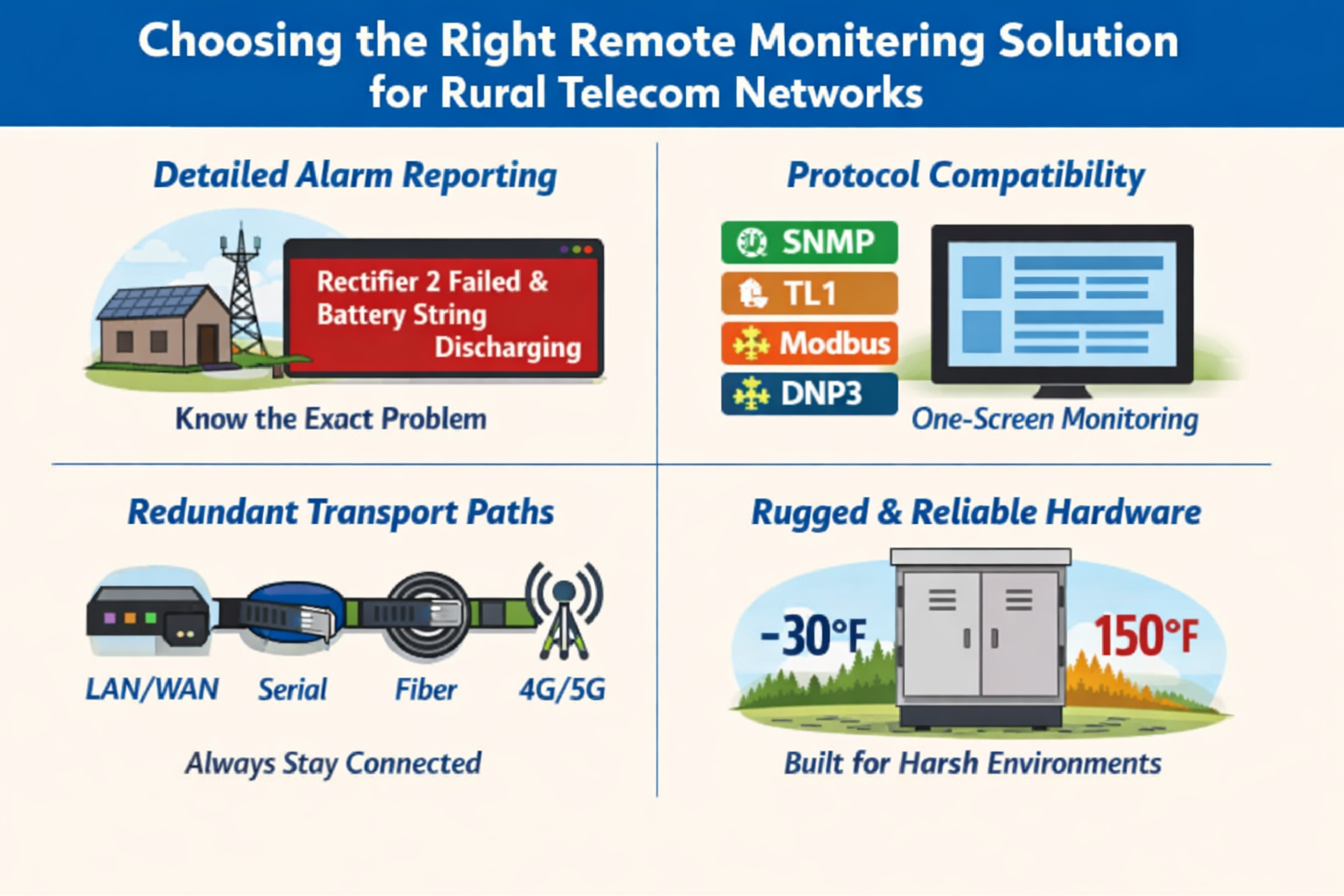
A well-configured remote telemetry unit (RTU) tells a different story. Instead of "Power Alarm," it reports "Rectifier 2 has failed and Battery String B is discharging at 45 amps." That single line of context may be the difference between a dispatch and a remote resolution.
Beyond granular alarms, the more capable systems support combination alarms. These are logical conditions where the RTU only fires an alert when two or more specific events happen together. A low battery reading in isolation might be a minor issue worth logging. That same low battery reading combined with a "Generator Failed to Start" condition is a critical emergency. Your monitoring system should know the difference, and it should tell you. That's one of the core capabilities we built into the NetGuardian series.
Todd Matherne, NCC System Administrator at EATEL (a provider that has partnered with DPS Telecom since 1994), described what that kind of visibility meant for his team: "The [DPS] system took out the stress of having our equipment fail without me knowing about it. It sends a page to a technician with the exact alarm."
No rural network was built in a single year from a single vendor's equipment. The infrastructure you're managing today is almost certainly a mix of gear from different eras: modern fiber and IP equipment alongside older switches, microwave radios, and legacy transport gear that still works perfectly well and nobody wants to replace.
The problem is that those devices speak different languages. IP-based equipment uses SNMP. Older telecom switches may output TL1. Many industrial power and HVAC systems communicate over Modbus, DNP3, or any number of other proprietary formats. If your monitoring platform can only handle one of those protocols, large portions of your network are simply invisible to it.
Protocol mediation solves this. It's the capability to receive data from all of those different device types and present them together in a single management view, what we call a one-screen NOC. Our T/Mon master station currently supports 35+ protocols. That number grew because clients came to us over the years with specific equipment they needed to bring under one roof, and we built support for it. Your network tells us what's needed, not the other way around.
The financial case is straightforward. Replacing functioning equipment just to make it speak a protocol your new monitoring platform understands can cost hundreds of thousands of dollars in hardware, labor, and service disruption. Mediation eliminates that cost entirely. The equipment keeps running and your visibility expands to include it.
Here's a breakdown of the protocols that matter most in rural telecom contexts:
| Protocol | Common Application | Why It Matters |
|---|---|---|
| SNMP (v1/v2/v3) | Modern IP-based equipment | Universal compatibility with current infrastructure |
| TL1 | Telecom switches and transport gear | Retains visibility into older equipment without replacement |
| ASCII/Text | Older switches, vendor-specific gear | Component-level fault identification without hardware changes |
| Modbus | Generators, rectifiers, industrial controls | Monitors power and backup systems directly |
| DNP3 | SCADA environments, utility integration | Secure, reliable telemetry for critical infrastructure |
Our NGCP case study shows what this looks like at scale. The National Grid Corporation of the Philippines manages 19,425 circuit kilometers across more than 7,000 islands. Before working with us, they had equipment running on multiple disconnected, vendor-specific systems with no unified view. Ralph Manuel, Head of Planning System Operations for NGCP, described it plainly: "We had some monitoring, but it was very limited." By deploying E1-capable NetGuardian RTUs and a T/Mon master station, NGCP unified fault management across the entire network without touching the provisioning interfaces already in place. Fault visibility became centralized. The provisioning workflows for each device type stayed exactly as they were.
A monitoring system that goes offline during a network failure is a real operational problem. If your alarm data travels over the same infrastructure as your client traffic, a significant outage may eliminate your visibility at the the exact moment you most need it.
Rural sites are especially exposed here. Fiber cuts happen. Microwave links degrade in severe weather. A site that's only reachable over a single transport path can disappear from your NOC dashboard and stay dark until someone physically drives out to investigate.
The answer is an RTU that supports multiple transport options and can switch between them automatically when the primary path fails. The transport methods that matter most in rural deployments:
A dedicated cellular backup path does more than provide redundancy. Because it's entirely separate from the network being monitored, a failure on your primary infrastructure won't take it with it. For sites where maintaining NOC visibility during a major outage is operationally or regulatorily critical, that independence matters.
Standard IT equipment is not designed for what a rural telecom site puts it through. Shelter huts reach temperatures that would trigger thermal protection on commercial server hardware. Outdoor cabinets near generators deal with vibration, humidity, and power transients that gradually degrade components not built to handle them.
Before selecting an RTU, verify its rated operating range against your actual site conditions. Equipment intended for this environment should reliably operate from -30°F to +150°F. For tower-based deployments where exposure is even more extreme, our telecom tower monitoring page covers the additional considerations.
Beyond temperature, the specs worth checking are:
We hear regularly from clients who have DPS equipment running reliably two decades after installation. A senior communications engineer at a state DOT told us: "We've always been very pleased with DPS Telecom's RTUs. They've lasted for 20 years." That kind of longevity comes from engineering for the conditions the hardware will actually face.
Monitoring system selection is no longer purely an operational decision. FCC mandates that took effect in 2025 have made real-time network visibility a regulatory requirement for most providers. Monitoring gaps that were previously expensive operational problems are now compliance liabilities.
The FCC's 911 Outage Notification Rule requires all Originating Service Providers (wireline, wireless, and VoIP) to notify the appropriate Public Safety Answering Points (PSAPs) within 30 minutes of identifying an outage that could affect 911 services.
Meeting this window is not possible if your primary method of identifying outages is client complaints. You need a monitoring system that detects 911-affecting failures automatically and immediately.
Reporting to the Disaster Information Reporting System is now mandatory during FCC-declared emergencies. Providers must submit granular data on outage locations, physical infrastructure status, and restoration progress. This requires a monitoring platform that can pull a consolidated network status view across all sites in real time, not one that requires manual data collection from individual RTUs.
BDC filings are due bi-annually on March 1 and September 1. They require location-accurate availability and performance data mapped to specific geographic coordinates. Providers receiving federal support through A-CAM or similar programs need monitoring tools that can document uptime and availability at the site level for regulatory verification.
| Requirement | Effective Date | What Your Monitoring System Must Do |
|---|---|---|
| 911 PSAP Notification | April 15, 2025 | Detect 911-affecting failures within minutes and generate notifications |
| Mandatory DIRS Filing | February 20, 2025 | Aggregate real-time infrastructure status across all sites |
| BDC Filings | Bi-annual (March 1 / Sept 1) | Track and report location-accurate uptime data |
Before evaluating any vendor, document what you actually have. List each remote site, the equipment installed, the protocols those devices communicate in, and the current alarm visibility you have (or don't have). This inventory will immediately surface the protocol mediation requirements any solution needs to meet.
Map the difference between what your current system sees and what you need to see. Common gaps in rural networks include power system health (battery state, rectifier status, generator run hours), environmental conditions (temperature, humidity, door intrusion), and transport path redundancy visibility.
Determine how alarms need to be routed. Which alarms go to the NOC? Which escalate to field technicians via SMS? Which should trigger automatic corrective actions (like switching to backup power or activating redundant HVAC) without human intervention? This shapes both the RTU selection and the master station configuration.
For each site, identify the primary and backup transport options available. Sites with no terrestrial backup path need cellular failover capability in the RTU. Sites in areas with limited cellular coverage may need satellite or point-to-point microwave backup.
The biggest selection mistake we see is buying a monitoring system sized for today's network. Rural broadband deployment is ongoing. According to NTCA's 2025 survey, 92% of rural clients now have access to downstream speeds of at least 100 Mbps, which means networks are expanding into increasingly remote territory. The network you're managing in three years will have more sites, more protocol diversity, and higher regulatory expectations than the one you're managing today.
Look for hardware and software that supports evolving transport options (from copper and fiber through 5G cellular), is configurable rather than fixed, and comes from a vendor with a track record of supporting products for extended periods. Replacing a monitoring system every five years creates re-training burdens and disruption your team doesn't need.
Twin Valley Telephone, a triple-play provider serving several counties in Kansas, deployed a T/Mon NOC and NetGuardian remotes to get better visibility across their territory. One of their key goals was smarter dispatch. Rather than sending the nearest available technician regardless of skillset, the system lets them page the technician closest to the affected site who actually has the skills to resolve that specific alarm type. As Thompson, their representative at DPS Factory Training, put it: "DPS is absolutely one of the better vendors we've worked with."
RT Communications, based in Worland, Wyoming, covers a large portion of the state where long drives are unavoidable. Matt Jordan, their CO technician, uses T/Mon's ASCII processing to pull detailed alarm data directly from their switches. "T/Mon is helpful in the way that it talks to my switch via ASCII with a very limited set of rules," Jordan said. "Most of my alarms come out that way."
That switch-level detail means the NOC can see exactly what the problem is before anyone gets in a vehicle. In one documented instance, a technician leaving the office noticed a T/Mon alarm showing a large number of missing nodes. "There were 500+ customers that were being affected," said another RT Communications team member. "This alarm kept us on top of that."
Both examples reflect the same underlying shift: moving from reactive dispatch to informed response. The monitoring system doesn't eliminate the need to drive, but it means technicians leave with a diagnosis, not a question.
It should support every protocol currently in use, including any proprietary or older gear. Ask specifically what the process is to add a protocol that isn't currently on the supported list.
Basic RTUs report raw inputs. A stronger system can be programmed to fire alerts only when specific conditions occur together, which reduces false alarms and helps prioritize real emergencies.
The unit should fail over to a secondary path (ideally cellular) automatically. If it doesn't, a network outage may also take out your visibility into that outage.
Ask for examples of how old the oldest actively supported hardware in their fleet is. Vendors who build for planned obsolescence create ongoing capital and retraining costs.
If it requires manual data export and spreadsheet assembly to meet these requirements, that's a significant operational burden every filing cycle.
Direct access to application engineers (not a general support queue) makes a meaningful difference when you're troubleshooting a site issue at 2 a.m.
If you're assessing your current monitoring setup or building the case for an upgrade, our application engineers work through your specific network requirements at no cost. We also offer loaner units so you can validate performance in your own environment before committing. Contact the DPS Telecom team to start the conversation.

Andrew Erickson
Andrew Erickson is an Application Engineer at DPS Telecom, a manufacturer of semi-custom remote alarm monitoring systems based in Fresno, California. Andrew brings more than 19 years of experience building site monitoring solutions, developing intuitive user interfaces and documentation, and opt...