Download our free Monitoring Fundamentals Tutorial.
An introduction to Monitoring Fundamentals strictly from the perspective of telecom network alarm management.
1-800-693-0351
Have a specific question? Ask our team of expert engineers and get a specific answer!
Sign up for the next DPS Factory Training!
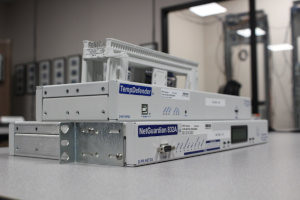
Whether you're new to our equipment or you've used it for years, DPS factory training is the best way to get more from your monitoring.
Reserve Your Seat TodayBy deploying NetGuardian RTUs, T/Mon LNX, and SiteMon IP cameras, NGCP unified multiple proprietary systems into one fault management platform - restoring alarm visibility across its nationwide transmission network.
"We like the NetGuardian because we were looking for a management system to manage our facilities."
- Ralph Manuel, Head of Planning System Operations, NGCP
| Industry | Electric Power Transmission |
| Company Type | National high-voltage transmission provider |
| Geography | Philippines (7,107 islands) |
| Network Scale | 19,425 circuit kilometers; 23,853 MVA substation capacity |
| Primary Challenge | Multiple disconnected, vendor-specific monitoring systems with limited facility visibility |
| Solution Deployed | Centralized fault management and remote site monitoring platform |
| Products Used | NetGuardian RTUs, T/Mon LNX Master Station, E1 WAN Muxes, VLAN Routers, SiteMon IP Cameras |
| Key Result | Unified monitoring system enabling remote diagnostics and improved alarm visibility |
| Initial Rollout | Luzon region (national control center location) |
The National Grid Corporation of the Philippines (NGCP) was incorporated in 2008 after assuming responsibility for the country's power transmission system from TransCo.
NGCP operates 19,425 circuit kilometers of transmission lines and 23,853 MVA of substation capacity. It is the only high-voltage transmission company in the Philippines.
Its network spans 7,107 islands - requiring reliable telecom monitoring to maintain continuous power delivery across remote and geographically complex regions.
NGCP's geography alone presents significant operational complexity.
"To give you an idea, the country is composed of 7107 islands during low tide," said Ralph Manuel. "During high tide, some are missing. We have some transmission cables between the big islands. Some islands have their own small 1.5 megawatt plants."
Beyond geography, NGCP faced three core monitoring challenges:
"We had various management systems that were vendor-specific and proprietary. We had to run multiple desktop programs to manage different gear from different vendors. Even different people were experts on each."
NGCP also needed to coordinate with independent generation companies in a newly privatized market.
"We just transmit the power," Manuel explained. "We're not the ones to decide which generator to choose to handle the load. That's why we have to make sure that communications are good."
At the same time, monitoring gaps were clear.
"We didn't have sensors for environmentals, doors, and power supplies. We had some monitoring, but it was very limited."
With increased service expectations and pressure to avoid outages, NGCP needed centralized telecom and facility monitoring - without replacing existing infrastructure.
After discovering DPS Telecom online, NGCP evaluated a custom-built NetGuardian RTU with a 125 VDC power supply for compatibility with its network.
Using DPS's custom design process, the solution evolved into an architecture that included:
The goal: consolidate alarm visibility and enable centralized fault management - without disrupting proprietary provisioning systems.
"For some particular types of equipment, like multiplexers, the T/Mon and the NetGuardians are for the fault management aspect," Manuel explained. "We do still need to use proprietary management interfaces for provisioning various pieces of equipment, but diagnostics can be done using the new fault management system."
This approach preserved existing systems while restoring monitoring control.
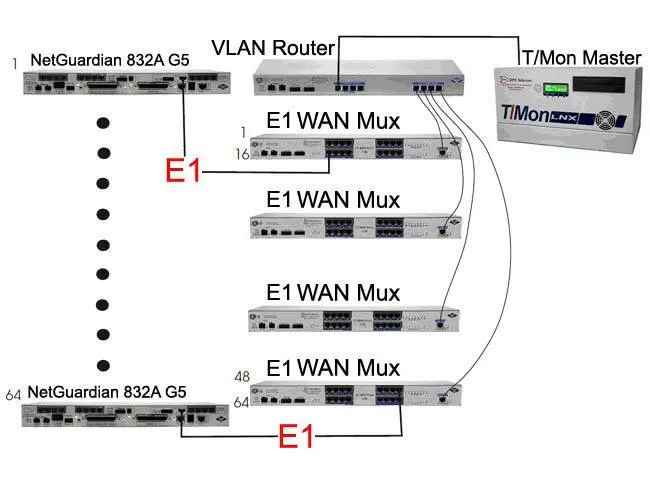
| Phase | What Happened |
| Evaluation & Testing | DPS provided a demo NetGuardian 832A (125 VDC build) for in-network testing. |
| Custom Engineering | DPS configured E1-capable RTUs integrated with WAN muxes and VLAN routers. |
| Central Integration | RTUs report alarms back to a T/Mon LNX master station at the national control center in Luzon. |
| Surveillance Deployment | SiteMon IP cameras installed for indoor equipment monitoring and intrusion visibility. |
| Regional Rollout | Initial deployment in Luzon, with evaluation before expansion to Visayas and Mindanao. |
| Result | Impact |
| Centralized fault management | Replaced multiple disconnected desktop monitoring systems |
| Remote diagnostics enabled | Improved ability to troubleshoot multiplexers and other network equipment |
| Environmental and facility monitoring added | Visibility into doors, power supplies, and site conditions |
| Integrated IP surveillance | Visual confirmation of alarms and after-hours monitoring |
| Preserved proprietary systems | No need to replace existing provisioning platforms |
| Business Benefit | Operational Impact |
| Improved alarm visibility | Unified monitoring across geographically dispersed islands |
| Reduced operational complexity | Eliminated reliance on multiple vendor-specific desktop tools |
| Greater reliability assurance | Supported higher service expectations in a privatized power market |
| Enhanced remote site monitoring | Enabled after-hours oversight and guided remote technician support |
| Scalable architecture | Designed for expansion beyond Luzon into Visayas and Mindanao |
NGCP added SiteMon IP cameras to strengthen facility monitoring.
"IP cameras will be indoors for monitoring of the equipment room. We will use them to monitor visual indications of trouble as well as for intruders," Manuel said.
Many sites are staffed only during normal business hours.
"Also, some of our sites are manned, but only during normal business hours. There have been some issues, so we want to monitor these sites after hours."
Cameras also simplify remote support.
"For normal operations, when we ask a technician to check or reset something, it will be simpler to guide them over the phone. You can see what they're doing."
Utilities can deploy RTUs at remote sites to collect alarms from power, environmental, and telecom equipment. These alarms report back to a centralized master station over WAN links such as E1. This enables unified visibility without replacing existing systems.
Yes. NGCP continued using proprietary systems for provisioning. The NetGuardian and T/Mon platform was used specifically for fault management and diagnostics, allowing integration without rip-and-replace.
Common alarms include power supply status, environmental conditions, door access, and telecom equipment faults such as multiplexers. Adding facility monitoring improves reliability and reduces outage risk.
IP cameras provide visual confirmation of alarms, enable after-hours monitoring, and allow engineers to guide technicians remotely. This improves response accuracy and speeds troubleshooting.
Start with the primary control center region, validate system performance, and then expand region by region. NGCP began in Luzon before planning expansion to Visayas and Mindanao.
If you're managing remote transmission sites, legacy vendor systems, or growing service expectations, you don't need to replace everything to regain control.
DPS Telecom helps utilities centralize alarm visibility, integrate SNMP and legacy systems, and deploy scalable remote site monitoring solutions.
Get a Free Consultation to see how you can unify monitoring across your network.
Related Case Studies