Download our free Monitoring Fundamentals Tutorial.
An introduction to Monitoring Fundamentals strictly from the perspective of telecom network alarm management.
1-800-693-0351
Have a specific question? Ask our team of expert engineers and get a specific answer!
Sign up for the next DPS Factory Training!
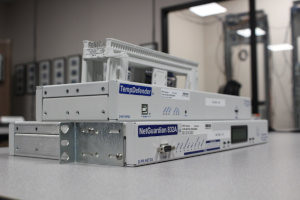
Whether you're new to our equipment or you've used it for years, DPS factory training is the best way to get more from your monitoring.
Reserve Your Seat TodayKansas provider cuts truck rolls and prevents outages with DPS monitoring
| Field | Details |
|---|---|
| Industry | Rural Telecommunications |
| Company Type | Fiber-to-home triple-play provider |
| Geography/Coverage | Multiple counties in Kansas area |
| Primary Challenge | Preventing outages and reducing truck rolls |
| Solution Deployed | Distributed RTU network with central monitoring |
| Key Result | Early outage detection before customer complaints |
| Products Used | NetGuardian RTUs, T/Mon alarm manager |
DPS Telecom customer Twin Valley Telephone is a triple-play provider serving several counties across Kansas. The company deployed fiber directly to customers' homes, delivering internet, phone, and television services. Their network covers a large rural territory requiring 1 hour and 45 minutes to drive from corner to corner.
As a telecommunications company, outages threaten Twin Valley's operations and bottom line. Customers depend on consistent uptime. When systems fail, technicians work around the clock until service is restored. Without proactive monitoring, Twin Valley faced several operational challenges. The first sign of an outage was often customer calls, meaning service was already disrupted. Technicians spent significant time identifying problem locations without real-time visibility. The territory spans a large area, making truck rolls expensive and time-consuming. Extended outage duration meant customers remained without service longer.
"Without monitoring, you don't know about an outage until a customer calls in and says their services are out," said Aaron Oehmke, Network Technician at Twin Valley.
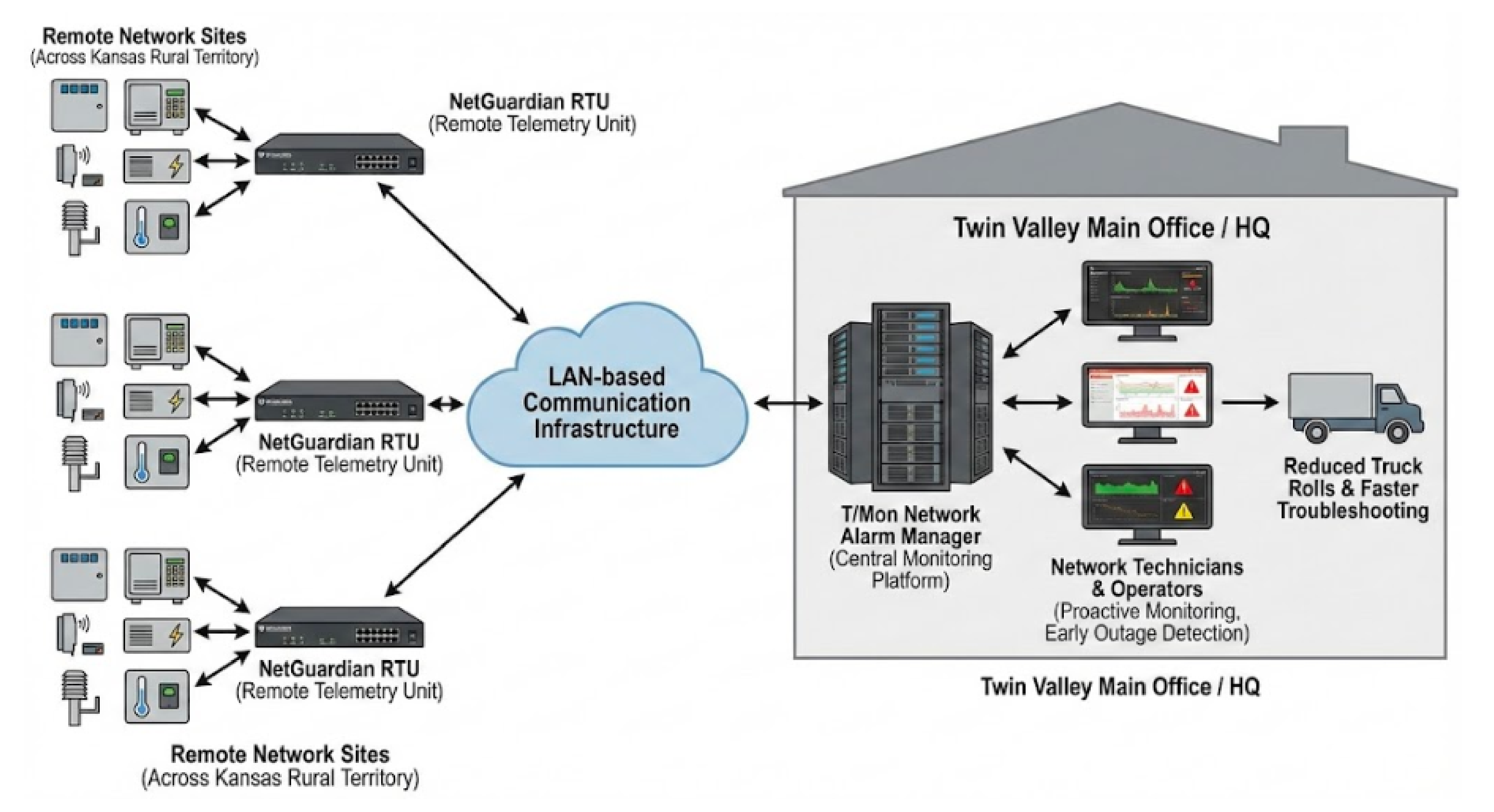
Twin Valley deployed multiple NetGuardian RTUs at sites throughout their territory. These remote monitoring units continuously track equipment status and environmental conditions. The RTUs report data back to a central T/Mon alarm management system located at their main office via LAN connectivity. This distributed monitoring architecture allows Twin Valley to track critical infrastructure across their entire service area from a single centralized system.
The distributed system allows each NetGuardian RTU to monitor local equipment and conditions while providing immediate alerts when problems arise. This gives Twin Valley complete visibility into network health across dozens of remote locations without requiring constant manual checks.
Remote monitoring transformed Twin Valley's approach to network management. The system delivers visibility into network conditions before customers experience service interruptions. This proactive approach fundamentally changed how the company manages infrastructure.
| Metric | Result |
|---|---|
| Outage Detection | Catches problems before customer impact |
| Troubleshooting Time | Quick identification of problem locations |
| Truck Roll Efficiency | Eliminates wasted trips, ensures proper equipment |
| System Expansion | Regular additions as network evolves |
"If you have something already set to let you know of an outage, it's cost savings for time spent troubleshooting and truck rolls."
Aaron Oehmke, Network Technician, Twin Valley Telephone
| Benefit | Impact |
|---|---|
| Proactive Outage Detection | Identifies and resolves problems before customers notice service interruptions |
| Reduced Operational Costs | Eliminates wasted time, unnecessary truck rolls, and excessive overtime expenses |
| Scalable Monitoring | Easily adds new equipment and sites as the fiber network continues to expand |
| Simplified Training | Web interface enables quick onboarding for new technical staff members |
Purpose-built remote telemetry units that track equipment status and environmental conditions at distributed sites.
Central monitoring platform consolidating alarms from multiple sites into one unified view.
How does remote monitoring prevent service outages?
Remote monitoring tracks equipment health and environmental conditions in real time. When parameters move outside normal ranges, you receive immediate alerts. This early warning lets you fix problems before they cause customer-facing outages. According to the Federal Communications Commission, network reliability is critical for telecommunications providers to maintain customer satisfaction and regulatory compliance.
What's the cost impact of monitoring versus reactive maintenance?
Monitoring reduces both troubleshooting time and unnecessary truck rolls. For networks covering large geographic areas, eliminating even a few wasted trips per month delivers measurable cost savings. More importantly, preventing outages protects revenue and customer satisfaction. Industry research shows that proactive monitoring significantly reduces operational costs for rural telecommunications providers.
How difficult is it to expand monitoring as the network grows?
Systems like T/Mon are designed for easy expansion. When you add new equipment or upgrade existing infrastructure, you can quickly integrate those assets into your monitoring system. Twin Valley regularly adds monitoring points as their network evolves. The modular architecture supports growth without requiring system replacement.
What kind of training is required to manage a monitoring system?
Modern monitoring platforms feature intuitive web interfaces that simplify training. DPS provides factory training programs where technicians get hands-on experience with equipment in a controlled environment. The web interface makes it easy to train everyone on the team without extensive technical background requirements.
Can monitoring systems work with different equipment manufacturers?
Yes. Protocol-flexible monitoring platforms integrate with equipment regardless of manufacturer or age. This is especially important for telecommunications providers who operate mixed-vendor environments. DPS RTUs support 30+ protocols including SNMP, DNP3, and Modbus for maximum compatibility.
Twin Valley Telephone reduced truck rolls and caught outages early by deploying NetGuardian RTUs monitored through T/Mon. Get visibility into your network before problems impact customers.
Get a Free Consultation | 1-800-693-0351