Download our free Monitoring Fundamentals Tutorial.
An introduction to Monitoring Fundamentals strictly from the perspective of telecom network alarm management.
1-800-693-0351
Have a specific question? Ask our team of expert engineers and get a specific answer!
Sign up for the next DPS Factory Training!
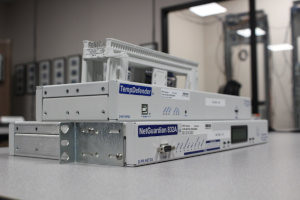
Whether you're new to our equipment or you've used it for years, DPS factory training is the best way to get more from your monitoring.
Reserve Your Seat TodayRegional telecom restores in-house alarm visibility and reduces service risk.
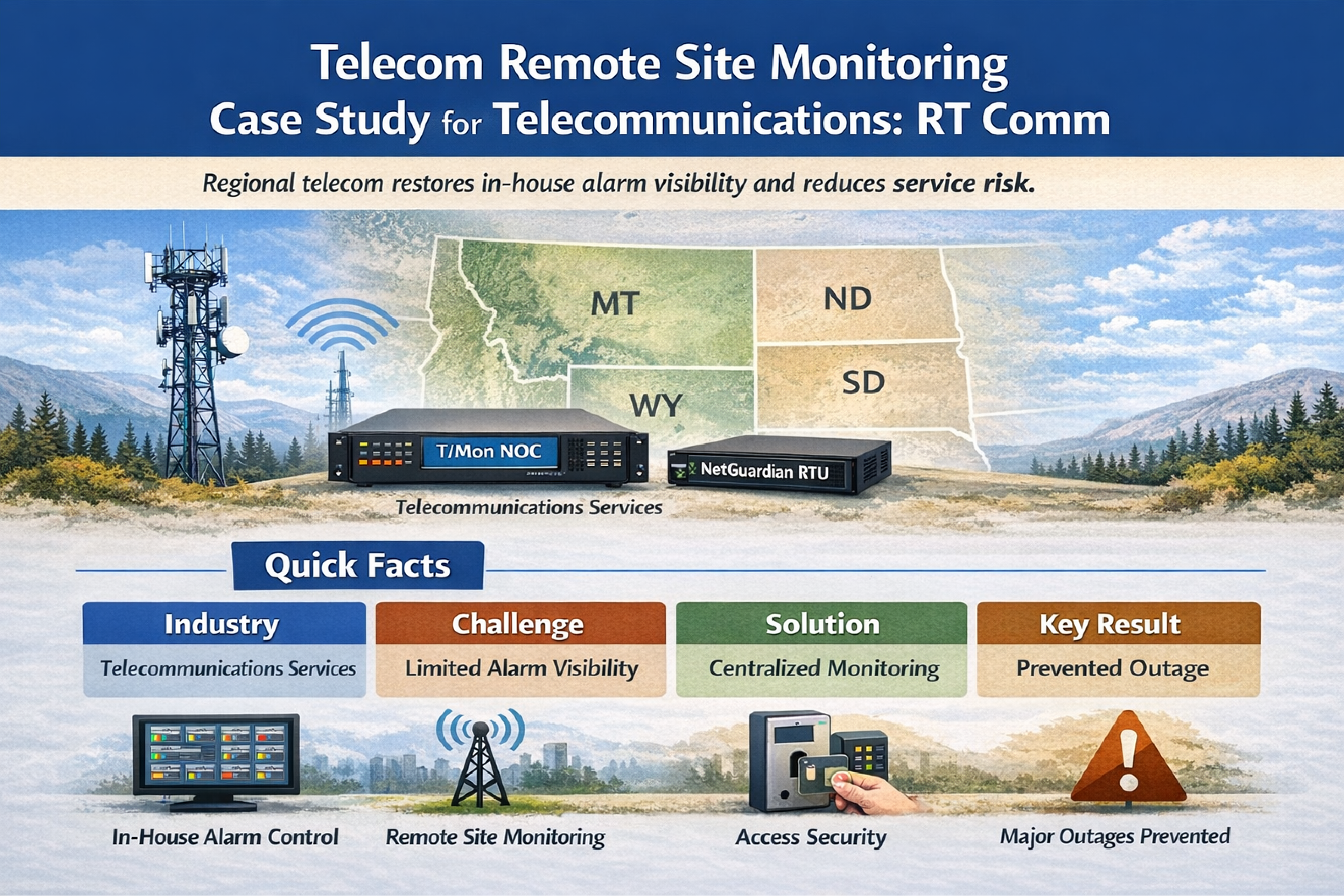
| Industry | Telecommunications Services |
| Company Type | Regional Fiber & Voice Provider |
| Geography/Coverage | Wyoming + MT, NE & SD regions |
| Primary Challenge | Limited alarm visibility and third-party reliance |
| Solution Deployed | Centralized telecom & access monitoring |
| Key Result | Prevented potential exchange isolation event |
| Products Used | T/Mon NOC, NetGuardian RTUs, Access System |
RT Communications is a regional telecommunications provider serving approximately 15,300 subscribers across Wyoming and parts of Montana, Nebraska, and South Dakota. The company has deployed over 800 miles of optical fiber in Wyoming and expanded fiber-to-the-home in multiple service areas. RT delivers voice, E-911, data, internet, hosting, and business telephone services.
RT previously relied on legacy monitoring equipment with functionality limited to simple opens and shorts. After-hours alarms were handled by a third party that would call staff when issues occurred. This created dependency, reduced visibility into advanced alarms, and introduced risk if alarms were delayed or missed.
"[The other vendor's] functionality was very limited to opens and shorts - and we had to pay another vendor to monitor it when no one was at our office."
RT deployed a centralized telecom monitoring platform anchored by a T/Mon NOC alarm master and distributed NetGuardian RTUs. The system integrates Fujitsu SONET transport gear and switch equipment using SNMP and ASCII, bringing alarms directly in-house and standardizing them into a single format.
T/Mon communicates with RT's switch via ASCII using a limited ruleset. "It was pretty painless to set up," said Matt Jordan. Once configured, alarms are presented in a consistent format, reducing the need for multiple standalone monitoring systems.
With centralized alarm visibility, RT identified escalating error-rate alarms while a specialist was on vacation. The alert indicated a potentially major issue that could have isolated entire exchanges. Because the team saw the alarms immediately, they began troubleshooting before a service failure occurred.
"I feel confident to go back and take ownership in our network monitoring with our DPS gear."
Matt Jordan, CO Technician, RT Communications
T/Mon NOC
Centralized SNMP and ASCII telecom alarm management platform.
NetGuardian RTU
Advanced remote site monitoring with built-in terminal server.
Building Access System
Electronic access control integrated with network monitoring.
By deploying a centralized alarm master that directly collects SNMP and ASCII alarms, providers can receive and manage alerts internally. This removes the need for an outside service to relay calls and restores full control over response workflows.
Yes. RT integrates Fujitsu SONET transport gear and switch equipment into T/Mon using SNMP and ASCII. According to Jordan, the ASCII integration required only a limited rule set and was straightforward to configure.
Using distributed RTUs like NetGuardian allows telecom providers to collect alarms, send notifications, and remotely access serial equipment. RT uses the integrated terminal server "all the time," reducing the need for site visits.
RT added a DPS Building Access System compatible with existing key fobs. As five companies consolidate into one, administrators can easily manage credentials and remotely grant access without issuing new physical keys.
If you're relying on limited alarm points or outside call centers, you may be introducing unnecessary risk. Centralized telecom monitoring gives you control, visibility, and confidence.
Get a Free Consultation
Or call us: 1-800-693-0351