Check out our White Paper Series!
A complete library of helpful advice and survival guides for every aspect of system monitoring and control.
1-800-693-0351
Have a specific question? Ask our team of expert engineers and get a specific answer!
Sign up for the next DPS Factory Training!
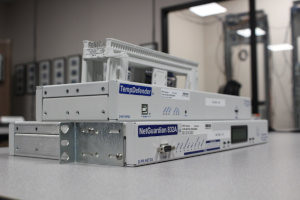
Whether you're new to our equipment or you've used it for years, DPS factory training is the best way to get more from your monitoring.
Reserve Your Seat TodayThe right remote monitoring system can reduce up to 25% or more of field dispatches, which translates to hundreds of thousands of dollars in annual savings for telecom and utility operators managing distributed infrastructure. A single truck roll costs anywhere from $150 to $1,000 or more depending on distance, labor rates, and complexity, and roughly one in four dispatches turns out to be unnecessary or requires a costly follow-up visit.
At DPS Telecom, we've deployed over 172,000 monitoring devices across more than 1,500 organizations since 1986, and we've seen the same pattern play out more than almost anything else. An organization buys monitoring expecting it to reduce dispatches. But when the alarm fires and the screen lights up, the NOC still can't tell whether Rectifier 2 actually failed or just hiccupped, so a technician gets in a truck and drives. The system didn't eliminate the truck roll. It just gave it a timestamp.
This guide covers what a truck roll actually costs, what monitoring capabilities genuinely change that calculation, and how to evaluate vendors before you commit.
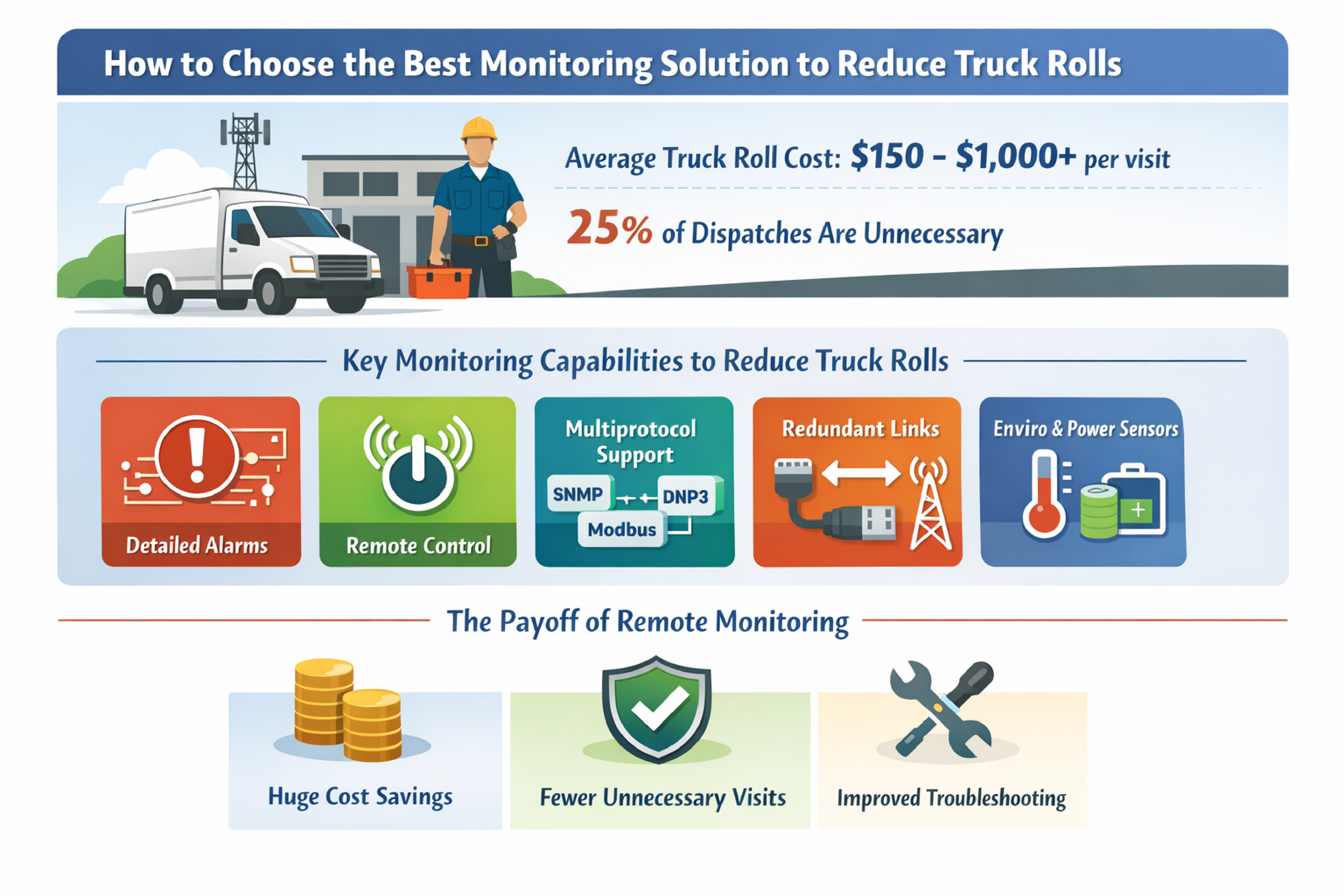
A truck roll is the dispatch of a field technician to a remote site for installation, troubleshooting, repair, or maintenance. In telecom, that means cell towers, central offices, remote cabinets, and customer premises. In utilities, it covers substations, power lines, meters, and pipeline infrastructure.
Cost estimates vary by geography and labor market, but they converge on a consistent picture:
| Source | Estimate | Scope |
|---|---|---|
| TSIA | $1,000+ | Fully loaded cost (up from $750 in 2011) |
| Aberdeen Group | $200-$300 | Direct costs only |
| nClarity survey | $998 (mean) | 51.5% of respondents agree costs reach $1,000+ |
| Field Technologies Online | $200-$2,000 | Varies by truck size and technician salary |
| S&C Electric Company | $150-$500 | Utility industry baseline |
The direct costs, technician wages, fuel, vehicle maintenance, and scheduling overhead, are only part of it. Indirect costs frequently exceed the direct ones. A FieldAware white paper calculated that eliminating just one unnecessary truck roll per day could reduce vehicle costs by up to $300,000 per year for a 50-vehicle fleet, with lost revenue potential exceeding $4 million annually.
What makes the numbers particularly painful is how many dispatches turn out to be avoidable. Industry data consistently shows that 17% to 25% of truck rolls result in "No Fault Found," meaning the technician arrives to find the issue has resolved itself or was a false alarm. Aberdeen Group research found that 25% of all service calls require at least one additional visit, and 33% require a second trip. The industry average first-time fix rate sits at just 75%. When a first visit fails, it takes an average of 1.6 additional trips to resolve the issue.
Bain & Company projects a $28 billion free cash flow gap for US telecom operators by 2028. Field operations already consume 60% to 70% of a typical telecom company's operating budget. Remote monitoring directly attacks the largest controllable cost in that budget.
Most monitoring platforms can tell you something went wrong. Fewer can tell you enough to decide whether sending someone out is actually necessary. The difference comes down to five capabilities that we've seen, over decades of deployments, separate systems that eliminate dispatches from systems that merely document them.
This is the single most important capability on this list, and it's the one most often underweighted during procurement. A summary alarm that says "Major Alarm at Site 14" is nearly useless for remote diagnosis. The NOC still dispatches blind because there's nothing else to go on.
A well-designed RTU surfaces component-level information. Instead of "Power Alarm," it reports "Rectifier 2 has failed and Battery String B is discharging at 45 amps." That single distinction can save a three-hour drive. The NOC operator now knows which rectifier, which battery string, the direction of the problem, and roughly how long they have before it becomes critical. That's actionable information.
Look for systems that support combination alarms, logical conditions that fire only when specific events coincide. A low battery reading alone might be a routine condition worth logging. A low battery combined with "Generator Failed to Start" is a critical emergency that demands immediate response. Without combination alarm logic, operators either dispatch on every ambiguous alarm or start guessing, and both outcomes are expensive.
Todd Matherne, a system administrator at EATEL who has worked with our equipment since 1994, described what this looks like in practice: "Nothing saves windshield time like automatic correction of alarm conditions. Problems can be fixed without visiting the site, without any human intervention at all."
Many field problems can be resolved by power-cycling a device, starting a backup generator, or switching to a redundant path. If the equipment to do that is 20 miles away, a remotely fixable problem becomes a dispatched technician. RTUs with built-in control relays change that equation: NOC operators can toggle equipment states remotely, often resolving the issue before anyone starts driving.
A remote power switch enables intelligent power cycling over IP. Access control systems provide electronic keyless door control, which can eliminate an entire category of truck roll that has nothing to do with equipment failure: the dispatch caused by a locked site and a missing key. These are problems that never needed a technician in the first place, and remote control capability can remove them entirely.
No real-world network speaks a single protocol. Rural and regional networks contain equipment spanning multiple decades, communicating via SNMP, TL1, ASCII, Modbus, DNP3, and proprietary formats, or any number of other older technologies. A monitoring platform that only speaks SNMP leaves older equipment invisible, and invisible equipment generates truck rolls because there's no other way to check on it.
This is why our T/Mon master station was designed to support 35+ protocols. The problem we were solving wasn't academic. Our clients were running real networks with equipment from different eras and different manufacturers, and they needed a single pane of glass, not a separate monitoring system for every protocol family.
The National Grid Corporation of the Philippines is a useful illustration of what protocol fragmentation looks like at scale. NGCP manages 19,425 circuit kilometers of transmission lines across more than 7,000 islands, and before working with us, their team was running multiple disconnected desktop programs to manage gear from different vendors. Ralph Manuel, Head of Planning System Operations, described the situation plainly: "We had some monitoring, but it was very limited."
We built a custom variant of the NetGuardian 832A with E1 connectivity to fit their infrastructure, reporting to a T/Mon LNX master station via E1 WAN muxes and VLAN routers. The result was a single fault management system across equipment that had previously been managed in silos, without replacing their existing provisioning interfaces.
If a monitoring system can't see all your equipment, you'll still be dispatching technicians to sites that "went dark" from the monitoring perspective but may have minor, remotely resolvable issues.
There's an obvious but often overlooked problem with monitoring systems that share transport infrastructure with the network they're watching: when the network goes down, the monitoring goes down with it. You lose visibility at precisely the moment you need it most.
RTUs should support automatic failover between Ethernet, cellular, fiber, serial, and dial-up paths. Cellular backup is particularly valuable because it creates a communication path completely independent of the production network. Even if your primary network link fails completely, the RTU is still reporting over cellular.
This is where a lot of organizations discover their monitoring has a critical blind spot. The outage takes out the monitoring. The NOC sees silence and dispatches. The technician arrives to find the primary link was down, the issue resolved itself, and there was nothing to fix. Redundant transport paths can prevent that scenario entirely.
Over half of major IT and telecom outages cost more than $100,000 in damages, and most trace back to environmental conditions rather than equipment failure: temperature excursions, humidity extremes, water intrusion, or power system problems. A failed HVAC unit doesn't announce itself with a loud alarm. It just gets warm in the equipment shelter, slowly.
Monitoring battery voltage, rectifier status, generator fuel levels, HVAC operation, and physical security changes the response from emergency dispatch to scheduled maintenance. You're not reacting to an outage. You're catching the preconditions before they become one.
Baca Valley Telephone in Des Moines, New Mexico serves 2,800 square miles of rural terrain, with remote sites ranging from 12 to 70 miles from headquarters. One mountaintop site is only reachable by Sno-Cat in winter, gets five to six feet of snow on its north face, and houses the radio repeaters for the county sheriff, emergency medical services, and county fire department. When their monitoring device was out for servicing, the site required a physical visit every ten days just to confirm generator status.
Paul Briesh, VP and General Manager of Baca Valley, explained what environmental visibility changed for his team: "It's dangerous to send somebody up in a Sno-Cat. It's a lot easier to look on an alarm board and see that the AC is off, but the generator is on, so we're OK." For Baca Valley, environmental monitoring didn't just reduce costs. It eliminated a genuine safety risk.
Choosing a monitoring system is easier when you've done the groundwork before talking to any vendor. Here's the process we recommend based on what we've seen work across thousands of deployments.
Start with a complete site inventory. Document every remote site, the equipment installed, the protocols each device communicates in, and your current alarm visibility. This inventory immediately surfaces your protocol mediation requirements, and it's the single most useful thing you can bring to any vendor conversation.
Identify your monitoring gaps. Map the difference between what your current system sees and what you actually need to see. Common gaps in rural and distributed networks include power system health (battery state, rectifier status, generator run hours), environmental conditions (temperature, humidity, door intrusion), and transport redundancy. Review your alarm event logs and unplanned outage records. Which truck rolls could have been avoided with better data?
Define alarm handling requirements. Determine which alarms should go to the NOC, which should escalate to field technicians via SMS, and which should trigger automatic corrective actions without human intervention. This shapes both RTU selection and master station configuration, and it's a conversation worth having internally before you go to market.
When comparing vendors, evaluate these capabilities specifically:
| Capability | What to Look For | Why It Matters |
|---|---|---|
| Protocol breadth | SNMP, TL1, ASCII, Modbus, DNP3, proprietary | Single-protocol systems leave equipment invisible |
| Alarm intelligence | Combination alarms, root alarm processing | Suppress cascading alarms, surface actual cause |
| Transport resilience | Automatic failover to cellular backup | Monitoring must survive the outage it's detecting |
| Hardware longevity | 15-20+ year operational lifespan | Reduces replacement cycles and total cost of ownership |
| Support quality | 24/7 access to design engineers | Faster resolution, custom configurations without delays |
| Customization | Custom builds without NRE fees | Fit monitoring to your network, not the other way around |
| Regulatory compliance | FCC 30-minute PSAP notification, DIRS reporting | Meeting current FCC mandates real-time visibility |
Test before committing. Ask every vendor whether they offer a pilot program or loaner equipment. We provide a 30-day loaner program and a money-back guarantee specifically because we believe a system should prove itself in your actual operating environment before you make a purchasing decision.
Here are documented results from organizations that deployed monitoring across geographically challenging networks.
| Organization | Challenge | Solution | Result |
|---|---|---|---|
| DANC (New York) | 750 miles of fiber, 4 technicians, 14 central offices | NetGuardian 832A RTUs + T/Mon | Issues that previously required multi-county drives resolved remotely |
| Silver Star Communications (Wyoming) | 90-minute round-trip drives when LAN failed at remote huts | NetGuardian 832A with serial pass-through | Eliminated blind site visits entirely |
| DPS client (cell tower operator) | Frequent after-hours call-outs | Multi-year monitoring buildout | 75%+ reduction in after-hours dispatches |
| PTCI (Oklahoma/Texas) | 7,200+ sq mi coverage, 9 technicians | NetGuardian 480/M16 + T/Mon LNX | Instant notification of power, HVAC, and generator events |
| Nebraska Central Telephone | Remote sites requiring winter snowmobile access | NetGuardian RTUs at each remote cabinet | Half-day trips avoided through remote diagnosis |
DANC's situation is a useful illustration of what lean monitoring looks like at scale. Four technicians. Fourteen central offices. 750 miles of fiber running through upstate New York. Tim Field, DANC's Network Engineer, was direct about what that required: "With four people and a network of that size, there's no way we could accomplish this without the network monitoring we use, and it's all DPS equipment."
Silver Star Communications in Wyoming tells a different version of the same story. When LAN connections failed at remote huts, technicians had no choice but to drive out. The NetGuardian 832A's serial pass-through capability created a backup access path into equipment even when primary connectivity was down. Central Office Technician Jim Eddins described what changed: "Before we had the NetGuardians, we didn't have connectivity to our devices when LAN failed. We had to drive out to the site."
Monitoring system selection is no longer purely an operational decision. FCC rules that took effect in 2025 have made real-time network visibility a compliance requirement for most providers, which changes the risk calculation for organizations that have treated monitoring as optional.
Three rules now set the floor:
A monitoring system that can't detect failures automatically, aggregate real-time status across all sites, and track site-level uptime for reporting doesn't just create operational exposure. Under these rules, it creates regulatory exposure as well.
Remote telemetry units range from roughly $700 for entry-level configurations to $4,000-$5,000 for high-capacity units. At a fully loaded truck roll cost of $1,000, an $800 RTU pays for itself after preventing a single dispatch. One of our clients documented payback by their fourth avoided truck roll. For organizations with helicopter-accessible mountaintop sites, where a single visit can cost several thousand dollars, even a premium RTU delivers full ROI on one prevented visit.
The real question isn't whether remote monitoring pays off. For organizations managing distributed infrastructure with lean teams, it almost always does. The question is whether the system you choose gives your NOC enough detail to act remotely, or whether it will just document the moment someone decided to send a truck.
The most useful question you can ask any monitoring vendor is simple: "If this alarm fires at 2 a.m., what information will my NOC operator have to decide whether to dispatch or not?" The answer tells you more about a system's actual value than any feature comparison.
If you're ready to map your site inventory against your current monitoring gaps, our engineers are glad to walk through your network and identify where the dispatch risk is highest. Talk to an engineer at DPS Telecom.

Andrew Erickson
Andrew Erickson is an Application Engineer at DPS Telecom, a manufacturer of semi-custom remote alarm monitoring systems based in Fresno, California. Andrew brings more than 19 years of experience building site monitoring solutions, developing intuitive user interfaces and documentation, and opt...