Check out our White Paper Series!
A complete library of helpful advice and survival guides for every aspect of system monitoring and control.
1-800-693-0351
Have a specific question? Ask our team of expert engineers and get a specific answer!
Sign up for the next DPS Factory Training!
Whether you're new to our equipment or you've used it for years, DPS factory training is the best way to get more from your monitoring.
Reserve Your Seat Today
You can have redundant power, a full generator, a healthy battery plant, and a backhaul path with failover, and a 911 site can still go dark, because the failure that takes it offline is usually the one nobody saw coming. 911 centers protect their critical infrastructure with remote monitoring by putting telemetry units at every dispatch center, radio tower, and unmanned equipment site, then feeding that live data to a central alarm master that watches power, environment, backhaul, and site security every hour of every day. The point is to catch those failures while they're still early warnings, before the site goes dark and calls start dropping.
We've built this kind of monitoring at DPS Telecom in Fresno, California since 1986, and more than 172,800 of our devices are in the field today, including public-safety networks like Steuben County's, which watches nine tower sites and its 911 center from a single system.
Most of the "protect your 911 infrastructure" conversation online is about cybersecurity: ransomware, denial-of-service attacks, and network breaches. When a Public Safety Answering Point (PSAP) or an emergency radio network actually goes down, the cause is usually far more ordinary. Commercial power fails. A generator runs out of fuel. A battery string depletes. A cooling unit quits and the shelter overheats. Someone cuts the fiber at an unmanned tower. These failures share one dangerous trait: they happen quietly, and most stay invisible until the moment the site goes dark. Remote monitoring is what turns that silent failure into an alarm you can act on.
The federal government treats 911 as critical infrastructure. The Cybersecurity and Infrastructure Security Agency (CISA) lists the Emergency Services Sector (ESS) as one of the country's 16 critical infrastructure sectors, meaning its incapacitation would do serious harm to public safety and national security. A PSAP sits at the center of that sector, connecting a person in trouble to police, fire, and emergency medical services.
The dispatch console is only the visible tip. A working 911 operation depends on a chain of physical infrastructure, and every link can fail:
CISA's own analysis of the sector makes the dependency plain: emergency communications rely completely on continuous power and a stable environment. Watch those dependencies and you protect the whole chain. Ignore them and any one link can bring the network down. This physical layer is the focus of the government and public safety remote monitoring work we do.
Catastrophic 911 downtime is rarely a single sudden event. It's usually a chain of small, unmonitored failures that stack up until the site finally goes dark.
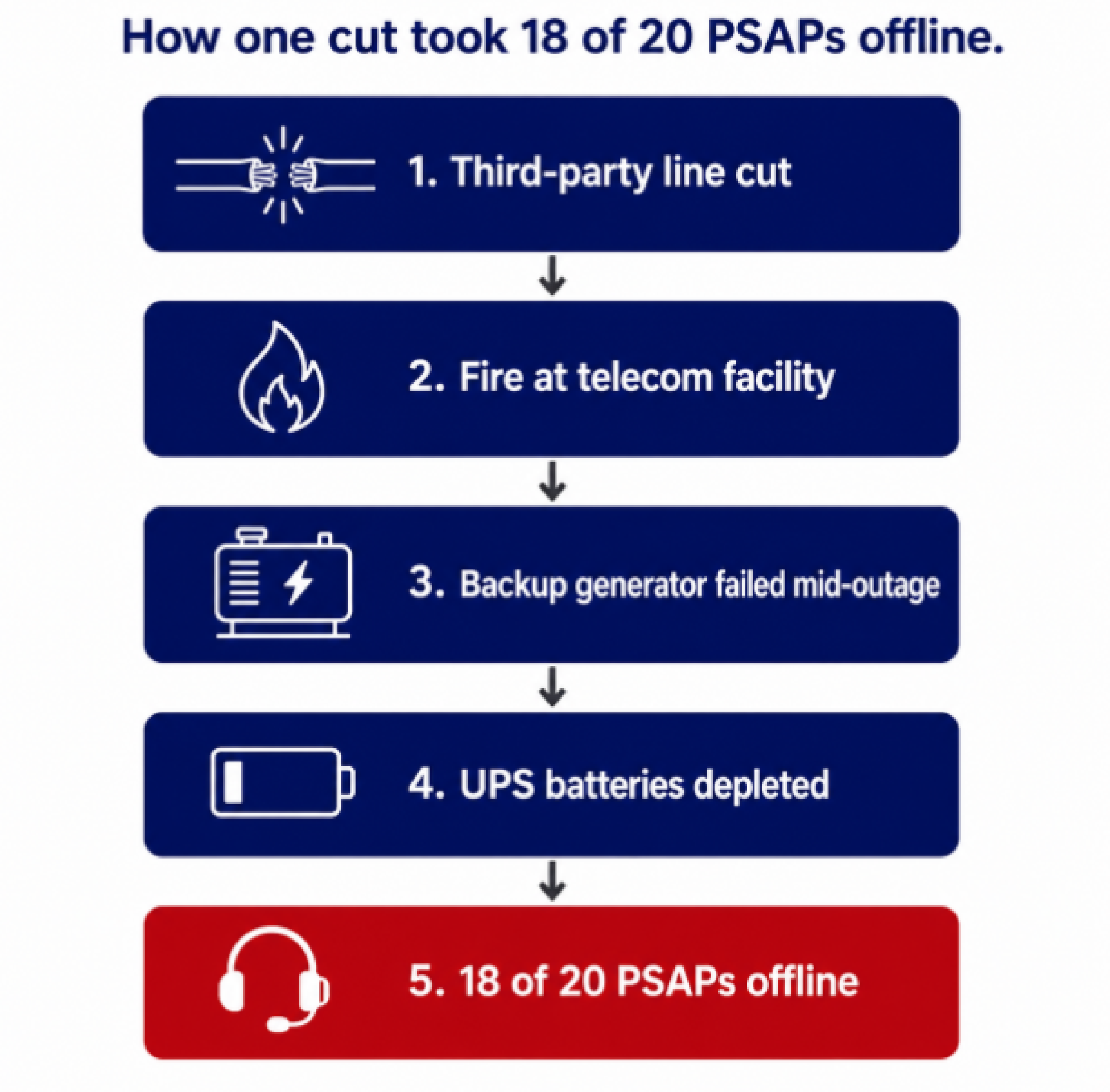
Southeastern Nebraska saw exactly that on September 2, 2023. A third-party irrigation crew cut a line, which set off a chain that ended in a fire at a central telecommunications facility. The facility lost commercial power and switched to its backup generator as designed. But the generator's status and fuel weren't being watched closely, and it failed partway through the outage. The site fell back to its uninterruptible power supply (UPS) batteries, which drained on schedule. When the batteries went, the network went with them, and 18 of the region's 20 PSAPs couldn't reliably handle 911 calls for hours.
We heard a similar story from a public-safety-radio client. A rectifier failure knocked out commercial power at one of their radio sites. The generator started right away and the battery plant was full, so nothing went down. Nobody knew anything had happened, because there was no monitoring. The generator ran through the night, then for four more days. After five continuous days it burned through its last drop of fuel. The batteries still held, so the site would have stayed up if a fuel truck had rolled within eight hours. But no truck came, because nobody knew to send one. Almost a week after the first failure, the only "monitoring data" anyone got was a report that radio coverage in the area was gone.
That's what silent failure looks like. Every backup worked exactly as intended. The site still went dark, because no one could see the problem in time to fix it.
The failures worth watching at a 911 operation fall into a few groups:

Towers carry several of these risks at once, which is why county tower networks usually get the most complete monitoring on the whole system.
Once you accept that these failures hide until it's too late, the question becomes what to watch. Across the public-safety sites we work with, the useful monitoring points are consistent:
Fred Marvin at the Steuben County Office of Emergency Services described his setup this way:
"We are monitoring nine tower sites, plus our 911 center. We are getting analog inputs for generator voltage, and microwave signal fade. Discrete alarms might be door entry, or temperature high/low, things like that."
That mix of analog readings and discrete alarms is the core of good situational awareness.
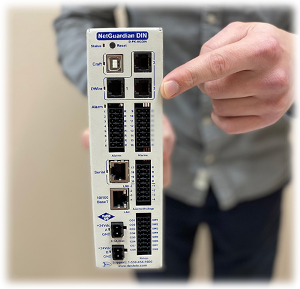
The system that does this has two parts. At each site, a remote telemetry unit (RTU) connects to the generator, batteries, HVAC, door contacts, and radios, and translates their status into data. That data goes back to a central alarm master at the dispatch center or network operations center (NOC), which collects, sorts, and displays every alarm across the network on one screen. In our 911 infrastructure monitoring systems, that's a NetGuardian RTU reporting to a T/Mon master, though our RTUs also report to third-party managers like SolarWinds or any standard SNMP platform if that's what an agency already runs.
Two kinds of inputs do the work. Discrete inputs are on or off: "commercial power fail," "door open," "generator running." Analog inputs measure a value on a scale, like battery voltage, temperature, or fuel level, the way a fuel gauge does. Analog monitoring is what lets you set staged thresholds, so a reading that drifts toward trouble raises a warning long before it becomes a critical failure. That window is the difference between scheduling a fix and losing the site.
The better systems also reason about combinations. On its own, "commercial power off" at 2 a.m. might not be worth waking anyone. But if the RTU sees commercial power off, and the generator fails to start, and battery voltage falling, it can combine those into one critical alarm and notify the on-call technician immediately. That logic is how you avoid both nuisance alerts and missed catastrophes.
It also matters that the alarm says what it is. "Commercial Power Fail," "High Microwave Noise," and "Door Open" tell a dispatcher exactly what happened and where. A generic "Major Alarm," or worse, no alarm at all, tells them nothing.
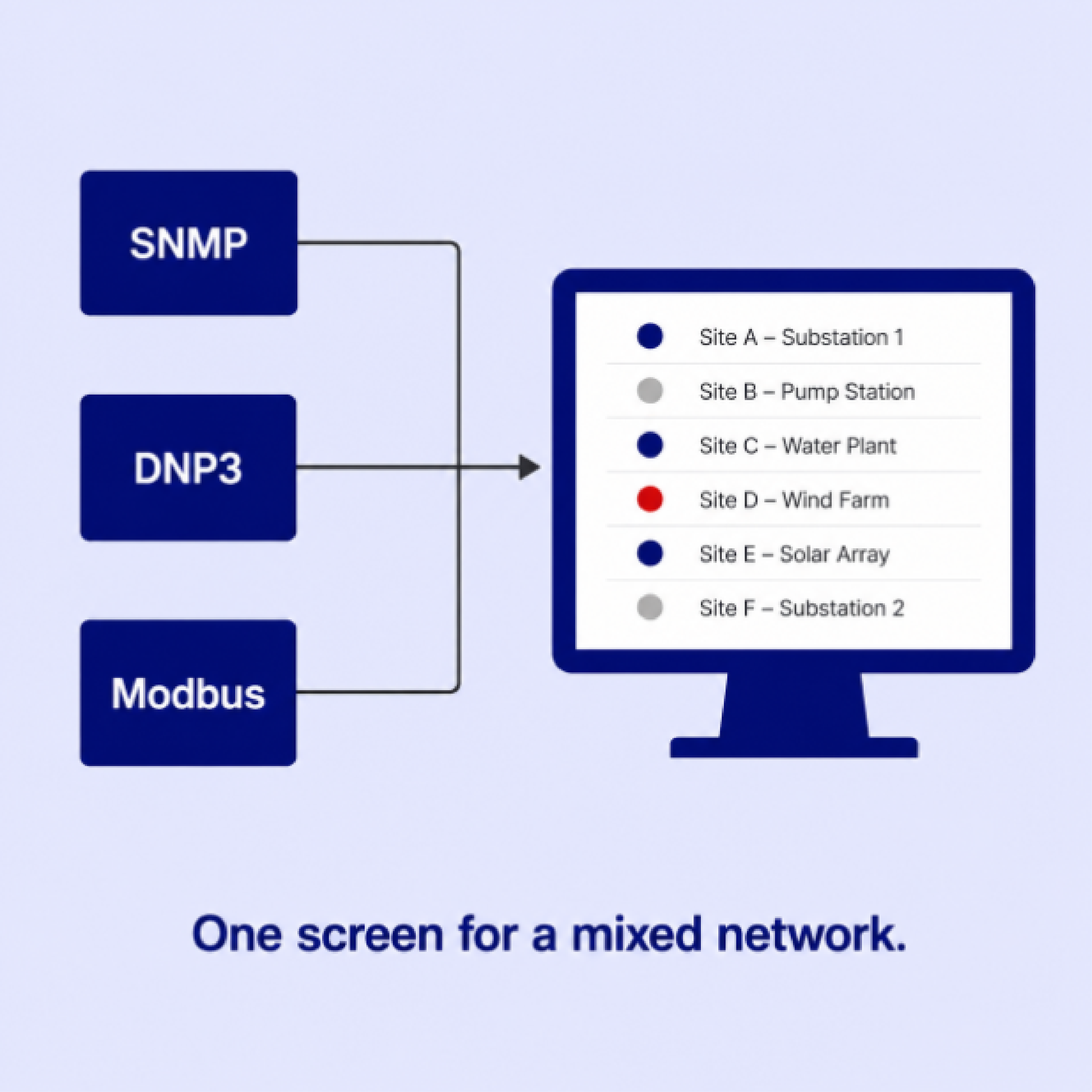
Public-safety networks are rarely one brand. You'll find Motorola or L3Harris radios next to older microwave gear, a mix of generators, and assorted sensors, each speaking its own language. A capable master translates between them, so SNMP gear, Distributed Network Protocol (DNP3) devices, Modbus equipment, and other older technologies all land on the same screen. DNP3 is especially useful for power monitoring, because devices can report an event the moment it happens instead of waiting to be polled.
Site security is worth a closer look, because unmanned towers are where intrusion happens. An RTU can tie door and motion sensors together with an Internet Protocol (IP) camera so you get a visual check before rolling a truck. Steve Palumbo at Lancaster County-Wide Communications saw the value right away:
"One of the other features I found interesting was the ability to control IP cameras. We're going to take a look at that, too."
Notification should fit how a dispatch team actually works. Phone dialers are slow and reach one person at a time. For the most urgent alarms, an RTU can trigger a push-to-talk (PTT) relay and broadcast a pre-recorded message straight to the handheld radios your on-duty staff already carry. The whole team hears it at once, with none of the dialing delay.
Finally, the alert should carry its own instructions. A tower-light alarm can tell staff to report the outage to the FAA. A low-fuel alarm can include the refueling contractor's number. When the response is built into the system, it doesn't depend on one senior person remembering what to do at 3 a.m.
For many 911 operations, the law requires monitoring outright. The FCC's outage-reporting rules, updated in April 2025, require covered 911 providers to notify affected PSAPs within 30 minutes of discovering an outage, with follow-ups every two hours until service is restored. You can't report an outage in 30 minutes if you don't know it's happening.
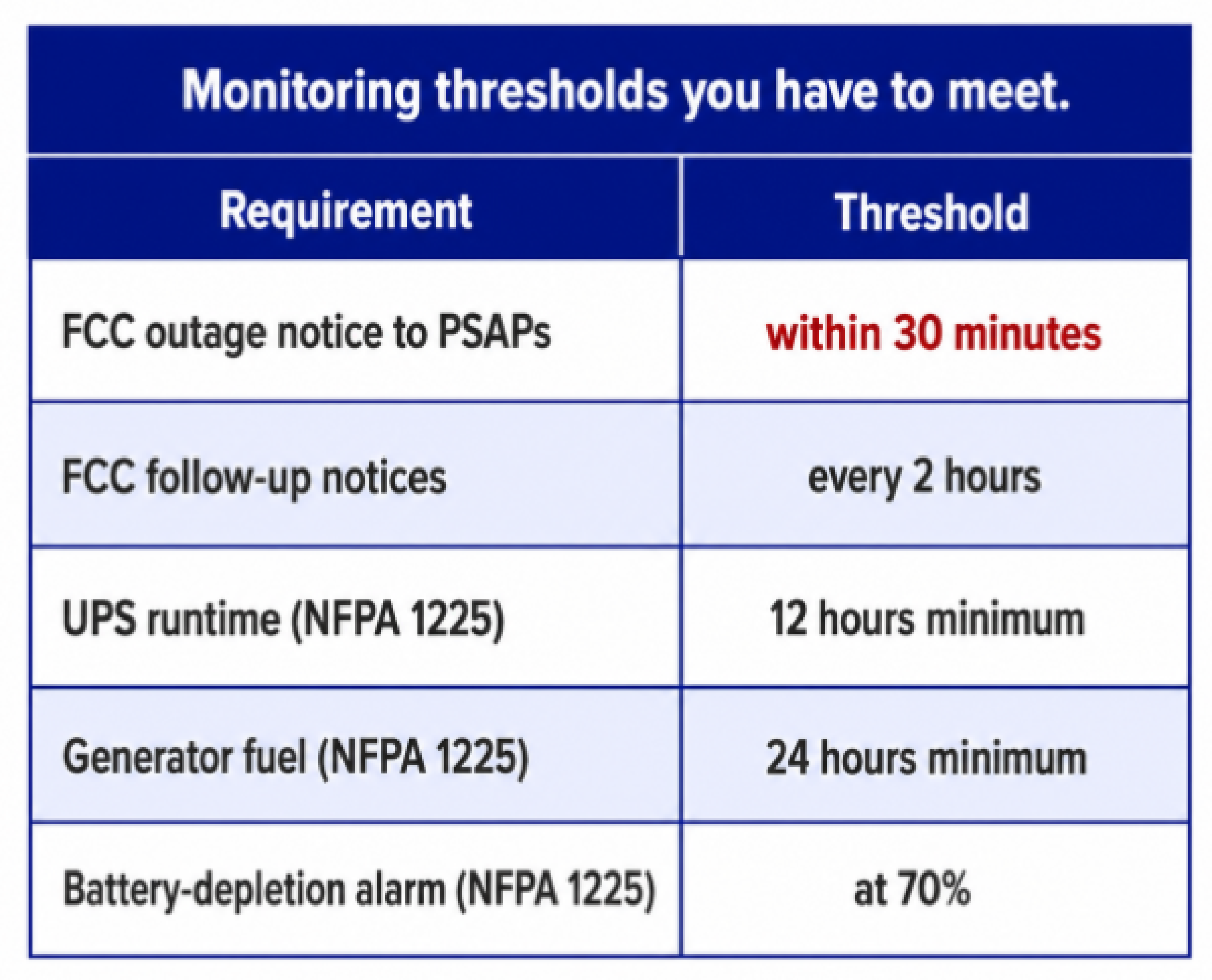
Building codes reach even further. Under the National Fire Protection Association's NFPA 1225 standard, in-building Emergency Responder Communication Enhancement Systems (ERCES) must generate real-time supervisory alarms for loss of normal power, charger failure, and battery depletion at 70 percent. PSAP facilities must maintain and monitor at least 12 hours of UPS runtime and 24 hours of generator fuel. Continuous monitoring is written into the code.
When a business loses its network, it loses revenue. When a 911 center loses its network, the cost is measured in response time and lives. Brain tissue starts dying within minutes of a stroke, and severe bleeding needs surgical care fast. In reporting on Utah's next-generation 911 rollout, a study cited by the FCC found that misrouted 911 calls, where a caller reaches the wrong PSAP and has to be transferred, add about 40 seconds to response times. A full outage removes the ability to reach help at all.
Regulators treat downtime accordingly. After a series of 911 outages in 2022, the FCC fined Lumen Technologies $867,000 for failing to design its network reliably and to notify affected PSAPs on time.
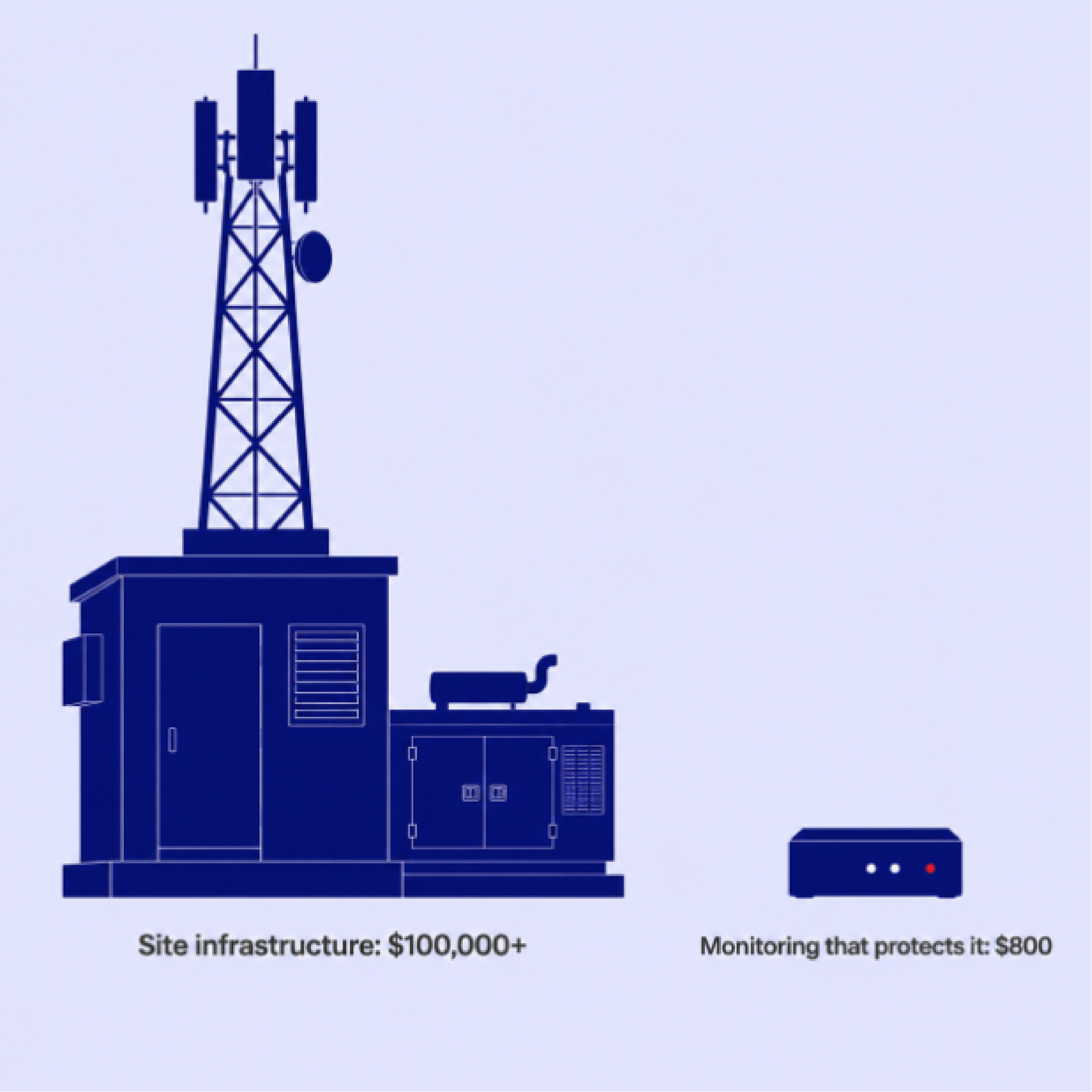
Against those stakes, monitoring is inexpensive, and this is where the numbers favor it. As our CEO, Bob Berry, puts it, agencies routinely spend $100,000 or more on infrastructure, then hesitate at $800 for the monitoring that protects it.
A single monitoring device commonly pays for itself the first time it prevents an incident. On a mountaintop radio site that needs a helicopter to reach, eliminating one unnecessary trip can pay for the device several times over.
That's the right way to weigh the purchase: total cost of ownership (TCO) rather than lowest upfront price. Monitoring cuts "windshield time," the hours technicians spend driving to sites just to learn what's wrong, and it lets them arrive with the right part on the first trip.
For agencies working within a county budget, several federal programs help pay for this. The 911 Grant Program runs through the Department of Transportation and the National Telecommunications and Information Administration, and the Federal Emergency Management Agency (FEMA) offers the Emergency Management Performance Grant (EMPG) and the State Homeland Security Program (SHSP). You can review the current options through the federal 911 funding resources. Framing a monitoring purchase around faster response and hardened infrastructure tends to line up well with what those programs fund.
If you're evaluating systems, a few factors matter more than the spec sheet:
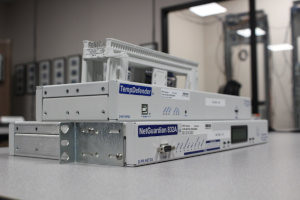
This is the ground we built DPS on. Our NetGuardian 832A G6 RTUs and the T/Mon LNX master are designed, built, and supported in Fresno, California. We customize without NRE fees on typical orders, our equipment routinely runs 20-plus years with no forced obsolescence, and when you call, you talk to the engineers who designed the gear. Roughly 80 percent of public-safety monitoring fits a standard configuration, and the other 20 percent is exactly where no-NRE custom engineering earns its keep.
There are other capable vendors, and the right fit depends on your network:
| Vendor | Background | Where it can fit |
|---|---|---|
| DPS Telecom | US (Fresno, CA) maker of NetGuardian RTUs and the T/Mon master since 1986 | Agencies that want custom-fit hardware, multi-protocol aggregation on one master, 20-plus-year field life, and direct engineer support under single-vendor accountability |
| Asentria (SiteBoss) | Seattle-area telecom site automation; acquired by Trystar in September 2025 | Buyers who want a standardized unit or need built-in private branch exchange (PBX) and telephony features that DPS doesn't offer |
| Dantel | Fresno, CA manufacturer | Central-office and NEBS-oriented utility monitoring |
| Davicom | Broadcast telemetry heritage in TV and radio, expanding into NFPA 1225 in-building compliance | Broadcast-centric sites and in-building ERCES compliance |
The competitor details above come from published information. They may not capture every available model, and some details may have changed since we reviewed them.
Asentria is a legitimate public-safety-radio monitoring option, and its SiteBoss line is well established. The practical difference we hear most often from clients is customization, since we'll modify a unit to fit and standardized products are, by design, not meant to change. If you want a closer look, we walk through the specifics in our comparison of DPS Telecom and Asentria SiteBoss and in a broader review of Asentria SiteBoss alternatives.
A remote telemetry unit (RTU) is the field device installed at each tower or dispatch site. It connects to power, environmental, and security equipment and reports their status to a central alarm master.
Covered 911 providers must notify affected PSAPs within 30 minutes of discovering an outage, then send follow-up notifications every two hours until service is restored.
Yes. NFPA 1225 requires in-building emergency responder systems to generate real-time supervisory alarms for power loss, charger failure, and battery depletion at 70 percent, and PSAP facilities must monitor backup power runtime and generator fuel.
If you're responsible for a 911 center or a county radio network and you want to see the failures before they take a site offline, we can help you map out what to monitor and design a system that fits your sites. Tell us what you're trying to accomplish, and we'll work out the rest.
Talk to an Engineer | 800-693-0351

Andrew Erickson
Andrew Erickson is an Application Engineer at DPS Telecom, a manufacturer of semi-custom remote alarm monitoring systems based in Fresno, California. Andrew brings more than 19 years of experience building site monitoring solutions, developing intuitive user interfaces and documentation, and opt...