Check out our White Paper Series!
A complete library of helpful advice and survival guides for every aspect of system monitoring and control.
1-800-693-0351
Have a specific question? Ask our team of expert engineers and get a specific answer!
Sign up for the next DPS Factory Training!
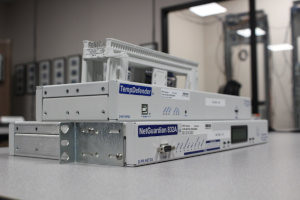
Whether you're new to our equipment or you've used it for years, DPS factory training is the best way to get more from your monitoring.
Reserve Your Seat Today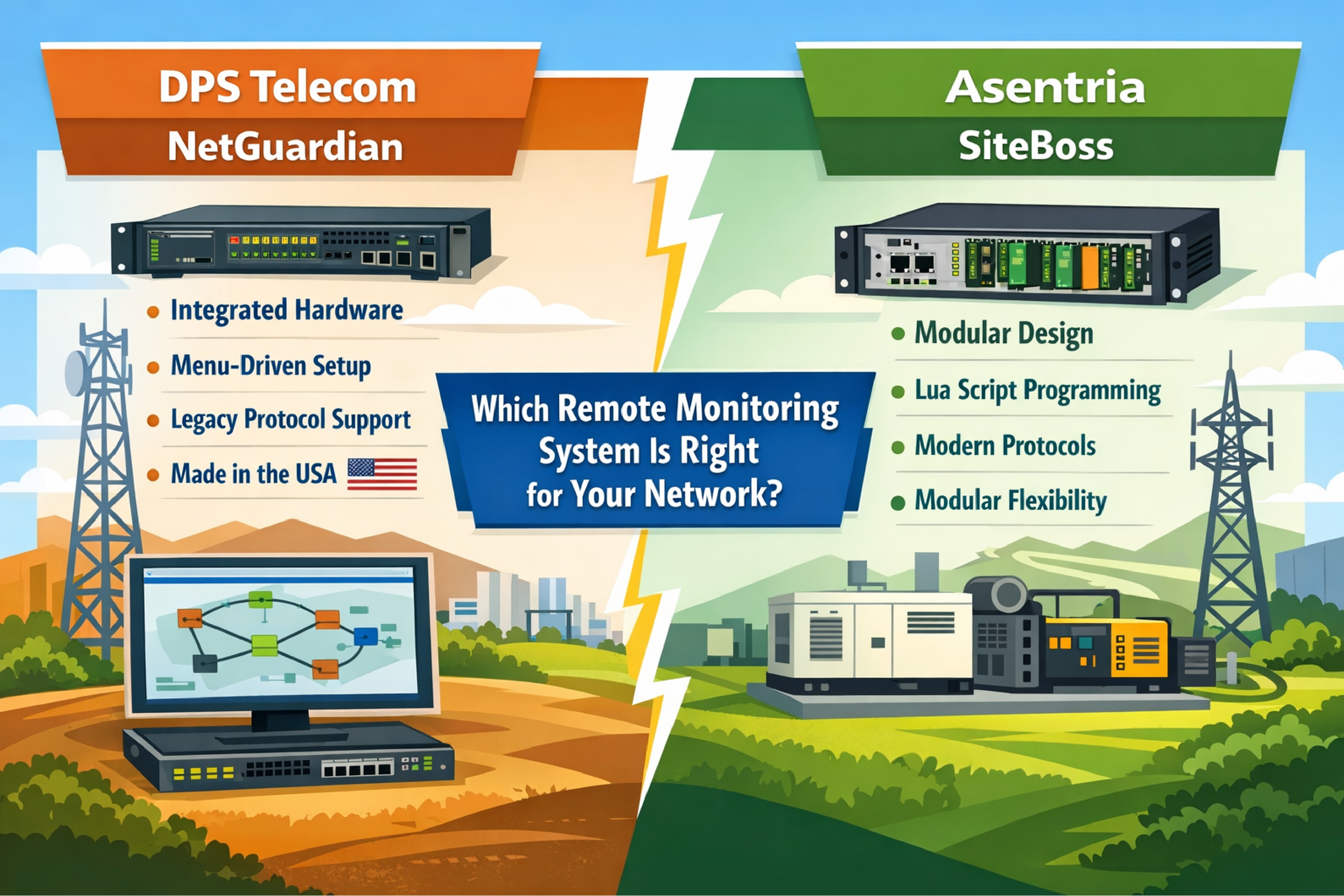
When evaluating remote monitoring solutions for telecommunications networks, two names consistently emerge: DPS Telecom and Asentria. Both manufacturers offer comprehensive remote telemetry units (RTUs) and monitoring platforms, but they take fundamentally different approaches to network reliability.
DPS Telecom's NetGuardian series emphasizes integrated hardware design with menu-driven configuration, extensive protocol mediation for legacy equipment, and vertical integration through U.S.-based manufacturing. Asentria's SiteBoss platform offers modular, programmable flexibility with Lua scripting capabilities designed for complex industrial automation. At DPS Telecom, we've spent over three decades helping telecommunications operators protect critical infrastructure. Through that experience, we've learned what works for standardized telecom deployments versus specialized industrial applications.
This comparison examines hardware architecture, software configuration, protocol support, manufacturing approaches, and total cost of ownership to help you determine which solution best fits your network's specific requirements.
The fundamental difference between these platforms lies in their hardware philosophy.
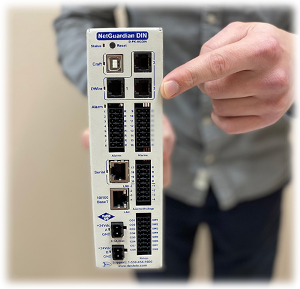
Our NetGuardian RTUs use a fixed-configuration approach. Instead of offering a single generic chassis, we engineer specific models matched to different site profiles. The NetGuardian 832A G6, for example, provides 32 discrete alarms, 8 analog inputs, and 8 control relays in a single integrated unit. All connectivity is direct PCB integration, eliminating the mechanical failure points associated with card-edge connectors.
This architecture delivers several operational benefits. The NetGuardian 216F integrates dual SFP fiber ports directly into the chassis, eliminating external media converters that introduce additional power supplies and failure points. Our Smart Fuse Panel AB6 combines power distribution with full RTU capabilities in a single rack unit, saving valuable cabinet space while reducing installation costs by approximately 50% compared to separate devices.
The NetGuardian 832A features dual Gigabit Ethernet NICs, allowing physical network separation between secure management LANs and general monitoring networks without software-based bridging. This air-gap capability is essential for cybersecurity compliance in critical infrastructure.
Asentria's SiteBoss S550 employs a chassis-and-card architecture. The base unit functions as a motherboard with expansion slots for adding functionality. Asentria offers over 40 expansion cards for various capabilities, from modems and Ethernet switches to specialized I/O and serial interfaces.
This modular approach provides theoretical flexibility for diverse applications. The platform is oriented toward industrial control, with specific cards for fuel management, generator interfacing, and power metering. However, modularity introduces operational complexity. Every expansion card relies on edge connectors susceptible to failure in environments with vibration or thermal cycling. Managing a fleet of modular units also requires stocking a diversified inventory of daughter cards. A replacement unit isn't immediately deployable until it's been populated with the correct cards.
| Consideration | DPS NetGuardian | Asentria SiteBoss |
|---|---|---|
| Physical Reliability | Direct PCB integration (higher MTBF) | Edge connectors (mechanical risk) |
| Deployment Simplicity | Order exact model for site needs | Requires card selection and population |
| Network Security | Dual NICs for physical separation | Software-based network separation |
| Fiber Connectivity | Native SFP ports (216F model) | Requires expansion card |
| Space Efficiency | Integrated designs like Smart Fuse Panel | Standard chassis requires separate components |
| Form Factor Options | Rack, wall, DIN optimized per model | Standardized chassis |
For telecommunications operators prioritizing reliability and straightforward deployment, integrated architecture removes failure points and simplifies field installations. For industrial applications requiring highly customized control logic, modular flexibility may be worth the added complexity.
How you configure site logic represents perhaps the most significant operational difference between these platforms.
Asentria markets the SiteBoss's Lua scripting as a primary differentiator. This lightweight programming language enables complex custom logic at the edge. A Lua script can parse non-standard serial strings, perform mathematical operations on analog inputs, or execute multi-step control sequences.
For specialized industrial applications, this programmability offers genuine flexibility. However, scripting in large-scale telecom networks introduces specific operational challenges. A script written by one engineer often becomes a "black box" to others. If that engineer leaves, institutional knowledge departs with them. Across a network of thousands of sites, maintaining consistent script versions becomes exponentially more difficult than managing standard firmware configurations. Small variations between sites create inconsistent behavior that complicates troubleshooting for network operations centers.
When a site fails at 3 AM, the responding technician needs clear answers about configuration states. Debugging syntax errors in line 40 of a Lua script requires programming expertise most field technicians don't possess. Asentria's custom scripting services indicate many customers lack internal expertise to manage these scripts independently, creating recurring software maintenance costs.
We explicitly designed our systems around menu-driven configuration accessible via web browser or the Windows-based NGEdit utility. Logic is handled through "Derived Alarm" equations configured via dropdown menus, not custom code. Control logic uses "Control Equations" that define triggers and actions through standard boolean operators and timers within a graphical interface.
Consider a typical scenario: a controller fails and must be replaced by a junior technician. With DPS equipment, the technician uploads a standard configuration file. All logic is visible and verifiable via checkboxes. There's no ambiguity. With script-based systems, the technician must ensure correct script files, libraries, and dependencies are present. Configuration errors require programming expertise to resolve, which field technicians typically lack.
In critical infrastructure, determinism is superior to flexibility. The goal is limiting variables that can cause failure. Our configuration model enforces standardization that protects networks from human error and complex debugging scenarios. Site behavior remains predictable and repeatable across the entire network footprint.
Real-world telecommunications networks are "brownfield" environments. You're managing heterogeneous equipment spanning decades, from modern IP-based routers to serial switches and analog systems.
We built our reputation on protocol mediation. Our T/Mon master station ingests alarms from virtually any source and presents them in a unified interface. T/Mon natively supports over 30 distinct protocols, including proprietary formats long abandoned by original manufacturers. This includes SNMP (V1, V2, V3), DNP3, Modbus, TL1, and protocols like Badger 481/1200, NEC 21SV, and Dantel 460.
This software-based mediation allows you to place T/Mon at the network's top level and continue using existing RTUs while gaining modern, web-based visibility. You avoid the massive capital expense and labor of replacing every RTU simultaneously. For sites that need to report to modern SNMP managers like SolarWinds while containing serial equipment, our NetMediator variant ingests serial data, converts it to SNMP traps, and forwards it northbound.
If you need a protocol we don't currently support, tell us what you're trying to accomplish. T/Mon currently supports 30+ protocols specifically because clients needed them at various times. We're willing to develop new protocol support when it serves customer requirements.
Asentria's documentation emphasizes modern standards like SNMP, Modbus, and DNP3. For integrating equipment using these contemporary protocols, the SiteBoss handles them effectively.
For connecting to equipment using older proprietary protocols, Asentria's typical approach involves rewiring contact closures from the device's punch-down block directly to the SiteBoss. While effective, this is labor-intensive and invasive. It carries high risk of service interruption during the transition and effectively requires replacing equipment intelligence rather than mediating it.
The difference matters significantly for operators with substantial investments in existing equipment. Software-based mediation allows you to modernize your management layer immediately while upgrading remote site hardware gradually over time. Hardware-focused approaches force more immediate and costly intervention at remote sites.
The master station aggregates millions of events, filters noise, and presents actionable insights to your network operations center.
Our T/Mon LNX isn't just a device manager for DPS products. It's a Manager of Managers designed to ingest data from other master stations, switches, and diverse RTUs. T/Mon employs algorithms to filter "flapping" alarms, such as door sensors oscillating in wind. This prevents alarm fatigue where dispatchers begin ignoring constant alerts and potentially miss true critical events.
The T/Mon GFX interface provides map-based network views, allowing operators to drill down from regional perspectives to specific site and rack layouts. Importantly, T/Mon operates on a perpetual appliance model. There are no per-point or per-device licensing fees. You can add 1,000 new NetGuardians without paying additional software licenses.
Asentria Site Manager (ASM) primarily manages the SiteBoss ecosystem. Its strengths lie in bulk configuration and firmware management for SiteBoss units. Unlike T/Mon, which mediates alarms from diverse equipment like Lucent 5ESS switches or Nortel PBXs, ASM focuses on Asentria device health and configuration. It functions more as a device management utility than a network-wide alarm master.
| Feature | DPS T/Mon LNX | Asentria Site Manager |
|---|---|---|
| Primary Function | Network-wide alarm master | Device management utility |
| Multi-Vendor Support | 30+ protocols, multiple manufacturers | Primarily Asentria devices and SNMP |
| Legacy Protocol Mediation | Native support (Badger, NEC, etc.) | Limited to rewiring approaches |
| Licensing Model | No per-point/device fees | Standard software licensing |
| Ownership Structure | Perpetual appliance | Software license |
For operators seeking unified visibility across multi-vendor network environments, T/Mon provides comprehensive alarm management. ASM serves its purpose well for organizations deploying exclusively Asentria hardware.
In our current geopolitical climate, supply chain resilience matters for critical infrastructure.
Our "Made in America" designation is substantive, not marketing. We maintain total vertical integration in Fresno, California. We buy raw aluminum sheets and process them in-house using computer-controlled water jets, punch presses, and press brakes. We powder-coat our own chassis. We operate our own SMT lines to populate circuit boards.
This integration means we're not waiting on contract manufacturers in Asia to prioritize our production runs. If a component becomes unavailable, our engineers can redesign boards to use available alternatives and put them into production immediately. A process that would take months with outsourced models happens in weeks.
This control allows us to offer custom metal work and connector variations with zero non-recurring engineering fees for reasonable order quantities. If you need a NetGuardian with specific military-grade connectors or unique footprints to fit existing cabinets, we can prototype and produce it quickly.
Asentria designs in Seattle and follows more traditional electronics supply chain practices. The modular nature of their products implies a diverse supply chain for various cards and components. In September 2025, Trystar acquired Asentria. Trystar is a Minnesota-based manufacturer specializing in electrical power resiliency solutions like docking stations, load banks, and microgrids.
As Asentria operates within a larger corporate structure focused primarily on power distribution and industrial resiliency, the SiteBoss platform serves a broader parent company portfolio. For telecommunications operators whose requirements often diverge from industrial power users, this organizational structure represents a consideration in vendor selection.
Sticker price represents only a fraction of total cost over a 10-15 year lifecycle.
We champion a CapEx-centric model. You buy the hardware and own the capabilities. There are no annual license fees to maintain T/Mon operations or add new RTUs. This creates predictable, flat cost structures over the system's life. Many competitors employ recurring "Software Maintenance Agreements" to access support, firmware updates, and advanced management features. Over a decade, these OpEx costs can exceed initial hardware investment.
We offer tuition-free factory training. Clients can send staff to Fresno for immersive four-day courses at no cost beyond travel expenses. This ensures your workforce maintains competence without relying on expensive external consultants.
Script-based systems often necessitate higher-level engineering staff or external consultants to manage complex logic, significantly inflating human capital costs. When standard configuration interfaces serve the same purpose, these additional costs represent poor value.
We provide free lifetime technical support for original owners. There's no pay-per-incident model or mandatory support contract required to reach an engineer. This contrasts with tiered support models where faster response times are gated behind premium maintenance contracts.
The choice between DPS Telecom and Asentria represents a choice between operational philosophies.
Asentria SiteBoss excels in scenarios requiring:
DPS Telecom NetGuardian is optimal for operators prioritizing:
At DPS Telecom, we acknowledge that our approach isn't universally optimal. For organizations managing highly specialized industrial control scenarios, Asentria's programmable platform offers genuine capabilities. However, for telecommunications carriers protecting critical network infrastructure, our integrated hardware, deterministic configuration, and comprehensive protocol support align more closely with operational realities.
We built our business around understanding that networks are complex, mission-critical assets. Your monitoring system's job is being transparent, reliable, and accessible when needed. That philosophy has guided our engineering for over 30 years.
Selecting remote monitoring infrastructure represents a decade-long commitment. The decision impacts not just initial costs, but operational efficiency, troubleshooting complexity, and total lifecycle expenses.
We'd be pleased to discuss your specific network requirements and help you evaluate whether our approach fits your operational model. Our application engineers bring decades of collective experience in telecommunications monitoring. We'll ask detailed questions about your site profiles, existing equipment, protocol requirements, and operational constraints. If our solution isn't the right fit, we'll tell you honestly.
Contact our engineering team to schedule a consultation. We can also arrange a risk-free evaluation so you can test equipment in your actual environment before making decisions. That's how confident we are in what we've built.

Andrew Erickson
Andrew Erickson is an Application Engineer at DPS Telecom, a manufacturer of semi-custom remote alarm monitoring systems based in Fresno, California. Andrew brings more than 19 years of experience building site monitoring solutions, developing intuitive user interfaces and documentation, and opt...