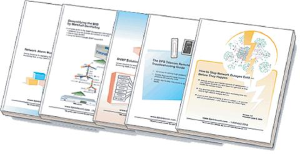
Check out our White Paper Series!
A complete library of helpful advice and survival guides for every aspect of system monitoring and control.
1-800-693-0351
Have a specific question? Ask our team of expert engineers and get a specific answer!
Sign up for the next DPS Factory Training!
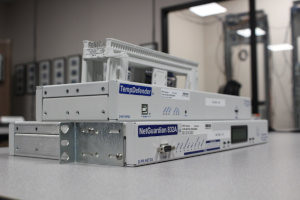
Whether you're new to our equipment or you've used it for years, DPS factory training is the best way to get more from your monitoring.
Reserve Your Seat TodayMany critical infrastructure sites, from tower locations and pump stations to remote equipment shelters, lack wired Ethernet connections. DPS Telecom NetGuardian RTUs pair with external cellular gateways to deliver alarm data, environmental readings, and equipment status from locations where running cable is impractical.
Talk to an Engineer | 800-693-0351

Founded 1986 | 172,800+ devices deployed | 1,500+ organizations served | Made in Fresno, CA | 9,800+ custom configurations
Not every site has access to a wired network. Tower sites on mountaintops, pump stations along pipelines, equipment shelters at highway interchanges, and field cabinets in rural service areas often sit far from any Ethernet drop. Without a monitoring connection, these sites go dark. You find out about failures from client complaints, field technicians who happen to be nearby, or scheduled maintenance visits that come too late.
No Visibility Until a Technician Arrives Without monitoring, equipment failures at remote sites can go undetected for hours or days, compounding damage and extending outages.
Unnecessary Truck Rolls Dispatching technicians to check on sites "just in case" wastes time and fuel. Without real-time data, every anomaly requires a physical visit.
Environmental Threats Go Unnoticed Temperature spikes, humidity buildup, water intrusion, and HVAC failures at unmanned sites can destroy equipment before anyone knows there is a problem.
Battery and Power Failures Cascade A failing battery bank or tripped breaker at a remote site can cascade into a full outage if no one is alerted while backup power is still available.
Security Gaps at Unmanned Locations Door openings, unauthorized access attempts, and vandalism at remote facilities go undetected without active monitoring.
A NetGuardian RTU is installed at the remote site and connected to your equipment via discrete alarm contacts, analog sensor inputs, and serial data ports. The RTU collects alarm data, environmental readings, and equipment status locally. Instead of transmitting over Ethernet, the RTU routes its data through an external cellular gateway (Global System for Mobile Communications (GSM) or Code Division Multiple Access (CDMA)), sending Simple Network Management Protocol (SNMP) traps and status reports to your Network Operations Center (NOC) or directly to our T/Mon LNX alarm master. From there, operators receive automated notifications via email, text, or pager, and can view site status through a web interface.

Talk to an Engineer | 800-693-0351
NetGuardian RTUs provide the same monitoring depth over a cellular link as they do over Ethernet. The RTU handles all data collection locally, so the cellular connection only needs to carry alarm reports and status updates.
| Discrete Alarm Inputs | Monitor door contacts, generator run signals, breaker status, smoke detectors, motion sensors, and any equipment that provides a dry contact closure or open/close signal. |
| Analog Sensor Readings | Track temperature, humidity, battery voltage, AC voltage, rectifier current, fuel levels, and airflow using standard 0-5VDC or 4-20mA sensor interfaces. |
| Serial Data Collection | Collect ASCII text output from generators, UPS systems, HVAC controllers, and other intelligent equipment with serial ports. |
| Power and Battery Status | Monitor AC input voltage, DC battery voltage, rectifier status, and generator operation to catch power problems before they cause site outages. |
| Environmental Conditions | Track temperature, humidity, water intrusion, smoke, and airflow using D-Wire sensors that plug directly into the RTU. |
| Building Access and Security | Log door openings, keypad entries, and motion detection events at unmanned facilities through integrated access control inputs. |
The right RTU depends on your site size and the number of alarm points you need to monitor. All of the units below support cellular transport via an external gateway.

NetGuardian 832A G5
The full-capacity RTU for sites with a high density of monitored equipment. Handles large sites with generators, batteries, HVAC, and dozens of discrete alarm points in a single unit.
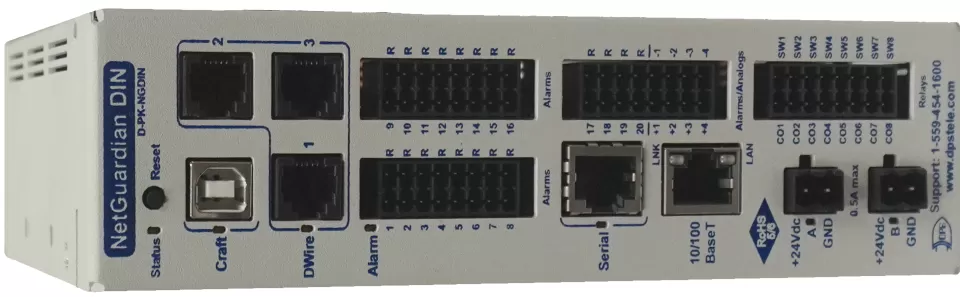
NetGuardian DIN
A compact, DIN-rail-mountable RTU for smaller sites or tight enclosures where rack space is limited. Fits inside equipment cabinets and outdoor enclosures with minimal footprint.
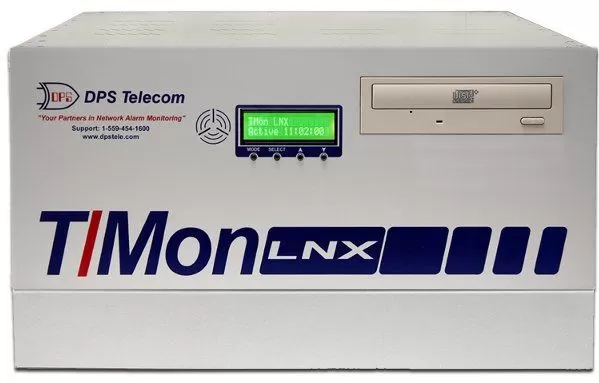
T/Mon LNX Alarm Master Station
The central management platform that aggregates alarms from all your cellular-connected RTUs into a single interface. Provides NOC-level visibility, automated notifications, and reporting across your entire network of remote sites.
NetGuardian RTUs are designed to integrate with whatever equipment and management systems you already have in place. The RTU sits between your field equipment and your NOC, translating alarms into standard protocols that your existing management platform can process. If you are running a third-party SNMP manager, the RTU sends standard SNMP traps. If you are using T/Mon as your alarm master, it communicates via DPS Communication Protocol (DCP) for tighter integration. If you have generators, UPS systems, or HVAC controllers that speak Modbus, the RTU can poll those devices over serial and forward the data upstream.
Talk to an Engineer | 800-693-0351
| Telecommunications | Cell tower sites, mountaintop repeaters, fiber regeneration huts, and roadside cabinets in areas beyond wired network reach. |
| Electric Utilities | Substations, switchgear sites, and distribution equipment in rural service territories where running Ethernet is cost-prohibitive. |
| Public Safety | 911 radio tower sites, emergency communications infrastructure, and dispatch relay stations that serve remote coverage areas. |
| Transportation | Highway communication cabinets, rail signal houses, tunnel ventilation sites, and bridge infrastructure along transportation corridors. |
| Government | Federal and municipal facilities at remote installations, border infrastructure, and military communication relay points. |
| Oil, Gas, and Water | Pipeline monitoring stations, pump houses, water treatment outposts, and well sites in isolated locations. |
| Custom Engineering at No Extra Cost | If your cellular-connected sites have unique requirements, we can modify RTU hardware, firmware, or I/O configurations to match. When orders exceed approximately 11 units, there are no Non-Recurring Engineering (NRE) fees. About 9,800 custom configurations have been completed to date. |
| Free Lifetime Tech Support | Every purchase includes lifetime access to our engineering support team in Fresno, CA. No call centers, no script readers. You talk directly with the engineers who designed your equipment. |
| 30-Day Loaner, 2-Year Warranty, Money-Back Guarantee | Evaluate our equipment in your environment with our 30-day loaner program. Every unit ships with a 2-year warranty and a money-back guarantee. |
| Made in Fresno, California | All DPS equipment is designed, manufactured, and tested in our Fresno facilities. Custom solutions can typically be delivered in under 90 days. |
Talk to an Engineer | 800-693-0351
Steuben County Office of Emergency Services, Public Safety
Monitoring Nine 911 Tower Sites and a Dispatch Center
Steuben County monitors nine 911 tower sites and a central dispatch center using DPS equipment. The system collects analog inputs for generator voltage and microwave signal fade, plus discrete alarms for door entry and temperature. Text alerts notify supervisors of site events in real time.
"We are monitoring nine tower sites, plus our 911 center. We are getting analog inputs for generator voltage, and microwave signal fade. Discrete alarms might be door entry, or temperature high/low, things like that." - Fred Marvin, Steuben County Office of Emergency Services
Cellular can serve as the primary transport for sites that have no other connectivity option. You can also configure it as a failover path, where the RTU uses Ethernet or T1 as the primary link and switches to cellular if the primary connection drops.
NetGuardian RTUs work with standard external GSM or CDMA cellular gateways. Your DPS application engineer can recommend compatible gateways based on the cellular coverage available at your site.
Alarm monitoring generates very little data. RTUs send compact SNMP traps and periodic status reports, not continuous video or large data streams. Most deployments use well under 100 MB per month per site under normal conditions.
Yes. NetGuardian RTUs send standard SNMP traps that any SNMP-compatible network management system can receive and process, whether that is T/Mon, SolarWinds, or another platform.
The RTU continues to collect and log alarm data locally. When the cellular link is restored, stored alarms are forwarded to your master station so nothing is lost during the outage.
DPS Telecom has helped 1,500+ organizations bring visibility to sites where wired connectivity is not an option. Our application engineers can walk through your site requirements and recommend a monitoring configuration that fits. Try it risk-free with our 30-day loaner program, backed by a 2-year warranty, money-back guarantee, and free lifetime technical support.