Download our free Monitoring Fundamentals Tutorial.
An introduction to Monitoring Fundamentals strictly from the perspective of telecom network alarm management.
1-800-693-0351
Have a specific question? Ask our team of expert engineers and get a specific answer!
Sign up for the next DPS Factory Training!
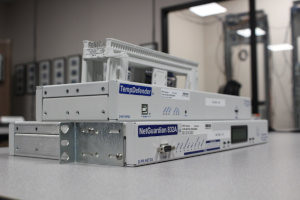
Whether you're new to our equipment or you've used it for years, DPS factory training is the best way to get more from your monitoring.
Reserve Your Seat TodayWhen an HVAC unit fails at an unstaffed site, temperatures can rise well beyond safe operating ranges for your equipment before anyone realizes something is wrong. The problem is finding out in time.
DPS Telecom has been building remote monitoring equipment for critical infrastructure since 1986. Our systems give operations teams continuous visibility into HVAC performance across all their remote sites, with configurable alarms that alert you the moment conditions move outside acceptable limits.
Talk to an Engineer | 800-693-0351
Every piece of network equipment operates within a specified temperature range. When a cooling system stops working properly at an unattended location, temperatures climb fast. Without monitoring, that failure goes undetected until someone visits the site, or until equipment starts failing.
We hear from clients who've managed exactly this scenario: they knew something was wrong at a site only after a service disruption. By then, the damage was already done.
A temperature sensor and an RTU at each site means you get an alert the moment conditions drift out of range. You can dispatch a technician with the right tools, knowing exactly what to expect when they arrive.
Effective HVAC monitoring at a remote site typically involves more than just a temperature reading. A complete picture includes:
| Monitoring Point | What It Tells You |
|---|---|
| Temperature | Whether the site is overheating or getting too cold |
| Airflow | Whether the HVAC is actually moving air (catches clogged filters and partial failures) |
| Humidity | Whether condensation risks are developing |
| HVAC unit status | Discrete alarm contact showing whether the unit is running or has faulted |
| Water intrusion | Early warning of leaks that could accompany HVAC failure or flooding |
A temperature sensor alone in one simple analog reading can detect HVAC failures, rising heat loads, seasonal shifts, and even fires. Combined with an airflow sensor, you'll catch degraded performance before temperatures reach a critical level.
DPS Telecom makes two types of equipment that work together for remote HVAC monitoring and control.
HVAC Controller
Our HVAC Controller provides climate management for critical facilities. It includes high-capacity relay outputs to control multiple HVAC components at once, direct interface with air handlers, chillers, and auxiliary systems, and configurable temperature setpoints. It gives you both monitoring and control, so you can take action remotely rather than immediately dispatching a truck.
NetGuardian RTUs
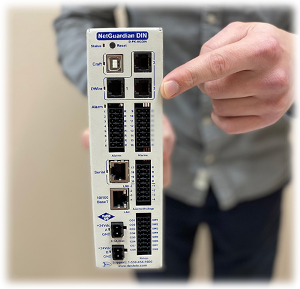
Our NetGuardian Remote Telemetry Units connect your HVAC monitoring to your management system. Specialized HVAC Integration RTU models interface directly with HVAC equipment. They monitor discrete alarm contacts, analog temperature and airflow readings, humidity levels, and other environmental conditions simultaneously.
RTUs support a wide range of transport options, including Ethernet, cellular, T1, fiber, and serial, so they work at sites regardless of what connectivity is available. All sensors use industry-standard 0-5VDC or 4-20mA interfaces for straightforward integration.
See the NetGuardian Product Family
For a small number of sites (fewer than 10), each NetGuardian RTU can function as a standalone system. You set up email or text alerts through the web interface and log in directly to check status.
Once you're managing more sites than that, a centralized alarm master makes more sense. Our T/Mon alarm master station collects data from all your RTUs and presents it in a single view. You can see HVAC status across all locations at once, with map-based displays, configurable alarm escalation, and logging for every event.
T/Mon supports 30+ protocols, so it works alongside most existing network management infrastructure.
Learn About T/Mon | 800-693-0351
DPS Telecom has manufactured more than 172,800 devices for over 1,500 companies since 1986. Our equipment routinely operates for 20 or more years in the field.
Every product is designed, manufactured, and tested at our facility in Fresno, California. When you need support, you're speaking directly with the engineers who built the equipment, not a call center.
We also build custom configurations when standard products don't match your application. There are no non-recurring engineering fees for orders exceeding approximately 11 units, and we typically deliver field-trial units within two months of finalizing requirements.
Talk to an Engineer | 800-693-0351
At minimum, a temperature sensor and a discrete alarm contact from the HVAC unit itself. Adding an airflow sensor gives you earlier warning of degraded performance, such as a clogged air filter, before temperatures reach critical levels.
Yes. Our HVAC Controller includes relay outputs to directly control HVAC components, allowing remote operators to take corrective action without dispatching a technician.
NetGuardian RTUs interface with industry-standard alarm contacts and analog sensors, making them compatible with most HVAC equipment. For equipment using digital protocols, our systems support DNP3, Modbus, SNMP, and 30+ others.
NetGuardian RTUs support Ethernet, cellular (GSM/CDMA), T1, fiber, serial, and dialup, so connectivity at a site isn't a barrier to deployment.
Each RTU reports to a central master station, such as our T/Mon, which aggregates data from all locations. Operators see all site conditions in one interface and receive alerts when any site goes out of spec.
Talk to an Engineer About Your Sites | 800-693-0351
If you're dealing with unmonitored remote sites or trying to get ahead of HVAC failures before they cause downtime, our engineers can help you figure out what a monitoring system would look like for your specific environment.
We don't use a sales team. When you call or reach out, you'll talk directly with someone who understands the equipment and can give you a straight answer on what will and won't work for your application.