Download our free Monitoring Fundamentals Tutorial.
An introduction to Monitoring Fundamentals strictly from the perspective of telecom network alarm management.
1-800-693-0351
Have a specific question? Ask our team of expert engineers and get a specific answer!
Sign up for the next DPS Factory Training!
Whether you're new to our equipment or you've used it for years, DPS factory training is the best way to get more from your monitoring.
Reserve Your Seat TodayYour tower sites are unmanned. Some go months without a visit. When something goes wrong, you find out the hard way: a technician gets called out at 3AM, drives an hour in the dark, and arrives to find a problem that a simple alert could have flagged hours earlier.
Remote cell tower monitoring changes that. You get real-time visibility into every site in your network, and your team only rolls a truck when there's a real reason to.
Talk to an Engineer or call 1-800-622-3314
Cell tower sites share a common set of infrastructure that needs to be watched. A monitoring system collects data from RTUs (Remote Telemetry Units) installed at each site and reports back to a central alarm management system.
Here's what a typical tower site monitoring setup tracks:
| Category | What Gets Monitored |
|---|---|
| Power | Generator voltage, battery voltage, rectifier status, AC commercial power, UPS |
| Environmental | Temperature, humidity, water intrusion, smoke |
| HVAC | Air handler operation, airflow, cooling status |
| Physical Security | Door contacts, motion sensors |
| Radio/Transport | Microwave signal fade, signal strength, circuit health |
| Tower | Obstruction/beacon lights, surge suppressors |
Tower sites tend to be in remote locations, sometimes on mountain tops or in areas that get snowed in for months. The cost of an unnecessary truck roll adds up fast: drive time, overtime, and the risk of arriving at a site with the wrong equipment for an unknown problem.
One DPS client reduced after-hours call-outs by over 75% after building out their monitoring system over six years. In some cases, site visits were eliminated entirely. In others, a trip that used to happen at midnight could wait until morning, because the monitoring system showed it wasn't urgent.
Good remote monitoring also helps you combine trips. When you know what's wrong at a site before you leave, you can coordinate multiple stops and send the right technician with the right parts.
A complete tower monitoring setup has two main components:
RTUs at each site collect data from your equipment and environment. They report back via Ethernet, cellular, T1, fiber, or dialup, whatever your site supports. When a threshold is crossed (temperature too high, generator voltage drops, door opens unexpectedly), the RTU sends an alert.
A central alarm master receives data from all your sites, processes it, and displays it in one place. Your NOC staff can see a geographic map of your network with color-coded status indicators. Technicians in the field get SMS or email alerts directly to their phones.
Alerts include details about the specific problem, which site it's at, and any response instructions you've built into the system. Even a new technician can look at an alert and know exactly what to do.
DPS Telecom's NetGuardian RTUs are the most widely used remote monitoring hardware for tower and telecom sites. Over 172,800 devices have been deployed worldwide.
Each unit monitors discrete alarms (door contacts, power failures), analog inputs (generator voltage, battery levels, temperature), and equipment via SNMP or Modbus. They support a wide range of transport options, so they work at sites regardless of what connectivity you have available.
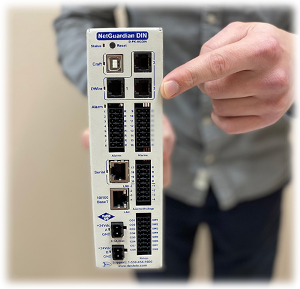
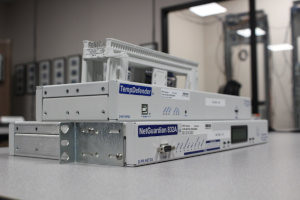
The NetGuardian 832A handles large sites. Smaller units like the NetGuardian DIN work well at compact or lower-complexity locations. Every unit is configured for your specific requirements. No one-size-fits-all bill of materials.
The T/Mon alarm master is the central hub that aggregates data from all your RTUs. It supports 30+ protocols, meaning it can communicate with both new equipment and legacy gear that's already in your network.
T/Mon displays alarms by severity, sends notifications to the right people (low fuel alerts go to your refueling contractor, not every technician), and maintains full alarm history. It integrates with standard SNMP managers like SolarWinds if you're already running one of those platforms.
Talk to an Engineer or call 1-800-622-3314
DPS Telecom has been building remote monitoring systems since 1986. The company manufactures everything in-house at its Fresno, California facility. Hardware design, firmware, circuit board assembly, and testing all happen under one roof.
That matters for a few reasons:
Fred Marvin of Steuben County Office of Emergency Services monitors nine tower sites plus a 911 center using DPS equipment: "We are getting analog inputs for generator voltage, and microwave signal fade. Discrete alarms might be door entry, or temperature high/low, things like that."
NetGuardian RTUs work over Ethernet, T1, fiber, GSM/CDMA cellular, serial, and dialup. This covers virtually any connectivity situation you'll encounter at a remote tower site.
Yes. DPS RTUs support 30+ protocols including SNMP, Modbus, DNP3, and TL1. The T/Mon alarm master can report to third-party management platforms like SolarWinds if that's what your NOC already uses.
Custom configurations are typically delivered in under 90 days. DPS also provides turn-up and installation assistance, databasing services, and factory training.
Most sites use fewer than 10 sensors (temperature, water detection, humidity, door contacts, motion). The RTU collects those inputs along with analog readings from generators and power systems, then reports back to your central alarm master.
DPS Telecom works with telecom operators, public safety agencies, utilities, and county governments that manage distributed tower sites. The first step is a conversation with one of our engineers about what you're monitoring and what gaps you have.
Request a Quote or call 1-800-622-3314