Check out our White Paper Series!
A complete library of helpful advice and survival guides for every aspect of system monitoring and control.
1-800-693-0351
Have a specific question? Ask our team of expert engineers and get a specific answer!
Sign up for the next DPS Factory Training!
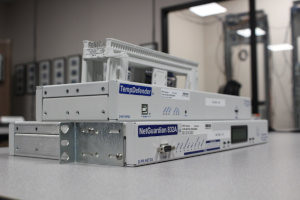
Whether you're new to our equipment or you've used it for years, DPS factory training is the best way to get more from your monitoring.
Reserve Your Seat Today
If you're weighing T/Mon against Paessler PRTG, you've probably noticed the two tools don't describe themselves the same way. That's actually the most useful place to start. Paessler describes PRTG as IT infrastructure monitoring software. T/Mon is a telecom alarm master built for remote, often unmanned field sites. Both keep an eye on your network, but they're designed for different monitoring jobs, so the right answer depends less on a feature checklist and more on what you're monitoring and where.
We build T/Mon here at DPS Telecom, so you know where our preference lands. We'll still lay this out straight. Naming a winner in the first sentence wouldn't tell you much anyway. What helps is seeing how each platform is designed, the sites each one fits, and how the two can run side by side. From there, the right call for your network gets easy to see. For nearly four decades we've helped more than 1,500 clients keep field infrastructure online, and most of those decisions came down to exactly this question.
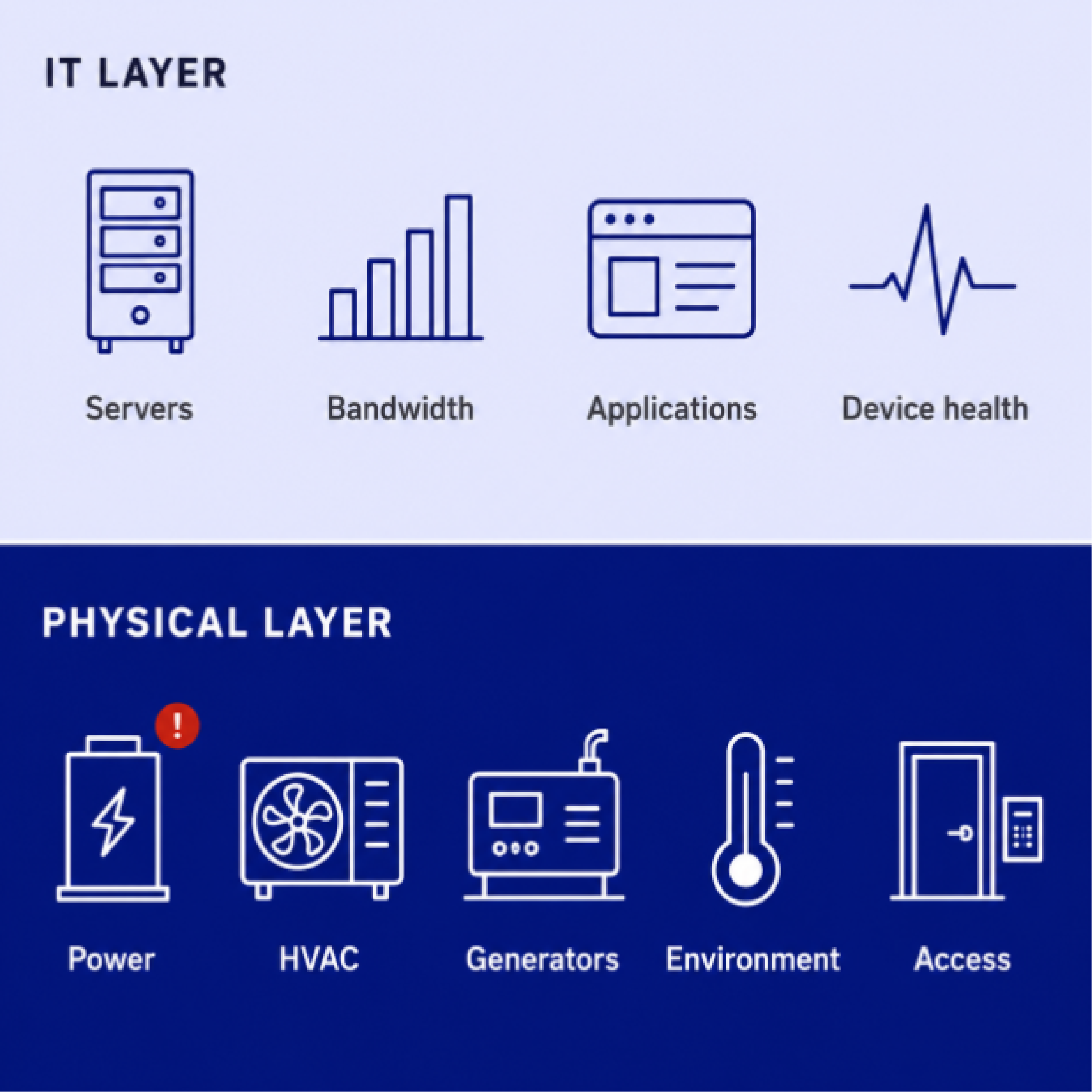
PRTG is aimed at the IT layer. Paessler describes it as all-in-one IT infrastructure monitoring, covering bandwidth, servers, applications, uptime, and device health. It reads that information mostly by polling IT equipment: it asks a device for a value on a set schedule using standard methods like SNMP, WMI, and flow protocols, and it can also receive SNMP traps. That design fits an IT team tracking servers, switches, and application performance inside staffed, climate-controlled environments.
T/Mon works at the physical layer of your network. It aggregates discrete and analog alarms from remote sites and pulls multi-vendor field gear into a single operations view: power plants, rectifiers, generators, HVAC, environmental sensors, radios, and access control. Instead of asking one server whether it's healthy, T/Mon watches the physical conditions that keep a whole site running. That's the job at a remote hut or cabinet where nobody's standing by.
| Consideration | Paessler PRTG | DPS T/Mon |
|---|---|---|
| Primary monitoring job | IT infrastructure: servers, bandwidth, applications, device health | Physical field-site alarms across remote, often unmanned sites |
| What it watches | IT metrics, each counted as a sensor | Discrete and analog alarms, power, environment, access, multi-vendor gear |
| Method | Polls devices with SNMP, WMI, and flow methods, and can receive SNMP traps | Aggregates alarms from field RTUs across many device protocols |
| Protocols | SNMP, WMI, NetFlow, jFlow, sFlow, HTTP, Ping | More than 30, including SNMP, TL1, DNP3, Modbus, ASCII, and older telecom formats |
| Form factor | Software on a Windows server, or hosted as a service | Hardware and software alarm master appliance |
| Licensing model | Sensor-based subscription (Paessler's model) | One-time hardware purchase sized to point and device capacity |
| Typical environment | Staffed, climate-controlled data centers and IT networks | Outdoor cabinets, huts, and remote sites running on DC power |
| Fits best when | An IT team is tracking servers, bandwidth, and uptime | NetOps or facilities is keeping distributed physical infrastructure online |
The clearest way to separate these tools is by what they can sense. IT monitoring software reads what a device can report about itself over the network. That works well when the thing you care about is a server, a port, or an application that already speaks a standard IT protocol.
A telecom alarm master starts a step earlier. A lot of the failures that take a remote site offline don't announce themselves over IP. A battery string discharging, a shelter climbing past a safe temperature, a generator that never started, an open door: those are contact closures and analog readings. Something in the field has to sense them and report them. That sensing and reporting is what our NetGuardian RTUs do, and T/Mon is the master station that collects it all in one place.
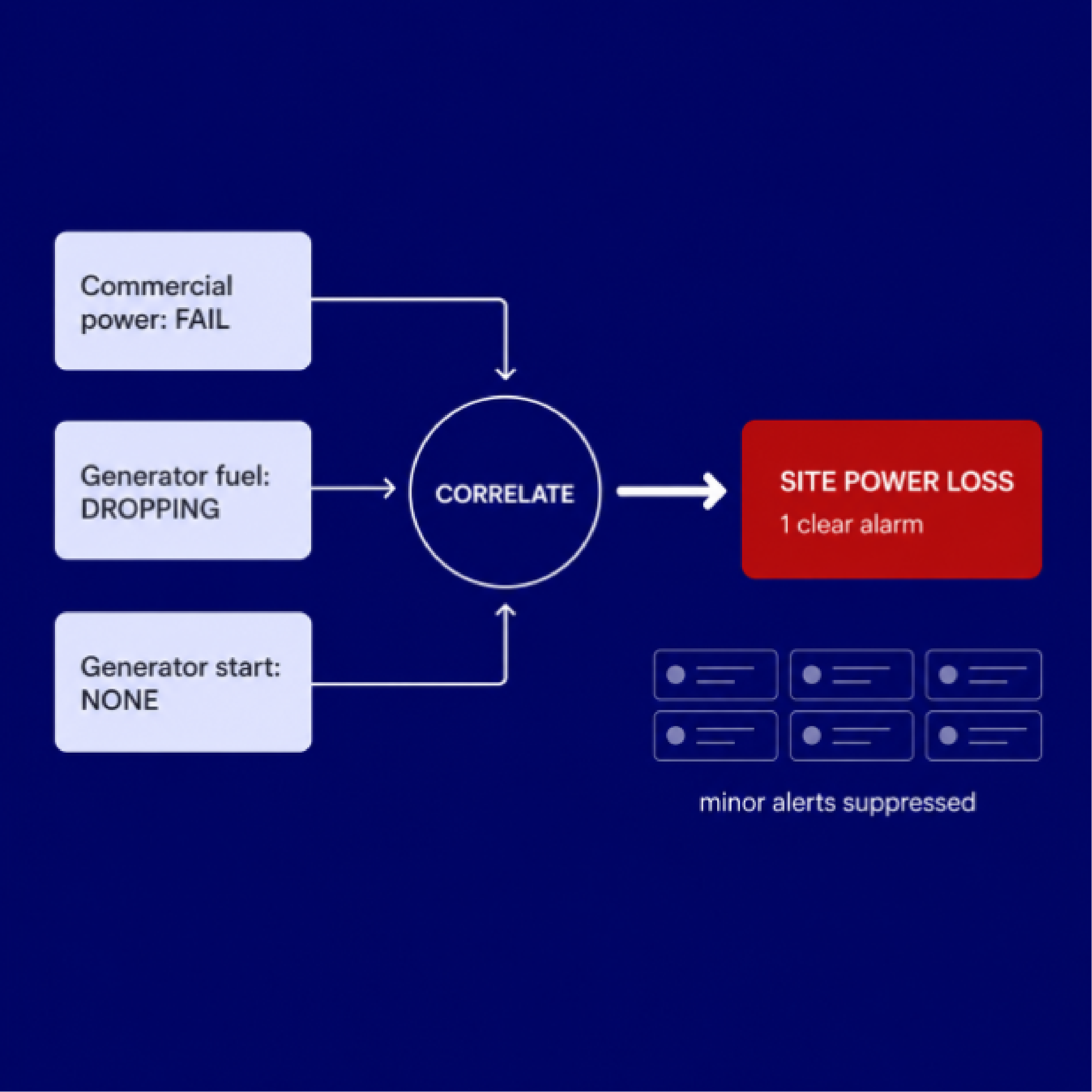
T/Mon can also correlate those inputs into a single, plain answer. If it sees a commercial power failure and a dropping fuel level but no confirmation that the generator started, it can suppress the flood of minor alerts and raise one clear "site power loss" alarm instead. For an operator at 2 a.m., that's the difference between a useful alert and a screen full of noise.
Telecom and utility networks rarely get replaced all at once. They grow over decades, so a modern router speaking SNMPv3 often shares a rack with gear that speaks a protocol from the 1980s or 1990s. That mix is normal, and it's exactly where a purpose-built alarm master earns its place.
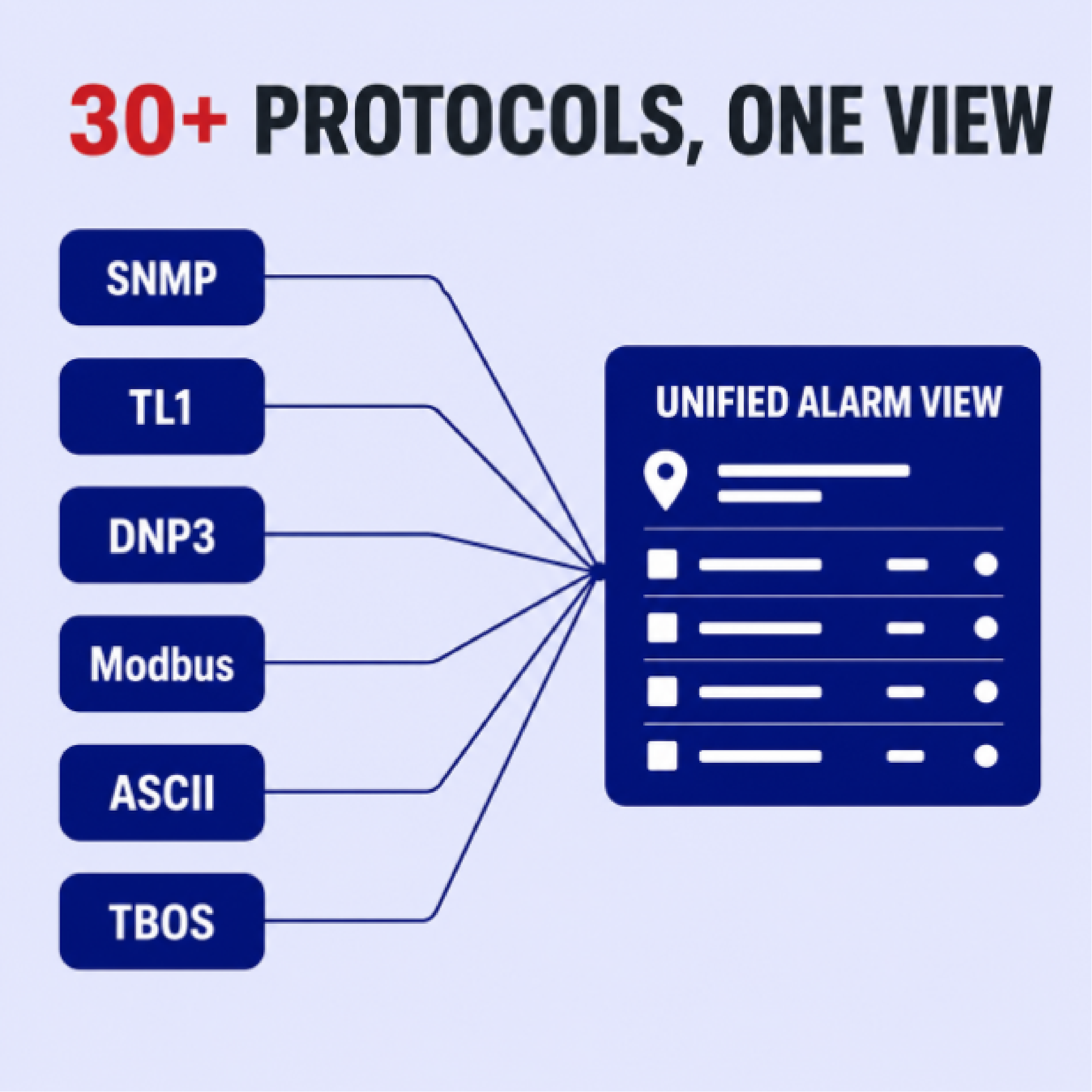
T/Mon acts as a protocol mediation engine. It supports more than 30 protocols today, and we add new ones when a client needs them. That list includes the standards IT teams already know, like SNMP, alongside telecom and industrial formats such as TL1, DNP3, Modbus, ASCII, or any number of other older and proprietary systems. T/Mon strips the payload from each of these, normalizes it, and presents everything on one map. That's the core of multiprotocol alarm aggregation, and it lets you keep functional equipment in service instead of replacing it just so a monitoring tool can read it.
Dominion used T/Mon to bring three separate legacy alarm systems into a single platform without swapping out the underlying field equipment.
IT monitoring platforms are built around IP standards and synchronous polling, which suits modern, standardized equipment. On a greenfield network running entirely on new gear with native SNMP, deep mediation of older telecom formats may not come up much. On a network carrying decades of mixed equipment, it often does.
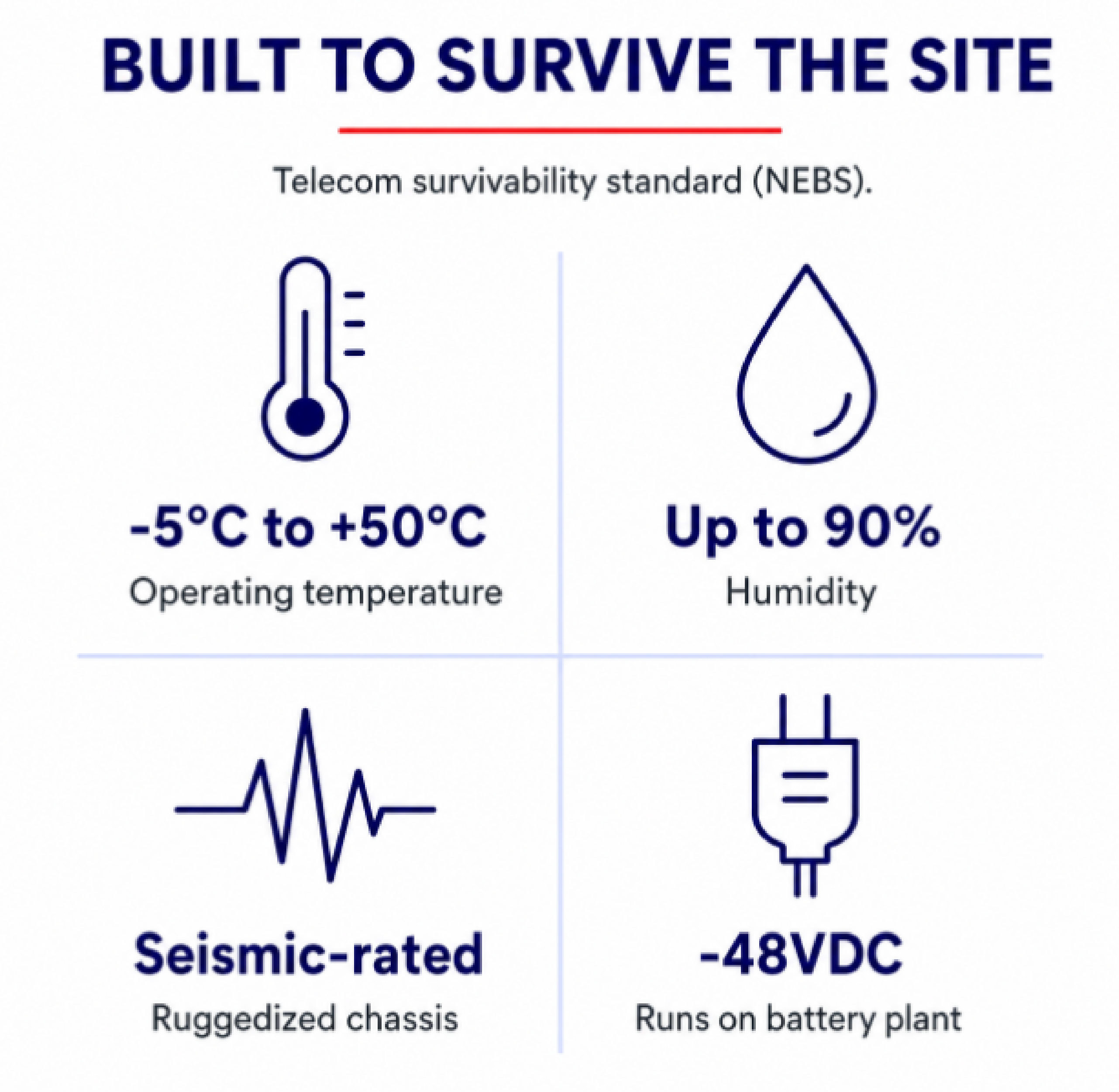
Monitoring equipment has to survive the site it sits in. That's a hardware requirement, and it applies no matter which platform you run. When a shelter loses its HVAC, and the temperature climbs, or when a seismic event or wildfire hits, your monitoring gear is the situational awareness you have left.
Telecom field hardware is typically built to NEBS, the Telcordia standard for telecom equipment survivability, for exactly this reason. NEBS covers survivability across extreme temperatures, humidity, vibration, and electrical surges. NetGuardian RTUs and T/Mon hardware are built to meet those requirements, with ruggedized chassis and mirrored storage, and they run natively on the site's redundant negative-48VDC battery plant, so monitoring can keep going on reserve power. General-purpose IT servers are designed for AC power and data-center conditions. That's a good fit for a data center and a different fit for an outdoor cabinet.
Paessler licenses PRTG with a sensor-based model, where a sensor is one monitored value on a device, such as the traffic on a single switch port or a server's CPU load. Monitoring one device thoroughly often uses several sensors. Paessler moved PRTG to subscription licensing in 2024, and a free edition covering up to 100 sensors remains available. For an IT department that budgets software as a recurring operating expense, that model lines up well with how IT costs are usually managed, and the sensor count scales as you monitor more values.
For infrastructure that stays in the field for 20 years or more, the math is worth looking at differently, and this is where we focus on total cost of ownership rather than the lowest upfront price. T/Mon follows the capital-expenditure pattern that's common in telecom and utility work. You buy the master station sized to your point and device capacity, and it runs without a per-sensor subscription. A T/Mon LNX, for example, supports up to 9,999 devices and 999,999 alarm points, so adding new sites usually draws on capacity you already own.
Beyond the licensing model, a few DPS design choices shape the long-term cost:
Yes, and for a lot of organizations that's the right setup. You don't have to rip out a tool your IT team already relies on. In plenty of utilities and carriers, IT runs the data center and corporate network on a platform like PRTG or SolarWinds, while NetOps or facilities handles the remote sites. Both jobs can stay where they belong.
Because NetGuardian RTUs support SNMP, they can send traps straight to a third-party manager. Your IT team keeps monitoring the logical network, and physical alarms from the field, like generator fuel, door contacts, and temperature, show up on the dashboard they already use. Our guide to the best RTU with SolarWinds compatibility covers how that reporting works, and if you're pricing options, how much an SNMP manager costs is a useful reference.
On larger networks with a lot of mixed and older gear, T/Mon can sit in the middle as a manager of managers. It does the heavy lifting of polling older substations, parsing asynchronous TL1 from optical gear, and reading serial Modbus, then forwards clean, normalized alarms upstream to your enterprise platform. That's the pattern behind South Central Communications' setup, where SNMP and RTU alarm monitoring came together under one system.
For an IT team whose main concern is server uptime, bandwidth, and application performance inside staffed, climate-controlled facilities, PRTG is a solid, well-established fit. Its polling model and auto-discovery are built for that world.
For the reader whose job is keeping revenue-generating field infrastructure online across many remote sites, T/Mon is the platform we'd point you to. It senses the physical failures that take those sites down, it's built to survive the environments the sites sit in, and it reads the protocol mix your field gear actually uses. Those are the three threads this whole comparison keeps circling back to. In our founders' book, 100% Uptime, Bob Berry and the DPS team make the case that once you're monitoring more than about ten remote sites, a central master station stops being optional, because logging into each RTU one at a time doesn't scale.
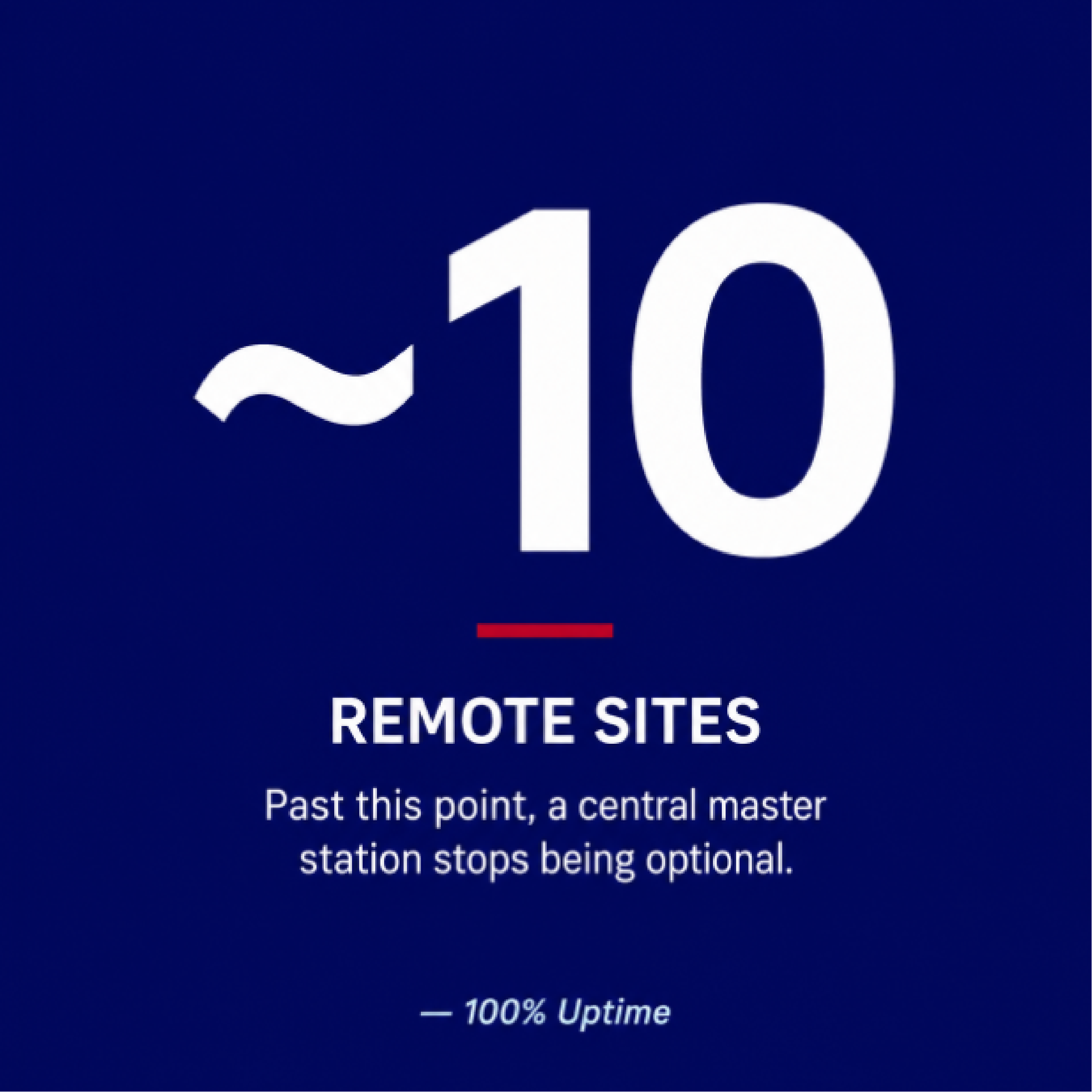
They also point out that fractured, proprietary systems are an easy way to build confusion and drive up cost. If you're trying to decide how to size that master station, our guide on how to choose the best alarm master for multi-site network monitoring is a good next read.
There's also a simple ROI angle worth keeping in mind. A single avoided site visit to a remote or mountaintop location, the kind that sometimes needs a helicopter, can cover the cost of the monitoring that prevented it. When you're protecting infrastructure worth hundreds of thousands of dollars, the monitoring is a small line item next to what it protects.
T/Mon is a hardware and software alarm master appliance, not software you install on your own server. It comes in models sized from small regional networks up to enterprise deployments with hundreds of thousands of alarm points.
T/Mon supports more than 30 protocols today, including SNMP, TL1, DNP3, Modbus, and ASCII. When a client needs a protocol we don't yet support, we develop it.
Yes. NetGuardian RTUs support SNMP and can send traps to third-party managers, so you can keep your existing IT tool and still bring field alarms into it.
PRTG can receive SNMP traps, so field data reaches it once a device in the field converts a contact closure or analog reading into a trap. Collecting that physical telemetry in the first place is the job an RTU and alarm master are built for.
In 100% Uptime, our founders put the line at roughly ten remote sites. Past that point, a central master station keeps you from logging into each RTU separately and gives you one view of the whole network.
Tell us what you're trying to monitor and where, and we'll help you find the right fit, even if that means keeping the IT tool you already run and adding T/Mon for the field. Give our engineers a call, and we'll walk through your network with you and figure out what actually makes sense for your sites.
Talk to an Engineer | 800-693-0351

Andrew Erickson
Andrew Erickson is an Application Engineer at DPS Telecom, a manufacturer of semi-custom remote alarm monitoring systems based in Fresno, California. Andrew brings more than 19 years of experience building site monitoring solutions, developing intuitive user interfaces and documentation, and opt...