Check out our White Paper Series!
A complete library of helpful advice and survival guides for every aspect of system monitoring and control.
1-800-693-0351
Have a specific question? Ask our team of expert engineers and get a specific answer!
Sign up for the next DPS Factory Training!
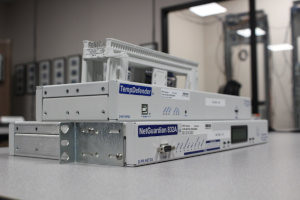
Whether you're new to our equipment or you've used it for years, DPS factory training is the best way to get more from your monitoring.
Reserve Your Seat Today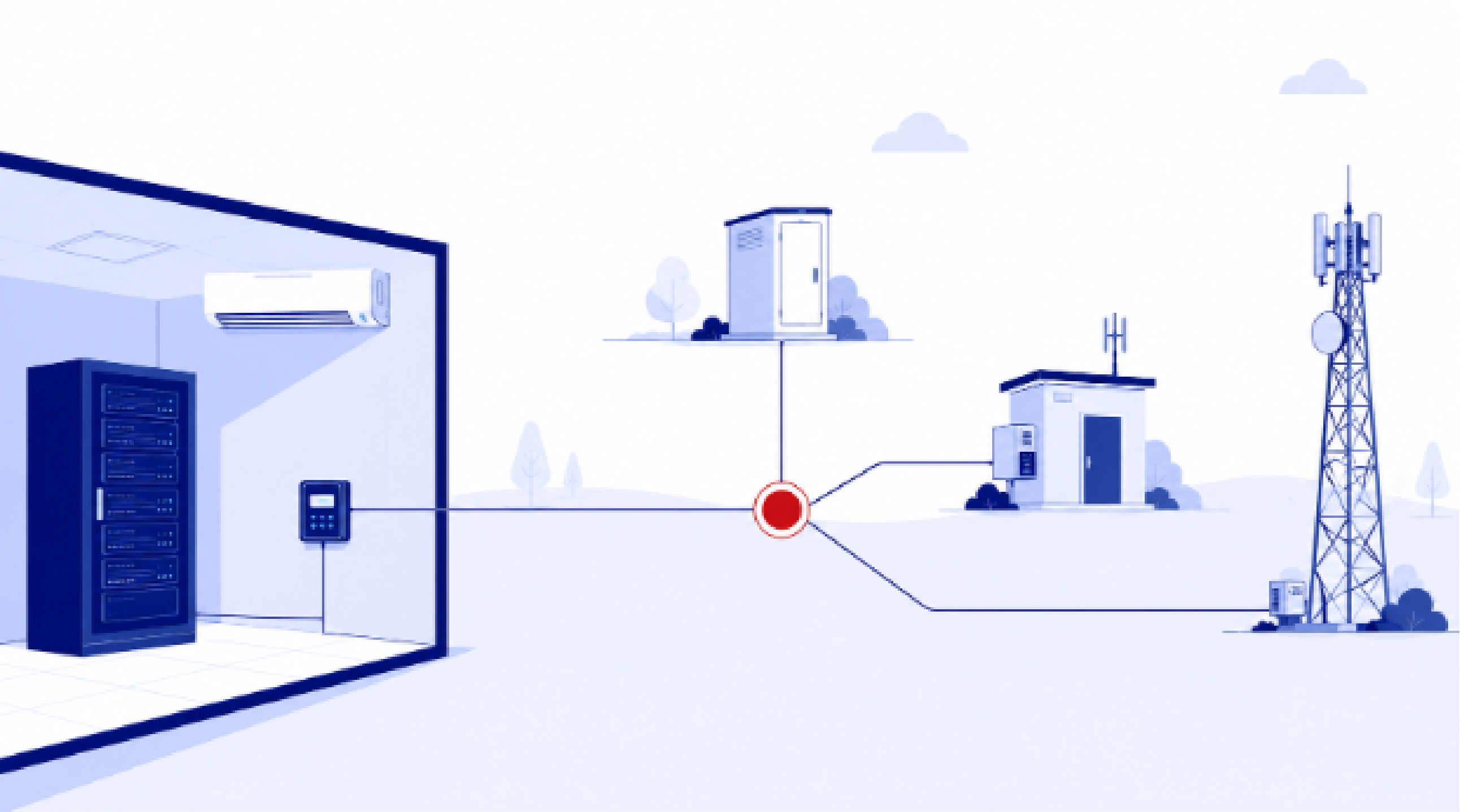
If your Sensaphone IMS-4000 is reaching the end of its service life, or you've sized up its successor, the IMS-4000E, and you're not sure it's the right next step, the most useful question to start with is where your monitoring lives today and how far it needs to reach. That answer, more than any single spec, points you toward the right replacement.
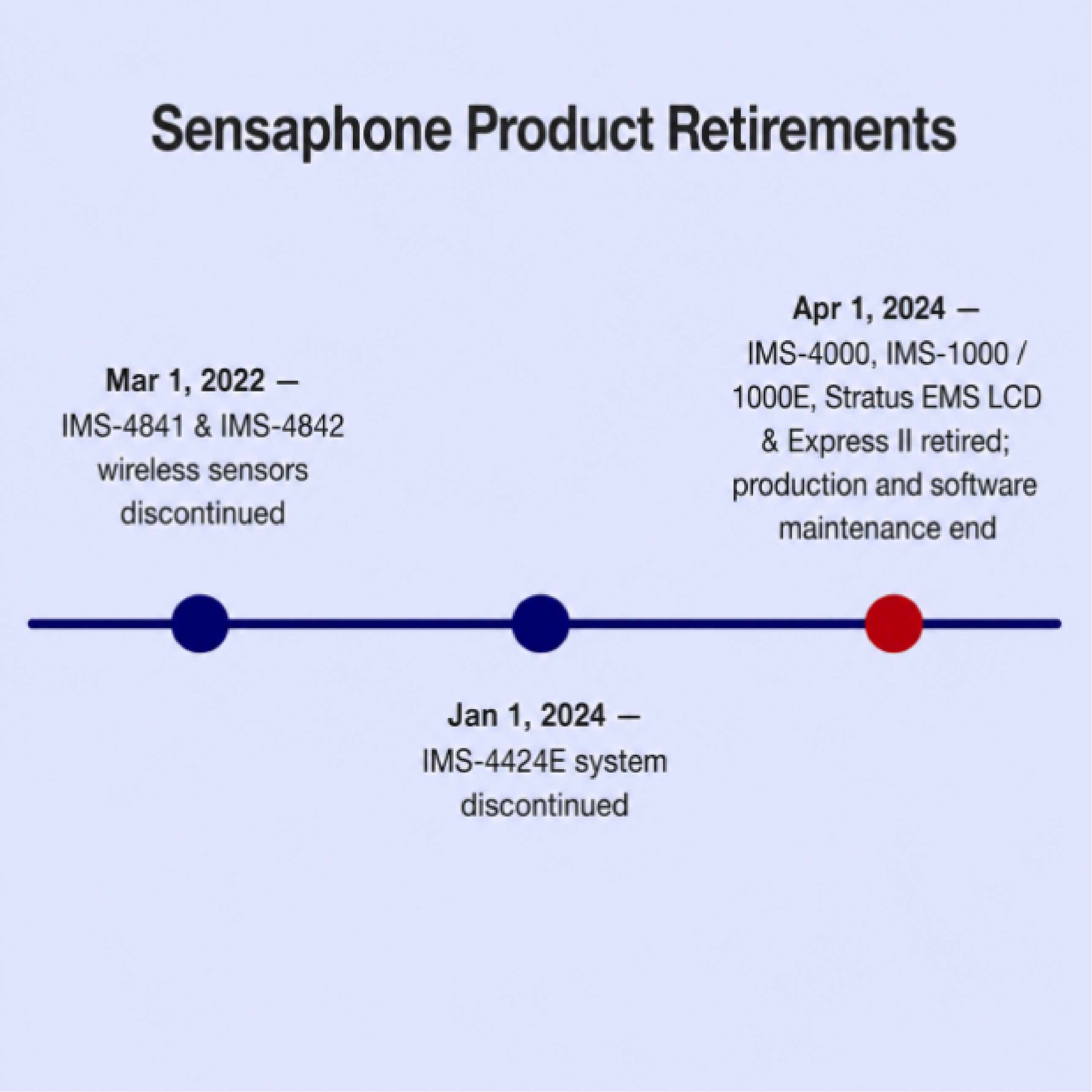
The IMS-4000 was built as a room-level environmental monitor for climate-controlled server rooms and IT spaces, and it did that job well. Sensaphone has since retired the original line, with production and software maintenance ending on April 1, 2024, and points existing users toward the backward-compatible IMS-4000E as the in-family successor. (Those details come from published Sensaphone product information and may have changed since we reviewed them.)
So whether you're retiring the original unit or weighing alternatives to the IMS-4000E itself, this is a good moment to ask a different question. Is a self-contained, single-room appliance still the right shape for you? Or have your sites grown past a tidy server closet into outdoor cabinets, remote huts, and a mix of equipment that speaks more than one language?
We build monitoring equipment here at DPS Telecom, and we've been at it for nearly 40 years. The best choice depends less on a feature checklist than on where your equipment lives. The right monitor for a conditioned server room isn't the right one for a string of outdoor cabinets, and neither belongs bolted inside an industrial control panel. The easiest move is to stay in the Sensaphone family with the IMS-4000E, and everything else is worth weighing against staying put. DPS is one of those options, and we'll be straight about where we fit and where another choice serves you better. For a full one-to-one breakdown, our DPS Telecom versus Sensaphone IMS-4000 comparison covers that matchup in depth.
For a full one-to-one breakdown, our DPS Telecom versus Sensaphone IMS-4000 comparison covers that matchup in depth.
A few factors tend to decide which of these systems fits your sites.
Here's how the IMS-4000E and the four alternatives stack up across those factors.
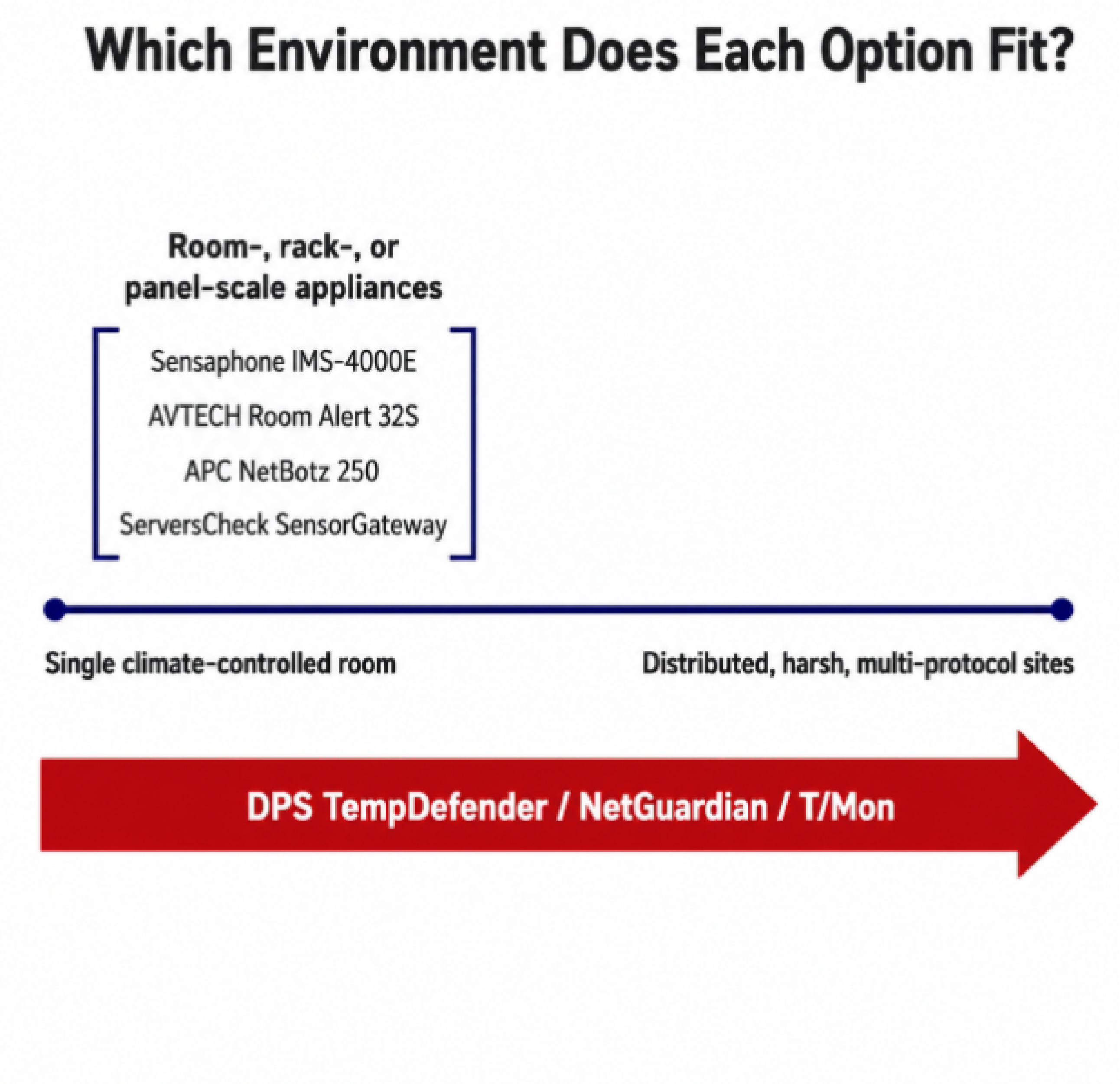
| Option | Best-fit environment | Multi-site centralization | Protocol range | Hardware standard | Approx. starting hardware cost |
|---|---|---|---|---|---|
| Sensaphone IMS-4000E (in-family baseline, included for comparison) | Climate-controlled server rooms | Single host (ConsoleView) | SNMP v1/v2c, email, voice, fax | Indoor commercial (FCC Part 15, UL 62368-1) | ~$2,010 host |
| DPS Telecom TempDefender, NetGuardian, and T/Mon | Server room up to harsh, distributed outdoor sites | T/Mon master station across thousands of sites | 30+ protocols, including SNMP, DNP3, Modbus, TL1, and ASCII | NEBS Level 3 option (GR-63-CORE, GR-1089-CORE) | RTUs from ~$700 |
| APC NetBotz 250 | Climate-controlled data-center racks | StruxureWare Data Center Expert | SNMP v1/v3, Modbus TCP/RTU, HTTPS | Indoor commercial (CE, FCC Class A) | ~$690 street price |
| AVTECH Room Alert 32S | Commercial server rooms | RoomAlert.com cloud or local manager | SNMP v1/v2c/v3, HTTPS, TLS | Indoor commercial (CE, RoHS, ISO 9001) | ~$1,449 bundled |
| ServersCheck SensorGateway | Industrial panels and SCADA sites | Integrates with third-party NMS, BMS, or ICS | SNMP v2/v3, Modbus TCP/RTU, MQTT (Message Queuing Telemetry Transport) | Industrial (UL 6238, CE, FCC) | ~$200 to $400 base unit |
(The competitor specifications and pricing in the table above were gathered from published product information for each vendor. They may not capture every model or configuration, and some details may have changed since we reviewed them.)
DPS is a strong fit when your monitoring spans multiple sites or harsh outdoor environments, or when your equipment speaks a mix of modern and legacy protocols that needs to roll up into one view. If that sounds like your network, put us on your shortlist and weigh us against the rest of this list.
If your needs haven't changed and your equipment still lives in a single climate-controlled server room, the most direct path is the successor Sensaphone built for that transition. Because the IMS-4000E is backward-compatible with the original, staying in-family means the least disruption: same architecture, same sensor family, same room-level scope.
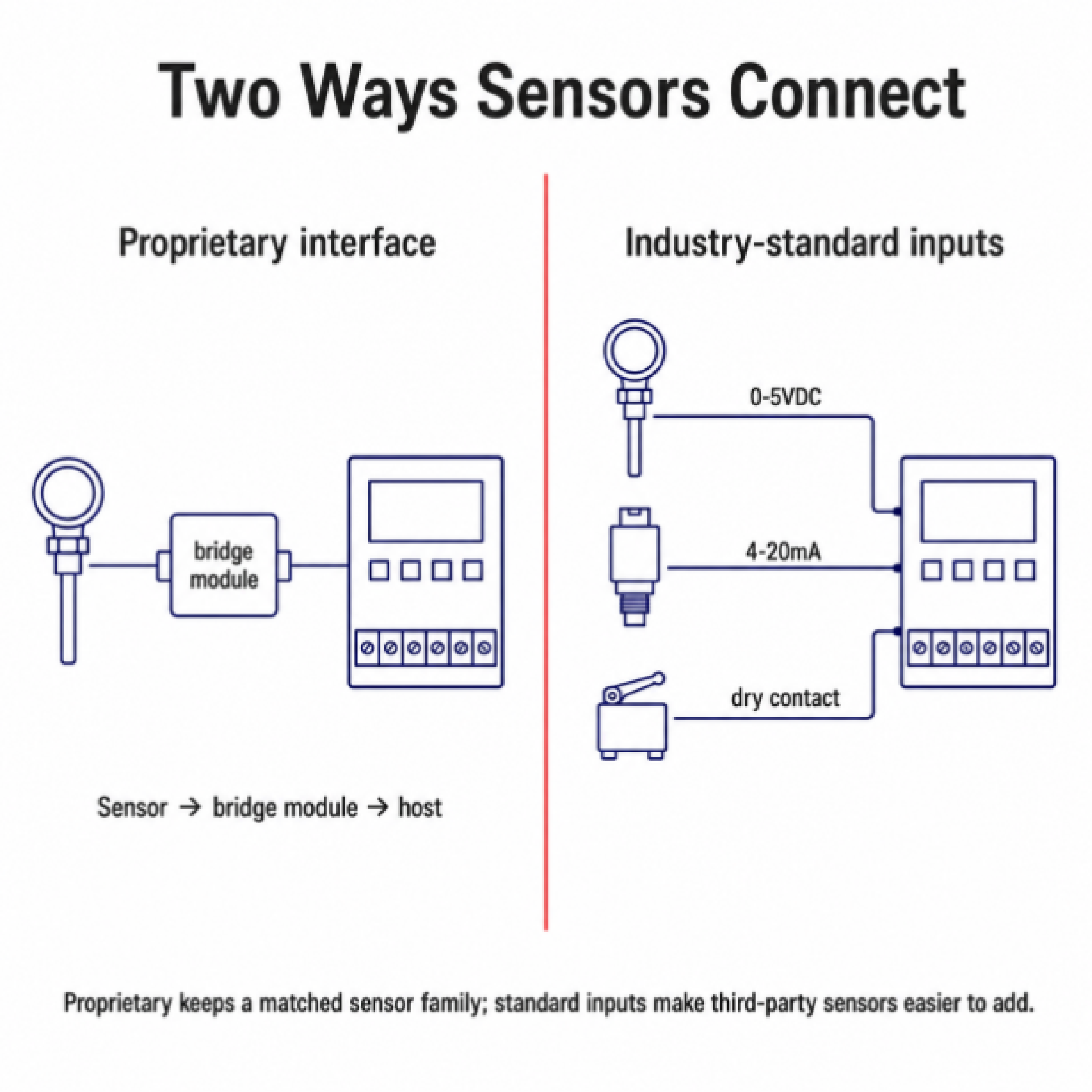
The IMS-4000E keeps the hub-and-spoke model, where a microprocessor-controlled host coordinates expansion nodes over the local network, and it carries forward the proprietary sensor ecosystem, using bridge modules to bring standard dry contacts and 4-20mA current-loop sensors into the system. It communicates over Ethernet and standard analog telephone lines and can notify staff by voice message, email, fax, pager, or SNMP trap. Published pricing puts the host around $2,010 before sensors, expansion nodes, or bridges.
What usually sends people looking anyway is one of a few things: sites spreading beyond one location, equipment moving into outdoor cabinets, a preference for industry-standard sensor interfaces over a proprietary family, or gear on site that speaks protocols beyond SNMP.
(IMS-4000E details above come from published Sensaphone product information and may have changed since we reviewed them.)
The DPS approach makes the most sense when your monitoring has grown past a single room, or you can already see that it will.
At the room level, our TempDefender G2 and TempDefender IT do the same job the IMS-4000 was built for: temperature, humidity, water detection, and door or smoke sensors in a server room or IT space. If you want that coverage plus more alarm capacity in one box, the NetGuardian ENV is the next step up. Those are the units we'd point an IMS-4000 or IMS-4000E user toward for straightforward server room monitoring, and our sensors use industry-standard 0-5VDC and 4-20mA interfaces, so you're not locked into a single sensor family.
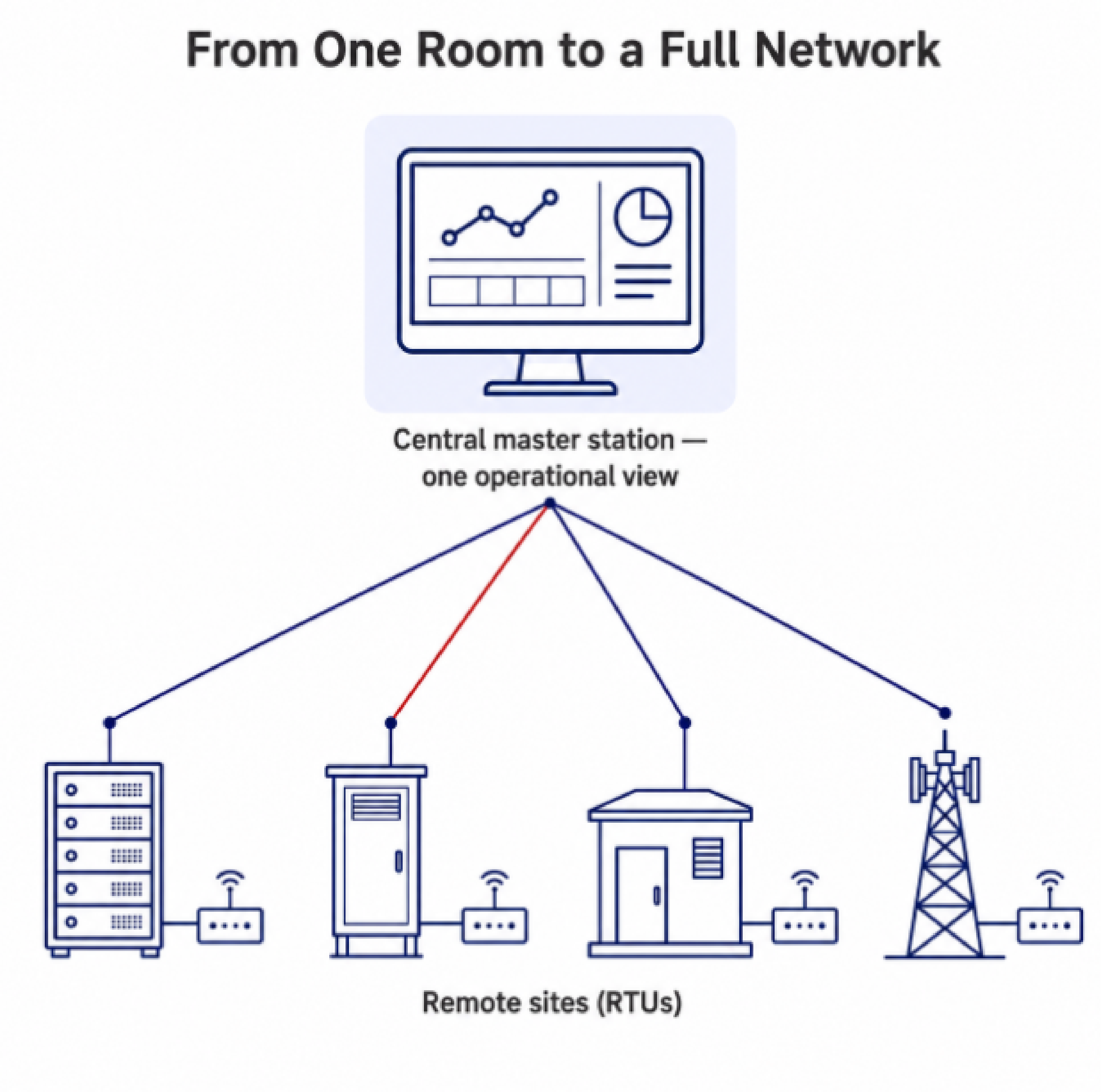
The difference shows up when you scale. A Remote Telemetry Unit (RTU) like the NetGuardian 832A G6 collects discrete alarms, analog readings, and serial data at each site, then reports up to a T/Mon LNX master station that aggregates thousands of sites into one operational view. If you're not sure what an RTU is or how it differs from a room appliance, our RTU overview walks through it. The point is that you can start with one room and grow to a network without re-platforming, because the same vendor covers both ends.
Two design choices matter for the readers most likely to be searching for an IMS-4000 or IMS-4000E replacement:
We design and build our equipment at our own facility in Fresno, California, which gives us direct control over our supply chain and lets us do custom engineering without Non-Recurring Engineering (NRE) fees for reasonable order quantities. So if a standard unit is close but not exact, we can adapt it. And because we control both the hardware and the software, our equipment is designed to stay in service for decades, with no forced obsolescence. One client, a senior communications engineer at a state Department of Transportation, put it plainly:
"We've always been very pleased with DPS Telecom's RTUs. They've lasted for 20 years."

Where might a different option suit you better? If your entire operation is a single climate-controlled room with no plans to grow, and cabinet-level physical access control is your priority, one of the data-center-focused options below may be a cleaner match. We'd rather tell you that than sell you more platforms than you need. For a deeper look at room-level choices, our guide to remote environmental monitoring and our breakdown of the best temperature monitoring system both go further.
For a climate-controlled enterprise data center where physical rack security is as important as temperature and humidity, the APC NetBotz 250, from Schneider Electric, is designed around that combination.
The NetBotz 250 pairs environmental sensing with cabinet access control. It offers onboard sensor ports for wired temperature, humidity, smoke, leak, and vibration monitoring, and expands through a hybrid topology that supports both wired sensor pods and wireless sensors over an integrated Zigbee coordinator. It can drive electronic swing-handle locks with Radio-Frequency Identification (RFID) credentials, giving you a physical audit trail for who opened which rack. For multi-unit deployments, it reports into Schneider's StruxureWare Data Center Expert, and it supports enterprise security features such as TACACS+ authentication, SNMP v3, and HTTPS.
It's a fit for organizations that manage high-density racks inside a conditioned building and want environmental data and cabinet security from one appliance. Just note that it's built for indoor data-center racks, so it suits that setting far better than an unheated outdoor site.
(NetBotz 250 details above come from published APC and Schneider Electric product information and may have changed since we reviewed them.)
If you run a standard commercial server room, warehouse, or IT space and want capable out-of-the-box sensing paired with a web dashboard, the AVTECH Room Alert 32S is built for exactly that.
The Room Alert 32S is a 1U rack-mount monitor with built-in temperature, humidity, dew point, heat index, and main power sensing. Its interface adds external digital sensor ports, dry-contact switch channels, analog inputs, and relay outputs, and it powers over Power over Ethernet (PoE) with an integrated mini backup battery. You can manage it through a local web interface, local management software, or the cloud-based RoomAlert.com portal, which handles alert routing, historical graphing, and reports on a subscription model. Security features include HTTPS, secure mail routing over TLS, and SNMP v3.
It suits organizations that prefer a cloud dashboard and predictable subscription costs across a handful of mid-tier indoor sites. The sensors and enclosure are designed for commercial indoor environments, though, not for hardened outdoor or carrier-grade installations.
(Room Alert 32S details above come from published AVTECH product information and may have changed since we reviewed them.)
When the monitor has to fit inside a control panel and talk to industrial systems on a manufacturing floor or in a process environment, the ServersCheck SensorGateway is built for that job.
The SensorGateway is a compact unit that mounts on a DIN rail inside standard industrial enclosures. It powers over PoE or direct DC terminal blocks, which lets it run off industrial and telecom power distributions without a separate converter. It expands through plug-and-play sensor hub modules and an optional relay output board. It also speaks several protocols at once: SNMP v2 and v3, Modbus TCP and RTU, and MQTT, all concurrently, so a single gateway can report into an IT Network Management System, a Building Management System (BMS), and an industrial control system together. It's also built with a firewall that filters access by IP and MAC address whitelist.
It suits Supervisory Control and Data Acquisition (SCADA) and building-management settings where panel space is tight and multiple industrial systems need the same data. The trade-off is that it's a compact gateway built for that industrial integration role, not a carrier-grade telemetry platform for a large distributed network.
(SensorGateway details above come from published ServersCheck and InfraSensing product information and may have changed since we reviewed them.)
There's no single winner here, because these systems are built for different jobs. Which one fits comes down to where your equipment lives and how far it needs to reach:
If you're replacing an aging unit as part of a broader refresh, our notes on replacing discontinued monitoring equipment cover the practical steps.
When did the Sensaphone IMS-4000 reach end-of-life? Based on published Sensaphone information, the original IMS-4000 line was retired with production and software maintenance ending on April 1, 2024, and the backward-compatible IMS-4000E is positioned as the in-family successor. Those details may have changed since we reviewed them.
Is the Sensaphone IMS-4000E an alternative to the IMS-4000? We treat it as the baseline rather than an alternative. It's the backward-compatible, in-family successor Sensaphone points existing users toward, so the practical question is whether staying in-family fits your sites better than one of the four alternatives above. If your monitoring still lives in one climate-controlled room and you want minimal change, it may. (Those details come from published Sensaphone information and may have changed since we reviewed them.)
Can a single server-room appliance monitor outdoor or multi-site infrastructure? It can, within limits. Room-level appliances are designed around climate-controlled indoor conditions, so outdoor cabinets, remote huts, and substations often call for hardware built to a standard like NEBS Level 3 and a master station that centralizes many sites into one view.
What's the difference between a room appliance and an RTU-plus-master approach? A room appliance is a self-contained unit watching one space. An RTU collects alarms and readings at each site and reports up to a master station such as T/Mon, which aggregates many sites and mediates different protocols. The RTU-plus-master model is built to grow with a distributed network.
Every network is different, so we'd rather start with a conversation than fire off a quote. When you call, you reach a DPS engineer directly, not a call center or a ticket queue. Tell us what you're trying to accomplish, where your sites are, and what you need to monitor, and we'll help you figure out whether a room-level unit is enough or whether you've grown into something built for multi-site, mixed-protocol infrastructure. If DPS isn't the right fit for your situation, we'll say so.
Talk to an Engineer | 800-693-0351

Andrew Erickson
Andrew Erickson is an Application Engineer at DPS Telecom, a manufacturer of semi-custom remote alarm monitoring systems based in Fresno, California. Andrew brings more than 19 years of experience building site monitoring solutions, developing intuitive user interfaces and documentation, and opt...