Check out our White Paper Series!
A complete library of helpful advice and survival guides for every aspect of system monitoring and control.
1-800-693-0351
Have a specific question? Ask our team of expert engineers and get a specific answer!
Sign up for the next DPS Factory Training!
Whether you're new to our equipment or you've used it for years, DPS factory training is the best way to get more from your monitoring.
Reserve Your Seat TodayChoosing the best SCADA system for critical infrastructure requires evaluating five core areas: vertical market alignment, licensing economics, protocol support, alarm management capabilities, and cybersecurity compliance. The system that fits your organization will match your specific operational requirements while providing a sustainable total cost of ownership over 15-20 years of expected service life.
At DPS Telecom, we've spent nearly four decades helping telecommunications providers, utilities, and government agencies monitor geographically distributed infrastructure. We've worked with over 1,500 organizations to deploy remote monitoring systems that fit their unique requirements. Through that experience, we've identified the criteria that separate effective SCADA deployments from expensive disappointments.
This guide walks through each selection factor with specific questions to ask vendors and considerations for your evaluation. Whether you're replacing discontinued equipment, responding to a recent outage, or planning proactive upgrades, these criteria will help you identify the system that fits your operational reality.
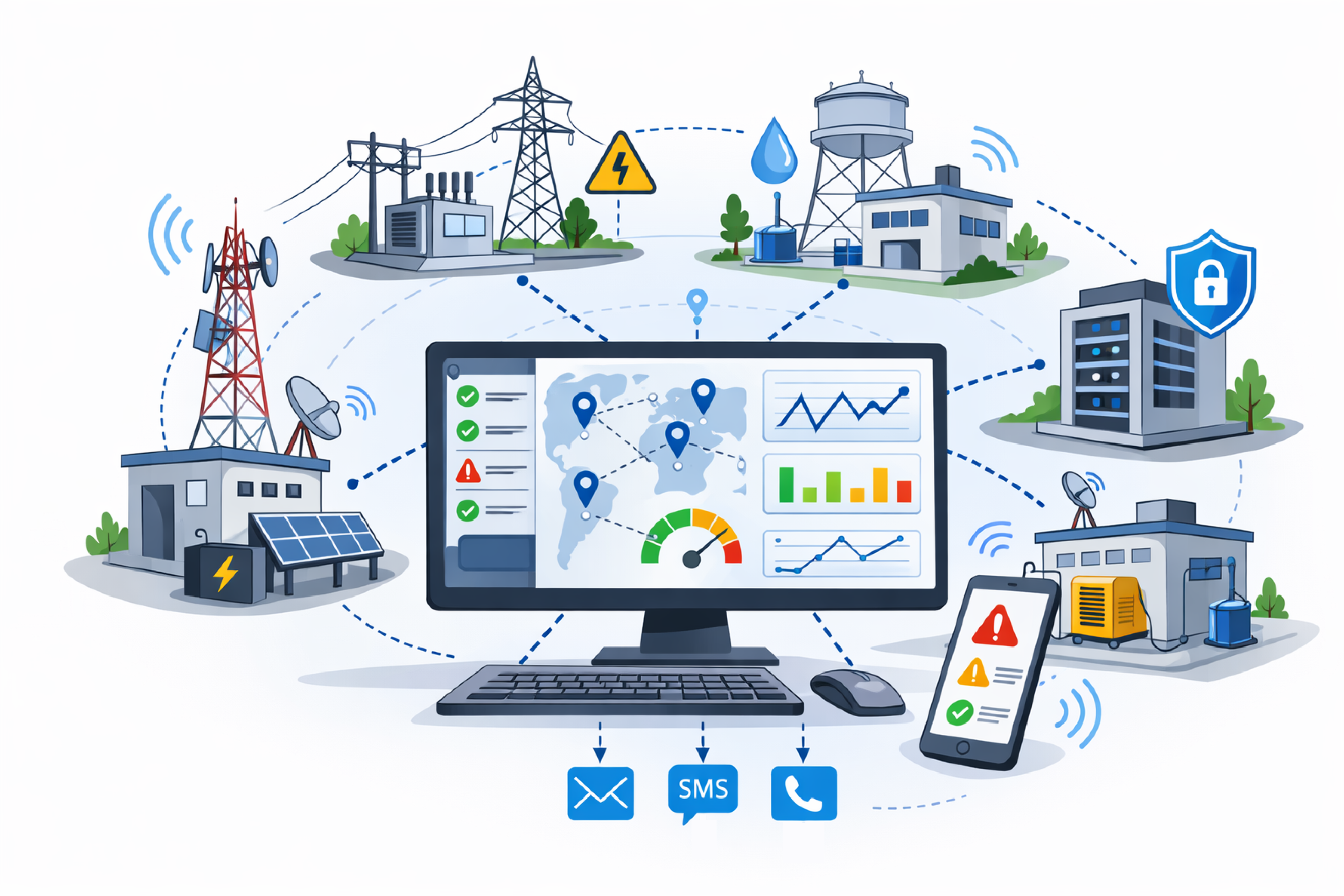
A SCADA platform's value comes from what it allows you to do: see equipment status remotely, receive alerts before conditions become emergencies, and make informed decisions without dispatching technicians to every site.
The first question is vertical alignment. A system designed for manufacturing automation handles different challenges than one built for telecommunications tower sites or utility substations. Requirements for a municipal water treatment facility differ from those of a regional fiber provider. Look for a platform with a proven track record in your specific sector, including specialized symbols, graphic sets, and pre-configured analytics that reduce deployment complexity.
Core capabilities to evaluate include:
The goal is replacing uncertainty with actionable intelligence. When a rectifier fails at 2 AM, a good SCADA system tells you exactly what's happening and how urgent the response needs to be.
Sticker price rarely reflects true cost. SCADA platforms use different licensing structures that dramatically affect your total cost of ownership (TCO) as your network grows.
| Licensing Model | Initial Cost | Growth Impact |
|---|---|---|
| Per-tag pricing | Lower upfront | Costs increase with every monitored point |
| Per-client licensing | Moderate | Adding users requires new licenses |
| Per-server licensing | Higher upfront | Unlimited tags and users |
| Hybrid models | Varies | May include base fee plus per-site costs |
Per-tag models appear affordable initially but create financial barriers to expansion. When you're charged for every data point, organizations tend to monitor less than they should. A 2025 study found that every minute of operational shutdown costs businesses a median of $33,333. Skimping on monitoring to save on licensing fees is a poor trade.
Server-based licensing, where you pay for the platform rather than individual tags or users, provides predictable costs regardless of how many sites or operators you add. This model makes economic sense for growing networks where you want the flexibility to monitor everything without budget approval for each new data point.
When evaluating pricing, also consider ongoing costs like annual support fees, software updates, and the engineering time required for customization. A platform that costs $100-$200 per hour for custom engineering adds up quickly if your requirements don't match off-the-shelf configurations.
Critical infrastructure networks accumulate equipment from different manufacturers over decades. Your monitoring and control switches might communicate via SNMP. Your generators probably speak Modbus. Older telecom gear may use TL1 or proprietary formats. A SCADA platform that only handles one protocol family forces you to maintain multiple monitoring interfaces or replace functional equipment prematurely.
Key protocols for critical infrastructure include:
Protocol mediation is the ability to translate between these different "languages" so everything appears in a single monitoring interface. Our T/Mon alarm management system currently supports over 30 protocols specifically because clients needed them. We continue adding protocols as requirements emerge.
When evaluating protocol support, ask whether the vendor will develop support for formats they don't currently handle. Some organizations are locked into monitoring gaps because their platform vendor won't accommodate a critical piece of equipment.
In critical infrastructure, alarm management isn't a convenience feature. It's a safety requirement. A system that floods operators with undifferentiated alerts during a crisis makes the situation worse.
Modern SCADA platforms should support alarm management standards like ISA 18.2, which provides a framework for preventing alarm floods during system-wide failures. Look for these capabilities:
Intelligent filtering: The ability to suppress redundant alarms and correlate related events. If a site loses power, you don't need 50 separate notifications for every piece of equipment that went offline.
Tiered escalation: Alerts should route to the appropriate person based on alarm priority, technician role, location, and time of day. If nobody acknowledges a critical alarm within a defined window, it escalates automatically.
Multiple notification channels: Encrypted email, SMS, voice calls, and integration with existing ticketing systems. Different situations call for different communication methods.
Historical archiving: A historian function that stores trending data with efficient compression. This supports regulatory compliance, forensic analysis after incidents, and long-term performance optimization.
One transit agency we work with configured their system so that unacknowledged alarms automatically notify field technicians and supervisors after a defined period. This ensures critical alerts never fall through the cracks during shift changes or busy periods.
SCADA systems were historically isolated from business networks and the broader internet. That's no longer the case. Modern deployments connect to IP networks for remote access, cloud integration, and enterprise reporting. This connectivity creates attack surfaces that sophisticated adversaries actively target.
The National Institute of Standards and Technology (NIST) Special Publication 800-82 Revision 3 provides a comprehensive framework for securing operational technology while addressing the unique performance and safety requirements of these environments. Key control families to evaluate include:
Network segmentation is particularly important. Isolating the SCADA network from general business IT prevents lateral movement by attackers who compromise other systems. Platforms that support VLANs and robust firewalling enable the compartmentalization that security frameworks require.
For energy sector organizations, NERC CIP standards are mandatory. These prescriptive requirements govern everything from cyber asset identification to configuration change management. NERC CIP-015-1, effective October 2025, requires continuous monitoring of internal network traffic within the electronic security perimeter. This mandate exposes the inadequacies of perimeter-only defense and requires deep visibility into internal communications.
| NERC CIP Standard | Key Requirement | SCADA Implication |
|---|---|---|
| CIP-002 | Cyber Asset Identification | Maintain automated inventory of all connected devices |
| CIP-005 | Electronic Security Perimeters | Support VPNs, firewalling, and 256-bit AES encryption |
| CIP-007 | Systems Security Management | Tools for managing ports, services, and malware prevention |
| CIP-010 | Configuration Change Management | Auditing that detects unauthorized changes to control logic |
| CIP-015-1 | Internal Network Monitoring | Traffic analysis within security perimeter |
When evaluating SCADA platforms, verify native support for the specific standards your organization must meet. Retrofitting compliance into a system that wasn't designed for it creates ongoing headaches.
Downtime in critical infrastructure isn't just lost productivity. It carries regulatory penalties, environmental remediation costs, reputational damage, and potential safety consequences.
Research from Atlassian indicates that while small businesses may experience outages costing $137 to $427 per minute, larger enterprises in utilities and manufacturing can see costs exceeding $9,000 per minute. A single eight-hour outage in a high-volume process environment can result in losses exceeding the entire capital cost of implementing a new SCADA system.
The shift from reactive to proactive maintenance drives ROI in SCADA investments. Reactive maintenance, where you fix equipment after failure, costs three to five times more than preventive strategies. SCADA data enables predictive maintenance by identifying failing components through anomalies in vibration, temperature, or current draw before they cause service-affecting outages.
One public-safety radio client shared this scenario: A rectifier failure cut off commercial power at a radio site. The backup battery plant and generator kept the site online, but without monitoring, nobody knew it happened. The generator ran continuously for five days until it exhausted its fuel. By the time the battery plant also depleted, the site went completely dark. Good monitoring would have provided days of warning.
The question isn't whether you can afford a robust SCADA system. It's whether you can afford the consequences of flying blind.
Remote Terminal Units (RTUs) and Programmable Logic Controllers (PLCs) serve different purposes, though they're sometimes conflated in SCADA discussions.
PLCs are optimized for high-speed logic required for machine control. They excel at manufacturing automation where millisecond response times matter. RTUs are designed for remote monitoring of environmental and status data across wide geographic areas. In critical infrastructure with distributed sites, RTUs are typically the appropriate choice.
Effective RTUs for critical infrastructure should provide:
Diverse I/O capabilities: Digital inputs for contact closures, high-resolution analog monitoring for voltages and temperatures, and control relays for remote equipment restarts.
Environmental hardening and NEBS compliance: Equipment rated for extreme temperatures, humidity, and power fluctuations. For telecommunications applications, NEBS (Network Equipment Building System) compliance ensures the hardware can withstand the demanding conditions found in central offices and remote sites. Our NetGuardian units are designed to operate without HVAC in conditions exceeding 110°F because many remote sites lack climate control.
American manufacturing: Equipment designed, built, and tested domestically provides supply chain security, quality control, and responsive support. When you need custom modifications or rapid replacement parts, domestic manufacturing eliminates international shipping delays.
Transport flexibility: Ethernet, serial, T1, fiber, GSM/CDMA, or dial-up connectivity. Different sites in the same network may require different communication methods based on available infrastructure.
Environmental monitoring: Temperature, humidity, water intrusion, smoke detection, and door access. Threats to critical equipment often come from the environment, not the equipment itself.
During Hurricane Rita, telecommunications providers used RTU data showing battery voltage levels in real-time to prioritize mobile generator deployment. Sites with the lowest battery reserves got resources first. This level of visibility is impossible with basic alarm systems that only provide binary "okay/not okay" status.
Reliability at the edge is paramount. Equipment that fails frequently or requires constant maintenance defeats the purpose of remote monitoring. Look for documented field performance over extended periods, not just laboratory specifications.
A SCADA system represents a 15-20 year commitment. The vendor you choose today needs to support the platform for its entire operational lifecycle.
Consider these factors:
Technical support quality: Do you reach engineers with relevant expertise, or scripted call-center representatives? When a critical system has problems, direct access to people who understand the technology matters.
System integrator ecosystem: A platform with a small integrator base may leave you vulnerable if your primary implementation partner becomes unavailable. Established platforms have broader support networks.
Training availability: Modern interfaces reduce the learning curve, but comprehensive training programs accelerate deployment and minimize operator errors.
Custom engineering capabilities: Can the vendor modify hardware or software to meet requirements that off-the-shelf products don't address? Some organizations need specialized configurations that generic platforms don't provide.
Longevity track record: Has the vendor supported products for decades, or do they abandon product lines when newer versions arrive? Organizations managing critical infrastructure need partners committed to long-term relationships, not vendors looking for quick transactions.
We frequently hear from organizations whose monitoring equipment manufacturer discontinued their product line, leaving them without support or replacement options. This creates urgency to find new solutions while managing the risk of unmaintained equipment.
The best SCADA system isn't necessarily the one with the most features. It's the one that aligns with your vertical requirements, security obligations, and long-term budget constraints.
Start by documenting your specific requirements:
Once you've documented requirements, evaluate platforms against them. Request demonstrations with your actual use cases, not generic presentations. Ask for references from organizations in your industry sector.
For geographically distributed infrastructure like telecommunications towers, fiber huts, and utility substations, the specialized focus of remote site monitoring often provides a better fit than industrial SCADA platforms designed primarily for manufacturing or process control. Purpose-built systems address environmental monitoring, power system integrity, and the transport diversity that distributed networks require.
If you're evaluating options for your critical infrastructure monitoring needs, we're happy to discuss your specific requirements and determine whether our approach makes sense for your situation. Contact our applications engineering team to start the conversation.

Andrew Erickson
Andrew Erickson is an Application Engineer at DPS Telecom, a manufacturer of semi-custom remote alarm monitoring systems based in Fresno, California. Andrew brings more than 19 years of experience building site monitoring solutions, developing intuitive user interfaces and documentation, and opt...