Check out our White Paper Series!
A complete library of helpful advice and survival guides for every aspect of system monitoring and control.
1-800-693-0351
Have a specific question? Ask our team of expert engineers and get a specific answer!
Sign up for the next DPS Factory Training!
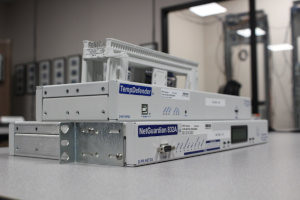
Whether you're new to our equipment or you've used it for years, DPS factory training is the best way to get more from your monitoring.
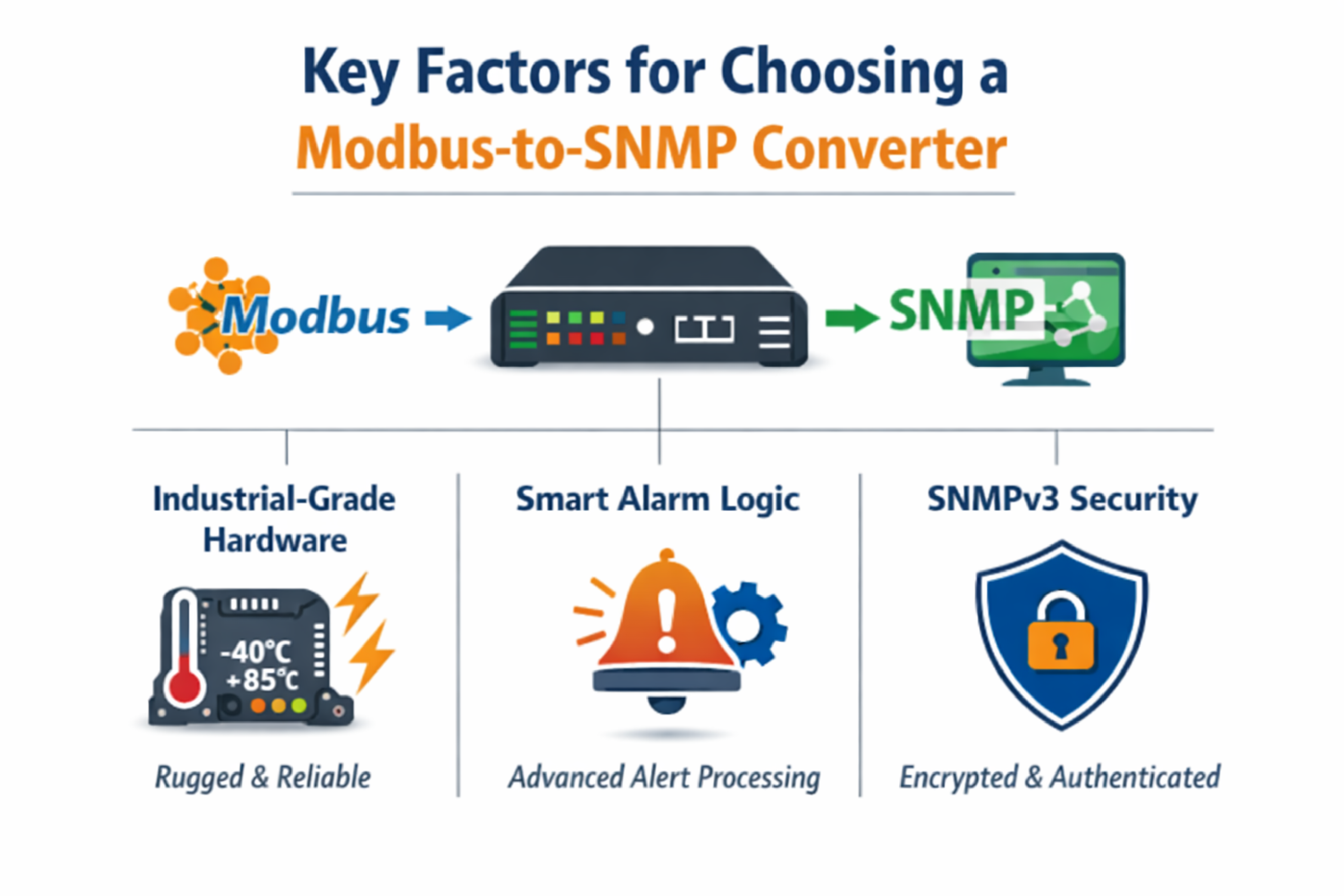
Reserve Your Seat TodayOver the past decades of building protocol mediation solutions for more than 1,500 companies, we've learned something important here at DPS Telecom: the difference between a converter that works in a lab and one that survives in the field often comes down to three factors:
A Modbus-to-SNMP converter needs to perform active protocol mediation, survive harsh industrial conditions, and provide secure network integration. The right device acts as an intelligent translator between your Modbus devices and SNMP management systems. When we talk with engineers evaluating converters, they often focus first on the protocol translation mechanism. That's important, but we've seen too many projects where a converter that performed beautifully in climate-controlled testing failed spectacularly the first winter in an outdoor telecom cabinet.
Temperature extremes, voltage fluctuations, and electrical noise destroy standard commercial equipment. Industrial sites require purpose-built hardware, and understanding why makes all the difference in your selection.
When we first started developing protocol mediation solutions, we thought the challenge was straightforward: read Modbus data, convert it to SNMP format, send it along. Our early deployments taught us otherwise.
Modbus and SNMP operate on fundamentally different communication philosophies. Modbus grew out of industrial automation in 1979, designed for localized data exchange over serial lines using a deterministic master-slave polling cycle. SNMP emerged from IT network management in the 1980s, built for distributed management of network devices using an asynchronous trap-and-query model. The gap between these approaches is wider than it first appears.
Your converter doesn't just translate data. It bridges incompatible communication architectures. Here's what that actually means in practice.
Consider how this works in practice. In telecommunications deployments monitoring backup generators across remote sites, Modbus-equipped generators hold status data in internal registers. In the Modbus world, these registers are passive. They don't report changes unless asked.
A quality converter provides four essential capabilities:
Modbus Master functionality: The device must initiate polling requests to slave devices. Passive converters that simply listen won't work.
Register mapping to OIDs: The converter translates 16-bit Modbus registers to hierarchical SNMP Object Identifiers. This mapping must be intuitive and configurable.
Intelligent alarm logic: The system monitors thresholds with hysteresis to prevent trap storms. Without this, a value oscillating around a threshold floods your network with alerts.
MIB file generation: The converter creates Management Information Base files automatically for your SNMP manager. Manual MIB creation becomes impractical above a dozen registers.
We recommend verifying converters support both Modbus RTU (serial) and Modbus TCP (Ethernet). Your current infrastructure may use serial communication, but equipment increasingly ships with TCP support. Having both options prevents obsolescence.
Register capacity requirements vary dramatically by application. Basic converters typically handle 32-64 registers, which may be sufficient for simple installations. Industrial applications monitoring generator farms with multiple PLCs, environmental sensors, and power distribution equipment can require tracking thousands of data points. We've engineered solutions for clients monitoring over 1,000 Modbus registers simultaneously through a single device.
Scalability matters as your monitoring requirements grow. We've seen organizations start with modest monitoring needs, then expand rapidly as they discover the value of comprehensive visibility. Starting with adequate capacity costs less than replacing converters later.
The difference between commercial-grade and industrial-grade hardware becomes clear when converters move from controlled facilities into actual deployment environments. Over decades of engineering protocol mediation equipment, we've learned that the gap between laboratory performance and field reliability often determines long-term success.
Industrial sites subject hardware to conditions that commercial equipment cannot handle. Understanding these environmental challenges is essential when evaluating converters for real-world deployments.
We've deployed monitoring equipment from Alaska to Arizona. These installations face dramatically different temperature challenges. Northern outdoor cabinets experience extreme cold during winter months. Desert installations in the Southwest see cabinet interior temperatures climb substantially during summer heat.
Commercial-grade equipment rated for typical office environments may fail under these conditions. The failure mode is often silent. Equipment may appear powered and operational while data processing has become unreliable or stopped entirely.
Industrial converters require temperature ratings that accommodate the full range of conditions the equipment will actually experience. This isn't about meeting a specification on paper. It's about maintaining accurate data translation when ambient conditions would destroy standard electronics.
When evaluating temperature specifications, verify that ratings match your deployment environment. Outdoor telecom cabinets, rooftop installations, and factory floor locations all demand industrial temperature tolerance.
Many industrial and telecom sites operate on DC power systems rather than standard AC. Telecommunications infrastructure commonly uses negative voltage DC systems for equipment power and battery backup. This is standard practice across the industry.
During power outages, monitoring your backup systems matters most. Converters that accept only AC power lose visibility precisely when you need it. This is why power input flexibility is a practical requirement rather than a convenience feature.
Industrial converters should accommodate the power systems actually present at deployment sites. This includes support for DC power inputs with tolerance for voltage fluctuations common in battery backup systems, ability to accept power from redundant sources to maintain operation if one fails, and compatibility with the voltage standards used in your specific infrastructure.
Power input flexibility determines whether monitoring remains operational during the emergencies when visibility is most critical.
Industrial equipment creates significant electrical interference. Motor-driven systems generate voltage transients. Variable frequency drives (VFDs) introduce electrical noise onto data lines. Heavy machinery can create ground loops that damage unprotected electronics.
We've seen installations where converters experienced repeated failures due to electrical conditions on Modbus communication lines. Industrial environments with heavy motor loads subject equipment to voltage conditions that would never occur in climate-controlled data centers.
Galvanic isolation provides protection by creating electrical barriers between different system sections. This prevents unwanted currents from traveling through your converter and potentially damaging connected network equipment. Professional converters implement isolation between serial communication ports, network connections, and power inputs.
Without adequate electrical isolation, your converter can become a vulnerability point. Electrical events on one part of your system can propagate to damage equipment throughout your installation. Proper isolation is essential anywhere motor-driven equipment, variable frequency drives, or other sources of electrical interference are present.
When selecting a Modbus-to-SNMP converter, match the specifications to your actual deployment conditions. Consider the temperature range your sites experience throughout the year, the power systems available at your installations, and the electrical environment created by your equipment.
Converters designed for benign office environments may work perfectly in climate-controlled facilities. They are inappropriate for outdoor cabinets, factory installations, or anywhere conditions exceed their design parameters. The cost difference between commercial and industrial equipment is modest compared to the expense of repeated failures and emergency replacements.
Industrial networks increasingly connect to IT infrastructure. They face the same cybersecurity threats as corporate systems. Protocol converters sit at this critical intersection point, and we've watched the security landscape evolve dramatically.
Ten years ago, SNMPv1 and v2c seemed adequate. Both versions transmit data and credentials in plain text. Anyone with network access can intercept packets and read sensitive information like fuel levels, battery voltages, or alarm status.
We first understood this risk working with a utility client. Their security team ran a simple packet capture on the monitoring network. Within minutes, they had complete visibility into generator status, battery voltages, and fuel levels across the entire infrastructure. No password required. No encryption to break.
Worse, attackers can send falsified data to your Network Operations Center. They could change alarm status from "Critical" to "Normal" or inject false information. Your monitoring system is now a huge security liability.
We now recommend converters support SNMPv3 exclusively for new deployments. This version provides three critical protections that we've seen make real difference in security postures:
Authentication: Verifies messages come from legitimate sources. This prevents spoofing attacks where unauthorized systems send fake data.
Encryption: Uses AES or DES algorithms to encrypt data packets. Even if intercepted, the data remains unreadable to attackers without decryption keys.
Message Integrity: Confirms data hasn't been altered during transmission. This protects against man-in-the-middle attacks where intruders modify alarm status or equipment readings.
For utilities, public safety networks, and government applications, SNMPv3 support often determines regulatory compliance. The protocol converter acts as a security gateway, protecting the boundary between industrial networks and your IT infrastructure. This isn't theoretical. We've helped clients pass security audits specifically because they deployed SNMPv3-capable equipment.
A converter with a low purchase price may carry hidden costs. These inflate total ownership expenses over the device's operational lifetime. Understanding true cost of ownership rather than focusing solely on upfront price can reveal significant differences between equipment options.
For the world's 500 largest companies, unplanned downtime consumes approximately 11% of annual revenue. The financial impact varies dramatically by industry:
| Industry Sector | Average Cost per Hour of Downtime |
|---|---|
| Automotive | $2,300,000 |
| Pharmaceutical | $500,000+ |
| Energy/Utilities | $250,000+ |
| Data Centers | $100,000-$500,000 |
| FMCG | $39,000 |
Source: Industrial Downtime Research
The best converter minimizes downtime risk. A device with high MTBF (Mean Time Between Failures) represents significant hedge against these catastrophic costs. Our NetGuardian platform achieves an MTBF of 60 years through robust engineering and high-grade components, a specification we arrived at through decades of field experience rather than laboratory projection.
Working with clients through complete project lifecycles revealed costs that aren't obvious during initial evaluation:
Implementation Complexity: Converters requiring manual coding or complex scripts increase labor costs substantially. Integration projects can see setup time exceed hardware cost by significant ratios. Lack of intuitive interfaces transforms simple deployments into engineering projects.
Maintenance Burden: Equipment requiring frequent reboots or lacking remote firmware updates increases operational expenses. Organizations have reported spending thousands annually in truck rolls to manually service converters, costs that can quickly exceed the original equipment investment.
The Silence Tax: When monitoring equipment fails without notification, your organization operates exposed. You're paying for monitoring but receiving no protection. This "silence tax" represents a significant hidden cost. Silent converter failures during critical events can result in outages with costs orders of magnitude greater than the converter investment.
Professional-grade converters should be "install and forget" devices. They run reliably for years without manual intervention, justifying higher upfront costs through eliminated operational expenses.
The manufacturer behind your converter determines long-term success as much as the hardware specifications. We've been manufacturing protocol mediation equipment since 1986, and we've learned what separates sustainable vendor relationships from problematic ones.
We manufacture all equipment in our Fresno, California facilities. This vertical integration means engineers who designed your specific device provide technical support. You don't get routed to overseas call centers reading from scripts.
When clients call with unusual issues, our support team can walk down the hall to engineering and get answers from the people who wrote the firmware. We've solved field problems in hours that would take weeks through conventional support channels. Look for vendors who provide direct technical support from engineers who designed the equipment, in-house manufacturing with supply chain control, support for products decades after purchase, and upgrade paths as security standards evolve.
One-size-fits-all solutions rarely fit perfectly in industrial environments. Your infrastructure has unique requirements developed over years or decades. We learned this while developing our Modbus-to-SNMP converter. Initial designs worked well for standard applications, but clients needed variations we hadn't anticipated.
Can the vendor modify configurations without non-recurring engineering fees? Support protocols beyond standard offerings? Scale capacity as monitoring needs grow? Integrate with both new and existing infrastructure?
Our converter is built on the proven NetGuardian RTU platform. This foundation provides flexibility to customize for specific applications while maintaining industrial reliability. Platform-based design lets us adapt quickly to unique requirements without starting from scratch.
Some vendors specialize in protocol converters. Others provide end-to-end monitoring ecosystems. Consider your complete needs: just the converter for integration with existing SNMP managers? A complete monitoring solution including master station software? Future expansion capabilities to monitor additional site parameters?
We provide both individual protocol mediation devices and complete telecom monitoring systems. This flexibility supports your current requirements while enabling future growth. We've worked with organizations that started with simple converter deployments, then expanded into comprehensive monitoring as they saw value.
Even the best hardware fails without proper implementation. We've learned installation best practices by investigating failures, optimizing successful deployments, and listening to field technicians who install equipment daily.
RS-485 Termination: Long cable runs on Modbus networks require 120-ohm termination resistors at the end of the line. Without proper termination, signal reflections cause data corruption. Intermittent communication failures on Modbus networks often resolve completely once proper termination is implemented.
Baud-Rate Matching: All devices on a Modbus segment must use identical baud rates. Quality converters offer auto-baud detection or wide manual setting ranges to match existing equipment. Mismatched baud rates create mysterious communication failures that can take hours to diagnose.
Daisy-Chain Topology: RS-485 is designed for daisy-chain configurations, not star topologies. Star configurations (bringing all cables to a central point, similar to Ethernet hub wiring) create signal integrity problems for RS-485 networks. Position your converter correctly in the chain to maintain signal integrity across all nodes.
Threshold Settings: Define what constitutes an alarm condition carefully. A Modbus register showing "50.1V" is just data until you specify that voltages above 50V require notification. We work with clients to establish meaningful thresholds based on equipment specifications and operational experience.
Hysteresis Implementation: If voltage oscillates between 49.9V and 50.1V around a 50V threshold, a basic converter floods your network with SNMP traps. Implement hysteresis (deadband) so alarms only trigger when conditions sustain beyond thresholds for defined periods. This prevents alarm fatigue while ensuring real problems generate alerts.
MIB File Integration: Your converter should generate clean, accurate MIB files automatically. These define every Object Identifier. This allows your SNMP manager to display human-readable status messages rather than cryptic numerical codes. Manual MIB creation becomes impractical above modest scale.
Before deploying to production, verify the converter polls all Modbus devices successfully, confirm SNMP traps generate under test alarm conditions, validate your SNMP manager properly interprets the MIB file, test failover behavior if using dual power inputs, and document baseline performance for future troubleshooting.
We've found systematic testing catches 90% of potential issues before they impact production monitoring. The time invested in testing returns many times over through eliminated emergency troubleshooting.
The difference between basic and professional converters becomes apparent under stress. We've observed this across thousands of installations in diverse environments.
Professional units provide sophisticated features developed through field experience rather than theoretical requirements:
Change-of-state detection ensures the converter only sends traps when values actually change. Simple converters report repeatedly, creating noise.
Trap storm prevention through rate limiting prevents network flooding. We've seen basic converters overwhelm SNMP managers with thousands of identical traps during equipment failures.
Time-based filtering ignores transient spikes that don't indicate real problems. Motors starting, brief voltage dips, and momentary sensor glitches shouldn't generate alarms.
Escalation logic sends different alerts based on alarm severity. Critical conditions trigger immediate notification while minor issues get logged for review.
The most effective monitoring considers both equipment status and environmental conditions simultaneously. Some converters include additional sensor inputs for temperature, humidity, water detection, and airflow.
We developed this capability after clients repeatedly asked to monitor both Modbus equipment data and cabinet environmental conditions. If your converter reports a generator running hot while environmental sensors simultaneously show the enclosure temperature spiking due to HVAC failure, you gain complete operational context. This integrated approach transforms data into actionable intelligence.
We've been engineering remote monitoring solutions since 1986. We've learned from thousands of installations across telecommunications, utilities, transportation, and manufacturing sectors.
This experience shapes product design in ways that aren't obvious from specifications. Features like wide voltage tolerance didn't come from lab requirements. They emerged from investigating field failures. Extended temperature ranges resulted from converters freezing in winter deployments. Robust isolation came from analyzing equipment destroyed by electrical spikes.
Every specification in professional equipment tells a story of problems solved and lessons learned. That accumulated knowledge makes the difference between equipment that works and equipment that endures.
Choosing the best Modbus-to-SNMP converter requires balancing technical specifications against long-term reliability. After working with more than 1,500 companies on protocol mediation projects, we've identified the priorities that predict success.
Prioritize converters that provide full SNMPv3 support for security and compliance, industrial temperature ranges (-40°C to +85°C minimum), high galvanic isolation (500V or greater), intelligent alarm logic with hysteresis, scalability for growing monitoring requirements, and direct vendor support from experienced engineers.
The protocol converter isn't a peripheral accessory. It's a critical link in your infrastructure monitoring chain. When a single hour of downtime can cost $250,000 or more, the converter selection becomes a foundational decision affecting reliability, security, and operational costs for years.
We've seen organizations make excellent technical choices that failed because they selected the wrong vendor partner. We've seen others choose adequate equipment that succeeded because strong vendor support compensated for technical limitations. Both equipment and partnership matter.
If you're evaluating options for your industrial application, our engineering team can discuss your requirements. We can explain how our solutions might fit your specific needs based on experience with similar deployments. Contact us to start that conversation.

Andrew Erickson
Andrew Erickson is an Application Engineer at DPS Telecom, a manufacturer of semi-custom remote alarm monitoring systems based in Fresno, California. Andrew brings more than 19 years of experience building site monitoring solutions, developing intuitive user interfaces and documentation, and opt...