Check out our White Paper Series!
A complete library of helpful advice and survival guides for every aspect of system monitoring and control.
1-800-693-0351
Have a specific question? Ask our team of expert engineers and get a specific answer!
Sign up for the next DPS Factory Training!
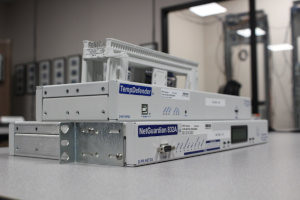
Whether you're new to our equipment or you've used it for years, DPS factory training is the best way to get more from your monitoring.
Reserve Your Seat TodayYour substations are the backbone of reliable power delivery, and most of them sit miles from your nearest crew. DPS Telecom builds substation monitoring systems that track power equipment, environmental conditions, and physical security at unmanned sites, then report alarms to your operations center in real time. With 172,800+ devices deployed across 1,500+ organizations, we design monitoring systems that electric cooperatives and investor-owned utilities can rely on for the long term.
Talk to an Engineer | 800-693-0351

Founded 1986 | 172,800+ devices deployed | International Organization for Standardization (ISO) 9001 certified | Made in Fresno, CA | 1,500+ organizations served
Electric cooperatives and utilities operate substations across wide service territories. Many of these sites are unmanned, which means equipment failures, environmental threats, and security breaches can go unnoticed for hours or days unless monitoring is in place. A transformer overheating after a cooling fan fails, battery banks degrading below safe voltage, or water intruding after a storm can each cause outages that affect thousands of ratepayers and lead to costly emergency repairs.
Our remote monitoring systems for electric cooperatives cover this same set of failure modes across substations and equipment shelters.
DPS Telecom's approach to substation monitoring starts with a Remote Telemetry Unit (RTU) installed at each site. The RTU collects discrete alarms from switchgear, transformer monitors, and relays. It reads analog inputs from battery voltage sensors, temperature probes, and current transducers. It can also pull data from Modbus and DNP3 devices already installed in the substation, such as generators or intelligent electronic devices (IEDs).
Each RTU reports to a centralized alarm management platform at your operations center. If you run our T/Mon LNX master station, alarms from every substation appear on a single map-based interface with automated notification escalation. If you already use a third-party SNMP manager, our RTUs can report to it directly through SNMP v1, v2, or v3.
When an alarm triggers, whether a door open, high temperature, low battery voltage, or a Modbus fault from a generator, your operators can be notified by email, text, or pager. That can mean faster dispatch decisions, fewer unnecessary truck rolls, and less time between failure and response.

Talk to an Engineer | 800-693-0351
Every substation has a different equipment profile, but the monitoring fundamentals are consistent. Here are the capabilities that matter most in electric cooperative and utility environments. Alternating current (AC) and direct current (DC) readings, input/output (I/O) counts, and Short Message Service (SMS) alerts all come up repeatedly in these deployments.
| Capability | Description |
|---|---|
| Power and Battery Tracking | Monitor AC voltage, DC battery voltage, rectifier output, and generator status through analog inputs and Modbus polling. Configurable thresholds can alert your team before backup power drops below safe levels. Our remote power monitoring systems and our battery monitoring best practices guide cover implementation details. |
| Environmental Sensing | D-Wire temperature, humidity, water detection, and smoke sensors connect to the RTU over a daisy-chained sensor bus. Alarm thresholds are configurable per sensor, so you can set tighter ranges for climate-controlled enclosures and wider ranges for outdoor pad-mount installations. |
| Door and Access Monitoring | Discrete alarm inputs from door contacts and motion sensors can track entry to fenced compounds and enclosed equipment shelters. Paired with our Building Access System, you can log who entered each site and when. |
| Protocol Mediation | RTUs can accept data from DNP3, Modbus, SNMP, and other protocol sources simultaneously, then translate it into a single unified alarm stream. Your existing IEDs, relays, and meters can report to one platform without replacement. |
| Automated Notification Escalation | T/Mon LNX sends alerts by email, SMS, or pager based on alarm severity, time of day, and on-call schedules. If the primary contact doesn't acknowledge, the alarm can escalate to the next person on the list. |
| Remote Control Relays | Control relays on NetGuardian RTUs allow operators to remotely cycle equipment power, reset devices, or activate backup systems without dispatching a truck. |
The specific DPS Telecom equipment for your deployment depends on site count, I/O density, and your existing infrastructure. Our guide to choosing the best RTU for utility substation monitoring walks through the sizing and hardening decisions in detail. Here are the products most commonly deployed in utility substation environments.

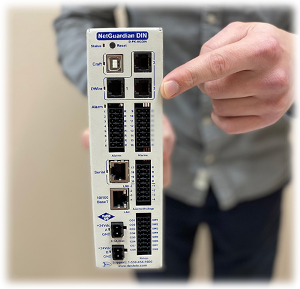
A common RTU choice for substation deployments. It monitors discrete alarms, analog inputs, and serial data at the site, then reports to T/Mon LNX or to an SNMP manager.
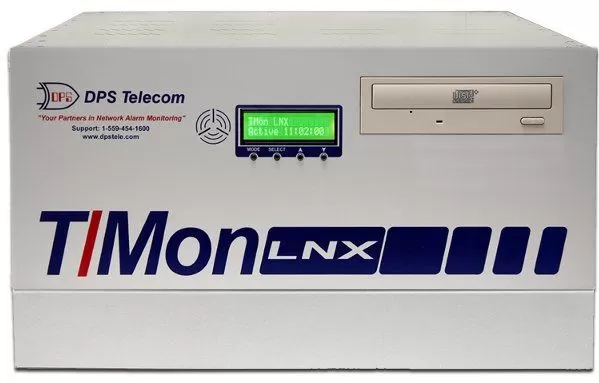
The centralized alarm master station for multi-site utility monitoring. It consolidates alarms from every substation into a single map-based interface with automated escalation.
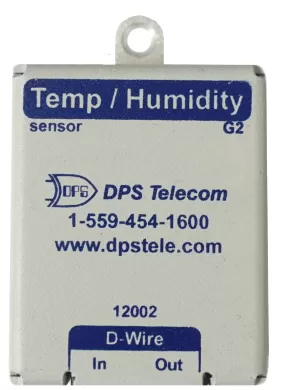
Plug-and-play sensors for substation conditions. Up to 16 D-Wire sensors can be daisy-chained from a single RTU port, across a chain of up to 600 feet.
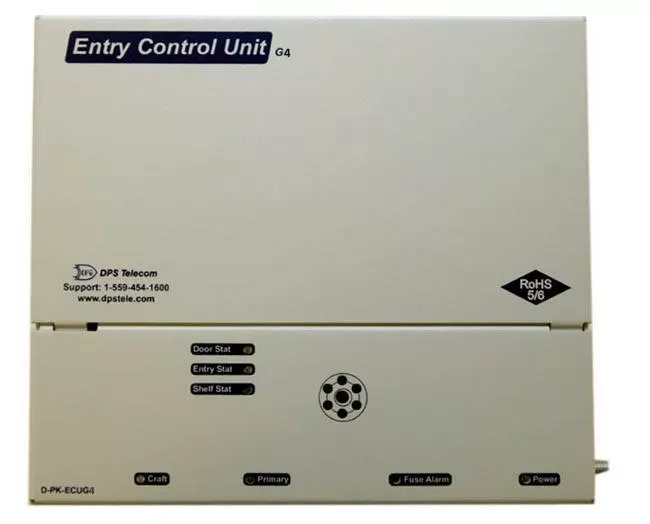
Physical security and access logging for substation compounds. The Entry Control Unit (ECU) G4 works with a NetGuardian RTU and integrates with T/Mon LNX for centralized access management alongside alarm monitoring.
Most utilities and electric cooperatives have substations with equipment from multiple manufacturers and eras. You may have DNP3-based relays alongside Modbus generators and SNMP-managed network switches. DPS Telecom equipment is designed to work alongside the gear you already have.
NetGuardian RTUs accept discrete alarm contacts, analog voltage or current signals, and protocol data from DNP3, Modbus, SNMP, Transaction Language 1 (TL1), American Standard Code for Information Interchange (ASCII), and other sources simultaneously. T/Mon LNX mediates between these protocols at the master station level, giving your operators one consolidated alarm view regardless of which device generated the alarm.
If your utility already uses a third-party SNMP manager, our RTUs can report directly to it. You can also run T/Mon LNX alongside an existing Supervisory Control and Data Acquisition (SCADA) system, with T/Mon handling the alarm monitoring layer while your SCADA platform handles process control.
Supported protocols and transports:
Custom engineering at no extra cost
Approximately 80% of your monitoring needs can typically be met with our standard modules. For the remaining 20%, our engineers can build custom configurations to match your specific substation requirements. DPS Telecom does not charge Non-Recurring Engineering (NRE) fees for custom modifications when minimum order quantities are met. We have completed 9,800+ custom builds.
Free lifetime technical support
When you call DPS Telecom for support, you reach engineers, many with decades of experience with our products. Support is included with every purchase, for life.
30-day loaner program and 2-year warranty
You can evaluate our equipment in your actual substation environment before committing. We ship a loaner unit directly to you for 30 days, and you pay only shipping. Every unit ships with a 2-year hardware warranty, and maintenance agreements can extend that coverage. We also offer a money-back guarantee.
Made in Fresno, California, and ISO 9001 certified
DPS Telecom designs and manufactures all equipment at our Fresno, California headquarters. ISO 9001 certification supports consistent build quality across every unit, and our focus on high-grade components has resulted in DPS equipment operating reliably for 20+ years in the field.
Talk to an Engineer | 800-693-0351
DPS Telecom has deployed monitoring systems at electric utilities, public utility districts (PUDs), and electric cooperatives across North America. These case studies cover real deployments in utility environments.
Central Lincoln PUD, electric utility. Central Lincoln PUD deployed NetGuardian 832A RTUs for network alarm monitoring across their coastal substations, moving alarm reporting from serial transport onto Internet Protocol (IP) as their network modernized.
Wheatland Electric Cooperative, electric cooperative. Wheatland Electric implemented DPS Telecom's Building Access System to manage security and access control at their network sites, consolidating multiple gate locks into the NetGuardian's building access manager.
Orlando Utilities Commission, electric and water utility. Orlando Utilities Commission uses T/Mon for centralized remote network monitoring across their combined electric and water operations, with RTUs at substations tracking doors, fans, and cooling systems.
DPS Telecom equipment supports DNP3, Modbus, and SNMP natively, so it can operate alongside your existing SCADA platform. T/Mon LNX handles the alarm monitoring layer while your SCADA system handles process control. Our RTUs can also report directly to a third-party SNMP manager.
NetGuardian RTUs connect to D-Wire sensors for temperature, humidity, water detection, smoke, vibration, and airflow. Up to 16 sensors can be daisy-chained from a single RTU port across a chain of up to 600 feet. Alarm thresholds are configurable per sensor, so you can set ranges appropriate for your specific substation environment.
DPS Telecom's G6 platform supports encrypted SNMP v3 communications and role-based access controls, which can help utilities meet NERC CIP security requirements. Physical access logging through our Building Access System can also provide audit trails for compliance documentation. Responsibility for designing, documenting, and enforcing a compliant infrastructure remains with the utility.
T/Mon LNX consolidates alarms from every substation into a single interface. Automated notification escalation means your on-call technician can be alerted immediately, even at 2 a.m. Control relays on NetGuardian RTUs allow remote equipment resets, which can reduce the number of truck rolls required.
NetGuardian RTUs support Ethernet, fiber, T1, serial, dialup, and cellular connectivity via an external GSM or CDMA gateway. For substations in areas without wired network access, cellular transport can provide a path for alarm data without running new cable.
If your cooperative or utility needs better visibility into what's happening at unmanned substations, our application engineers can help scope a system that fits your sites, protocols, and budget. Every consultation starts with your specific requirements. We offer a 30-day equipment loaner, a 2-year hardware warranty, a money-back guarantee, and free lifetime technical support.