Download our free Monitoring Fundamentals Tutorial.
An introduction to Monitoring Fundamentals strictly from the perspective of telecom network alarm management.
1-800-693-0351
Have a specific question? Ask our team of expert engineers and get a specific answer!
Sign up for the next DPS Factory Training!
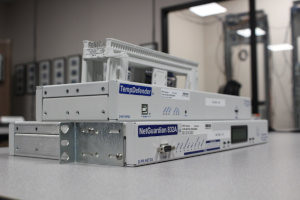
Whether you're new to our equipment or you've used it for years, DPS factory training is the best way to get more from your monitoring.
Reserve Your Seat TodayElectric cooperatives run distributed infrastructure across wide geographic areas, often in rural terrain, with most sites unmanned. When something fails at a substation or equipment shelter 30 miles out, you need to know about it before a member calls you. You also need enough detail to send the right person with the right parts.
DPS Telecom has built remote monitoring systems for utilities and co-ops since 1986. We've deployed equipment at organizations from regional co-ops to large investor-owned utilities including Southern Company and Dominion Energy, with some installations exceeding 1,000 monitored sites.
Talk to an Engineer 800-693-0351
Your substation and remote equipment shelters share a predictable set of failure modes. A good monitoring system keeps eyes on all of them.
Power and backup systems:
Environmental conditions:
Physical security:
Communication infrastructure:
The further you build out your monitoring, the clearer your situational awareness gets. As one client at a cooperative telephone company put it: "There are a few basic things we want to monitor, whether the cabinets have commercial power, if the battery voltage in those cabinets is getting low, or if it just completely shuts off. Those are really the three critical things we want to monitor more intelligently."
Consider this scenario: a rectifier fails at a remote site. The generator starts automatically and runs continuously. With a fully charged battery plant backing it up, there is no immediate service impact, so no alarms surface through informal channels. Five days later, the generator runs dry. Now you have a site outage and no obvious cause until someone drives out.
This failure pattern is something we hear about regularly from co-ops and public safety operators. Without monitoring on the rectifier, the generator run time, and the fuel level, the cascade is invisible until it has already happened.
Poor power monitoring is also hard on equipment. Rectifiers that fail into overvoltage conditions can destroy battery strings. Cells puff out internally and can become physically stuck in their mounting trays. Replacing the batteries is expensive; the labor to extract them often costs more.
Good monitoring catches these conditions early, when the fix is simple.
Talk to an Engineer 800-693-0351
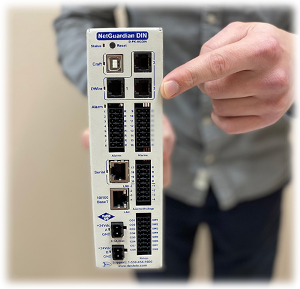
A Remote Telemetry Unit (RTU) is the device installed at each remote location. It collects discrete alarms (door open, commercial power fail, generator running), analog readings (battery voltage, temperature, fuel level), and protocol-based data from intelligent equipment.
Our NetGuardian RTU family covers the range from small, cost-effective units suited to simpler sites to full-capacity units for substations with many I/O points. Key capabilities:
RTU prices range from around $700 for smaller units to $4,000-$5,000 for top-tier configurations. For co-ops with fewer than 10 sites, RTUs alone can handle your monitoring needs. Each one can send email or SMS alerts and be accessed directly via browser.
Once you're managing more than 10 or 15 sites, logging into each RTU individually doesn't scale. You need a central alarm aggregator: a master station that pulls data from all your remote units and presents it in a unified view.
Our T/Mon master station consolidates alarms from all your sites into a single interface, with map-based alarm display, role-based access, automatic escalation, and support for 30+ protocols. That matters for co-ops that have accumulated equipment from different vendors and eras, where DNP3, Modbus, SNMP, TL1, and legacy formats all need to feed into one system.
T/Mon also integrates with existing SCADA platforms. If you have a central management system already in place, our equipment can serve as the remote data collection layer rather than replacing what you have.
View T/Mon Alarm Master Systems
For rural co-ops, windshield time is a real budget item. Driving 30-60 minutes each way to investigate an unknown alarm, only to find it could have waited until morning or required a part you didn't bring, is expensive in both time and overtime costs.
Detailed alarm data changes the dispatch decision entirely:
One DPS client reduced after-hours call-outs by over 75% over several years of gradually expanding their monitoring system. That client also reported spending about two hours a year managing the master station software. When your staff is stretched thin, that kind of low overhead matters.
Talk to an Engineer 800-693-0351
Electric cooperative infrastructure often spans decades of equipment generations. Replacing devices just to standardize protocols is rarely practical.
DPS equipment supports all major utility-relevant protocols natively:
| Protocol | Common Use |
|---|---|
| DNP3 | SCADA environments, utility automation |
| Modbus | Generators, rectifiers, industrial equipment |
| SNMP (v1, v2, v3) | Network devices, modern equipment |
| TL1 | Legacy telecom gear |
| ASCII | Custom equipment text output |
If you're running something not on this list, tell us what you're working with. T/Mon has grown to 30+ protocol support specifically because clients came to us with integration problems we hadn't seen before.
Custom configuration at no extra charge. Every unit is configured to match your site requirements before it ships. We don't send generic equipment.
Direct access to engineers. When you call for support, you reach the engineers who designed your equipment, not a call center working from scripts.
Equipment that lasts. We regularly hear from clients still running RTUs they purchased 15-20 years ago. As one senior communications engineer put it: "We've always been very pleased with DPS Telecom's RTUs. They've lasted for 20 years."
A trial before you commit. We offer a 30-day loaner program (you cover shipping) so you can test equipment at your sites before purchasing.
The tech lead at one electric utility client described their decision this way: "The thing I liked was that DPS was going to make it fit our needs. They were going to make their stuff fit ours."
Talk to an Engineer 800-693-0351
What protocols do DPS RTUs support for substation environments?
Our NetGuardian RTUs support DNP3, Modbus, SNMP (v1, v2, and v3), TL1, and ASCII. DNP3 and Modbus are the most widely used protocols in utility SCADA environments, and both are natively supported.
Can DPS equipment integrate with an existing SCADA platform?
Yes. NetGuardian RTUs can report to any standard SNMP manager or third-party SCADA platform. T/Mon also supports direct enterprise integration.
How many sites can T/Mon manage?
T/Mon scales from small co-op deployments to thousands of locations. Power utilities with more than 1,000 monitored sites use DPS equipment.
What connectivity options work in rural areas?
NetGuardian RTUs support Ethernet, cellular (GSM/CDMA), fiber, T1, serial, and dialup. For rural sites without wired backhaul, cellular is the most practical transport option.
What does a typical co-op deployment look like?
Most of our co-op and regional utility clients monitor between 40 and 300 sites. Deployments typically start with RTUs at the highest-priority locations and expand over 12-18 months. We support that rollout with system design, installation assistance, and databasing services.
DPS Telecom has served 1,500+ organizations across utilities, telecom, transportation, and public safety since 1986, with more than 172,000 devices deployed. We can help you build a monitoring system that fits your site count, existing infrastructure, and budget.