Check out our White Paper Series!
A complete library of helpful advice and survival guides for every aspect of system monitoring and control.
1-800-693-0351
Have a specific question? Ask our team of expert engineers and get a specific answer!
Sign up for the next DPS Factory Training!
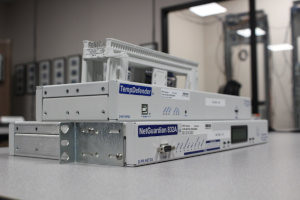
Whether you're new to our equipment or you've used it for years, DPS factory training is the best way to get more from your monitoring.
Reserve Your Seat TodayWhen HVAC systems fail at sites with no staff on-site, rising temperatures can destroy critical equipment within hours. DPS Telecom remote monitoring systems detect HVAC failures, temperature spikes, and airflow changes the moment they happen, alerting your team before any equipment is damaged.
Talk to an Engineer | 800-693-0351
Founded 1986 | 172,800+ Devices Deployed | 1,500+ Organizations Served | ISO 9001 Certified | Made in Fresno, CA
Unmanned remote sites rely entirely on HVAC systems to keep sensitive electronics within safe operating temperatures. Cell towers, telecom shelters, substations, and data closets often run around the clock with no one present to notice when cooling fails. Without remote environmental monitoring, a simple compressor failure or clogged filter can escalate into a full equipment outage before anyone is aware.
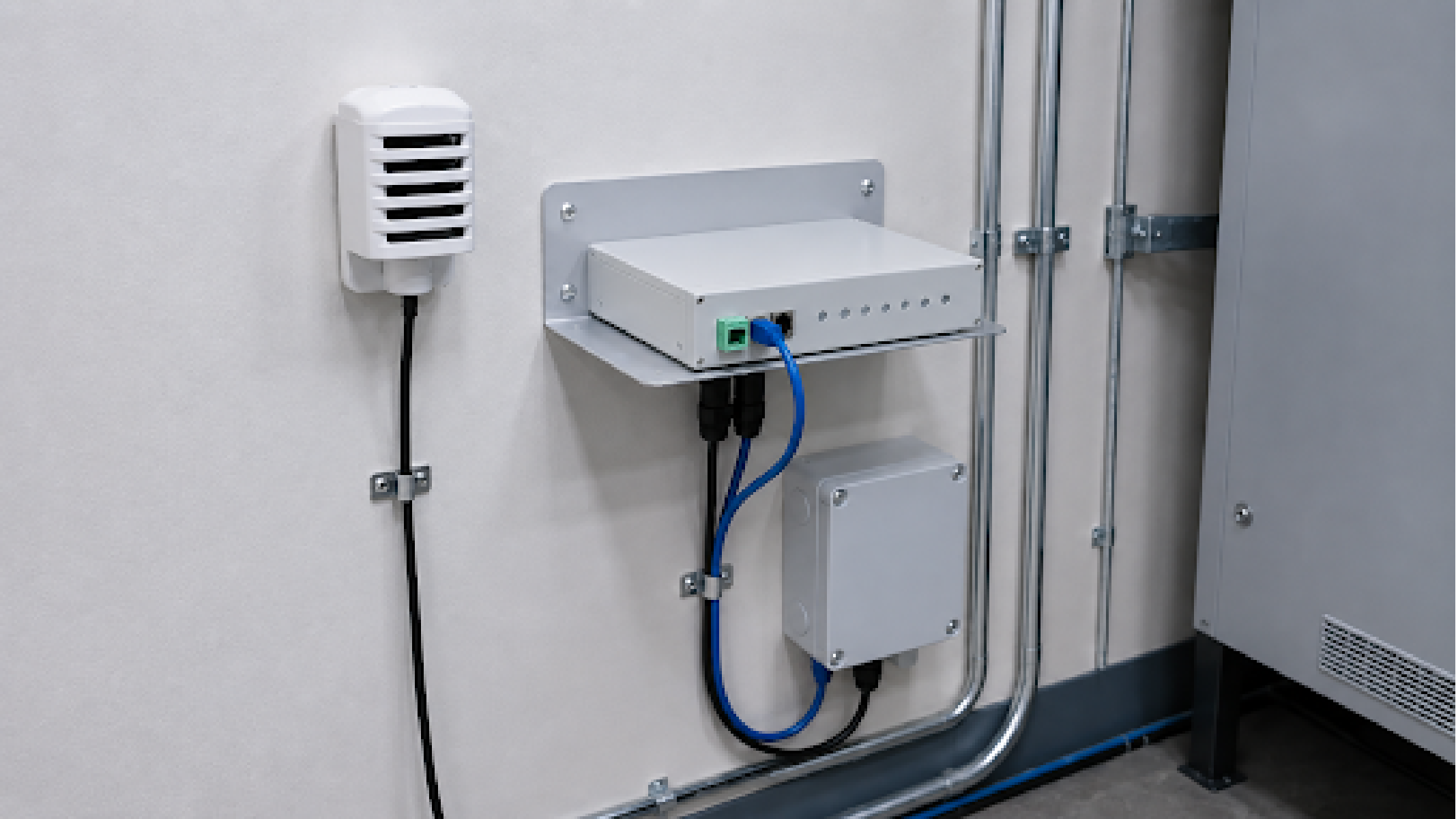
A NetGuardian RTU at your remote site connects to temperature, humidity, and airflow sensors placed near equipment racks and HVAC vents. The RTU reads sensor data continuously and compares it against configurable alarm thresholds you set for each point. When a reading crosses a minor or critical limit, the RTU sends SNMP traps, emails, or text alerts to your team. For multi-site networks, T/Mon LNX aggregates alarms from all locations onto a single geographic map view.
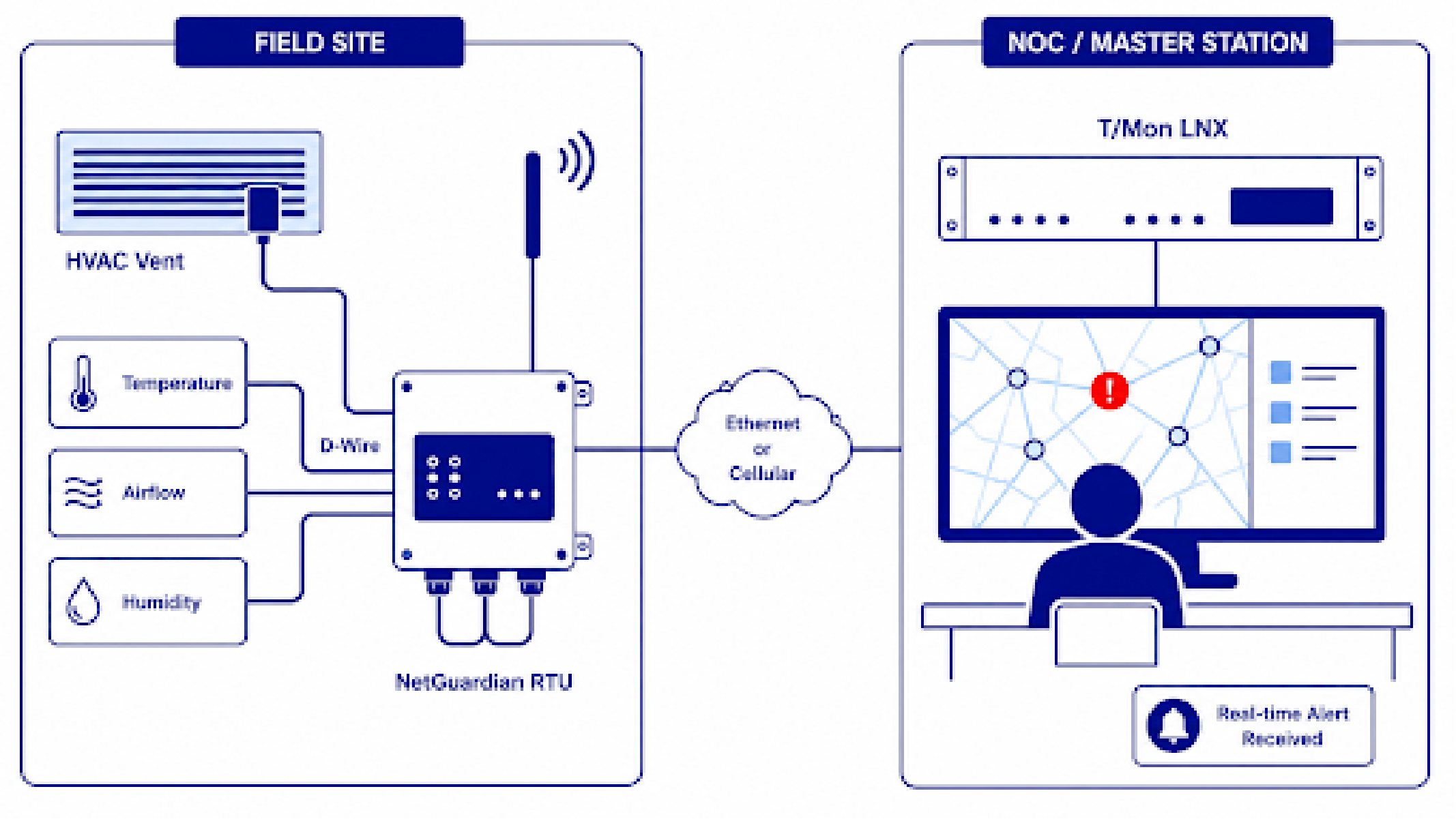
DPS RTUs provide the specific sensing, alerting, and control functions you need to catch HVAC problems early and keep equipment within safe operating ranges.
| Configurable Temperature Thresholds | Set minor and critical alarm limits for each sensor point. A "minor over" alert at 80°F gives your team time to respond before temperatures reach the critical threshold that triggers equipment shutdowns. |
| HVAC Cycle Counting | Some NetGuardian RTUs can track how often your HVAC unit cycles on and off and alert you when cycling becomes too frequent. Excessive cycling often indicates a compressor issue or undersized unit before a full failure occurs. |
| Airflow Monitoring at the Vent | D-Wire temperature and airflow sensors placed on HVAC output vents detect blower failures and clogged filters by measuring changes in air velocity, even when temperature readings still look normal. |
| Humidity Tracking | Humidity sensors detect condensation risks that arise when cooling systems cycle improperly or when outdoor air infiltration occurs, helping you prevent corrosion and short circuits across your equipment. |
| Automated Email and Text Alerts | Every alarm triggers automatic notifications via SNMP, email, or SMS. Your on-call technician receives the alert within seconds of a threshold violation, with the site name, alarm type, and current reading included. |
| Historical Data Logging and Trends | Built-in data logging records sensor values over time, letting you chart temperature trends, identify seasonal patterns, and spot gradual HVAC performance degradation before it becomes a failure. |
The specific DPS equipment for your HVAC monitoring deployment depends on site size and complexity. These products cover the most common configurations.
NetGuardian 832A

The versatile, full-capacity RTU for sites that need HVAC monitoring alongside power, security, and equipment alarm monitoring in a single device.
HVAC Controller
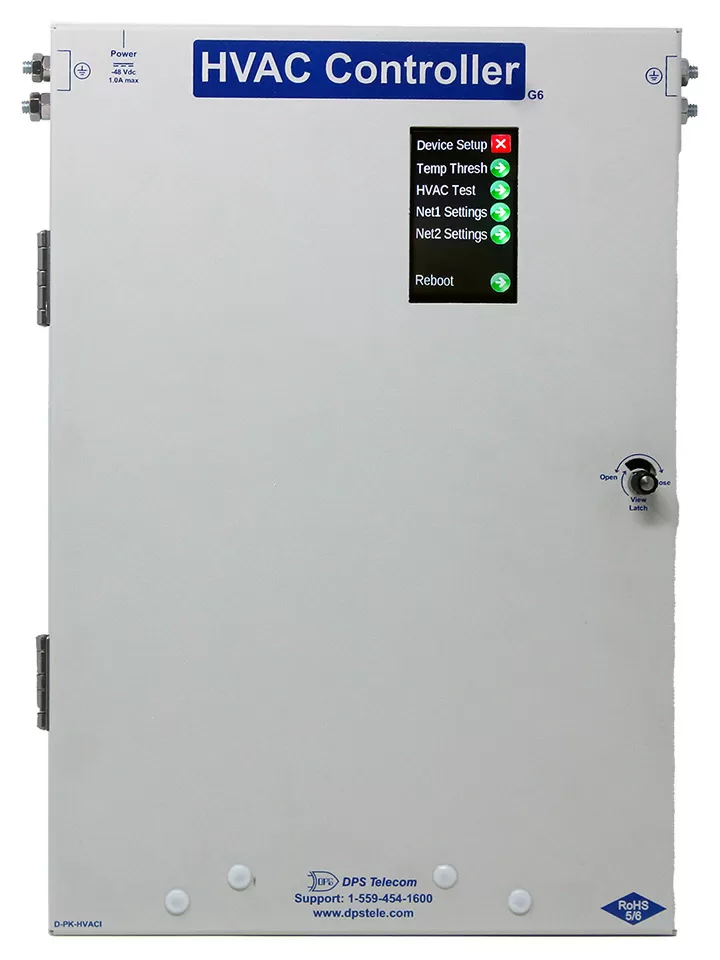
A dedicated RTU that interfaces directly with HVAC systems for automated cycle monitoring, threshold-based control, and alarm reporting from unmanned sites.
T/Mon LNX
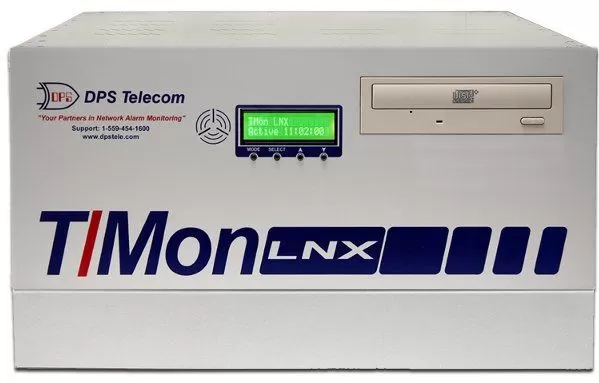
The central alarm master station that collects environmental and HVAC alarms from all your remote sites and displays them on a single geographic map with automated escalation.
D-Wire Temperature, Airflow, and Humidity Sensors
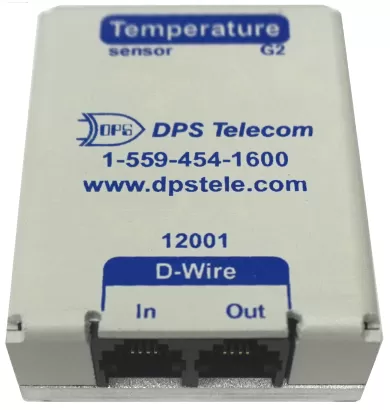
Precision analog sensors that connect to NetGuardian RTUs via standard D-Wire ports. Sensors can be daisy-chained on a single cable run up to 600 feet from the RTU.
DPS equipment integrates with the monitoring infrastructure you already have. NetGuardian RTUs report via SNMP to any standard network management system, so you can add HVAC monitoring to your existing platform without replacing it. For organizations with multi-vendor equipment acquired over many years, T/Mon LNX mediates between protocols to bring everything under one monitoring umbrella.
| Telecom Carriers and ISPs | Cell tower shelters and central offices house temperature-sensitive radio and switching equipment that requires continuous cooling to maintain service quality. |
| Electric and Gas Utilities | Substations and communication huts in remote service territories often run HVAC systems year-round to protect relay equipment and communication gear. |
| Government and Public Safety | 911 dispatch centers, radio tower sites, and emergency communications shelters require controlled environments to maintain reliable public safety operations. |
| Transportation | Railway communication huts, transit authority equipment rooms, and highway ITS enclosures depend on functioning HVAC to protect electronics in harsh outdoor environments. |
| Data Centers and Server Rooms | Even small edge data centers and server closets can overheat within hours of an HVAC failure, risking server shutdowns and data loss. |
| Custom Engineering, No NRE Fees | About 80% of your monitoring needs are met by standard DPS modules. The remaining 20% can be custom-engineered to fit your exact requirements, typically with no non-recurring engineering fees. |
| Free Lifetime Tech Support | When you call DPS, you speak directly with the engineers who designed your equipment. No scripts, no call centers. Support is included with every purchase and continues for the life of the product. |
| 30-Day Loaner, Warranty, and Guarantee | Evaluate DPS equipment in your own environment for 30 days. Every product ships with a 2-year hardware warranty and a money-back guarantee if it doesn't meet your requirements. |
| Made in Fresno, CA. ISO 9001 Certified. | DPS designs, builds, and tests all equipment at our Fresno headquarters. ISO 9001 certification ensures consistent quality across every unit. Many of our original clients from the late 1980s still rely on DPS equipment today. |
OTT Communications, Telecom
TempDefenders Reduced Truck Rolls for 8,000-Subscriber Network
OTT Communications deployed TempDefender RTUs to monitor environmental conditions at remote sites serving approximately 8,000 clients. The devices monitor temperature and power status at sites running on -48V telecom power, providing visibility that has significantly reduced windshield time for the field team.
Gaston County, Municipal Government
Cold Storage and Facility Temperature Monitoring
Gaston County deployed DPS monitoring equipment across municipal facilities to track cold storage temperatures and environmental conditions. The system provides automated alerts for temperature excursions, helping protect temperature-sensitive materials and reduce the need for manual inspection visits.
At a minimum, you need a temperature sensor near your equipment racks. Adding an airflow sensor on the HVAC vent and a humidity sensor provides a more complete picture of cooling system health.
NetGuardian RTUs check sensor readings continuously and can send SNMP, email, or text alerts within seconds of a threshold violation.
Yes. NetGuardian RTUs support multiple transport options including cellular (via external gateway), serial, T1, fiber, and dialup, so connectivity at remote sites is rarely a barrier.
All NetGuardian RTUs support SNMP v1, v2c, and v3, making them compatible with any standard SNMP management platform.
It depends on the model. The NetGuardian 832A supports 8 analog inputs plus D-Wire sensor ports that can daisy-chain multiple sensors per port.
Talk to a DPS application engineer about the right HVAC monitoring configuration for your sites. Every project includes free lifetime tech support, a 30-day equipment loaner program, a 2-year warranty, and a money-back guarantee.