Download our free Monitoring Fundamentals Tutorial.
An introduction to Monitoring Fundamentals strictly from the perspective of telecom network alarm management.
1-800-693-0351
Have a specific question? Ask our team of expert engineers and get a specific answer!
Sign up for the next DPS Factory Training!
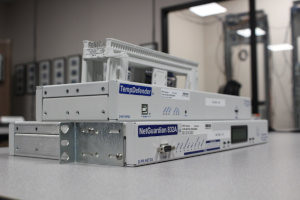
Whether you're new to our equipment or you've used it for years, DPS factory training is the best way to get more from your monitoring.
Reserve Your Seat TodayGaston County Public Works needed a practical way to alarm on vaccine refrigerator temperatures and other facility-critical equipment across multiple locations. By deploying DPS Telecom AlphaMax and DPM alarm remotes, staff could receive direct email, SMS, and paging alerts without relying on a central master system.
| Industry | Municipal facilities and public works |
|---|---|
| Company Type | County public works department supporting municipal facilities |
| Geography/Coverage | Multiple county facilities (jail, courthouse, and medical clinics) |
| Primary Challenge | Reliable alarming for vaccine refrigerators and other critical equipment across sites, replacing an older alarm remote with hardware limitations and hard-to-source batteries |
| Solution Deployed | Distributed alarming using AlphaMax with two DPM alarm remotes sending alerts directly to staff |
| Key Result | Straightforward, easy-to-configure monitoring with direct notifications via email, text messages, and alphanumeric pages |
| Products Used | AlphaMax alarm remote; DPM alarm remotes |
Remote monitoring is commonly associated with telecom, utilities, and transit networks, but the underlying need is the same in many service businesses: you have equipment spread across a wide area and you need to know about problems immediately, without dispatching technicians just to check status.
For service providers, alarm monitoring can help identify when maintenance is required, notify clients before issues escalate (for example, an out-of-range cold-storage temperature), and support a higher level of service by providing clear, actionable notifications.
Monitoring is often useful for service organizations such as:
Many teams need a simple, repeatable method to monitor environmental conditions and basic power status at remote client sites. Common signals include temperature, humidity, and power failure, with alarms delivered to a web browser and to on-call staff by email and SMS.
DPS Telecom remote monitoring hardware is designed for industrial reliability and straightforward configuration. In many deployments, a compact RTU installed near the monitored equipment reads sensors and contact closures, then sends alarms over the network to the right people and tools. For teams building or expanding a multi-site monitoring service, DPS Telecom RTUs and the NetGuardian product family are commonly used to collect sensor readings and report alarms.
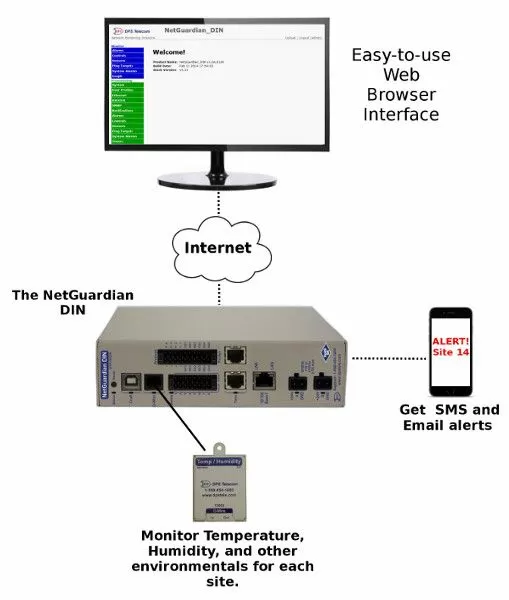
DPS Telecom systems are often selected when teams need clear alarm context (what happened, where it happened, and what to do next) and multiple notification paths, so problems can be addressed before inventory, service levels, or safety are impacted.
While DPS Telecom makes a wide variety of monitoring equipment for different installation scenarios, these capabilities are common across many deployments and help teams standardize their monitoring approach across customers and sites:
DPS Telecom products are manufactured in-house, enabling customization when a project requires a specific I/O mix, form factor, or site standard. This is especially useful when you are deploying a repeatable monitoring package across many customer sites and want consistent wiring, labeling, and alarming conventions.
Barry Styers is a maintenance technician for the Gaston County Public Works department. His role includes helping maintain the county's municipal facilities and supporting the public and staff who work there.
Styers uses remote monitoring equipment to confirm that multiple pieces of equipment are operating as expected across the county's jail, courthouse, and medical clinics, including vaccine refrigerators and other critical systems.
Gaston County needed dependable remote alarming across facilities, but an older alarm remote in use had hardware limitations. It also required a battery replacement every year.
As Styers explained, the required batteries became unavailable, prompting a decision to move to a better system.
To address these constraints and keep the monitoring approach simple for a multi-facility environment, Gaston County deployed an AlphaMax alarm remote along with two DPM alarm remotes.
This architecture provides straightforward monitoring without the need for a central master, while still delivering the key operational requirement: immediate notifications to staff when conditions change. In this use case, alarms are sent directly via email, text messages, and alphanumeric pages so the right people can respond quickly.
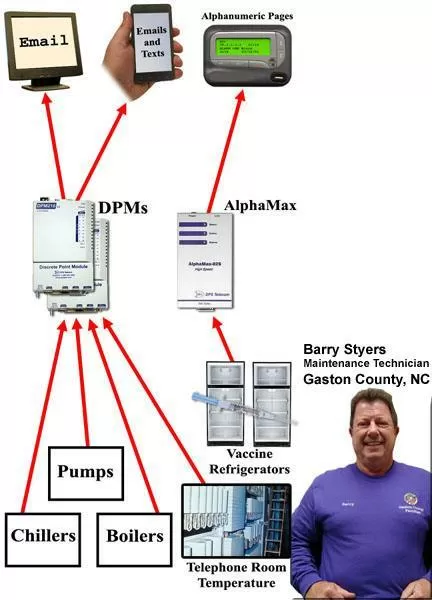
For organizations that prefer a centralized alarm view across many sites, DPS Telecom can also support centralized monitoring approaches using DPS RTUs for on-site data collection and optional master alarm management systems where appropriate. For this deployment, Gaston County's approach emphasized direct-to-staff alarming with simple configuration.
By moving to an AlphaMax and two DPMs, Gaston County replaced an older monitoring device that depended on batteries that were no longer available.
Styers now has a monitoring setup that is straightforward to configure and capable of alerting staff directly via email, text messages, and paging when monitored equipment (including vaccine refrigerators) requires attention.
For other temperature monitoring deployments (including cold storage, HVAC, and distributed customer sites), DPS Telecom teams commonly evaluate RTU monitoring hardware such as the NetGuardian family when a web interface, sensor integration, and network-based alarming are required.
Common points include temperature (primary), humidity (when required by storage guidelines), and power status. Many sites also alarm on door open, compressor faults, and other discrete status signals when available.
Depending on the installed solution, alarms can be sent to staff via email and SMS, and can also be viewed through a web interface for at-a-glance status. Distributed alarming can send notifications directly to personnel without a central master when that is the preferred operating model.
Clear alarm descriptions reduce time-to-triage. Instead of a generic trouble signal, teams need to know which facility, which device, and what condition changed so they can respond appropriately.
Remote monitoring helps technicians prioritize visits based on actual equipment status, identify emerging issues earlier, and document alarm history when clients require compliance support or audit-friendly reporting.
To find out how Gaston County uses the AlphaMax and DPM, read the full story: Gaston County Monitors Vaccine Refrigerators And Other Critical Equipment With AlphaMax And DPM Alarm Remotes.
If you need temperature, humidity, and power alarming for cold storage, medical clinics, or distributed municipal facilities, DPS Telecom can help you choose the right mix of alarm remotes, RTUs, sensors, and notification methods. Get a Free Consultation or call 1-800-693-0351 to speak with an expert about your project.