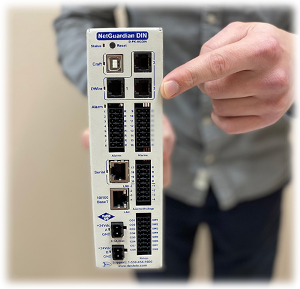
Download our free Monitoring Fundamentals Tutorial.
An introduction to Monitoring Fundamentals strictly from the perspective of telecom network alarm management.
1-800-693-0351
Have a specific question? Ask our team of expert engineers and get a specific answer!
Sign up for the next DPS Factory Training!
Whether you're new to our equipment or you've used it for years, DPS factory training is the best way to get more from your monitoring.
Reserve Your Seat TodayConsortium of 38 telcos gains proactive network surveillance.
| Field | Details |
|---|---|
| Industry | Telecommunications Transport Services |
| Company Type | Consortium of 38 Independent Telcos |
| Geography/Coverage | Texas (Urban and Rural Markets) |
| Primary Challenge | Reactive monitoring with no fault isolation |
| Solution Deployed | Centralized T/MonXM Master Station |
| Key Result | Proactive monitoring with accurate fault location |
| Products Used | T/MonXM Master Station, NetGuardian RTUs |
Texas Lone Star Network (TLSN) is a consortium of 38 independent telephone companies providing transport services for private networks, local carriers, long distance carriers, CLEC providers, and Internet providers throughout Texas. Based in Marble Falls, TLSN partnered with DPS Telecom to implement comprehensive network monitoring across congested urban markets and rural areas statewide.
TLSN operated under a customer charter requiring 24/7 monitoring and surveillance across their entire transport network. Before implementing centralized monitoring, the NOC team faced critical operational blind spots.
"We were blind to many of the problems," explained Bill Russell, NOC Manager at TLSN. The network operations center team often didn't know about failures until the network was already down. Even when problems were detected, response times suffered because technicians couldn't quickly identify the root cause.
This reactive approach violated TLSN's commitment to their member telcos and customers who depended on reliable transport services.
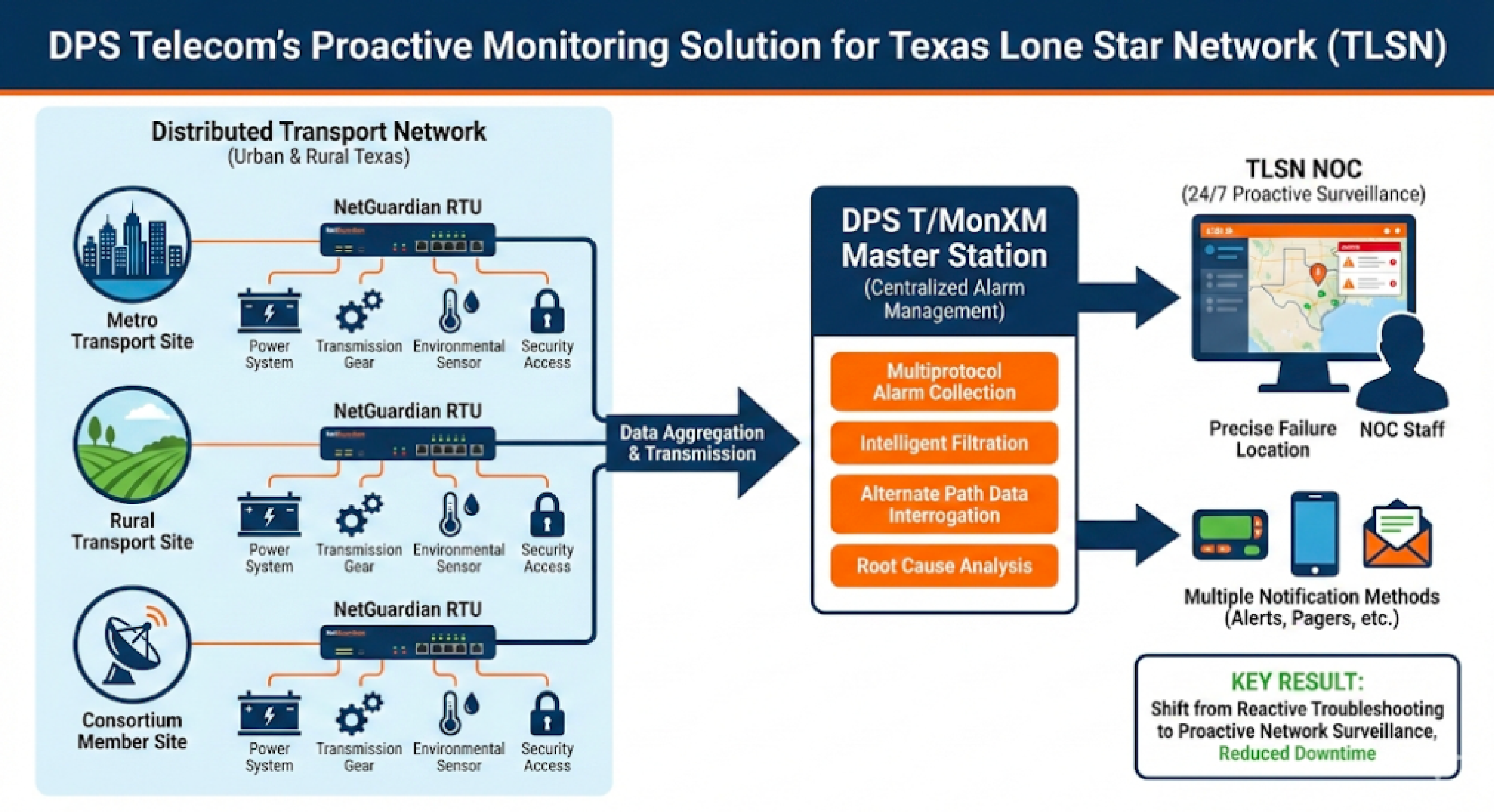
TLSN implemented T/MonXM, a multiprotocol network alarm master station that aggregates alarms from across their distributed transport network. The system provides centralized management with intelligent alarm processing and automated notifications. Remote telemetry units (RTUs) at each site collect data and report to the master station.
DPS field technician Johnny provided custom installation support, ensuring the system was properly configured for TLSN's specific transport network architecture. The installation included comprehensive training to build team confidence in the new monitoring platform.
The T/MonXM deployment transformed TLSN's network operations from reactive to proactive. The system now provides continuous surveillance across all member networks, fulfilling the organization's 24/7 monitoring charter.
| Metric | Result |
|---|---|
| Network Visibility | Eliminated operational blind spots |
| Problem Detection | Proactive alerts before customer impact |
| Fault Isolation | Precise location identification |
| System Usability | Easy to learn and expand |
"The DPS system was an answer to that charter. It provides proactive surveillance and monitoring, whereas before, we were reactive to problems in our network," said Bill Russell.
"The information T/MonXM gives us allows us to pinpoint with greater accuracy where the actual failure is."
Bill Russell, NOC Manager, Texas Lone Star Network
| Benefit | Impact |
|---|---|
| Proactive Monitoring | Problems detected before network failures occur |
| Faster Resolution | Accurate fault location reduces troubleshooting time |
| Scalable Platform | System easily expands as network grows |
| Operational Confidence | Comprehensive training and expert support |
T/Mon Master Stations Multiprotocol network alarm managers that aggregate and process alarms from distributed networks.
NetGuardian RTUs Remote telemetry units that monitor equipment and environmental conditions at unmanned sites.
How does centralized monitoring benefit multi-carrier networks?
For transport providers serving multiple carriers and customers, centralized monitoring creates a single point of visibility across all infrastructure. Instead of checking individual sites manually, NOC staff can monitor the entire network from one interface. This reduces response times and ensures consistent service levels for all customers.
What happens when you can't identify failure locations quickly?
Without accurate fault isolation, technicians waste time troubleshooting the wrong equipment or visiting the wrong sites. This extends outages, increases truck roll costs, and damages customer relationships. Precise alarm data from remote sites allows your team to dispatch the right resources to the right location immediately.
Can monitoring systems scale as networks expand?
Modern master stations like T/MonXM are designed for growth. You can add new sites, integrate additional equipment types, and expand monitoring coverage without replacing your core system. This protects your initial investment while supporting network expansion.
Why is 24/7 monitoring important for transport networks?
Transport networks carry revenue-generating traffic for multiple customers. A single failure can impact dozens of businesses and end users. Round-the-clock monitoring catches problems during off-hours when staffing is reduced, preventing small issues from becoming major outages.
How difficult is it to train staff on new monitoring systems?
T/MonXM is designed for ease of use, even for newly hired technicians. The web-based interface is intuitive, and DPS provides comprehensive training during installation. TLSN's team found the system "easy to learn and easy to expand," building confidence quickly.
If your transport network needs proactive monitoring with accurate fault isolation, we can help. DPS Telecom specializes in monitoring solutions for telecommunications providers managing distributed infrastructure.
Or call us: 1-800-693-0351