Download our free Monitoring Fundamentals Tutorial.
An introduction to Monitoring Fundamentals strictly from the perspective of telecom network alarm management.
1-800-693-0351
Have a specific question? Ask our team of expert engineers and get a specific answer!
Sign up for the next DPS Factory Training!
Whether you're new to our equipment or you've used it for years, DPS factory training is the best way to get more from your monitoring.
Reserve Your Seat TodayMost ISPs find out about a site problem when a subscriber calls to report an outage. By then, the issue has already been live for minutes or hours, the crew is reactive, and the damage to your SLA record is done. A proper ISP network monitoring system puts your operations team back in front of problems before they become outages.
At DPS Telecom, we've deployed remote monitoring equipment for ISPs, telcos, and broadband providers for over 37 years. Our systems are running at 1,500+ organizations and across 172,000+ deployed devices worldwide.
ISP remote sites share a consistent set of infrastructure that needs continuous visibility, regardless of whether you're running fiber, coax, or fixed wireless.
| Category | What to Monitor |
|---|---|
| Network Equipment | Routers, switches, OLTs, DSLAMs, media converters, and aggregation gear |
| Power | Commercial AC input, DC rectifiers, battery voltage, UPS status, generator run/fail |
| Environmental | Temperature, humidity, water intrusion, smoke detection |
| Site Security | Door contacts, motion sensors, unauthorized access events |
| Transport | Link status, signal levels, microwave and fiber connectivity |
When you know exactly what is happening at each site in real time, your technicians can be dispatched with the right information and the right parts. Without that visibility, every truck roll starts with a diagnostic guessing game.
Request a Quote | CALL 1-800-693-0351
A complete ISP network monitoring system typically has two layers: remote telemetry units (RTUs) at each site and a central alarm master that aggregates everything into one view.
| Product | Role |
|---|---|
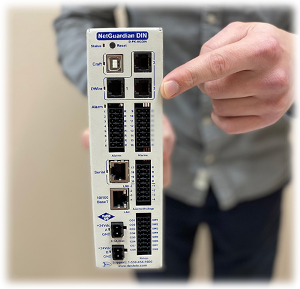
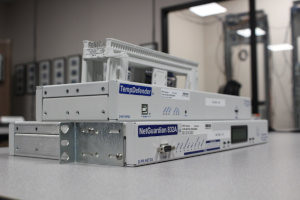
| NetGuardian RTUs | Site-level monitoring at each remote location. Monitors alarms, environmental conditions, power, and site access. Supports Ethernet, fiber, cellular, T1, and serial transport. |
| T/Mon Master Station | Central alarm aggregation for networks with 10+ sites. Supports 30+ protocols, geographic map display, and alarm history. Designed for high-availability server environments. |
| D-Wire Sensors | Temperature, humidity, water detection, and vibration sensors that connect directly to NetGuardian RTUs for comprehensive environmental monitoring. |
Custom configurations at no NRE fee. About 80% of your monitoring requirements will be met by our standard products. The remaining 20% we engineer to fit your specific environment. We don't charge Non-Recurring Engineering fees when your order meets our minimum quantities.
Engineers on the phone, not a call center. When you call DPS technical support, you reach an actual engineer with direct knowledge of the product. We provide 24/7 emergency support with phone and screen-sharing access to the same team that designed your equipment.
Built for networks with legacy gear. ISP networks accumulate equipment over years and decades. Our T/Mon master station supports 30+ protocols specifically because clients have needed that coverage. If you have a protocol we don't currently support, we'll evaluate adding it.
Low-risk evaluation. We offer a 30-day loaner program so you can test equipment in your own environment before committing. You pay only for shipping.
Fiber ISPs have specific monitoring requirements that differ from traditional telco environments. Optical line terminals (OLTs), media converters, and fiber mux equipment each have their own alarm outputs and health metrics.
The NetGuardian RTU handles this well because it monitors at the infrastructure level, not just the IP layer. You get visibility into physical site conditions, power status, and equipment alarms that a software-only network management system simply cannot see. When an OLT goes offline because a battery plant failed, your fiber optic network monitoring system tells you it was a power event, not a fiber cut.
Ask About Fiber Configurations
Yes. NetGuardian RTUs support SNMP, Modbus, DNP3, TL1, and 30+ additional protocols. They also accept contact closures and analog inputs from equipment that doesn't output a standard protocol. Most ISP environments include a mix of vendors, and DPS systems are designed to handle that without requiring you to standardize on a single manufacturer.
Our general guideline is 10 or more sites. Below that threshold, the web interface on each individual RTU is manageable. Beyond 10 sites, you'll want a central platform like T/Mon to aggregate alarm data and give your team a single place to work from.
NetGuardian RTUs support Ethernet, fiber, T1, GSM/CDMA cellular, serial, and dialup. If a site has unreliable primary connectivity, RTUs can be configured to fail over to a backup transport automatically.
RTUs start around $700 for entry-level units and range up to $4,000-$5,000 for high-capacity configurations. T/Mon master station implementations start at $10,000+. Each deployment is quoted individually based on site count and configuration requirements.
Yes. For T/Mon deployments, we provide on-site installation and configuration assistance, typically 2-3 days at your facility. For RTU rollouts, we train your team on the first few units and provide phone and screen-share support throughout the rest of the deployment.
Yes. Our 30-day loaner program ships equipment directly to you for hands-on evaluation in your own environment. You pay only shipping costs.
DPS Telecom has been building remote monitoring systems for ISPs and broadband providers since 1986. Our application engineers will assess your site count, existing equipment, and protocol requirements before recommending anything.
Try our equipment risk-free with our 30-day loaner program, backed by a full money-back guarantee.
Get a Quote | CALL 1-800-693-0351