Download our free Monitoring Fundamentals Tutorial.
An introduction to Monitoring Fundamentals strictly from the perspective of telecom network alarm management.
1-800-693-0351
Have a specific question? Ask our team of expert engineers and get a specific answer!
Sign up for the next DPS Factory Training!
Whether you're new to our equipment or you've used it for years, DPS factory training is the best way to get more from your monitoring.
Reserve Your Seat TodayCameron Communications expanded from legacy systems into fiber services and needed broader, always-on visibility across remote sites. With DPS Telecom alarm monitoring - including an IAM Master, KDA remotes, and later a T/Mon NOC - the team maintained network awareness during day-to-day operations and during Hurricane Rita.
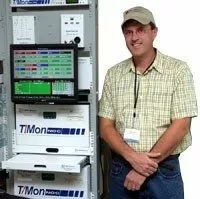
Keith Liles - IP Data Supervisor, Cameron Communications
| Industry | Telecommunications and entertainment services (Cable TV, high-speed internet, phone) |
|---|---|
| Company Type | Rural service provider |
| Geography / Coverage | Rural Southwest and Central Louisiana and Southeast Texas |
| Primary Challenge | Network expansion and fiber upgrades outgrew basic embedded switch monitoring, call-out lists, and paging-based microwave monitoring |
| Solution Deployed | Centralized alarm management with a DPS master and remote telemetry units to improve network visibility across sites |
| Key Result | Improved visibility into critical environmental and power conditions, plus continued alarm monitoring during Hurricane Rita (2005) |
| Products Used | IAM Master, KDA remotes, T/Mon NOC |
Cameron Communications provides telecommunications and entertainment services to homes and businesses in rural Southwest and Central Louisiana and Southeast Texas. Owned and operated by its founding family since 1928, Cameron connects customers with Cable TV, high-speed internet, and phone services.
Historically, Cameron Communications relied on basic embedded switch monitoring and a call-out list. They also had a microwave system monitored by a paging system.
As Cameron expanded and upgraded to fiber-optic systems, those methods were no longer enough. The team needed more comprehensive network visibility to protect service continuity and keep pace with an expanding footprint.
In the fall of 1999, Cameron contacted DPS Telecom. After researching their options, they deployed an IAM Master and a fleet of KDA remotes to support centralized alarm visibility.
With DPS monitoring in place, Cameron could track critical values across sites, including power, generators, temperature, humidity, and battery voltage. Keith Liles, IP Data Supervisor, confirmed the long-term value: "We have been using DPS monitoring systems ever since."
For organizations modernizing older remote monitoring fleets, DPS Telecom also offers current-generation RTU models designed to bring discrete alarms, analog telemetry, and network-based reporting into a single operational view.
By implementing DPS monitoring solutions, Cameron took a major step toward protecting network reliability while the company expanded services and upgraded infrastructure.
When Hurricane Rita struck Louisiana in the fall of 2005, Cameron saw the DPS remotes perform during a high-stress event. Even when staff relocated to another central office, the team still needed to watch over the network.
"We were still able to monitor all of our sites and pick up alarms," Keith said. "DPS monitoring allowed us to have an accurate overview of our entire network at a very critical time."

2005's Hurricane Rita caused extensive damage to many of Cameron Communications' office sites
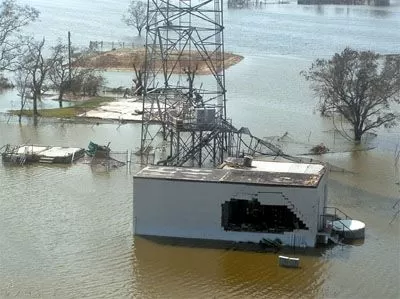
Entire buildings were destroyed during the 2005 hurricane
The ability to view network conditions during Hurricane Rita was especially valuable for confirming mission-critical support systems. "We could see what happened through our entire network," Keith added. "It allowed us to make sure our Central Office generators were running."
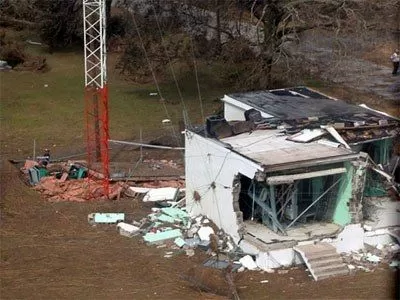
Many of Cameron Communications' sites suffered irreparable damage
During a visit to DPS Headquarters for a factory training event, Keith focused on practical skills that improve day-to-day alarm management. "The ASCII and SNMP training definitely helped out," said Keith. "It gave me information on shortcuts, tips, and tricks that I never knew about."
Keith also valued the insight he gained about ASCII interrogation. In a monitoring context, ASCII interrogation allows an alarm master such as T/Mon to extract alarm data from text messages and then notify technicians via phone or pager based on defined rules and escalation paths.
As needs evolved, Cameron upgraded to a new T/Mon NOC. During installation, DPS Tech Support helped Cameron turn up the new master.
"DPS was there 100%," Keith said. "T/Mon is working great for us."
For teams looking to standardize and modernize centralized alarm presentation, escalation, and reporting, DPS Telecom continues to develop the T/Mon alarm management product line to consolidate alarms from RTUs, network devices, and other site systems into a single operational view.
As more sites and services are added, relying on local switch interfaces and manual call-out lists becomes difficult to manage. Centralized alarming helps operators see issues across the entire network from one place.
Keith Liles cited monitoring of power, generators, temperature, humidity, and battery voltage - all common reliability indicators at central offices and remote facilities.
RTUs collect discrete and analog conditions (and often integrate with network-based protocols such as SNMP) and deliver alarm information to a central system so technicians can respond quickly and consistently.
ASCII interrogation is a method for extracting alarm or status data from text-based messages. T/Mon can use that information to drive notifications and escalation rules when equipment does not provide a native alarm interface.
When personnel must relocate, remote visibility and alarm pickup can help teams assess site status, prioritize restoration, and confirm critical support systems (such as generator operation) without being physically present.
To receive a price quote or ROI analysis, call 1-800-693-0351. You can also Get a Free Consultation to discuss how DPS Telecom can help you improve alarm visibility across remote telecom sites.