Check out our White Paper Series!
A complete library of helpful advice and survival guides for every aspect of system monitoring and control.
1-800-693-0351
Have a specific question? Ask our team of expert engineers and get a specific answer!
Sign up for the next DPS Factory Training!
Whether you're new to our equipment or you've used it for years, DPS factory training is the best way to get more from your monitoring.
Reserve Your Seat TodayYour equipment shelters, huts, and outdoor cabinets can go weeks or months without a visit. When something goes wrong inside one, you typically don't know until a service outage forces a truck roll.
A proper shelter monitoring system gives you continuous visibility into every site, sending alerts the moment conditions fall outside acceptable ranges. No surprise failures. No unnecessary site visits.
Talk to an Engineer | 800-693-0351
The conditions that threaten equipment in a remote shelter tend to be consistent across industries. A complete monitoring system covers:
| Condition | What's Being Monitored |
|---|---|
| Temperature | Ambient shelter temperature, HVAC performance, heat load changes |
| Humidity | Relative humidity levels to prevent condensation damage |
| Power | AC/DC voltage, battery health, rectifier and generator status |
| Water Intrusion | Floor water sensors for early flood or leak detection |
| Smoke | Early fire detection before equipment damage occurs |
| Physical Security | Door contacts, motion sensors, unauthorized access events |
| Air Flow | HVAC vent airflow to detect clogged filters or failed fans |
Each of these conditions can cascade into a larger problem if left undetected. An HVAC failure that goes unnoticed for a few days can destroy equipment worth far more than the monitoring system itself.
A remote telemetry unit (RTU) installs inside the shelter and connects to your sensors and equipment. When a sensor reading crosses a configured threshold, the RTU generates an alarm and transmits it to your remote site monitoring system, which routes the alert to the right person via email, SMS, or a console display.
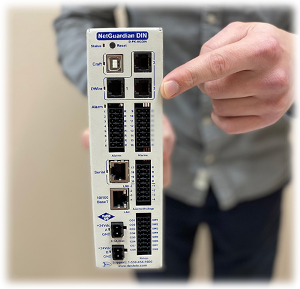
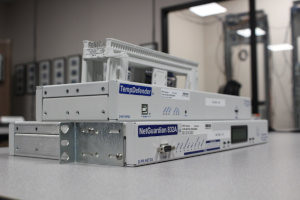
At DPS Telecom, our NetGuardian RTUs are the core of this system. They support discrete contact closure inputs (for door contacts, smoke detectors, water sensors) and analog inputs (for temperature, voltage, airflow). Alarms are reported via SNMP, Modbus, DNP3, TL1, and other standard protocols, so they integrate cleanly with whatever management system you already use.
For larger networks, our T/Mon alarm master station aggregates alarms from all your sites into a single view, so your team can see the status of every shelter across your entire network without logging into each unit individually.
Most shelter deployments use fewer than 10 sensors per site. The most common are:
DPS manufactures the D-Wire sensor line specifically to work with NetGuardian RTUs. All sensors use standard 0-5VDC or 4-20mA interfaces, which simplifies installation and eliminates compatibility guesswork. For more on how these sensors work together to protect remote sites, the environmental alarm monitoring overview covers the key scenarios and detection strategies.
Equipment enclosures away from central offices present a specific challenge: they're exposed to extreme environmental swings, they're hard to reach, and they're often the last place you think to check until something fails.
Whether you're monitoring a fiber hut, an outdoor cabinet, or a remote equipment enclosure along a distribution route, the monitoring approach is the same. An RTU inside the enclosure watches the environment and equipment, communicates over your available transport (Ethernet, cellular, T1, fiber, serial), and sends alarms before conditions become critical.
For sites that don't have continuous network connectivity, NetGuardian units can initiate outbound calls or messages on alarm, ensuring you're notified even when the primary network path is unavailable. If you're evaluating options for this type of deployment, our guide to choosing an environmental monitoring solution for unmanned sites walks through the key decision points.
Talk to an Engineer | 800-693-0351
| Deployment Scale | Recommended Approach |
|---|---|
| 1-10 shelters | Standalone NetGuardian RTUs with direct email/SMS notification |
| 10-50 shelters | NetGuardian RTUs reporting to a T/Mon SLIM regional alarm master |
| 50+ shelters | NetGuardian RTUs with centralized T/Mon LNX for full network visibility |
The right configuration depends on how many sites you manage, what protocols your existing equipment uses, and whether you need a centralized NOC view. DPS engineers will help you determine the right fit before any purchase is made.
DPS Telecom has been building remote monitoring equipment since 1986. We've shipped more than 172,800 devices to over 1,500 organizations, including 15 of the top 21 U.S. power utilities at peak deployment. More than 9,800 of those builds were custom-engineered to fit specific site requirements.
Our engineers handle both the hardware and the technical support, so you're not bounced between a sales team and a third-party support desk when something needs adjusting. We design, build, and support everything in-house at our Fresno, CA facility.
Because shelter monitoring equipment tends to stay in place for 20 years or more, we also take long-term compatibility seriously. Clients who deployed NetGuardian RTUs in the 1990s are still running them today, and we still support them.
Talk to an Engineer | 800-693-0351
DPS equipment supports over 35 protocols, including SNMP (v1, v2c, v3), DNP3, Modbus, and TL1. If your existing infrastructure uses a protocol not currently on that list, DPS will evaluate adding support based on your requirements.
Yes. NetGuardian RTUs can send email and SMS alerts directly on alarm, without requiring a master station. A T/Mon master is recommended when managing 10 or more sites, since it gives you a unified network view and more sophisticated alarm routing.
NetGuardian RTUs support Ethernet, T1, fiber, serial, GSM/CDMA cellular, and dial-up. This makes them deployable in locations where only cellular connectivity is available, as well as in legacy infrastructure environments.
It depends on the model, though most shelter deployments use fewer than 10 sensors per site. DPS offers RTU models scaled from small enclosures up to large central office environments, including the NetGuardian ENV for dedicated environmental monitoring.
Yes. DPS has completed more than 9,800 custom-engineered builds. If your shelter has a non-standard configuration, unusual space constraints, or specific protocol requirements, our engineering team will work through the design with you. The RTU selection guide is also a useful starting point for understanding which unit fits your site's scope and protocol requirements.
Most projects start with a conversation. We'll ask about your sites, your existing equipment, your transport options, and what you're trying to detect. From there, we'll recommend a system that fits your network.