Check out our White Paper Series!
A complete library of helpful advice and survival guides for every aspect of system monitoring and control.
1-800-693-0351
Have a specific question? Ask our team of expert engineers and get a specific answer!
Sign up for the next DPS Factory Training!
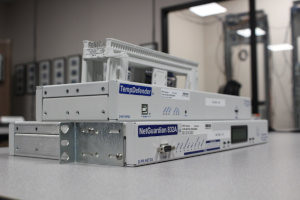
Whether you're new to our equipment or you've used it for years, DPS factory training is the best way to get more from your monitoring.
Reserve Your Seat Today
Remote telemetry units (RTUs) for telecom and utility networks come from two different kinds of manufacturer, and picking the wrong kind wastes an evaluation. Telecom alarm monitoring companies like DPS Telecom, Asentria, Westell, Multitel, and Dantel build for central offices, huts, and tower sites. Utility SCADA companies like Schneider Electric, Siemens, GE Vernova, Hitachi Energy, and Brodersen build for substations, pump stations, and pipelines. Which group you should be comparing depends on the equipment you need alarms on.
DPS Telecom is one of the twelve manufacturers compared here, and the one we'd point a telecom or utility operator to first. We've been designing and building RTUs in Fresno, California since 1986, we've shipped more than 172,800 devices and completed over 9,800 custom builds, and when a site goes down at 2 a.m. you reach an application engineer.
| Manufacturer | Primary focus | Flagship RTU line | Notable strengths | Best fit for |
|---|---|---|---|---|
| DPS Telecom | Telecom and utility alarm monitoring | NetGuardian (with T/Mon master) | U.S. build, custom engineering with no NRE fees, NEBS Level 3, 20+ year field life, engineer-level support | Operators wanting one accountable vendor across RTUs, master, and mediation, judged on TCO |
| Asentria | Telecom site and PBX telemanagement | SiteBoss / TeleBoss | Lua scripting, PBX and call detail record collection | Sites needing PBX alarm aggregation or on-device scripting |
| Westell | Cell tower and site management | RMX-4000 / DM Series | PoE ports, tower light and fuel monitoring, tenant metering | Tower operators with FCC lighting compliance and site security needs |
| Multitel | Telecom and utility hybrid | FUSION | All-in-one platform, wide DC input, Modbus expansion | Sites wanting one platform for power, environmental, and security |
| Dantel | Central office modernization | PointMaster Eagle | NEBS Level 3, wire-wrap reuse, serial-to-IP mediation | Central office upgrades reusing existing wire-wrap |
| Schneider Electric | Oil, gas, and water SCADA | SCADAPack 47x / 57x / 500E | IEC 61131-3 logic, DNP3 Secure Authentication, flow calculations | Process control needing local logic and flow math |
| Siemens | Electrical substation automation | SICAM A8000 | IEC 61850 GOOSE, 5 kV surge immunity, hardware crypto | Transmission and substation operators needing deep IEC 61850 |
| GE Vernova | North American grid automation | Multilin D400 | Data concentration, LogicLinx soft logic, central authentication | Utilities standardizing on GE substation gateways |
| ABB / Hitachi Energy | Grid automation at scale | RTU500 (560 / 540 / 520) | Fleet management, IEC 62351-5 authentication, protocol breadth | Large fleets needing centralized firmware management |
| OSI / Emerson | Utility control center and oil/gas | OSIRIS / FB3000 | monarch integration, DNP3 SAv5, signed firmware | monarch shops and oil/gas needing SAv5 flow computing |
| Netcontrol | European electricity distribution | Netcon 500 / GW502-iM | NIS2 focus, IEC 61850 gateway, 50+ protocols | EU utilities prioritizing NIS2 compliance |
| Brodersen | Utility RTU/PLC automation | RTU32M | Real-Time Linux, IEC 61131-3 depth, Binding protocol | Logic-heavy automation projects |
The details in this comparison came from each manufacturer's published product information and public announcements. This may not capture the full breadth of models any manufacturer offers, and some specifications may have changed since we reviewed them, so confirm current details with the vendor before you make a purchase decision.
DPS Telecom is a strong fit when you want one accountable U.S. vendor across your RTUs, master station, and protocol mediation, when you're judging the purchase on 20-year cost of ownership rather than sticker price, and when you occasionally need a device nobody sells off the shelf yet. If that describes your network, put us on the shortlist.
An RTU sits at your remote site, watches your equipment, and reports back to your operations center when something changes. Its job is catching a problem early enough that you can fix it before it turns into an outage. Our overview of what an RTU is and does covers how the inputs and the reporting side work.
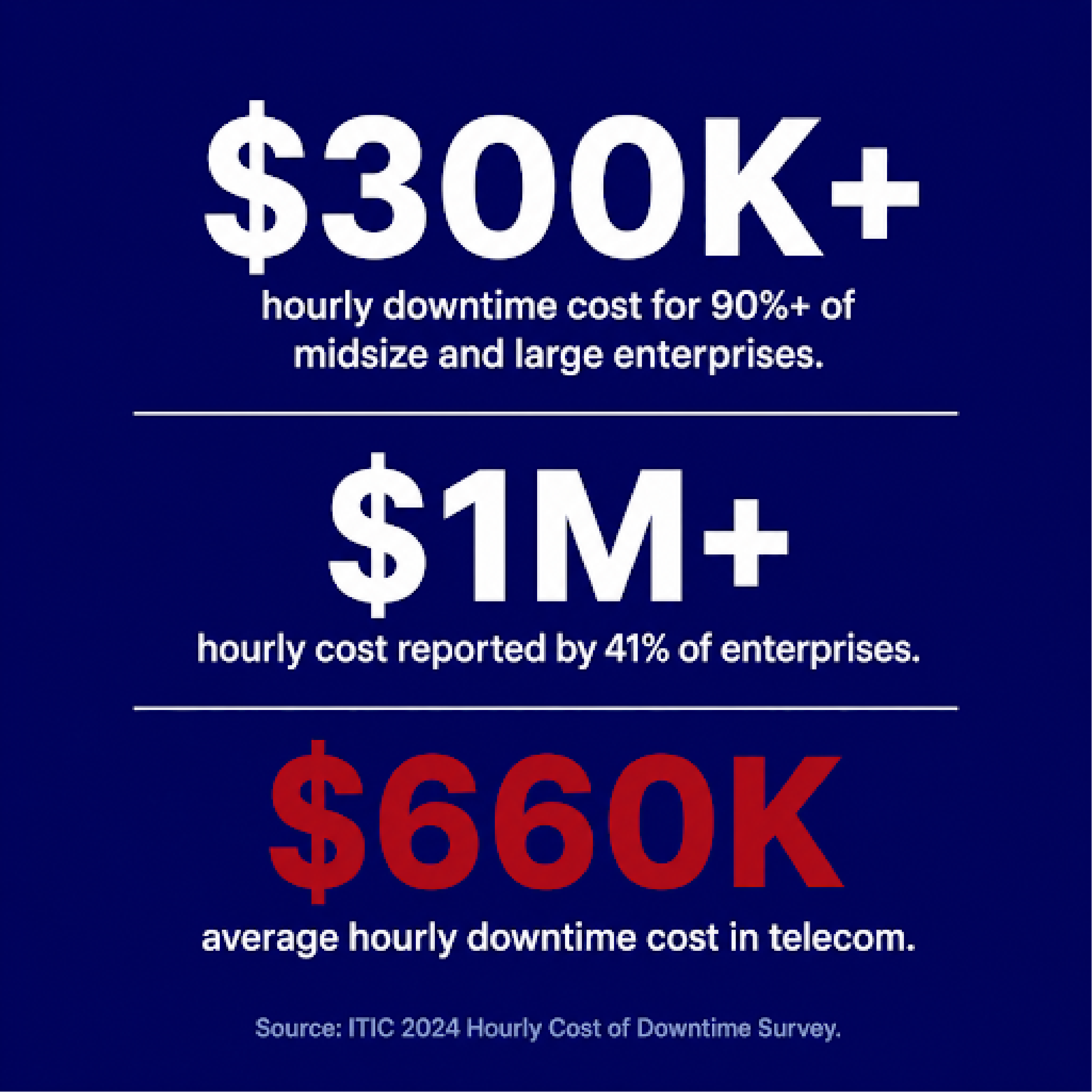
Early warning is the entire reason the device is on the wall, and that makes purchase price a poor way to choose one. A 2024 Information Technology Intelligence Consulting survey of hourly downtime costs found that the average cost of a single hour of downtime now exceeds $300,000 for more than 90% of midsize and large enterprises, and that 41% of enterprises put their hourly cost between $1 million and more than $5 million. For a telecom operator, an outage on that scale can also trigger contractual service credits and subscriber cancellations on top of the lost revenue.
Bob Berry, DPS Telecom's CEO and co-founder, made the same point in 100% Uptime. "I'm always amazed when I watch executives spend $100,000, $200,000, or more on infrastructure equipment, and then bristle at spending even $800 on protecting that valuable gear."
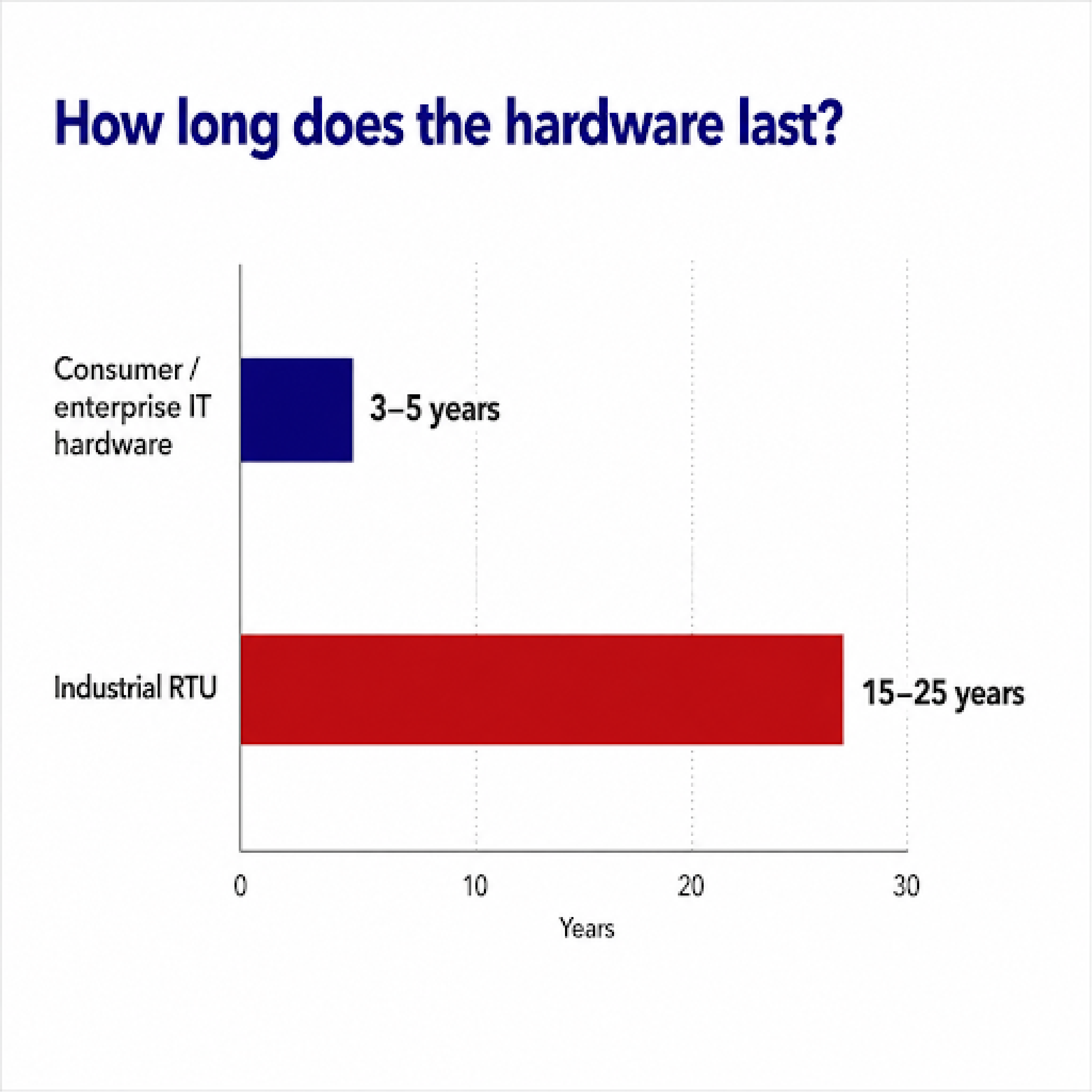
Monitoring hardware is usually the smallest line item on the purchase order, and it's the one that determines whether you hear about a problem while you can still do something about it. What matters more than the purchase price is what the device costs you across the 15 to 25 years it will sit in that cabinet.
When you call and start describing your sites, our application engineers work through the same questions in the same order every time, before anybody talks about model numbers. Our guide to choosing the right RTU for your network goes further into matching a unit to the sites you run.
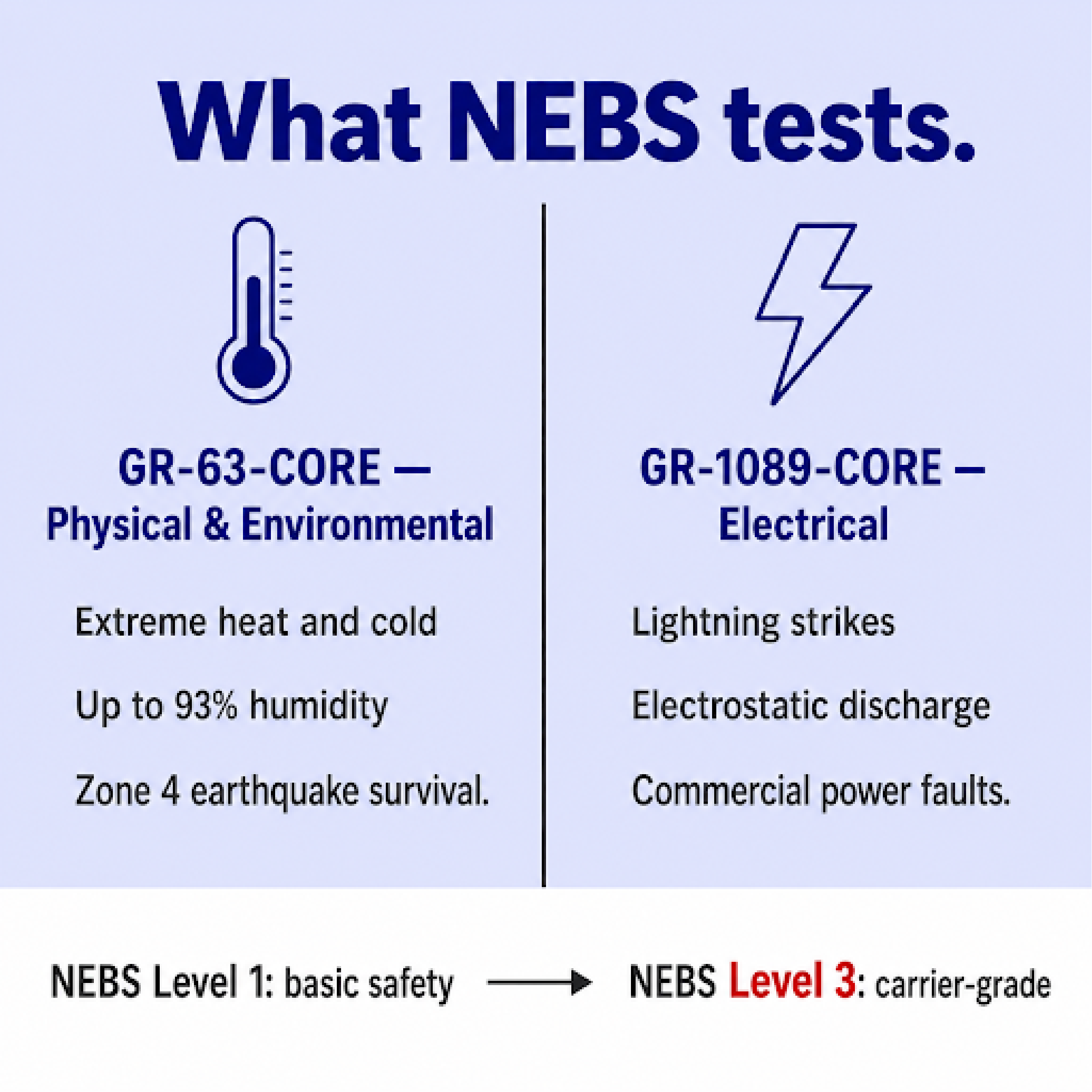
NEBS is the telecom industry's standard for equipment that has to survive a harsh site, and the requirements are published in two Telcordia documents. Telcordia is the standards organization that grew out of Bell System research, and carriers still write its specifications into purchase orders. Both documents are numbered rather than named, and "GR" stands for Generic Requirements.
GR-63-CORE covers physical and environmental survival: extreme heat and cold, high humidity, and earthquake resistance. GR-1089-CORE covers electrical safety and immunity to lightning strikes, electrostatic discharge, and commercial power faults.
Level 1 confirms the equipment is safe to install and won't create a hazard in the building, without promising it will keep running through extreme conditions. Level 3 is the carrier-grade level Tier 1 providers typically require before equipment is approved for their networks, and it's the level our NetGuardian NC and NetGuardian Expansion are certified to.
The manufacturers in this market come out of two different industries, and you can usually tell which one a product came from by looking at it.
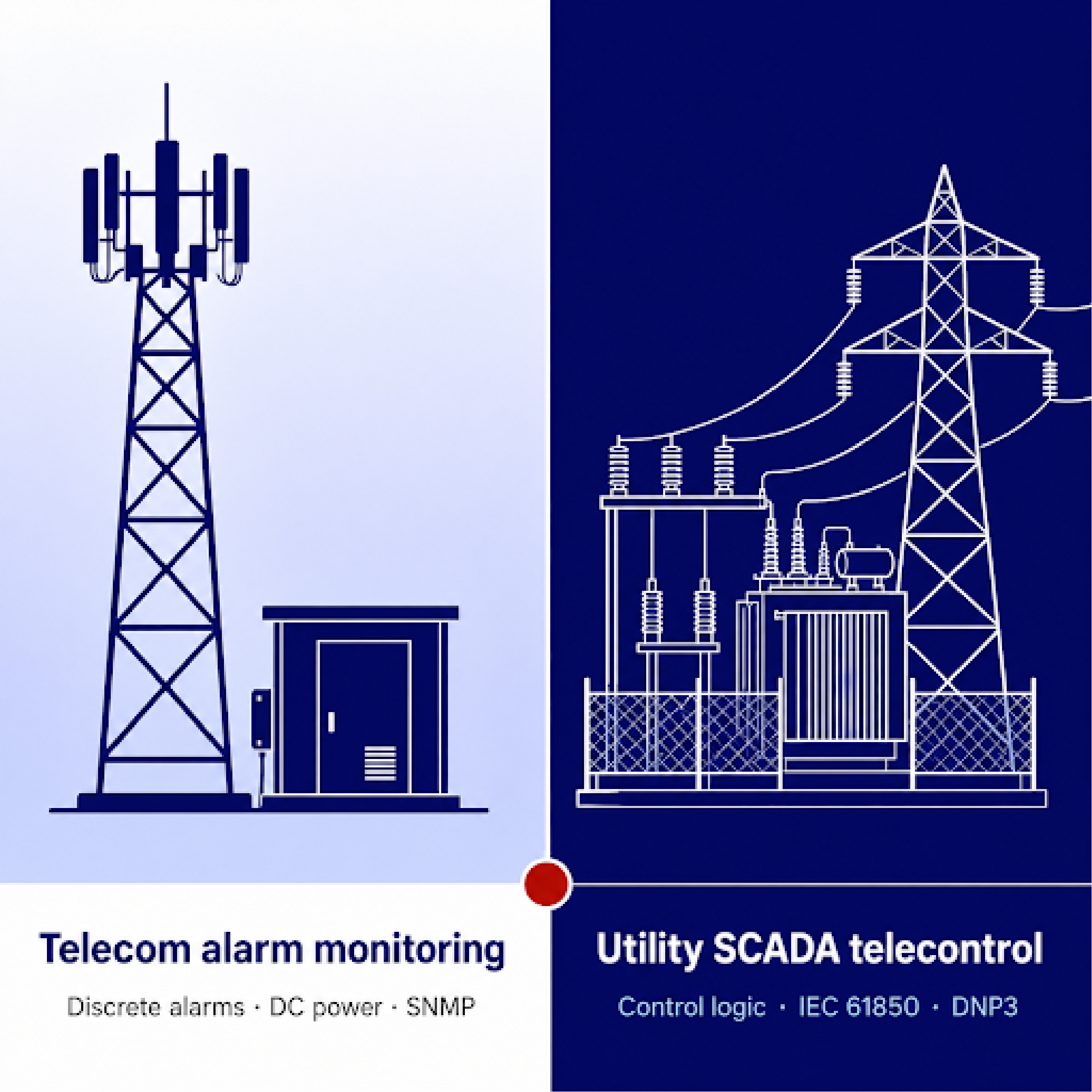
Telecom alarm monitoring manufacturers build for central offices, huts, and tower sites. Their units mount in a 19-inch rack and run on the -48 volt direct current (DC) power plant that's already in the building. Capacity is counted in alarm points, meaning dry contact closures wired in from batteries, rectifiers, generators, air conditioning, and door sensors, and a single unit may carry dozens or hundreds of them. They report to a network operations center over SNMP, and they carry telecom certifications like NEBS.
Utility Supervisory Control and Data Acquisition (SCADA) manufacturers build for substations, pump stations, and pipelines. Capacity is built up from plug-in modules instead of counted in alarm points, and the units often mount on DIN rail inside a control panel. Most include a programmable logic engine, so the device can act on what it reads instead of only reporting it upstream. Protocol support runs to utility standards like DNP3, International Electrotechnical Commission (IEC) 61850, and IEC 60870-5, and the hardware is rated for the electromagnetic conditions inside a high-voltage substation.
Which side you should be shopping on depends on what's in your cabinets. If your evaluation also has to cover master-station software, our comparison of the best RTU and master manufacturers for remote monitoring covers that pairing.
DPS Telecom builds remote monitoring gear for telecom carriers, rural and regional internet service providers (ISPs), power utilities, transportation agencies, public safety, and government, and all of it comes out of one set of facilities in Fresno, California. Printed circuit board assembly, firmware, chassis work, and NEBS compliance testing happen under our own roof. That's what lets us control the supply chain and turn a custom idea into a field-trial unit in about 90 days.
Custom work is a large share of what we build. A standard NetGuardian RTU covers roughly 80% of what clients need, and the other 20% is the part we find interesting. Tell us what you're trying to accomplish and we'll build it. Once your order runs past roughly 11 units there's no non-recurring engineering (NRE) charge, because the volume justifies the development on our side. Successful custom builds often become catalog items, so the work one operator commissions ends up solving the same problem for the next one.
Our RTUs routinely run 20 years or more in the field, we don't design in planned obsolescence, and we still support products that shipped decades ago. When you call, an application engineer picks up. Technical support is free for the life of the product, with 24x7 emergency coverage.
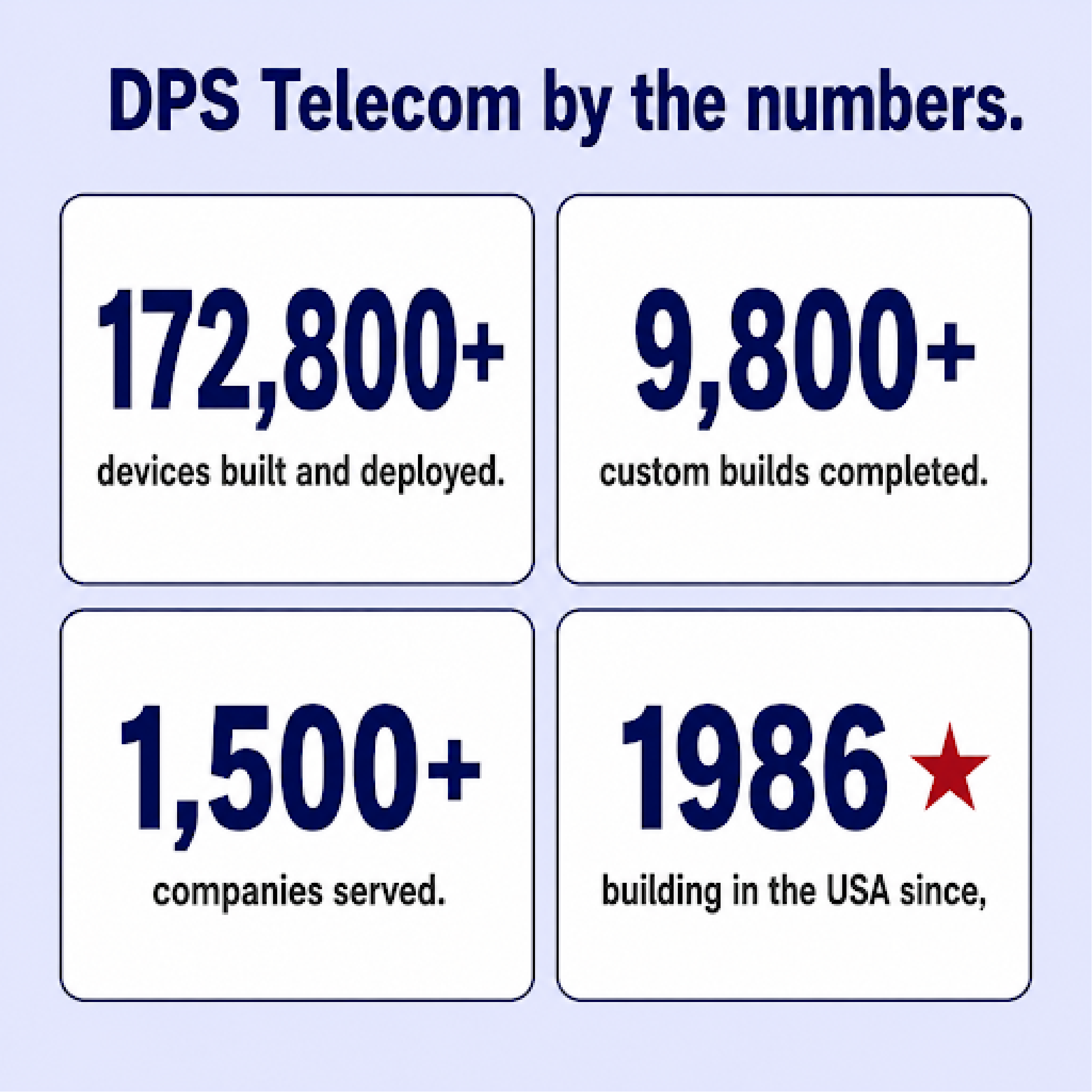
Across nearly 40 years, DPS Telecom has shipped more than 172,800 devices, completed over 9,800 custom builds, and worked with more than 1,500 companies. Remote monitoring is a small industry, and our RTUs sit in racks next to most of the hardware named here.
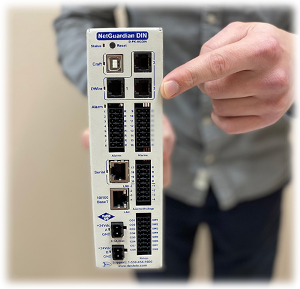
NetGuardian RTUs take discrete alarms, analog inputs, environmental sensors, power monitoring, and site access. They report over Ethernet, serial, fiber, cellular, or satellite through a gateway, and for compatibility with existing infrastructure they also support T1 and dialup. The NetGuardian NC and NetGuardian Expansion are certified to NEBS Level 3. Across the NetGuardian and T/Mon line we support over 25 protocols, including SNMP v1, v2c, and v3 with encryption, DNP3, Modbus, TL1, ASCII, and any number of other older protocols. We also mediate legacy and proprietary protocols into standard ones, so field equipment that predates your current network can report onto a modern IP network without being ripped out first.
Pairing our RTUs with the T/Mon alarm master gives you one accountable system across the network, and it leaves your options open. NetGuardian RTUs also report to third-party SNMP managers including SolarWinds, Castle Rock's SNMPc, and Nagios. Plenty of clients run T/Mon in one department and an existing SNMP manager in another, with the same RTUs feeding both.
Our comparative analysis of why buyers choose DPS Telecom works through these criteria feature by feature.
DPS Telecom is a strong fit when you want one accountable U.S. vendor across your RTUs, master station, and protocol mediation, when you're judging the purchase on 20-year cost of ownership rather than sticker price, and when you occasionally need a device nobody sells off the shelf yet. If that describes your network, put us on the shortlist.
Asentria has been building remote site automation and telemanagement hardware from the Seattle area since 1984. Its SiteBoss line handles site automation and connects to rectifiers, generators, heating, ventilation and air conditioning (HVAC) equipment, and access control. The TeleBoss line handles private branch exchange (PBX) management and call detail record collection. Both families support Lua scripting, so an engineer can write custom action logic onto the device itself rather than asking the manufacturer to build it. Asentria became part of Trystar, a power-resiliency company, in September 2025.
Best fit for sites that need telephone or PBX alarm aggregation alongside site monitoring, or teams that would rather script their own on-device logic than have it engineered for them.
Westell describes its remote monitoring products as an extension of an operator's operations support systems, and much of the line is aimed at cell tower operators. The flagship RMX-4000 is a one-rack-unit (1RU) chassis rated from -40 to 65 degrees Celsius. It carries four Power over Ethernet (PoE) ports, IPsec and OpenVPN tunneling, and SNMPv3. The RMM-400 puts 128 discrete inputs on a wire-wrap block and carries NEBS Level 1 certification. The DM Series is a set of compact DIN-rail modules for edge sites with very little rack space. Westell concentrates on tower light monitoring, generator fuel management, and tenant power metering, which are tower problems more than central office problems.
Best fit for tower operators who need tower-lighting and Federal Communications Commission (FCC) compliance monitoring, fuel management, or PoE-powered site cameras run off the RTU itself.
Multitel is a Canadian manufacturer, and it describes FUSION as an all-in-one remote telemetry unit for telecom, power utilities, and railways. The platform accepts -40 to -60 volts DC input and operates from -40 to 65 degrees Celsius. It supports SNMP v1, v2c, and v3 alongside Modbus, and handles up to 64 binary inputs and 11 analog inputs natively. It scales past that through a distributed architecture of external Modbus modules, so a growing site adds modules rather than a second RTU. Multitel acquired UMBRELA Corp in June 2026, which the company announced as an expansion of its environmental management and HVAC remote monitoring in Canada.
Best fit for telecom and utility sites that want one platform covering DC power, environmental control, and physical security.
Dantel is an established remote monitoring manufacturer, also based in Fresno, California, and its focus is central office modernization. The PointMaster Eagle is designed to drop into existing wire-wrap infrastructure through its Eagle Smart Adapter Kit, so an operator can reuse the wiring harness already in the building instead of rewiring the site. On a central office upgrade, reusing that harness saves the labor of pulling new wire to every alarm point. The Eagle scales from 64 to 256 alarm inputs and carries NEBS Level 3 certification. It also translates serial protocols such as TL1, DCP, TABS, and TBOS into secured IP protocols including SNMPv3, Secure Shell (SSH), and RADIUS.
Best fit for central office upgrades that need to preserve existing wire-wrap and bridge serial protocols to secure IP.
Schneider Electric's SCADAPack line sits between an RTU and a programmable logic controller (PLC), and the company positions it for oil and gas and for water and wastewater. The 47x, 57x, and 500E series run ARM Cortex processors across a -40 to 70 degree Celsius range, with native support for DNP3 with Secure Authentication, IEC 60870-5-104, and Modbus. Schneider highlights programmable logic written to the open IEC 61131-3 standard, along with licensed flow calculations for pipelines. Those are process control capabilities rather than alarm collection capabilities, which points the product at a different job than a telecom RTU.
Best fit for process control in oil, gas, and water where local control logic and fluid flow calculations matter more than discrete alarm density.
The Siemens SICAM A8000 is a modular platform built for electrical substation automation. The CP-8050 scales to 2,048 input/output (I/O) points, and Siemens rates the hardware for surge immunity up to 5 kV. Protocol support leans heavily toward utility standards, including IEC 61850 with high-speed Generic Object Oriented Substation Events (GOOSE) messaging, DNP3, and IEC 60870-5. Security features include a hardware crypto chip, IPsec, and IEC 62443-4-2 certification, and the platform can run isolated custom applications in Docker containers. Substation automation at transmission voltages is its own discipline, and the A8000 is designed around substation protocols and substation electrical conditions in a way a telecom alarm RTU never has to be.
Best fit for electrical transmission and substation operators that need deep IEC 61850 integration and hardware-level cybersecurity.
GE Grid Solutions, now GE Vernova, has a long history in North American grid automation through the Multilin D20 and D25 controllers. In June 2024 GE issued an end-of-manufacturing and supply notice for its conformal-coated D.20 I/O modules, and it now points utilities toward the Multilin D400 substation gateway. The D400 aggregates data from serial and LAN-based intelligent electronic devices, supports IEC 61131 soft logic through its LogicLinx tool, and secures communications with centralized authentication and Transport Layer Security (TLS) or virtual private network (VPN) tunneling.
Best fit for utilities standardizing on GE substation gateways for data concentration and soft logic.
The RTU500 series is offered through ABB and Hitachi Energy. The RTU560 is a rack-based system for large substations, while the RTU540 and RTU520 use compact DIN-rail housings for distribution sites. Protocol support covers IEC 61850, DNP3, IEC 60870-5, and Modbus. The 12.6 firmware release added fleet management that pushes firmware and configuration to large numbers of RTUs at once, along with brute-force login protection and IEC 62351-5 authentication. For an operator maintaining hundreds of units across a distribution network, pushing firmware centrally saves sending a technician to each site.
Best fit for large grid operators managing sprawling fleets that need centralized firmware management.
Open Systems International (OSI), acquired by Emerson in 2020, is best known for its monarch energy management and advanced distribution management software used by electric utilities. Its OSIRIS RTU is a Linux-based unit that integrates natively with monarch and expands through the OSIRIS XM module, so a control center already standardized on that software can add remotes without a second integration layer. On the oil and gas side, Emerson's FB3000 RTU and its FB1000 and FB2000 flow computers digitally sign their firmware so tampering can be detected, and they support DNP3 Secure Authentication v5 (SAv5) for cryptographically authenticated control actions.
Best fit for utilities already running OSI monarch that want native remotes, or oil and gas operators who need DNP3 SAv5 and on-device flow computing.
Netcontrol is an international automation provider focused on electricity distribution and cybersecurity, with the Netcon 500, the Netcon 200, and the GW502-iM gateway. Much of its positioning is built around compliance with the European Union's second Network and Information Security Directive (NIS2), using built-in firewalls, VPN tunneling, and IEC 62351-3 encrypted communications. Fleets are patched centrally through the Netcon Application Manager. The Netcon series supports more than 50 utility protocols and can act as an IEC 61850-8-1 gateway, translating substation data into IEC 60870-5-104 or DNP3 for control centers running those protocols.
Best fit for European utilities that prioritize NIS2 compliance and IEC 61850 gateway mediation.
Brodersen's RTU32M is a hybrid of an RTU and a PLC, built on ARM Cortex processors running Real-Time Linux and expandable to as many as 60 hot-swappable I/O modules. Its STRATON WorkBench environment supports all five IEC 61131-3 programming languages with cycle-by-cycle online debugging, which suits a team that writes and maintains its own control logic rather than specifying it to a vendor. Alongside Modbus, IEC 61850, DNP3, and Open Platform Communications Unified Architecture (OPC UA), there's a proprietary Binding protocol for fast, event-based data exchange between units across a wide-area network.
Best fit for logic-heavy utility, water, and power automation projects that need deep IEC 61131-3 programming.
Make a list of the equipment you need alarms on before you compare model numbers. That list tells you which group of manufacturers belongs on your shortlist, and it usually settles the question faster than working through spec sheets does.
How long the hardware lasts decides more of your cost than the purchase price does, so ask whether the manufacturer will still be supporting this model in 15 years. An RTU you have to replace early costs you the replacement project on top of the original purchase. Then ask who owns the problem when a site fails in the middle of the night. With an RTU from one company and a master station from another, coordinating between the two while alarms aren't arriving becomes your job.
DPS Telecom manufactures in the United States, engineers to fit the network you already have, and supports what we ship for decades. Our RTUs report into your existing SNMP manager, so choosing us doesn't cost you the tooling your team already knows.
Tell us what you're trying to accomplish, and we'll help you spec the right RTU for your network.
Talk to an Engineer | 800-693-0351

Andrew Erickson
Andrew Erickson is an Application Engineer at DPS Telecom, a manufacturer of semi-custom remote alarm monitoring systems based in Fresno, California. Andrew brings more than 19 years of experience building site monitoring solutions, developing intuitive user interfaces and documentation, and opt...