Check out our White Paper Series!
A complete library of helpful advice and survival guides for every aspect of system monitoring and control.
1-800-693-0351
Have a specific question? Ask our team of expert engineers and get a specific answer!
Sign up for the next DPS Factory Training!
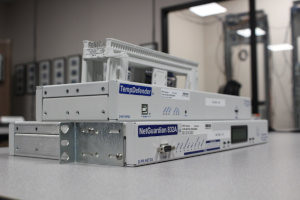
Whether you're new to our equipment or you've used it for years, DPS factory training is the best way to get more from your monitoring.
Reserve Your Seat Today
When "American-made" lands on your requirements list for remote monitoring, you're usually solving for something bigger than a label on the box. For the distributed, mostly unmanned sites that telecom carriers, utilities, transit agencies, public-safety operators, and government facilities depend on, domestic manufacturing gives you supply-chain control, procurement compliance, faster custom turnaround, and support you can actually reach. This guide ranks the U.S.-based remote monitoring manufacturers worth shortlisting and lays out the criteria we use to judge them, weighed over a 15 to 20 year service life rather than lowest upfront price.
We're DPS Telecom, and we've designed, built, and tested our monitoring equipment in Fresno, California since 1986. More than 172,000 of our devices are deployed across over 1,500 organizations, so the checklist below is the same one we walk clients through when domestic sourcing is a hard requirement. We build remote telemetry units (RTUs) and the T/Mon master station that collects their alarms, which puts us on both sides of a monitoring system.
For critical infrastructure, "American-made" is really a risk decision. It determines whether your equipment clears federal procurement rules, how fast you can absorb a supply-chain shock, and whether the engineers who designed your hardware are in your time zone when a site goes dark at 2 a.m.
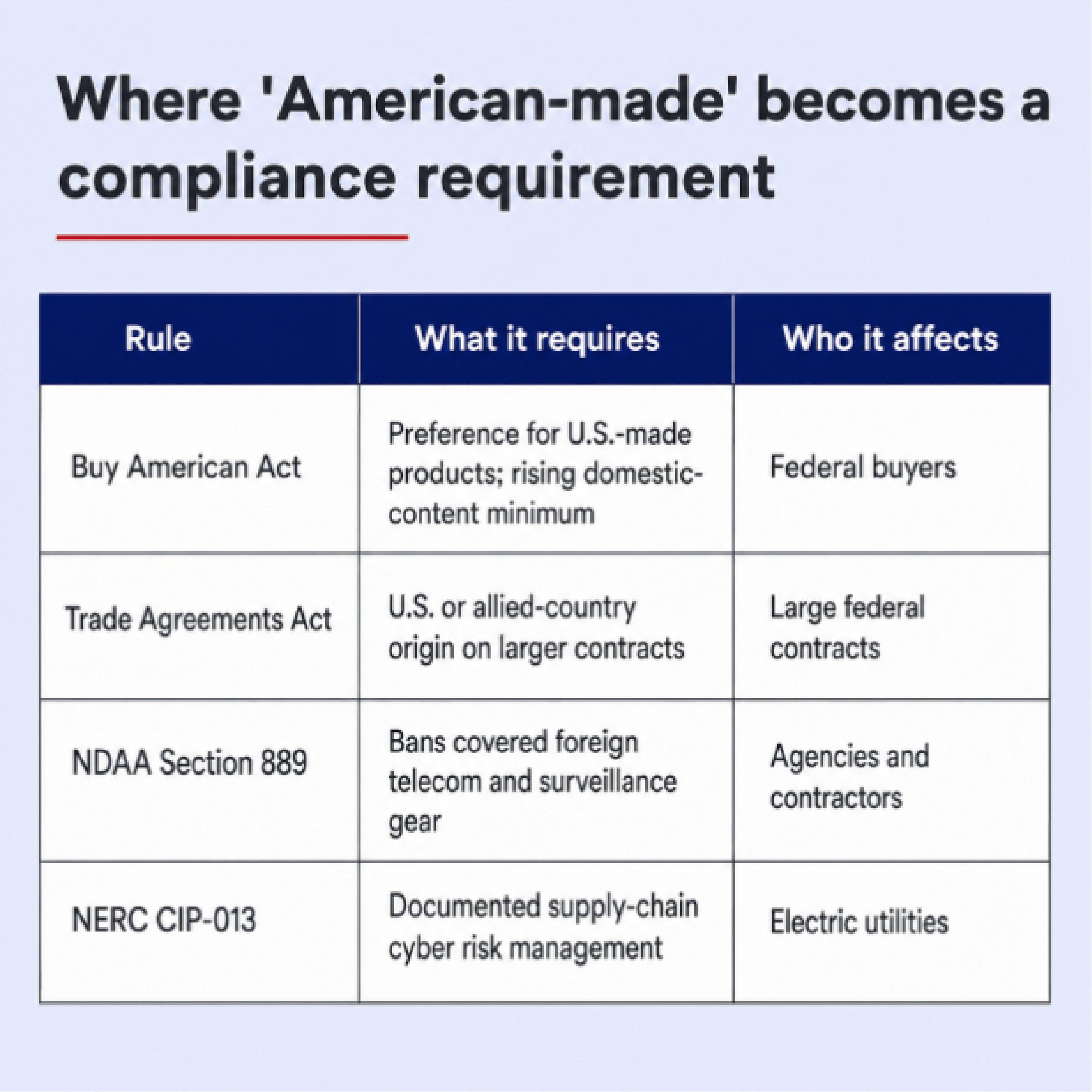
The phrase carries real procurement weight. The Buy American Act (BAA) sets a preference for domestic end products in federal purchasing, and recent Federal Acquisition Regulation (FAR) updates have raised the domestic-content threshold to 65 percent for items delivered in 2024, with a scheduled climb to 75 percent for items delivered starting in 2029. For larger contracts, the Trade Agreements Act (TAA) restricts purchases to products made in the United States or a designated country.

Supply-chain security rules reach further. Section 889 of the National Defense Authorization Act (NDAA) bars federal agencies and contractors from using certain foreign-made telecommunications and video surveillance equipment. For electric utilities, North American Electric Reliability Corporation Critical Infrastructure Protection standard CIP-013 (NERC CIP-013) puts documented supply-chain cybersecurity risk management on the operator. Because monitoring equipment sits close to your routers, radios, and cameras, knowing exactly where your RTUs and master station were built keeps a compliance gap from sneaking in through the back door.
There's a practical side too, beyond the regulations. A manufacturer that runs its own board assembly and engineering in the United States can redesign around a component shortage in weeks instead of waiting on an overseas contract manufacturer. And when something fails at a remote site, domestic support means reaching a person who shares your language and your working hours.
Not every provider that says "made in the USA" controls the same amount of its own supply chain, and the differences show up over a 15 to 20 year deployment. Here is what we look at:
Environmental resilience belongs on this list too. Remote sites see temperature swings, electrical noise, and vibration that office-grade hardware doesn't survive. For utility and transportation deployments, hardware built to standards like IEEE 1613 and IEC 61850-3 (fanless operation, tolerance from -40C to +75C, and high electromagnetic interference immunity) is what separates a 20-year unit from one that fails in under 10. Network Equipment-Building System (NEBS) testing is the telecom equivalent, and a vendor with its own testing lab can catch problems before hardware ever ships. Our guide to choosing the best RTU for your network goes deeper on matching hardware to site conditions.
With those criteria in mind, here is how the U.S.-based providers compare for critical-infrastructure remote site monitoring. Each entry notes where a provider legitimately fits, because the right choice depends on what you're monitoring.
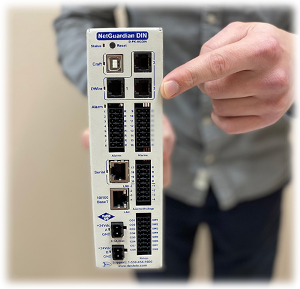
We built our NetGuardian RTUs and T/Mon master station in Fresno, California, where we've manufactured our monitoring equipment since 1986. Manufacturing is vertically integrated: circuit board assembly, chassis fabrication, firmware, and NEBS compliance testing all happen in-house, under an ISO 9001 quality system, in a lab that includes an anechoic chamber for electromagnetic testing.
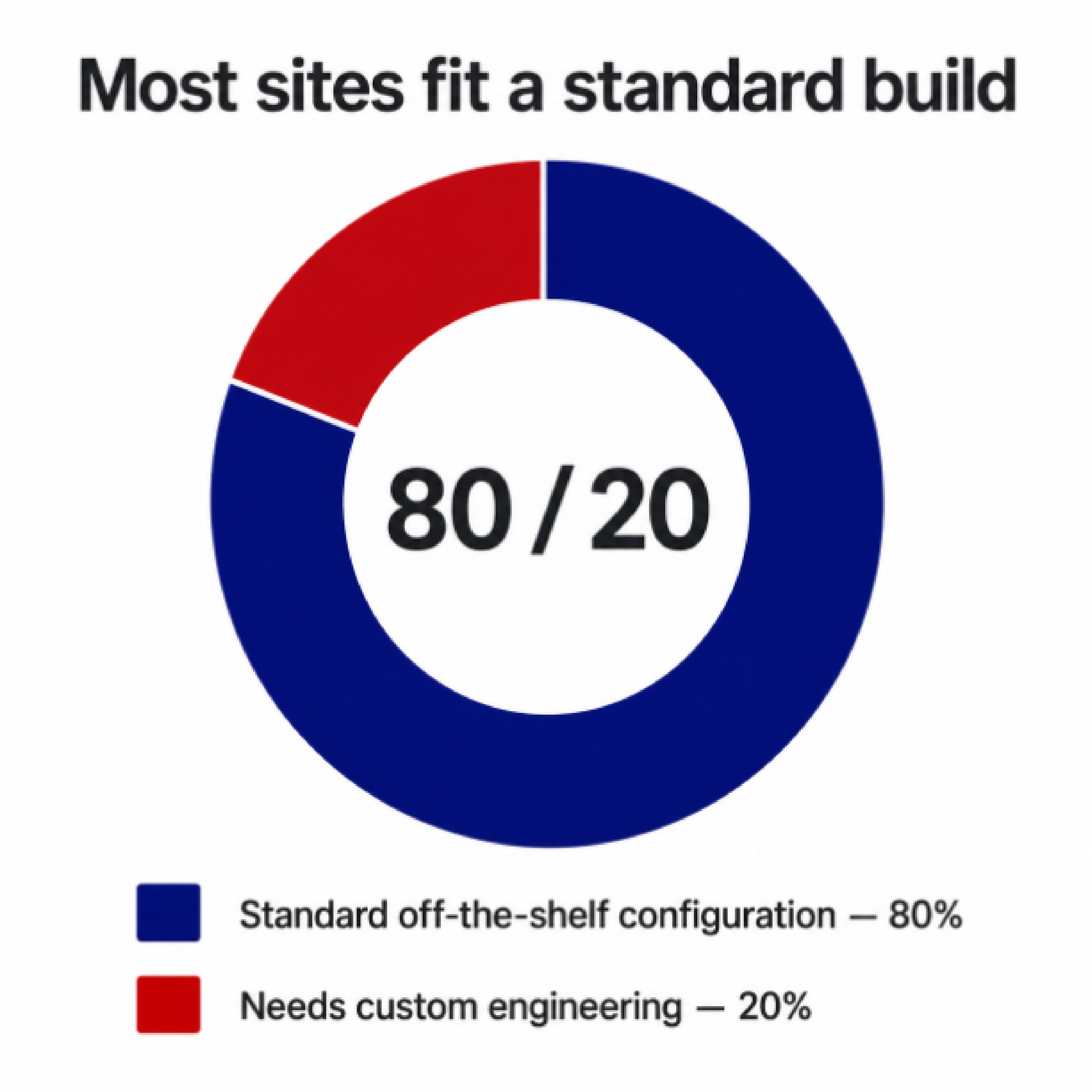
Custom engineering comes without NRE fees on orders above roughly 11 units, and a typical custom build ships as a field-trial unit in about two months. Our equipment is designed for 20-plus years of field life with no planned obsolescence, and when a product does reach end of life, there's a defined discontinued-equipment replacement path so you're not forced into a full swap-out. Support comes straight from the engineers who designed the gear, and every purchase includes factory training and lifetime support.
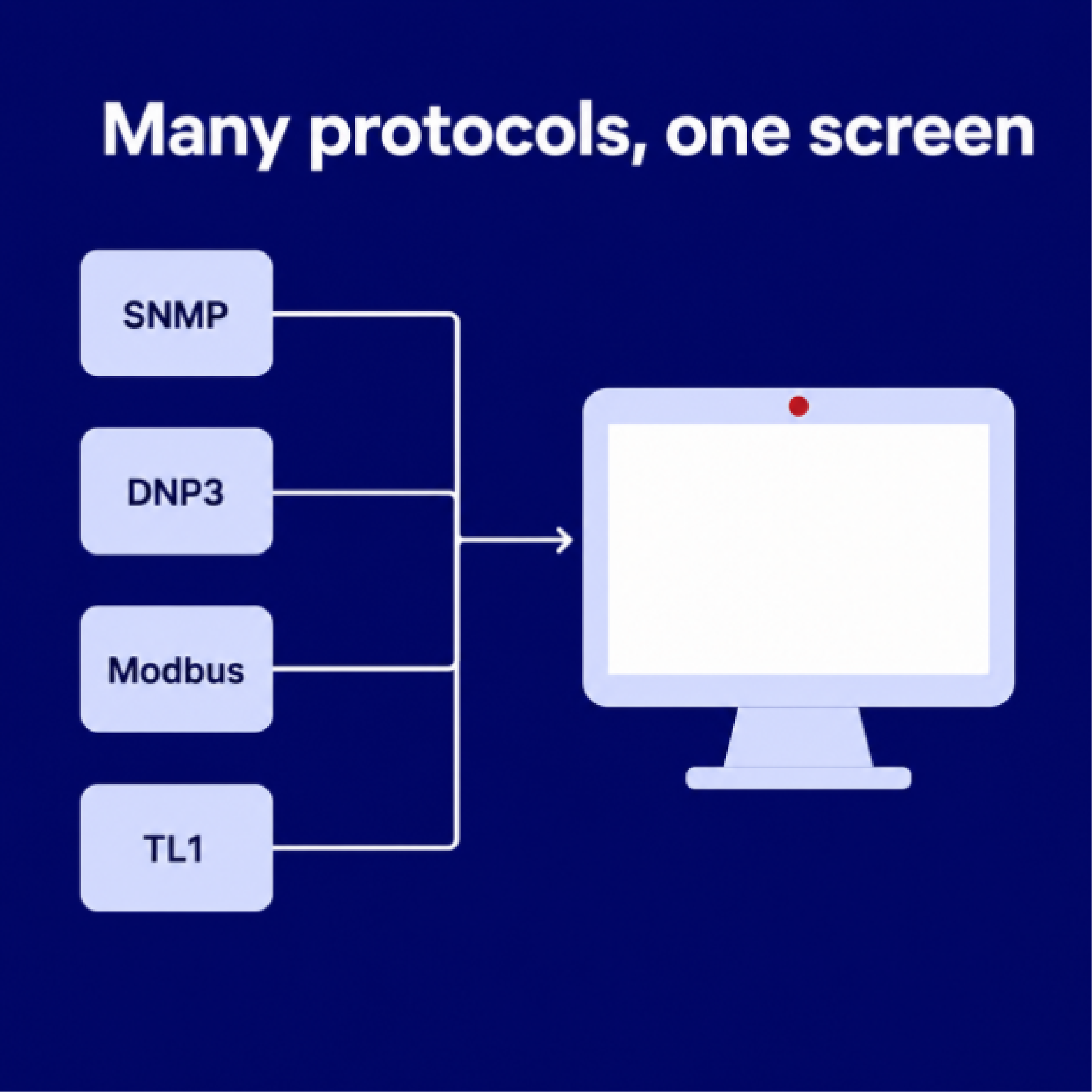
Single-vendor coverage is where we differ most from providers who build only one piece of the system. The NetGuardian RTU family collects alarms at the site, the T/Mon master station presents them on one screen, and T/Mon's protocol mediation (35 protocols, including DNP3, Modbus, TL1, and Simple Network Management Protocol (SNMP) versions 1 through 3) pulls older and proprietary equipment into the same view. If you'd rather keep your existing master, our RTUs also report to third-party SNMP managers like SolarWinds, Castle Rock, and IBM Open View, so choosing our hardware doesn't lock you into our software. That scale is proven in the field, with deployments at operators like Southern Company, Dominion Energy, the New York City Transit subway system, and AT&T, alongside smaller county, co-op, and rural-ISP networks.
Best fit: telecom carriers and fiber ISPs, electric utilities and co-ops, transit and public-safety agencies, and government facilities that want one accountable vendor for both the remote units and the master, with domestic manufacturing and custom-fit builds.
Westell manufactures core remote site management and telecom integration hardware in the United States. The company lists its core products as Made in the USA and as compliant with the Buy American Act, the Trade Agreements Act, and Build America, Buy America (BABA), which makes it a straightforward option for buyers who need documented compliance on federally funded projects such as broadband deployment. Some ancillary or older components may be sourced overseas, so compliance is worth confirming at the specific part-number level.
Best fit: buyers who need documented BAA, TAA, and BABA compliance on fiber distribution, power distribution, and remote site management hardware, especially for grant-funded builds.
Asentria designs and builds its SiteBoss site controllers in Seattle. The platform is Linux-based and supports Lua scripting, which appeals to teams that want to write their own site automation logic. Asentria was acquired by Trystar in 2025.
Best fit: telecom and industrial sites where a scriptable, Linux-based controller and in-house automation logic are priorities.
Schweitzer Engineering Laboratories (SEL) is a large, 100 percent employee-owned U.S. manufacturer with facilities in Pullman, Washington; Lewiston, Idaho; and Lake Zurich, Illinois. SEL is a well-established name in electric utility protection relays and substation automation, with deep support for DNP3 and IEC 61850. The company has noted that some final panel integration takes place in San Luis Potosi, Mexico, so utilities with strict domestic-content requirements should verify origin at the specific product level.
Best fit: electric utilities standardizing on protection relays and substation automation, where DNP3 and IEC 61850 are central.
Dantel is a long-standing California manufacturer, operating since 1971, that builds telecom monitoring systems including its WebMon and 460 ACS product lines. Like us, it manufactures domestically in Fresno.
Best fit: telecom operators looking for an established, California-based alarm monitoring option.
RLE Technologies manufactures and assembles most of its core products in the United States, with a focus on leak detection and environmental monitoring for data centers and critical facilities.
Best fit: data center and facility teams whose primary concern is leak detection and environmental logging.
Sensaphone manufactures its monitoring products in the United States and focuses on environmental monitoring for applications like heating, ventilation, and air conditioning (HVAC), cold storage, server rooms, and agriculture, along with auto-dialer alarm systems.
Best fit: server rooms, cold storage, and facility environmental monitoring built around proprietary sensors rather than heavy discrete and analog telecom alarm arrays.
Monnit manufactures commercial wireless sensor solutions in Utah. Its strength is broad, lower-cost wireless sensing for commercial Internet of Things (IoT) deployments. Buyers with federal sourcing requirements should request a certificate of origin for specific parts.
Best fit: commercial buildings and light-industrial sites that need many inexpensive wireless sensors rather than hardened, protocol-heavy site controllers.
| Provider | Where it's manufactured | Product scope | Best-fit buyer |
|---|---|---|---|
| DPS Telecom | Fresno, CA (vertically integrated) | RTUs, T/Mon master station, protocol mediation | Operators wanting one vendor for remote units and master, with custom builds |
| Westell Technologies | Aurora, IL (core products) | Remote site management, fiber and power distribution | Buyers needing documented BAA, TAA, and BABA compliance |
| Asentria | Seattle, WA | SiteBoss Linux-based site controllers | Teams wanting scriptable site automation |
| Schweitzer Engineering Laboratories (SEL) | Pullman, WA; Lewiston, ID; Lake Zurich, IL (some panel integration in Mexico) | Protection relays, substation automation | Electric utilities focused on DNP3 and IEC 61850 |
| Dantel | Fresno, CA | Telecom monitoring (WebMon, 460 ACS) | Telecom operators wanting an established CA option |
| RLE Technologies | Fort Collins, CO | Leak detection, environmental monitoring | Data center and facility leak-detection needs |
| Sensaphone | Aston, PA | Environmental monitoring, auto-dialers | Server rooms, cold storage, agriculture |
| Monnit | Salt Lake City, UT | Commercial wireless sensors | Commercial IoT sensor deployments |
(This comparison reflects published company information gathered during research. It may not capture every product line, and details can change since they were reviewed.)
Several recognized monitoring brands are headquartered or manufactured outside the United States, and that is the most common reason domestic-sourcing buyers narrow their field early. As one example, Ovarro (formerly Kingfisher/Servelec) is headquartered in the United Kingdom and manufactures its Kingfisher RTUs at a facility in Malaysia. That doesn't make the hardware bad, but it does place it outside the Buy American Act and Trade Agreements Act rules that many of you are bound by. If you carry federal-sourcing obligations, confirming a provider's manufacturing location early can save a lot of downstream work.
A product generally qualifies when it's manufactured in the United States and enough of its component cost is domestic to meet the current Federal Acquisition Regulation threshold, which is 65 percent for items delivered in 2024 and scheduled to reach 75 percent in 2029. Because no electronics maker sources every component domestically, compliance hinges on where "substantial transformation" (board assembly, firmware, and final assembly) happens.
Both can be compliant. A single-vendor system simplifies accountability and supply-chain auditing, which helps with standards like NERC CIP-013. A multi-vendor network can still be unified by a master station with protocol mediation, so you don't have to replace working equipment just to get one view of everything.
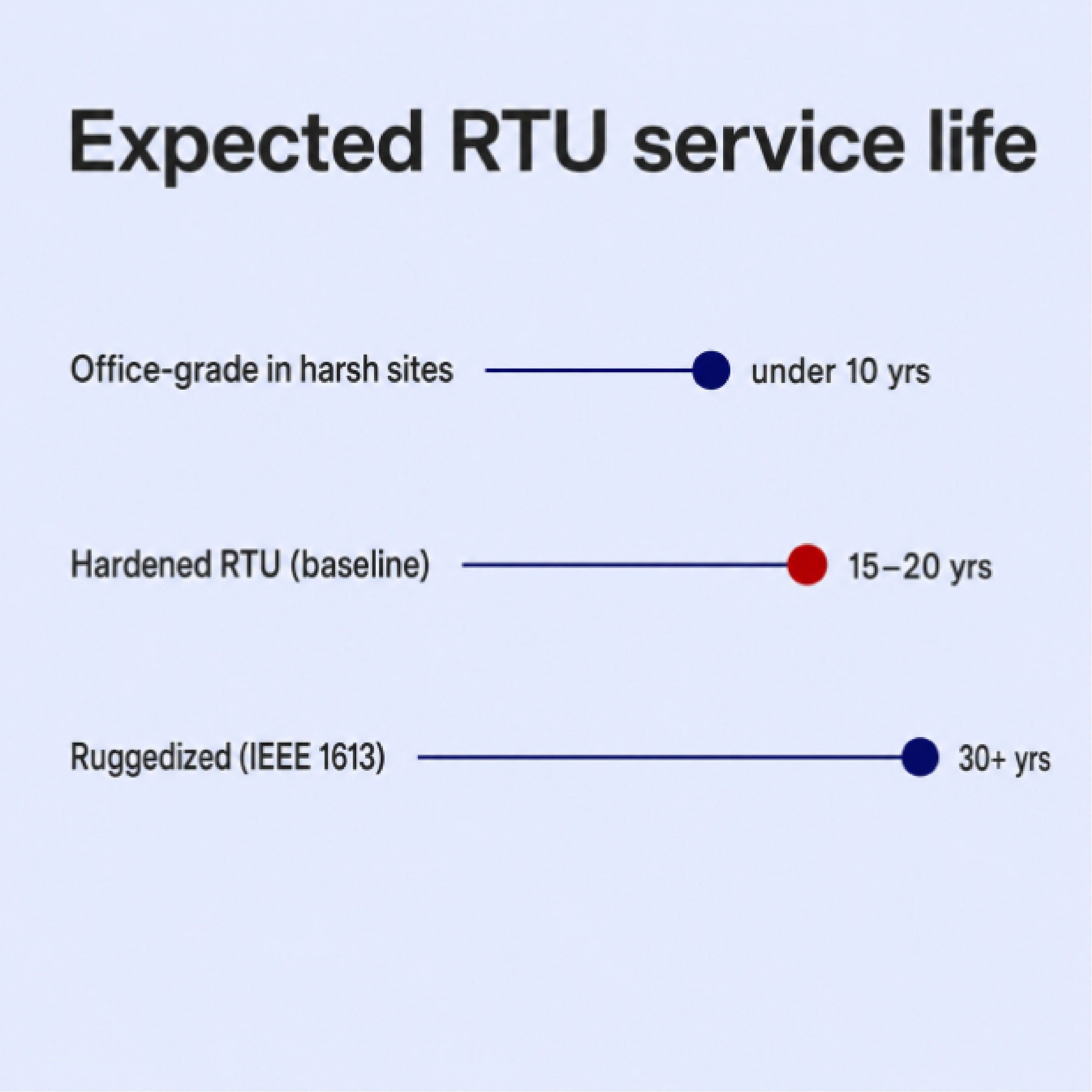
Industry estimates generally put the baseline service life of an RTU at 15 to 20 years, with hardened units running longer, while office-grade hardware in harsh sites can fail in under 10. Environmental hardening and a vendor's obsolescence policy are the two biggest factors.
Often, yes. Domestic manufacturing carries higher labor and facility costs, so the upfront price can run higher than offshore hardware. Over a 15 to 20 year life, that gap is usually offset by custom engineering without NRE fees, no forced obsolescence, and included support and training.
If domestic manufacturing, custom-fit hardware, and support from the people who built your equipment are on your list, we'd like to help you scope it out. Tell us what you're trying to monitor and we'll work through the options with you, whether that's a handful of county sites or a thousand-site utility rollout.
Talk to an Engineer | 800-693-0351

Andrew Erickson
Andrew Erickson is an Application Engineer at DPS Telecom, a manufacturer of semi-custom remote alarm monitoring systems based in Fresno, California. Andrew brings more than 19 years of experience building site monitoring solutions, developing intuitive user interfaces and documentation, and opt...