Check out our White Paper Series!
A complete library of helpful advice and survival guides for every aspect of system monitoring and control.
1-800-693-0351
Have a specific question? Ask our team of expert engineers and get a specific answer!
Sign up for the next DPS Factory Training!
Whether you're new to our equipment or you've used it for years, DPS factory training is the best way to get more from your monitoring.
Reserve Your Seat Today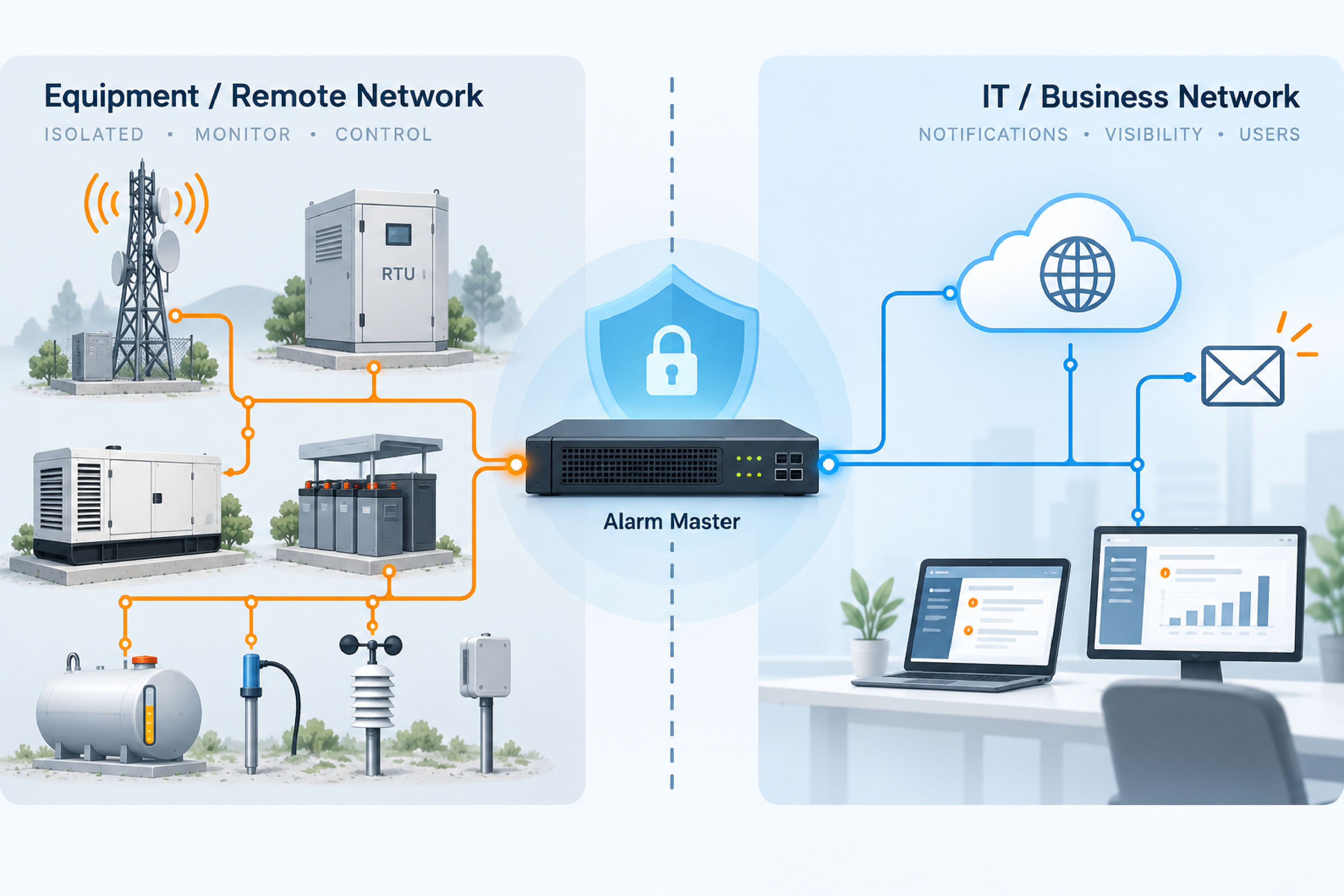
Monitoring network isolation is the practice of keeping the network that connects remote site equipment - RTUs, radios, power plants, and sensors - physically or logically separate from the organization's business IT network. A dual-homed alarm master sits at the boundary, with one network interface on the isolated equipment network and another on the IT network, so alarms and email can reach people without opening a path between the two networks.
This article explains why public safety and utility teams isolate their monitoring networks, how a central alarm master with multiple network interfaces makes that practical, and how the same system can consolidate site alarms and analog readings like generator fuel levels into one view. It is written for radio systems technicians, communications managers, and IT staff at counties, emergency communications agencies, and utilities.
Remote site equipment was rarely designed with the internet in mind. Many RTUs, power plants, and radio infrastructure devices assume they live on a trusted, private network. When that assumption breaks, the exposure can be significant.
The most common way it breaks is accidental. A single connection between the equipment network and a network with internet access - a misconfigured switch port, a convenient patch cable, or a router added for a short-term project - can expose dozens of devices at once. Teams that have lived through this kind of incident tend to make isolation a priority afterward.
Isolation reduces the risk in several ways:
An alarm master is the central system that collects alarms from field RTUs and other devices, stores history, and notifies people. When it has two or more network interface cards (NICs), each interface can sit on a different network.
A typical isolated design looks like this:
| Interface | Connects To | Used For |
|---|---|---|
| Equipment-side NIC | Isolated monitoring network with RTUs and site devices | Polling RTUs, receiving SNMP traps, collecting analog readings |
| IT-side NIC | County or corporate IT network | Email notifications, network time, user access to the web interface |
| Out-of-band access | KVM or console connection | Administration without opening the equipment network |
The point is that the alarm master is the only system with a foot in both networks, and it does not route traffic between them. RTUs never need a path to the internet to send an email; they report to the alarm master, and the alarm master sends the email from its IT-side interface. DPS T/Mon alarm masters support multiple network interfaces for exactly this kind of separation.
Coordinate the design with IT early. Decide which services the IT-side interface needs - usually mail relay and a time source - and restrict it to those. Firewall rules on the IT side should allow the alarm master to send mail and receive user web sessions, and little else. DPS outlines more on secure monitoring design.
Modern trunked radio systems often come with their own element manager that collects alarms from radio equipment. It is natural to ask whether a separate site monitoring system is still needed.
Many agencies keep both, and intentionally duplicate some alarms between them, for good reasons:
An existing fleet of site RTUs, such as units in the NetGuardian family, can keep emailing alarms during the transition and then report to the central alarm master once it is in place.
Sizing an alarm master starts with device count and growth plans, not with the largest platform available. A county or agency with around 20 RTUs and a goal of centralizing existing alarms usually does not need a large-network system.
A practical approach:
Starting smaller is not a dead end. Data and configuration can move to a larger platform later if the network grows past what the smaller system was sized for.
As generator fleets grow, simple dry-contact low-fuel alarms stop being enough. A team with two generators can live with "fuel low" alarms. A team with fifteen needs to know how much fuel is in every tank so deliveries can be planned.
The usual progression:
That last point matters for adoption. The facilities employee who manages generators is often not a radio technician and does not want to log into several systems. A single consolidated screen and a scheduled email meet that person where they are.
Derived Alarms help as well. Low fuel by itself may be a routine refill item, and commercial power failure by itself may be expected at a site with backup. Both at once is critical, and an alarm master or RTU can create a single high-priority alarm for that combination.
Off-grid radio sites powered by solar, batteries, and generators add new equipment to monitor: solar charge controllers, battery management systems, and rectifiers. These systems often expose data through SNMP or Modbus rather than contact closures.
Planning tips for off-grid sites:
Homegrown collectors built on small single-board computers are sometimes used to gather battery data. They can work, but a supported RTU that polls the battery system directly is easier to maintain across many sites.
To limit who can reach field equipment, contain mistakes such as an accidental internet connection, and simplify security reviews. Site equipment often assumes it is on a trusted private network.
The RTUs report to a central alarm master on the isolated network. The alarm master uses a second network interface on the IT network to send email and get network time, without routing traffic between the two networks.
Usually yes. Radio managers focus on radio equipment, while RTUs cover site infrastructure such as doors, power, generators, batteries, and fuel. RTUs and alarm masters also send after-hours notifications directly.
A small-network platform such as the T/Mon MINI is typically a good starting point for around 20 devices, with larger platforms available if the network grows.
Yes. Analog fuel readings from each site can be grouped into one view on the alarm master and sent out as a scheduled email report.
Often yes, through SNMP or Modbus if the equipment supports it. An RTU at the site can poll those systems and report their data with the rest of the site alarms.
If your radio or utility monitoring network shares a path with IT, or your site alarms are spread across systems that only some people can see, a dual-homed alarm master can isolate the equipment and consolidate the alarms. DPS Telecom has helped public safety agencies and utilities monitor remote sites since 1986. Get a Free Consultation, or call 1-800-693-0351 or email sales@dpstele.com.

Andrew Erickson
Andrew Erickson is an Application Engineer at DPS Telecom, a manufacturer of semi-custom remote alarm monitoring systems based in Fresno, California. Andrew brings more than 19 years of experience building site monitoring solutions, developing intuitive user interfaces and documentation, and opt...