Check out our White Paper Series!
A complete library of helpful advice and survival guides for every aspect of system monitoring and control.
1-800-693-0351
Have a specific question? Ask our team of expert engineers and get a specific answer!
Sign up for the next DPS Factory Training!
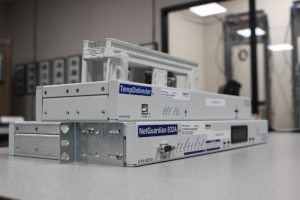
Whether you're new to our equipment or you've used it for years, DPS factory training is the best way to get more from your monitoring.
Reserve Your Seat Today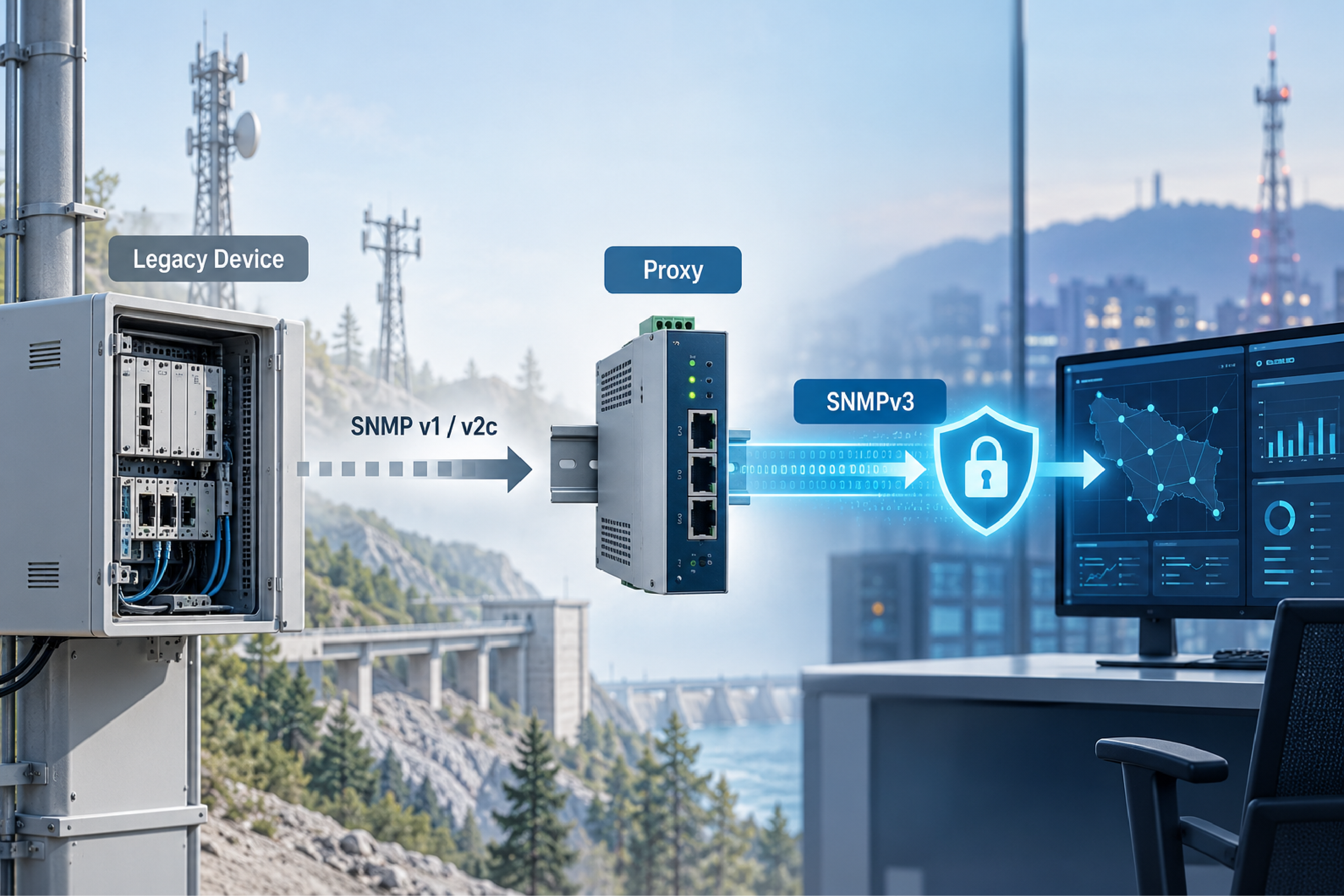
An SNMPv3 proxy is a device that sits between older SNMP equipment and the network that carries its traffic, receiving SNMPv1 or SNMPv2c messages and re-sending them as authenticated, encrypted SNMPv3 messages. It lets a network meet modern security requirements without replacing field equipment or the management system that still speaks an older version of SNMP.
This article explains why SNMP version gaps happen, how a proxy secures traffic in transit, how to handle a head-end management system that cannot read SNMPv3, and when an alarm master acting as a mid-level manager is the better design. It is written for network engineers at telecom carriers, utilities, transportation agencies, and public safety networks who have legacy SNMP devices and a security policy that no longer accepts them on the wire.
SNMP has been the default language of network monitoring for decades, and long-lived equipment keeps the version it shipped with. A rectifier, radio, or transport shelf installed fifteen years ago may only send SNMPv1 or v2c traps. A firmware update may not exist, or the vendor may no longer support the product.
Meanwhile, security expectations have moved on. SNMPv1 and v2c protect messages with only a community string, which works "almost like a VLAN tag" and is "not as secure as a password," as DPS factory training describes it. The community string travels in clear text. Anyone who can see the traffic can read the alarm contents and learn the string. SNMPv3 adds user-based authentication and encryption, which is why security reviews increasingly require it.
The result is a common mismatch:
Replacing every legacy device to close that gap is expensive and slow. A proxy closes it at the network layer instead.
An SNMP proxy for this purpose is a small protocol converter installed near the legacy device. The device keeps sending exactly what it always has. The proxy receives the v1 or v2c trap on a local connection, re-packages the same information as an SNMPv3 trap with authentication and encryption, and forwards it across the network to the SNMP manager.
The alarm content does not change. A customer described it well during a recent discussion with DPS: "it's the same information just wrapped in a slightly different packet." What changes is who can read it in transit and whether the receiver can trust where it came from.
Typical characteristics of a field proxy:
The key design principle is to keep the unencrypted segment as short as possible. If the only clear-text SNMP traffic is a cable run inside a locked cabinet, the exposure is small. For background on how traps are structured, see DPS's guide to SNMP traps.
Securing the field end solves only half the problem when the management system at the head end also speaks only v1 or v2c. If the manager cannot decrypt v3, sending it v3 traps will not help.
There are three practical ways to handle this:
| Approach | How It Works | Considerations |
|---|---|---|
| Upgrade or configure the manager for v3 | Enable SNMPv3 users on the existing management system | Cleanest, if the manager supports v3 for the relevant device types; confirm with its supplier |
| Proxy pair: secure the middle | A field proxy converts v1/v2c to v3; a head-end unit converts v3 back to v1/v2c for the manager | Leaves every existing device unchanged; the head-end conversion must be confirmed with the proxy vendor for your specific setup |
| Alarm master as mid-level manager | An alarm master collects v3 traffic from many sites, then forwards alarms to the existing manager in a format it accepts | Adds filtering, history, and protocol options; best for multi-site networks |
The proxy pair is attractive because nothing already deployed changes. The legacy device at one end and the legacy manager at the other both see the SNMP version they expect, and only the network in between sees v3. It is not yet a common request, so ask the proxy vendor to confirm the reverse conversion with your equipment before committing to the design, and ask the management system supplier whether it can accept a v3-wrapped trap from a device it expects to send v2c.
A mid-level manager is a monitoring system that collects alarms from field devices, processes them, and forwards a selected subset to another system above it. Instead of every field device talking directly to the head-end manager, they talk to the mid-level manager, and it talks upward.
This architecture becomes the better choice when:
DPS's T/Mon alarm masters are commonly deployed this way. T/Mon mediates 35+ protocols, keeps alarm history, and can forward alarms northbound as SNMP, DNP3, Modbus, or ASCII text, with filtering so only the severities a given team cares about leave the system. Sizes range from the T/Mon MINI for small networks up to large-network platforms. For a deeper explanation of translating between protocols, see how protocol mediation works.
Converting traffic to SNMPv3 is a strong step, but it is one part of a broader plan. Factory training stresses a simple rule for any device that offers encryption: "When we do have encryption, we allow you to force it." Having v3 available is not the same as requiring it.
A practical checklist:
Where RTUs collect contact closures and analog readings at the same site, current-generation units in the NetGuardian family can send SNMPv3 traps natively, so the proxy is needed only for the legacy equipment that cannot.
A proxy is a bridge, not a permanent substitute for current equipment. Choosing between the two comes down to the device's remaining life and what else it lacks.
Standardization matters in either case. Many teams stick with one proxy or RTU model across all sites because their staff is trained on it and support is simpler, even as they keep firmware current.
It receives SNMPv1 or v2c messages from a legacy device and re-sends the same information as authenticated, encrypted SNMPv3 messages, so traffic is secure in transit without changing the device.
No. The alarm content stays the same. Only the packet format, authentication, and encryption change.
That is a head-end conversion, and it is a less common design. Confirm it with the proxy vendor for your specific equipment, and check with the management system supplier whether it can accept SNMPv3 directly instead.
Not by modern standards. A community string travels in clear text with SNMPv1 and v2c and works more like a label than a password. SNMPv3 replaces it with user authentication and encryption.
When there are many sites, when different teams need different subsets of alarms, or when the upstream system needs a protocol other than SNMP. An alarm master can terminate SNMPv3 from every site and forward filtered alarms upward.
DIN rail proxies typically run from 12, 24, or -48 VDC to match telecom and utility sites. Where only AC is available, an AC/DC converter is used.
If a security review is pushing you toward SNMPv3 but your field equipment and management system are not ready, a proxy or a mid-level alarm master can close the gap without replacing gear that still works. DPS Telecom has designed monitoring equipment since 1986 and can help you pick the architecture that fits your network. Get a Free Consultation, or call 1-800-693-0351 or email sales@dpstele.com.

Andrew Erickson
Andrew Erickson is an Application Engineer at DPS Telecom, a manufacturer of semi-custom remote alarm monitoring systems based in Fresno, California. Andrew brings more than 19 years of experience building site monitoring solutions, developing intuitive user interfaces and documentation, and opt...