Check out our White Paper Series!
A complete library of helpful advice and survival guides for every aspect of system monitoring and control.
1-800-693-0351
Have a specific question? Ask our team of expert engineers and get a specific answer!
Sign up for the next DPS Factory Training!
Whether you're new to our equipment or you've used it for years, DPS factory training is the best way to get more from your monitoring.
Reserve Your Seat Today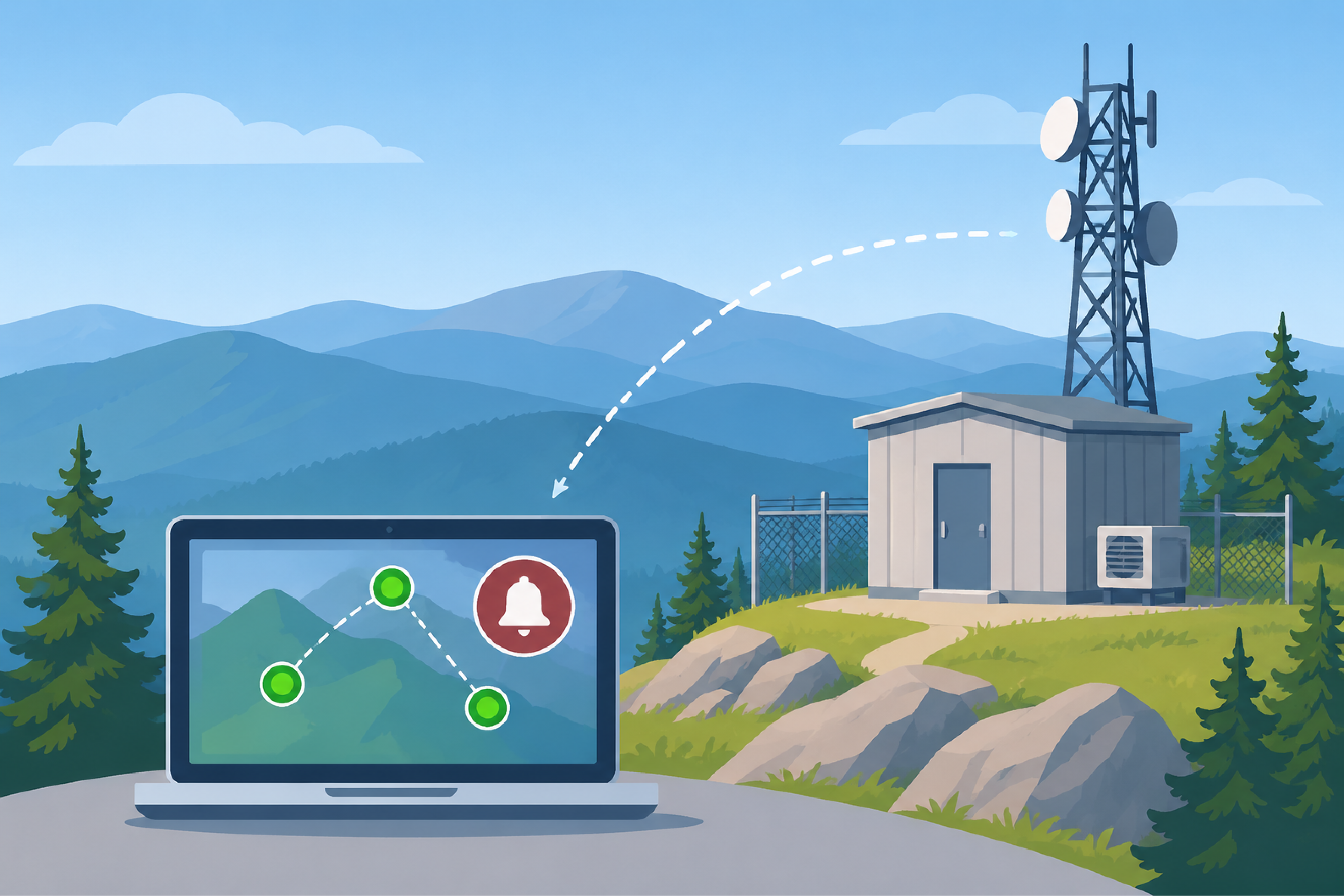
Monitoring without a NOC means running alarm monitoring for a radio or communications network when no one staffs a network operations center around the clock. Instead of an operator watching a screen, the monitoring system itself has to decide what matters, notify the right person, and prove on a regular basis that it is still watching.
This article explains how small public safety agencies and their service providers can monitor mountaintop radio sites without a NOC, how prebuilt device modules shorten SNMP setup, why a quiet monitoring system needs scheduled reports, and how Derived Alarms and silencing keep notifications meaningful. It is written for fire departments, emergency communications agencies, and the radio service shops that support them.
Many fire departments and small public safety agencies operate radio sites on mountaintops, often two or three of them, linked by microwave and running simulcast. They have capable radio service partners, but neither the agency nor the partner runs a 24-hour NOC. Without monitoring, the agency learns about problems when something fails and someone calls the service shop.
The risk is not just the dramatic outage. It is the quiet degradation that comes first:
Each of these is survivable if someone knows. Monitoring without a NOC is about making sure someone does, through notifications rather than a staffed console. A map view is still useful for a quick look, but as one fire department communications lead put it, the most important thing is getting the alarms.
Most modern radio infrastructure, microwave radios, and DC power plants report over SNMP. To make sense of that traffic, a monitoring system needs each manufacturer's MIB.
A MIB (Management Information Base) is a file the equipment manufacturer provides that describes the structure of the device's SNMP data. Without it, a manager receives an SNMP trap but cannot tell what it means. With it, the manager can extract which alarm occurred and its value.
The traditional workflow is labor-intensive:
For a small agency without a dedicated network engineer, that is a lot of setup. It is also where problems hide: some MIBs contain errors, and a few manufacturers have gone out of business without leaving usable files.
A device module is a prebuilt set of rules for a specific manufacturer and product that tells the alarm master how to read that device's alarms. Instead of compiling MIBs and writing rules, the user selects the module, enters the device's IP address and site name, and the alarm definitions fill in automatically.
DPS T/Mon alarm masters include a library of device modules organized by manufacturer, covering many common rectifiers, power plants, radios, and access devices. T/Mon mediates 35+ protocols, so SNMP devices and RTUs can report into one system.
| Situation | What Happens |
|---|---|
| Module exists for the device | Select it, enter IP and site name, verify alarms |
| Module exists for a close relative of the device | Engineering checks whether the existing module can be adapted with small changes |
| No module exists | A new module is built from the manufacturer's MIB, then validated against live traffic |
| Customer has in-house engineering | Device modules are open, so the customer can build or adjust modules themselves |
Before committing to a monitoring platform, send the vendor your complete equipment list - radio base stations, microwave radios, power plants, battery systems - and ask which modules already exist. That single question often decides whether a project can move forward immediately.
When a module does not exist, it is usually developed from the manufacturer's MIB and then validated in the customer's network, because no vendor has every model of radio and power plant in its lab. The process typically looks like this:
This is closer to a beta than a lab-certified release, and that is fine. Real traffic from your own equipment is the best test there is. Ask the vendor for a timeline up front, since module work competes with other engineering priorities.
A month without alarms can mean two very different things: the network is healthy, or the monitoring path is broken. Without a NOC, nobody would notice the difference.
DPS factory training frames this with a simple contrast. Asynchronous reporting, where devices send traps only when something happens, is fast and light, but "its failure mode is silence." Polling makes silence meaningful, because a device that stops answering raises its own alarm. Instructors compare it to an action-movie guard taken out before he can radio in, versus a boss who regularly asks, "Where are you?"
Practical ways to prove the system is watching:
DPS covers more ways to detect a lost reporting path in maintaining visibility when the network is down.
Without a NOC to filter alarms, every notification goes straight to a person's phone. Nuisance alarms quickly teach people to ignore them. Three tools help.
Derived Alarms combine conditions into one alarm that reflects what actually matters. Low fuel with commercial power present is a routine refill. Commercial power failure with fuel available is expected at a site with a generator. Commercial power failure and low fuel together is critical, because the site is running out of time. Derived Alarms can also suppress expected events: a generator alarm during its scheduled exercise window, such as Tuesdays from 10 to 11 a.m., can be held back, while a "failed to test" alarm fires if the generator did not run in that window.
Timed silencing quiets a known problem for a set period. Silence a site during a maintenance window, or for two days while waiting on a replacement part, and the silence expires on its own so nobody forgets to turn alarms back on.
Role-based notification sends each alarm to the right person. Radio technicians, power technicians, and administrators can have separate profiles, each with their own password and rights, such as permission to acknowledge alarms or view only. On-call schedules can rotate who receives notifications.
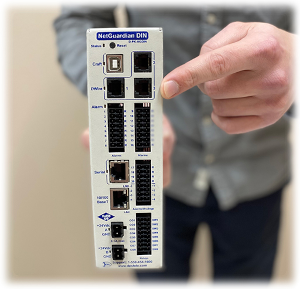
At the site level, RTUs in the NetGuardian family add contact-closure monitoring for doors, generators, and HVAC that radio equipment does not report on its own.
Many trunked radio systems are sold with the vendor's own element manager. For agencies without a NOC, the question is whether that manager is required, or whether radio equipment can report directly to a site alarm master.
The answer depends on the specific radio products. Some devices send standard SNMP traps that any manager can read with the right MIB or module. Others route alarms through the vendor's own manager. Ask the radio vendor and the alarm master vendor together, with exact model numbers, before finalizing the design. If the element manager is required, the alarm master can usually still collect the radio alarms from it, alongside site infrastructure alarms from RTUs, and handle notification for both. For the protocol translation side, see how protocol mediation works.
For a two- or three-site network, a small platform such as the T/Mon MINI is usually the right size, with the option to grow.
Yes. An alarm master can collect alarms from radio, microwave, power, and site RTUs, then send email and text notifications to on-call staff, with scheduled reports to show the system is working.
A MIB is a file from the equipment manufacturer that describes the structure of its SNMP data. The monitoring system uses it to interpret traps and values from that device.
A prebuilt rule set for a specific manufacturer and product. Selecting the module and entering the device's IP address configures its alarms without compiling MIBs or writing rules.
One can usually be built from the manufacturer's MIB and validated against live traffic in your network by triggering a few non-service-affecting test alarms.
Poll key devices so a lost device raises an alarm, and schedule a weekly report by email. A report that arrives with no alarms confirms the system is watching.
Use timed silencing for the site or alarm. The silence expires automatically at the end of the window, so alarms return without anyone having to remember.
If your agency runs radio sites without a NOC, the monitoring system has to do the watching for you. DPS Telecom has supported public safety and utility networks since 1986, and can check your equipment list against existing device modules before you commit. Get a Free Consultation, or call 1-800-693-0351 or email sales@dpstele.com.

Andrew Erickson
Andrew Erickson is an Application Engineer at DPS Telecom, a manufacturer of semi-custom remote alarm monitoring systems based in Fresno, California. Andrew brings more than 19 years of experience building site monitoring solutions, developing intuitive user interfaces and documentation, and opt...