Check out our White Paper Series!
A complete library of helpful advice and survival guides for every aspect of system monitoring and control.
1-800-693-0351
Have a specific question? Ask our team of expert engineers and get a specific answer!
Sign up for the next DPS Factory Training!
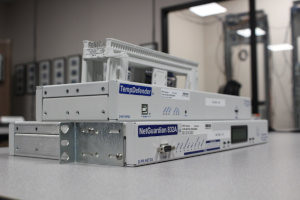
Whether you're new to our equipment or you've used it for years, DPS factory training is the best way to get more from your monitoring.
Reserve Your Seat Today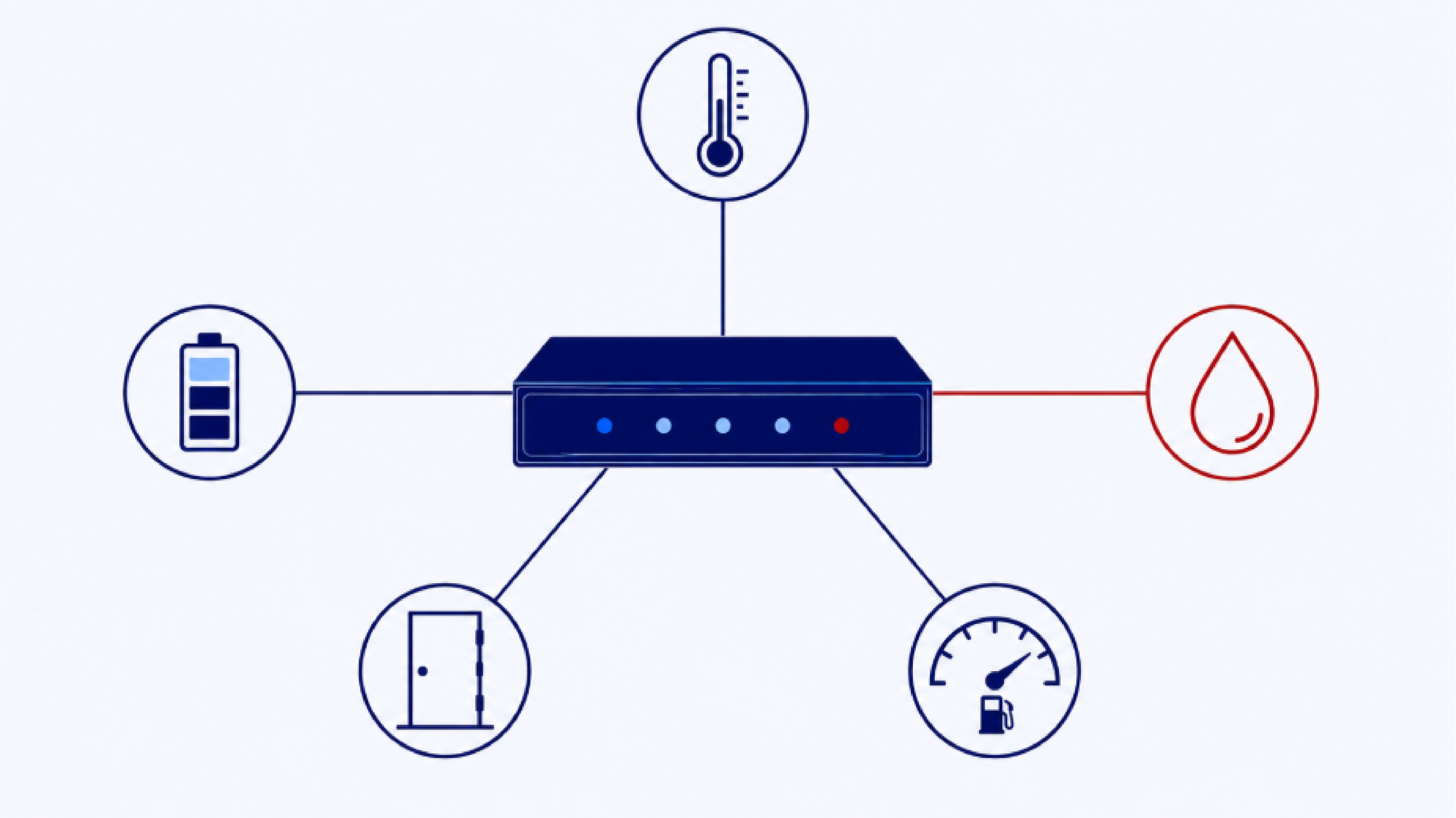
Your SCADA system already tells you what the grid is doing at each substation. Breaker positions, bus voltages, transformer loading, and fault events from your relays and IEDs all flow back to the control room in real time. Then a technician drives two hours to an unmanned site for a vague "station alarm" and finds a rectifier that had failed, a battery string that dried out, or a control house running ten degrees too hot. Your grid data looked fine the whole time, because the trouble was in the supporting infrastructure your grid SCADA doesn't poll. Your relays and IEDs report what the grid is doing, not the health of the DC plant that powers them, the rectifier that keeps that plant charged, or the HVAC that holds the control house in range. Your relays and IEDs report what the grid is doing, not the health of the equipment that keeps them running.
You improve substation visibility by monitoring the part of the site your grid SCADA doesn't cover: the DC power and battery plant, rectifiers, backup generators and fuel, HVAC and temperature, water and smoke, and physical access. RTUs are what make that possible. A well-configured RTU polls these site devices directly, translates older or proprietary equipment into the standard protocols your system already speaks (DNP3, SNMP, and Modbus), and forwards everything to a central master station so operators can watch every unmanned site from one screen.
At DPS Telecom, we've built RTUs and master stations for utilities since 1986, and we've manufactured more than 172,000 monitoring devices. Everything below sits alongside your grid SCADA and protective relaying rather than replacing either one.
Most substation monitoring content focuses on primary grid data, because that is what SCADA was designed around. The visibility gaps that cause surprise failures, safety events, and wasted truck rolls are usually in the supporting infrastructure and site conditions instead. Improving visibility means finding that gap and closing it, one category of equipment at a time.
Grid SCADA and RTU site monitoring cover two different layers of the same substation.
| What your grid SCADA already sees (primary electrical data) | What RTU site monitoring adds (site power, environment, and access) |
|---|---|
| Breaker and switch positions | DC battery plant voltage and cell-level health |
| Bus and line voltages | Rectifier and charger status |
| Line loading and power flow (MW and MVAR) | Loss of commercial (AC) power |
| Transformer loading and tap-changer position | Generator run status and fuel level |
| System frequency | HVAC performance, temperature, and humidity |
| Fault events and relay targets | Water intrusion and smoke |
| Protection and control actions | Door access and perimeter intrusion |
We'll walk you through each item in the right-hand column: what to monitor, why it matters, and how an RTU brings it into view.
The DC battery plant is the most important auxiliary system in the substation, so it is the right place to start. Your protective relays, breaker trip coils, digital fault recorders, and SCADA communications all run on DC. If a fault hits the line and the battery string can't deliver the voltage and current to trip the breaker, the breaker doesn't open. That is how a routine fault turns into transformer damage.
Manual battery checks leave months-long blind spots. A technician measures float voltage and cell impedance on a quarterly visit, and a cell can dry out or short in between. An RTU tied into your battery monitoring closes that gap by reporting string and float voltage, cell-level health, and temperature continuously, and it raises an alarm the moment a cell drifts off its baseline. That continuous record also gives you auditable evidence for NERC PRC-005 protection-system maintenance without a site visit. If battery health is your immediate concern, our battery voltage monitoring page covers the specifics.
Rectifiers keep the DC plant charged, which makes them easy to overlook until one fails. When a rectifier drops offline, or when commercial AC power goes out and the site falls back on its plant, the batteries start discharging. Without visibility, you often don't find out until the whole plant is low and the relays are at risk. An RTU monitors rectifier output, charger alarm contacts, and loss of commercial power, so you catch a charging problem while the batteries are still full and you have time to schedule a repair during normal hours.
A backup generator only helps if it starts and has fuel. A generator that fails to crank, or a fuel tank that has been slowly siphoned or leaking, turns a short outage into a long one. RTUs monitor run status, fault conditions, and fuel level, and they can pull that data from the major generator brands you already run, including Kohler, Cummins, and Generac, over Modbus or dry contacts. You confirm the generator is ready during a routine check, well before the next outage puts it to the test.
The control house environment decides how long your microprocessor relays and communication gear last. Heat shortens the life of solid-state electronics, and humidity leads to condensation inside equipment cabinets. RTUs track indoor temperature and humidity, and they can run local HVAC control logic to keep the room in range.
Trending is where the real payoff shows up. Trending means watching how a reading moves over time instead of only alarming when it crosses a fixed threshold. Say the RTU logs HVAC runtime and shows the compressor running longer and longer to hold the same setpoint while outdoor temperatures stay flat. That slow climb is your early warning of a failing compressor, a refrigerant leak, or a clogged filter, and you often see it weeks before a plain high-temperature alarm would ever trip.
That head start is the benefit. You service the unit during business hours, skip the emergency after-hours call, and avoid the thermal damage a dead HVAC system would do to your relays. Moving from calendar-based maintenance to condition-based maintenance this way is one of the clearest returns on adding site telemetry.
Water and fire cause fast, expensive damage, and both are easy to catch early. Floor-level moisture sensors wired to an RTU flag a roof leak or a failing pipe before the water reaches an energized cabinet, and smoke detection gives you the first warning of a fire in an unmanned building. These are simple discrete inputs, but they protect some of the most expensive assets on the site.
Substations are remote, unmanned, and increasingly targeted, so knowing who is on site matters. RTUs accept inputs from door contacts, motion sensors, badge readers, and perimeter sensors, and they report an entry attempt the instant it happens. If someone opens a cabinet holding a protective relay or a network switch, or breaches the fence, the alarm reaches your operations or security center right away. This is also the layer that supports your NERC CIP physical security obligations, which we cover further down.
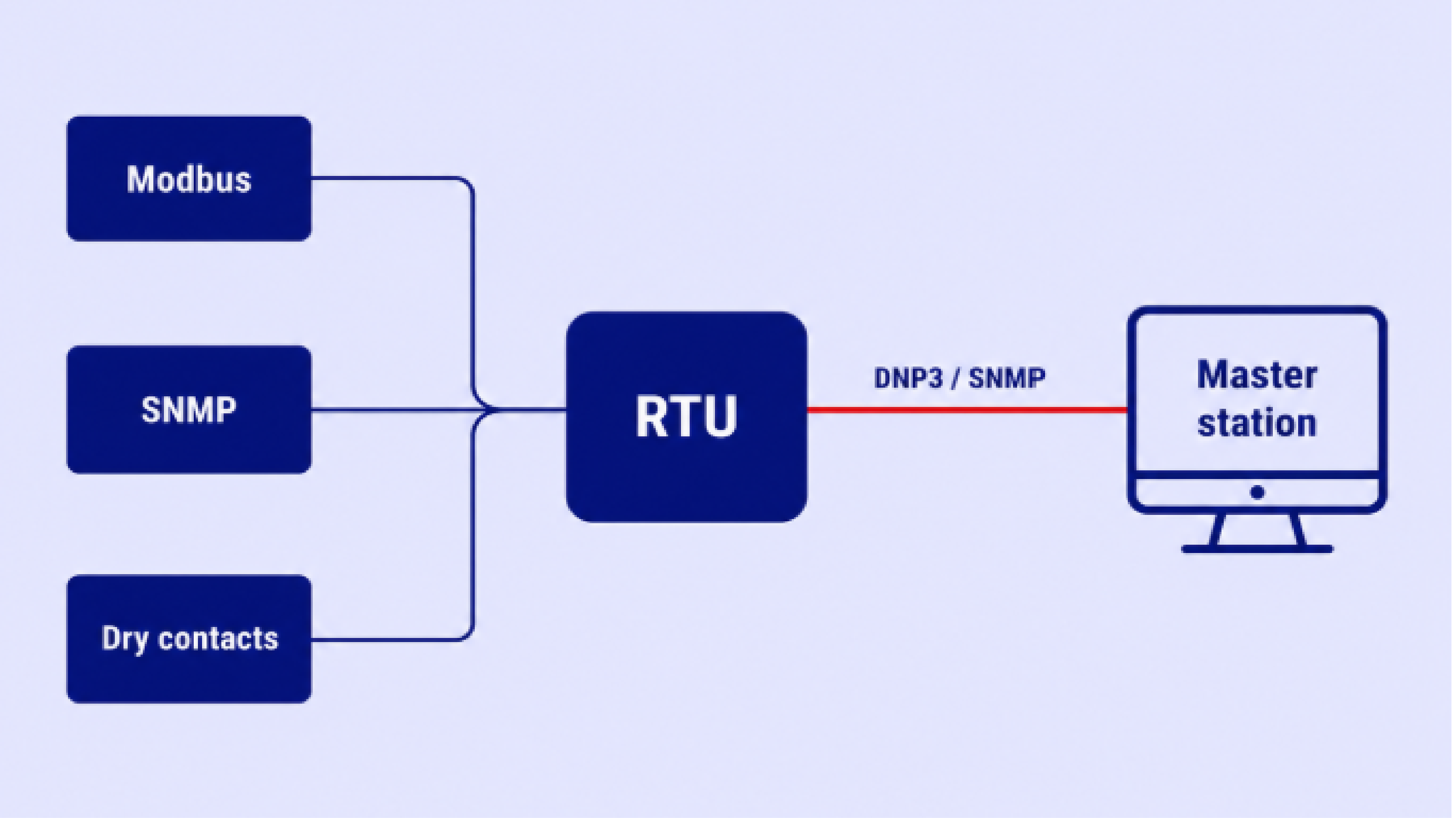
Most utilities hit the same practical obstacle. A substation is full of equipment from dozens of vendors, installed over thirty or forty years, speaking a mix of serial, IP, and proprietary formats. You can't rip all of it out, and you shouldn't have to.
An RTU works as a gateway and data concentrator for that mixed environment. It polls each site device in its native protocol (Modbus, SNMP, or simple dry contacts), normalizes the readings, and presents them upstream to your master in a standard protocol such as DNP3 or SNMP. The result is that a proprietary battery monitor or an older HVAC controller becomes visible in the same system you already use, without a forklift upgrade. Our equipment supports DNP3, Modbus, and SNMP (v1, v2, and v3) natively, and our T/Mon master station mediates 30-plus protocols so mixed sites report cleanly to one place. If you have specific devices that only speak Modbus, our Modbus-to-SNMP converter page shows how that mediation works in practice.
Individual RTUs can be your whole monitoring system when you have a handful of sites, since you can log into each one's web interface. Once you grow past roughly ten sites, that approach gets unmanageable fast, and you end up with dozens of icons and no single picture of your network.
A master station solves that by aggregating alarms from all your RTUs and remote equipment into one screen, often with a map view and mobile alerts. It lets a small operations team watch hundreds of unmanned sites at once. The NetGuardian RTU family reporting to a central master is the standard pattern we build for utilities of every size, from an electric cooperative running a handful of sites to a large utility monitoring well over a thousand.
Centralizing creates one predictable problem of its own, alarm floods. A single event at a site can trip dozens of related alerts, and a bouncing door switch can throw twenty state changes in a second. When every toggle reaches the operator, the real warnings get buried. Good RTUs handle this at the edge with report-by-exception logic, debounce timers, and chatter filtering, so only stable, meaningful events travel upstream. Prioritizing genuine alarms over nuisance ones is what keeps operators focused during an actual event, and it follows the same alarm-management principles laid out in standards like ANSI/ISA-18.2.
Expanding what you monitor is worth doing because it moves numbers your management already watches.
Fewer truck rolls and less windshield time. When operators can see exact site conditions remotely, they stop dispatching techs just to diagnose a vague alarm. They fix what they can from the control room, and when a truck roll is genuinely needed, the tech arrives, briefed and carrying the right part. A single dispatch to a remote substation gets expensive once you count wages, the vehicle, overhead, and the hours a tech spends behind the windshield, and a real share of first trips fail when the tech goes in blind and has to come back. Cutting those out across hundreds of sites adds up quickly. Our guide to the best ways to enhance power utility telemetry goes deeper on the math.
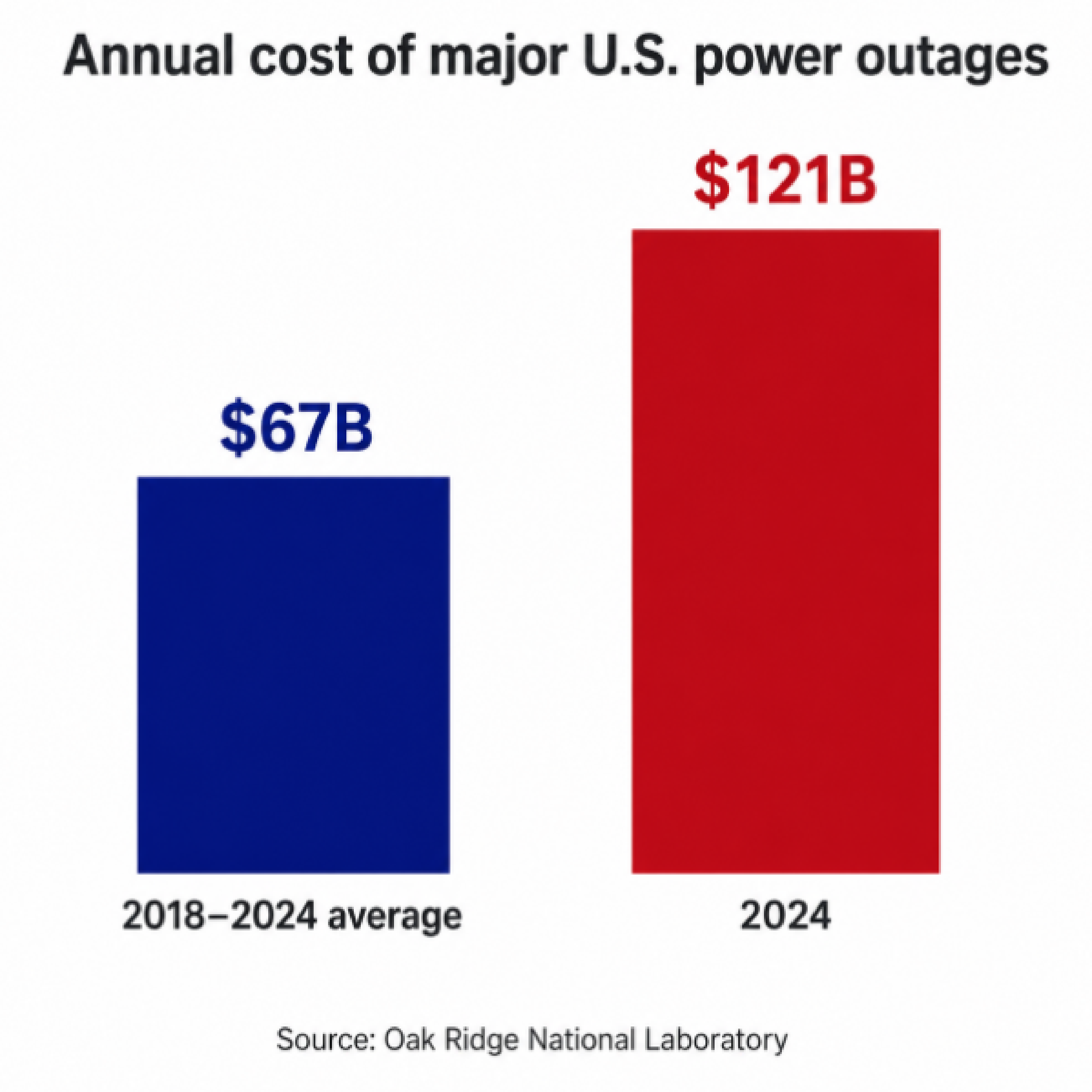
Fewer small faults that turn into outages. Support-equipment failures often start or prolong the outages that hurt most. Oak Ridge National Laboratory reports that major power outages cost U.S. electricity customers an average of about $67 billion a year from 2018 through 2024, and roughly $121 billion in 2024 alone. Seeing a discharging battery plant, a low fuel tank, or a failing cooling system early is how you keep a local equipment fault from cascading into a customer-facing interruption.
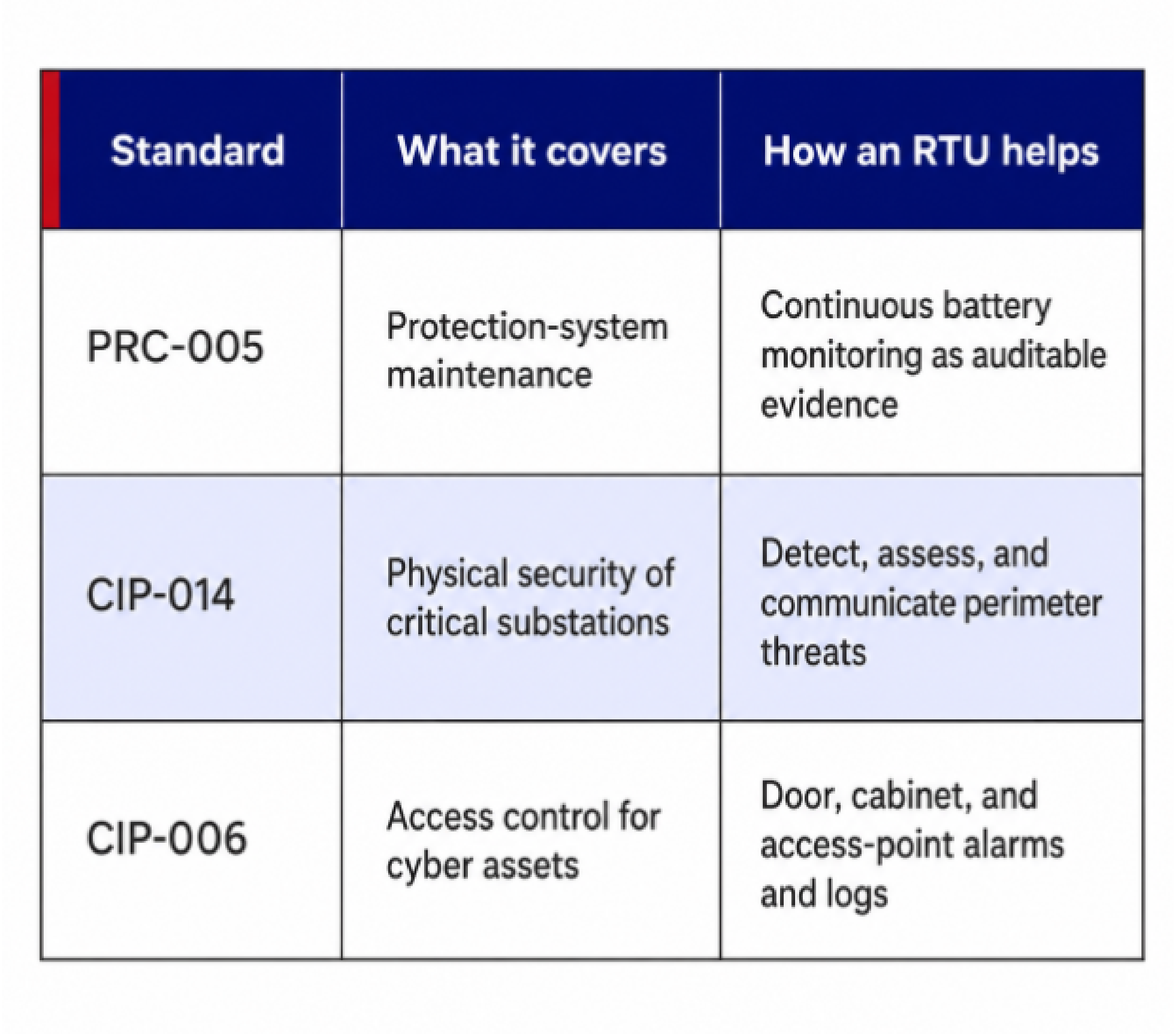
Stronger evidence for NERC compliance. Regulators increasingly expect the kind of continuous visibility RTUs provide. NERC PRC-005 covers protection-system maintenance, where continuous battery monitoring supplies auditable evidence. CIP-014 requires you to detect, assess, and communicate physical threats at critical substations, and CIP-006 governs access control and logging for the cyber assets inside them. RTUs feeding a central master are how many utilities demonstrate those functions are actually working, especially given the rising physical and cyber threats to grid infrastructure documented in recent years.
Do RTUs replace protective relays or grid SCADA? No. RTUs complement your protection and control systems by monitoring the supporting infrastructure and site conditions that primary SCADA and relays don't cover. Your relays keep protecting the grid; the RTU makes sure the equipment that keeps those relays running stays healthy.
Can an RTU monitor equipment that only speaks Modbus or an older serial protocol? Yes. That is one of the main jobs of a monitoring RTU. It polls the device in its native protocol and presents the data upstream in DNP3 or SNMP, so older and proprietary gear becomes visible in the system you already run without replacing it.
How many substations can one master station monitor? A single master station is designed to aggregate alarms from hundreds of remote sites onto one screen, which is why utilities move to a master once they grow past roughly ten sites. The right architecture depends on your network size and protocol mix, and it is worth scoping with an engineer.
Closing your site-level visibility gaps starts with deciding what to monitor and how to bring your existing equipment into one view. That is exactly the kind of project we scope every day. If you're choosing hardware, our buying guides on how to choose the best RTU for utility substation monitoring and the substation monitoring system buying guide are good next steps.
When you're ready to talk through your own sites, we'll help you map your visibility gaps and build a monitoring plan that fits the equipment you already have.
Talk to an Engineer | 800-693-0351

Andrew Erickson
Andrew Erickson is an Application Engineer at DPS Telecom, a manufacturer of semi-custom remote alarm monitoring systems based in Fresno, California. Andrew brings more than 19 years of experience building site monitoring solutions, developing intuitive user interfaces and documentation, and opt...