Check out our White Paper Series!
A complete library of helpful advice and survival guides for every aspect of system monitoring and control.
1-800-693-0351
Have a specific question? Ask our team of expert engineers and get a specific answer!
Sign up for the next DPS Factory Training!
Whether you're new to our equipment or you've used it for years, DPS factory training is the best way to get more from your monitoring.
Reserve Your Seat TodayBoth the DPS Telecom NetGuardian DIN and the RLE Technologies Falcon F200 start from the same I/O footprint: 8 discrete alarm inputs and 4 sensor channels. On paper, that similarity makes them look interchangeable. In practice, the two products were built for different environments and different operational requirements, and choosing the wrong one for a telecom deployment can create real problems down the line.
This comparison walks through the specifications, power architecture, protocol support, scalability, and support models for both units. We've tried to evaluate each product fairly on its own terms. RLE describes the Falcon F200 as a compact facility monitor for server rooms and IT closets. We build the NetGuardian DIN specifically for telecom infrastructure, which means some of the differences below are features we prioritize by design, not happy accidents.
Note: The Falcon F200 data below was gathered from published RLE product information and may not capture the full breadth of available configurations. Some specifications may have changed since it was reviewed.
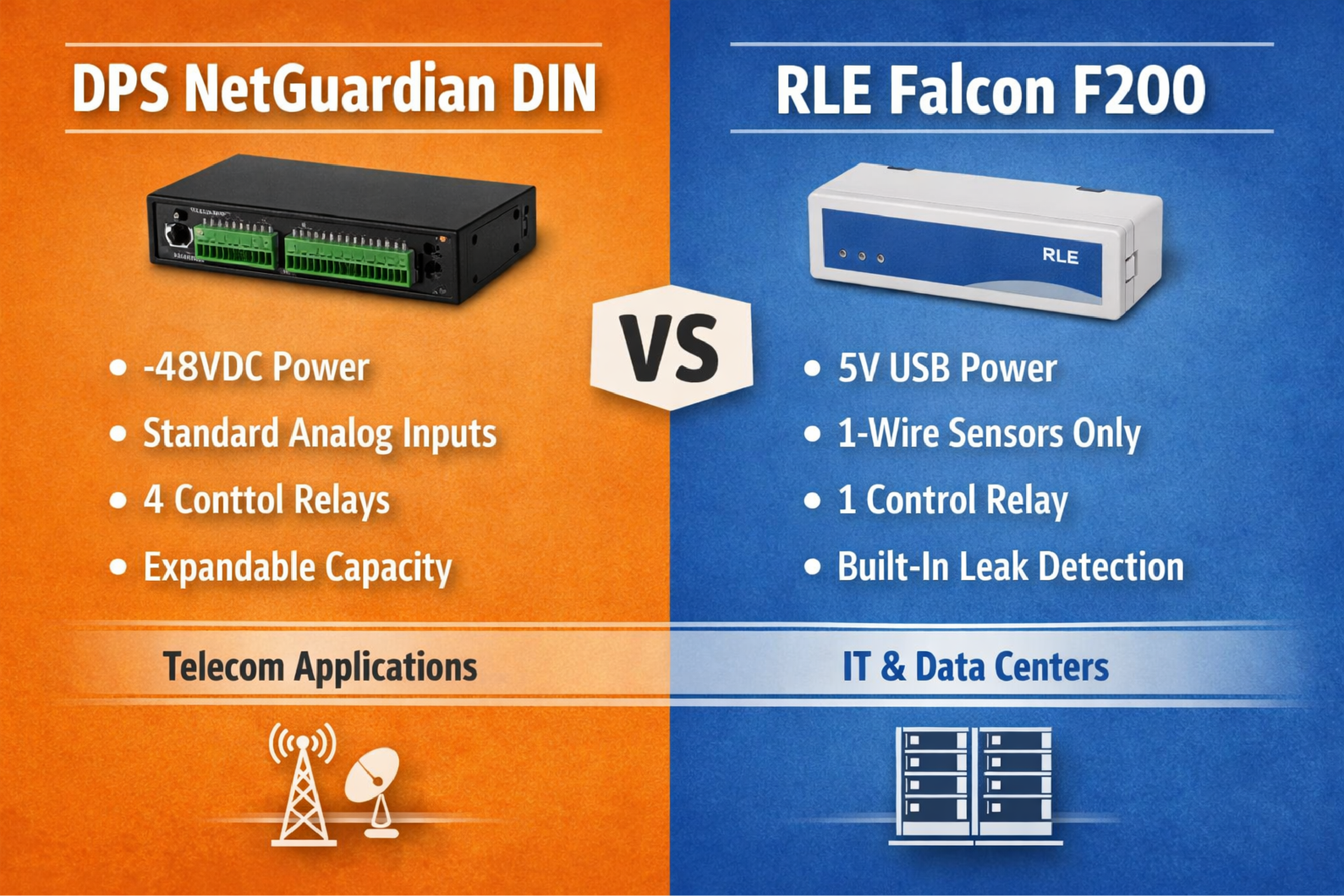
| Specification | DPS NetGuardian DIN | RLE Falcon F200 |
|---|---|---|
| Discrete alarm inputs | 8 | 8 |
| Analog/sensor inputs | 4 (4-20mA / 0-5VDC) | 4 (proprietary 1-Wire only) |
| Control relay outputs | 4 | 1 (Form C) |
| Ping targets | 32 | None |
| Internal temperature sensor | Yes | No (external required) |
| Sensor expansion | D-Wire port, up to 16 daisy-chained sensors | None |
| Leak detection | Not built-in | 1 zone, up to 200 ft cable |
| Serial ports | RS-232, RS-485 (optional) | None |
| SNMP versions | v1, v2c, v3 | v1, v2c only |
| Web interface | Yes | Yes (mobile-friendly) |
| Email alerts | Yes | Yes (up to 8 recipients, SSL) |
| Built-in data trending | Via T/Mon | Yes (43,200 points, CSV export) |
| Event logging | Yes | 50 events with timestamps |
| Power input | -48VDC (telecom standard) | 5VDC USB wall adapter |
| Additional power options | +12V, +24V, +48V, PoE | USB hub only |
| Operating temperature | 32 to 140°F (0 to 60°C) | -13 to 158°F (-25 to 70°C) |
| Dimensions | 7.25"W x 2.1"H x 5.15"D | 5.63"W x 1.0"H x 2.63"D |
| Expansion | Up to 3 DIN DX units (4x capacity) | None |
| Approx. price | ~$700+ (contact us for a quote) | ~$595 MSRP |
The most consequential difference between these two products for telecom deployments is power architecture.
Telecom sites run on -48VDC battery plant. It's an industry-wide standard, and every piece of telecom-grade equipment, from DSLAMs to optical transport shelves, connects directly to that plant. The NetGuardian DIN ships with native -48VDC input, which means it draws power from the same battery-backed bus feeding the rest of the site. If commercial AC fails, the unit stays online as long as the battery plant holds.
The Falcon F200 runs on 5VDC delivered through a USB wall adapter. In any site that relies on AC utility power, the F200 can go offline during a power event unless a separate UPS is protecting that outlet. At a standard IT closet with a UPS on every rack, that's a reasonable assumption. At a remote telecom site, it may not be.
For operators who need alarm visibility during power events, specifically the scenario where you most need remote monitoring, this distinction matters more than any other specification on this list.
The NetGuardian DIN also supports +12VDC, +24VDC, +48VDC, and Power over Ethernet, giving you flexibility across different site configurations without requiring a separate power supply.
Both units offer 4 analog sensor channels, but the F200's accept only RLE's proprietary 1-Wire temperature and humidity probes (RJ-11 connector). The NetGuardian DIN accepts industry-standard 4-20mA and 0-5VDC analog signals.
That distinction opens up a much wider range of what you can monitor. With standard analog inputs, a single NetGuardian DIN can accept signals from fuel tank level sensors, battery voltage monitors, differential pressure gauges, generator output meters, airflow velocity transducers, and virtually any other field device that produces a 4-20mA or 0-5VDC signal. You're not locked into one sensor ecosystem.
The NetGuardian DIN supports SNMPv3 with authentication and encryption. The Falcon F200 supports SNMP v1 and v2c only, which transmit alarm data unencrypted across the network.
For organizations operating under security compliance frameworks, SNMPv3 is often a hard requirement. Beyond that, the NetGuardian DIN fits into a broader multi-protocol ecosystem through our T/Mon alarm master station, which supports over 25 protocols including SNMP, DNP3, TL1, Modbus, TABS, TBOS, E2A, and legacy formats from a wide range of vendors.
T/Mon aggregates alarms from NetGuardian RTUs, third-party SNMP devices, and other equipment into a single NOC display with configurable escalation paths: on-screen alerts, email, phone, pager, and SMS. It also includes root alarm processing to filter out cascading nuisance alarms, and graphical facility mapping through its T/GFX module.
The Falcon F200 can send traps to third-party NMS platforms and supports native Modbus TCP/IP for building management integration. It can also be monitored within RLE's Falcon FMS architecture for multi-unit aggregation. RLE does not offer a centralized alarm master station equivalent to T/Mon.
| Protocol | DPS NetGuardian DIN | RLE Falcon F200 |
|---|---|---|
| SNMP v1/v2c | Yes | Yes |
| SNMP v3 (encrypted) | Yes | No |
| DNP3 | Available on 420/832A models | No |
| TL1 | Via T/Mon | No |
| Modbus TCP/IP | Via T/Mon or G6 integration | Native |
| Serial reach-through | RS-232/RS-485 (optional) | None |
The NetGuardian DIN includes 4 control relay outputs. The Falcon F200 includes 1 (Form C).
Control relays allow an RTU to trigger physical actions at the site: cycling generator transfer switches, resetting HVAC equipment, activating alarm panels, or controlling any device with a dry-contact input. Four relays give NOC staff meaningful remote control capability. One relay limits what's possible without a truck roll.
The NetGuardian DIN can monitor up to 32 network ping targets, polling IP-addressable equipment and generating alarms when devices stop responding. The Falcon F200 has no ping monitoring capability.
For a telecom site with switches, routers, DSLAMs, and microwave radios, ping monitoring lets you detect network equipment failures from the NOC before a technician is dispatched. It also provides a lightweight layer of network health visibility that doesn't require a separate network management system.
The Falcon F200's I/O count is fixed. When a site outgrows 8 discrete inputs and 4 sensor channels, the only RLE option is to replace the unit with the Falcon FMS platform (which starts around $3,700 based on published information).
The NetGuardian DIN supports up to 3 NetGuardian DIN DX expansion units. Each DX adds 8 discrete alarms, 4 analog inputs, and 4 control relays. Fully expanded, one NetGuardian DIN deployment reaches 32 discrete inputs, 16 analog channels, and 16 control relays without replacing the base unit.
When sites require more capacity than that, our NetGuardian product family includes a range of purpose-built options:
This tiered lineup means you can standardize on DPS across equipment closets, huts, and major headend sites while staying on a single management platform.
A fair evaluation includes the areas where the F200 holds a genuine edge.
DPS Telecom (founded 1986, Fresno, CA) has been building alarm monitoring equipment for telecom operators since the long-distance carrier build-out of the late 1980s and 1990s. We appeared on Inc. magazine's Inc. 500 list in 1997 and have accumulated over 1,500 clients including AT&T, Verizon, Sprint Nextel, Motorola, Consolidated Communications, and Telecom Papua New Guinea. All PCB design, software development, metal fabrication, assembly, and testing happen at our 45,000 sq ft campus in Fresno. We hold ISO 9001 certification and maintain an in-house NEBS pre-compliance lab, including an anechoic chamber, representing over $1M in testing infrastructure. NEBS Level 3 certification is available on request for clients who need it.
RLE Technologies (founded 1984, Fort Collins, CO) built its reputation on water leak detection, describing themselves as a leader in facility monitoring for data centers and critical facilities. They report over 20 million feet of SeaHawk sensing cable installed worldwide. In late 2023, RLE was acquired by May River Capital, and in December 2024 merged with UK-based NDSL Group to form a platform company called Parameter. The combined entity is positioning around AI-driven data center power monitoring.
RLE's strengths in leak detection and data center environmental monitoring are real. Their institutional focus, however, is facilities management rather than telecom alarm aggregation, and the F200's specifications reflect that.
For telecom operators deploying equipment into central offices, carrier-grade facilities, or remote infrastructure sites, NEBS (Network Equipment-Building System) compliance is often a baseline requirement. NEBS Level 3 is the telecom industry's most rigorous standard, covering thermal, mechanical, electrical safety, and EMC requirements for equipment that shares space with critical carrier infrastructure.
DPS Telecom maintains an in-house NEBS pre-compliance lab at our Fresno campus, including an anechoic chamber, representing over $1M in testing infrastructure. NEBS Level 3 certification is available on request for clients who require it.
RLE Technologies does not publish NEBS certifications for the Falcon F200, which reflects its design focus on data center and IT facility environments where NEBS is generally not a requirement.
For operators where NEBS compliance is a procurement requirement, this distinction is worth confirming early in any evaluation process.
At DPS Telecom, all technical support is handled by the same engineers who design and build the products. Support is free for the lifetime of the equipment, with no tiered plans and no per-incident fees. We also offer:
Billy Young, Network Engineer at Consolidated Communications, has been working with us for years: "They're reliable. We have about 160 deployed at this time, some have been deployed since '99, and I would say we might have a 1% failure rate."
P.J. Renehan, Project Manager at Motorola, said: "DPS has been the best customer and tech support vendor I have worked with in the last twenty-five years I have been in the industry."
RLE provides support through web-based request forms and sells primarily through distribution partners and value-added resellers. Firmware updates are free.
The Falcon F200 is a capable facility monitor for IT closets and data center edge spaces, particularly when leak detection is the primary concern. It's compact, affordable, and straightforward to deploy in AC-powered environments.
The NetGuardian DIN was designed for a different set of requirements: unattended telecom sites with -48VDC power plants, NOC teams managing alarms from hundreds of distributed locations, and operators who need encrypted SNMP, remote relay control, and a path to expand capacity without replacing hardware.
For telecom and network infrastructure monitoring, the differences between these two products go beyond specification gaps. They reflect two different design philosophies built for two genuinely different environments.
If you're evaluating the NetGuardian DIN for your sites, contact our team to request a quote, arrange a 30-day loaner, or schedule a factory visit. We're happy to work through your specific monitoring requirements and point you toward the right configuration.

Andrew Erickson
Andrew Erickson is an Application Engineer at DPS Telecom, a manufacturer of semi-custom remote alarm monitoring systems based in Fresno, California. Andrew brings more than 19 years of experience building site monitoring solutions, developing intuitive user interfaces and documentation, and opt...