Check out our White Paper Series!
A complete library of helpful advice and survival guides for every aspect of system monitoring and control.
1-800-693-0351
Have a specific question? Ask our team of expert engineers and get a specific answer!
Sign up for the next DPS Factory Training!
Whether you're new to our equipment or you've used it for years, DPS factory training is the best way to get more from your monitoring.
Reserve Your Seat Today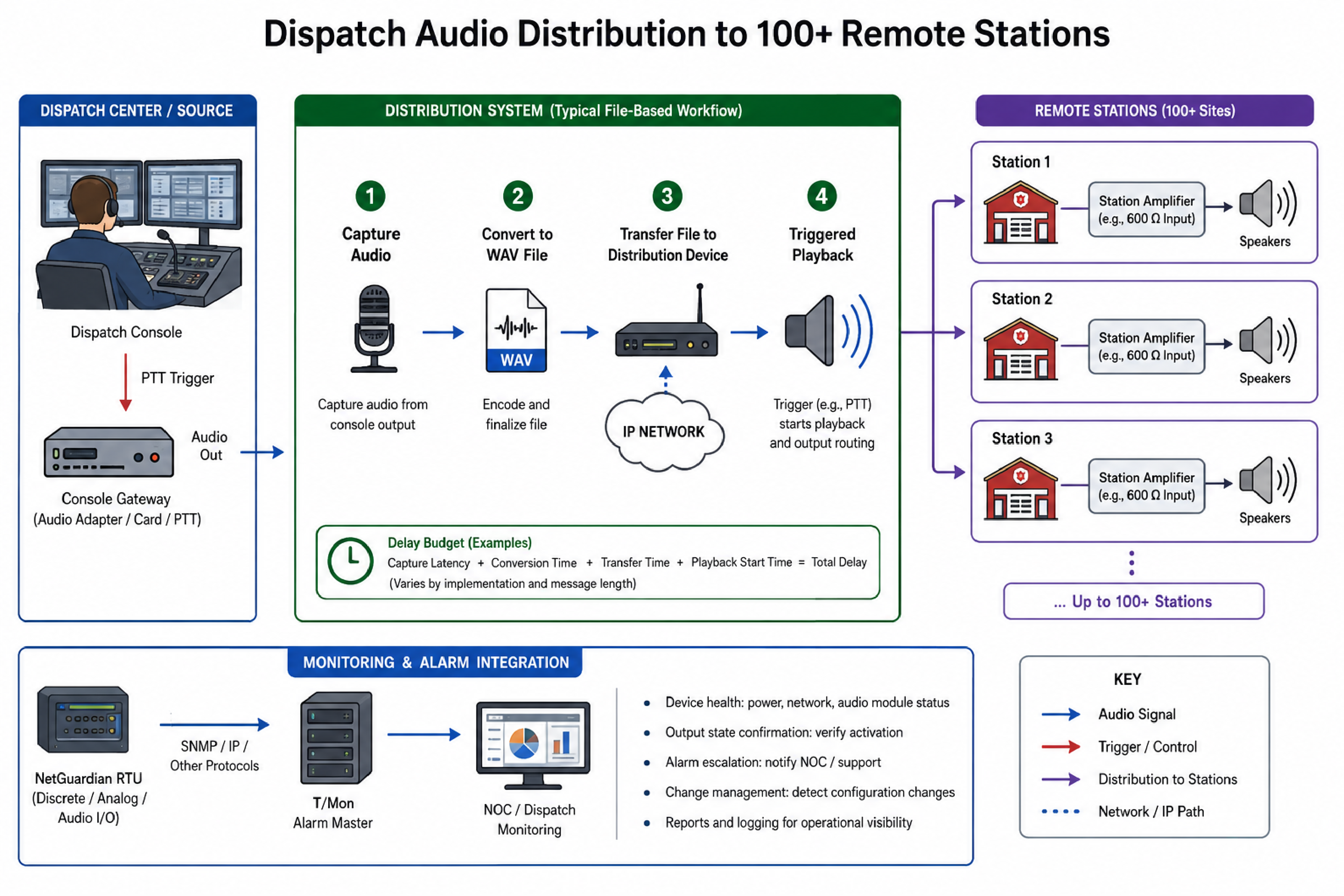
Dispatch audio distribution, in public safety infrastructure monitoring, refers to capturing an announcement from a dispatch console audio source and delivering it to many remote amplifier and speaker systems with predictable timing, audibility, and control.
Dispatch teams often need a one-to-many audio path for station alerting, administrative announcements, or operational notices. The operational requirement is simple to state: a dispatcher presses a button and a message plays at dozens or hundreds of remote stations. The engineering reality is more complex because console environments, audio interfaces, and station amplifier inputs were not always designed for large-scale fan-out, long runs, or precise time coordination.
This article explains a real-world style application request from a public safety communications environment: distributing dispatch audio to roughly 100+ remote stations. It outlines why common approaches can introduce delay or audio quality issues, what design criteria matter most, and how DPS Telecom evaluates architectures that combine triggering, audio handling, and remote site interfaces.
Dispatch audio distribution is the practice of taking audio that originates at a dispatch console or console gateway and delivering it to remote endpoints such as fire stations, facilities, or field buildings where it feeds an amplifier and speaker system.
Unlike radio talkgroup audio, dispatch audio distribution is usually a fixed infrastructure function. It is intended to be clear, consistent, and repeatable. The audio may be live (real time), buffered (short latency), or file-based (record then play), depending on what the source system can provide and what the distribution devices can do.
In large deployments, dispatch audio distribution also implies operational controls such as selecting which sites receive a message, logging who triggered an announcement, and monitoring whether remote endpoints are healthy. Those requirements tend to bring monitoring and alarm integration into the design, not just audio wiring.
One-to-many audio from dispatch to stations solves a coordination problem: operators need a reliable way to deliver the same spoken message to many facilities without depending on each facility to be monitoring the same radio resource at the right time.
Common operational drivers include:
In many environments, dispatch consoles provide multi-select or similar features to transmit to many radio resources. That does not always satisfy the requirement for station speakers, and some console systems impose resource limits or workflow constraints. As a result, teams look for an infrastructure audio distribution layer that complements the console system rather than replacing it.
A console gateway audio source constraint is any limitation in how the console environment can output, package, or expose audio for downstream systems.
In one representative design discussion, the console environment included a gateway that provided:
A key engineering point was that the gateway was not considered modifiable to directly generate or offer a downloadable WAV file on demand. That matters because many distribution approaches assume you can request an audio file from the source system. If the source cannot natively produce a file, the distribution design must include a separate capture and conversion step.
Another constraint is the trigger. Many teams want to use an existing console signal, such as PTT, as the trigger mechanism that starts distribution and playback. Triggering is usually the easy part. Making the audio available in the right format at the right time is usually the harder part.
A triggered file-based audio workflow is an architecture that records audio, converts it into a file (often WAV), transfers the file to a distribution device, and then uses a trigger to start playback to one or more outputs.
A typical workflow discussed for one-to-many station announcements looks like this:
This architecture is attractive when the originating system cannot provide a simple digital stream for fan-out, or when the distribution device is optimized for playback rather than acting as a live audio matrix.
The engineering question that always follows is timing. If the expected message is around one minute, does the recording plus conversion plus transfer add a delay that operators will notice? The only responsible answer is: it depends on implementation details, and the delay should be measured or modeled for the exact workflow.
Audio workflow delay is the sum of each stage that sits between the operator speaking and the remote speaker producing sound.
For a file-based workflow, the delay budget usually includes:
Some delays are fixed. Some vary with message length. For example, a system that must fully record a message before it can create a complete WAV file will inherently delay playback until recording ends. Other systems can create a rolling buffer or stream to reduce perceived delay.
During engineering evaluations, DPS Telecom typically models the expected delay based on the chosen capture method, file size, transfer mechanism, and destination device behavior. If the modeled delay is not acceptable for the operational workflow, the next step is to evaluate alternate architectures that reduce buffering and transfer steps.
Scaling audio distribution to 100+ endpoints introduces both audio and operational failure modes.
Common issues include:
These risks are the reason an audio distribution design often needs both an audio plan (levels, impedance, isolation) and a monitoring plan (status, alarms, and confirmation).
A trap relay is typically used to react to events (often SNMP traps) and activate outputs. A trap relay with audio features can be useful for triggering playback and routing audio under defined conditions, but that does not automatically make it a live audio matrix.
In one design discussion, the following practical constraints were identified for a Trap Relay style approach:
That distinction matters. If the requirement is truly live audio duplication to many outputs at once, a file-based playback device may not be the right tool. If the requirement is automated playback of a captured announcement, a trap-driven workflow can be appropriate, depending on the required delay and audio format support.
DPS Telecom engineers typically clarify the requirement early: does the organization need true live fan-out, or is near-real-time playback of a short recorded announcement acceptable?
Choosing between live, buffered, and file-based audio is a design decision that should be made using explicit operational criteria, not assumptions.
| Approach | Definition | Strengths | Tradeoffs / Risks | When It Fits |
|---|---|---|---|---|
| Live fan-out | One live input duplicated to many outputs in real time | Minimal delay; dispatcher experience is immediate | More specialized hardware; level/impedance isolation can be harder; scaling can be complex | Alerting where even short delay is unacceptable |
| Buffered / near-real-time | Audio streamed with small buffers and controlled latency | Predictable delay; can support distribution controls | Requires streaming support end-to-end; network QoS matters | Large networks needing controlled latency and monitoring |
| File-based playback | Record, encode (e.g., WAV), transfer, then play at remote outputs | Simple playback endpoints; repeatable audio; easier logging possibilities | Delay depends on recording length and transfer; may not feel live | Administrative announcements and station messages where seconds of delay are acceptable |
In many public safety station scenarios, the best fit is determined by how operators use the function. If they treat it like a live paging system, the design must behave like live paging. If they treat it like a station notification that can be queued and played, a file-based design may work well.
An amplifier interface is the electrical and signal-level boundary between the distribution system and the station amplifier input. In many facilities, station amplifiers and paging systems use legacy interfaces that resemble telephony lines, often described as 600 ohm audio. That does not guarantee the input is truly 600 ohm in all conditions, and it does not define the required level (mic, line, or something in between).
Key interface verification steps include:
Photos of punch blocks and the amplifier input specifications shorten troubleshooting time. They also help prevent subtle errors like swapped polarity, incorrect shielding, or feeding a mic input with line level.
An audio distribution and control solution usually combines two capability sets: (1) how audio is handled and routed, and (2) how events trigger actions and how the system is monitored.
Based on the representative requirements described, DPS Telecom commonly evaluates combinations of the following product families and approaches:
The correct selection depends on whether the design is primarily an audio distribution problem, a trigger automation problem, or a combined monitoring and audio control problem.
Protocol and alarm integration means connecting the audio distribution infrastructure into the same operational monitoring environment that already watches sites, power, environmental conditions, and network gear.
For a station announcement system, integration can support:
In a DPS Telecom style architecture, a NetGuardian RTU at key points can collect discrete and analog alarms and forward them via SNMP or other methods to an alarm master such as T/Mon. This reduces blind spots where an audio distribution system exists but is not operationally supervised.
City-scale audio design requirements are the data points needed to convert a concept into a repeatable build and cutover plan.
A practical pre-design checklist includes:
Collecting this data early prevents late-stage surprises, such as discovering that a station amplifier requires a control contact closure that was not included in the original design.
Live one-to-many audio fan-out is a specialized requirement. A trap relay device may support audio routing and playback behaviors, but it is not automatically a real-time audio matrix that duplicates one live input to many outputs simultaneously. The requirement should be validated against the device design and I/O capabilities.
A WAV-based workflow can be acceptable if the operational requirement allows a predictable delay. The total delay depends on whether the system must fully record the message before conversion and transfer, and on how the destination device ingests and starts playback. Timing should be modeled or tested with the exact source and network path.
PTT is commonly discussed because it is already part of the dispatch workflow. The best trigger is the one that is reliable, clearly correlated to the desired announcement, and easy to monitor. In some designs this can be a contact closure or logic signal; in others it can be a network event.
600 ohm audio is a traditional impedance reference from telephony and legacy audio interfaces. It does not automatically specify the correct signal level, balance, or wiring method. The amplifier input specifications should be verified for each standard station build, and isolation may be needed to prevent noise.
Monitoring is typically implemented by supervising the distribution devices (power, network, module status) and any key output or control states. DPS Telecom systems often integrate this information into centralized monitoring so dispatch support staff can quickly identify which sites are degraded.
These options are considered when the requirement is primarily about scaling audio I/O cleanly and repeatably across many channels and sites. They can be a better fit than attempting to force a trigger-focused device into a live matrix role, depending on the desired behavior and timing.
If a dispatch or NOC team needs to distribute console announcements to many remote stations, the critical engineering questions are timing, interface compatibility, and operational monitoring. DPS Telecom can help evaluate live vs file-based architectures, validate trigger methods, and recommend the right mix of Trap Relay products, Smart Audio Distribution Panels, and NetGuardian audio I/O options for a scalable design.

Andrew Erickson
Andrew Erickson is an Application Engineer at DPS Telecom, a manufacturer of semi-custom remote alarm monitoring systems based in Fresno, California. Andrew brings more than 19 years of experience building site monitoring solutions, developing intuitive user interfaces and documentation, and opt...