Download our free SNMP White Paper. Featuring SNMP Expert Marshall DenHartog.
This guidebook has been created to give you the information you need to successfully implement SNMP-based alarm monitoring in your network.
1-800-693-0351
Have a specific question? Ask our team of expert engineers and get a specific answer!
Sign up for the next DPS Factory Training!
Whether you're new to our equipment or you've used it for years, DPS factory training is the best way to get more from your monitoring.
Reserve Your Seat TodayNova Scotia Power needed to replace an obsolete SNMP manager without losing visibility across a province-wide network. By deploying DPS Telecom's T/Mon NOC on top of existing NetGuardian RTUs, the team improved day-to-day monitoring and gained reporting tools to support fewer site visits over time.
| Industry | Electric utility |
|---|---|
| Company | Nova Scotia Power |
| Geography / Coverage | Nova Scotia (province-wide monitoring) |
| Primary Challenge | Replace an obsolete SNMP manager while maintaining and expanding network monitoring visibility |
| Solution Deployed | T/Mon NOC alarm management system integrated with deployed NetGuardian RTUs |
| Key Result | Improved visibility and access to historical data to help track reliability and support fewer truck rolls |
| Products Used | T/Mon NOC; NetGuardian RTUs (approximately 80 deployed) |
| Services | Factory training at DPS headquarters |
Nova Scotia Power provides nearly 97 percent of the electricity for Nova Scotia and has served as their main provider for over 80 years. This includes a growing base of some 483,000 commercial, residential, and industrial customers.
With responsibility to produce and distribute over 13,000 gigawatt hours of electricity a year, Nova Scotia Power depends on reliable monitoring across thousands of kilometers of transmission and distribution lines.
"Now we monitor the whole province, everything from power supplies, right through transportation equipment like the microwave and fiber."


"I inherited the old system from the guy that retired," said Boutilier, an Electronics Technician. "He pretty much built it, and I had to maintain it."
Nova Scotia Power's existing SNMP manager was becoming obsolete, creating risk for ongoing network oversight. The team needed a replacement that would preserve current monitoring coverage while supporting additional layers of visibility and long-term reliability tracking.
"When taking over the old system," Boutilier did not anticipate their current SNMP manager becoming obsolete. Their concern was finding a suitable replacement that would maintain their current level of network monitoring, while leaving room to add more levels of protection.
"We wanted more visibility - a more user-friendly system for our techs," Itiveh said.
With DPS NetGuardian RTUs already deployed throughout the network, Nova Scotia Power evaluated DPS Telecom's T/Mon alarm management software and selected T/Mon NOC to replace the obsolete SNMP manager.
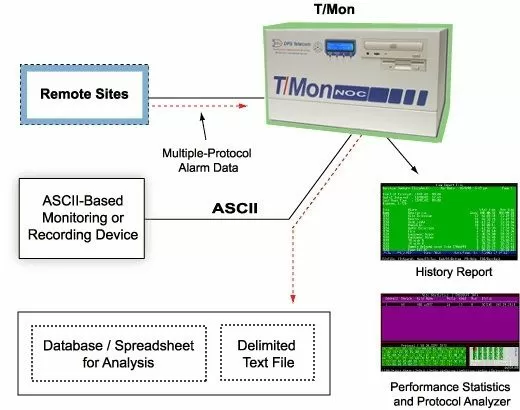
In a typical deployment, NetGuardian RTUs collect site alarms and telemetry (discrete inputs, analog values, and IP/SNMP-polled data) and forward them to T/Mon. T/Mon then centralizes alarm presentation, filtering, escalation, and reporting so technicians can prioritize issues and document recurring conditions without logging into multiple tools.
"I can see what with T/Mon, we'll be able to store data that will help us track the reliability of our system"
"We're now at DPS to complete training. We just purchased a T/Mon, and it's going to replace our obsolete (SNMP manager)," Itiveh said.
Factory training at DPS headquarters helped Boutilier and Itiveh plan how they wanted to use the new alarm system and where they wanted the monitoring program to go next. Training is often a practical step in a T/Mon rollout because it helps teams standardize alarm naming, prioritization, and escalation paths across many sites and technologies.
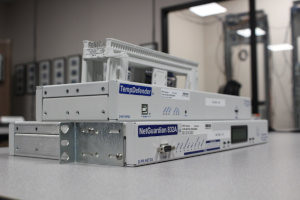
With approximately 80 NetGuardians deployed across the network, the team monitors power supplies and transportation equipment, including microwave and fiber infrastructure.
"With T/Mon, we'll be able to have records that say this alarm keeps coming in from this system at this site, and happens for several days, months or years."
One operational priority is reducing truck rolls for basic maintenance items. "With the implementation of the T/Mon, I'd like to start doing things like weekly or monthly maintenance on our generators," Boutilier explained. "We physically have to go to the site and do that now, so it would be nice to have that kind of control."
T/Mon History Reports Can Help Save Time and Money
Looking to help cut costs with T/Mon in place, Itiveh plans on using T/Mon historical data to pin down common network problems. "Down the road, we'll be able to see we've got a flaky link." Trending analysis will help Nova Scotia Power identify and prevent network-affecting issues.
An SNMP manager can become difficult to maintain as systems age or as networks expand. T/Mon is designed for 24/7 alarm operations, with features for alarm filtering, escalation workflows, and historical reporting that support utility-grade monitoring programs.
NetGuardian RTUs collect site conditions and alarms, then deliver that information upstream. T/Mon receives the alarms, presents them in an operator-friendly view, and supports organized response with event history and reporting.
History reports record when alarms occur, how often they recur, and which sites or systems produce them. This supports reliability tracking and makes it easier to identify repeating issues that can be addressed proactively.
When technicians can see a clear alarm record and correlate recurring issues, they can avoid unnecessary trips and focus on confirmed, actionable maintenance tasks. The goal is fewer truck rolls for routine checks and faster response to real faults.
If you are replacing an aging SNMP manager or want to standardize alarm reporting across many remote sites, DPS Telecom can help you design a monitoring architecture based on T/Mon and NetGuardian RTUs. Get a Free Consultation or call 1-800-693-0351 to speak with an expert about your project.