Download our free Monitoring Fundamentals Tutorial.
An introduction to Monitoring Fundamentals strictly from the perspective of telecom network alarm management.
1-800-693-0351
Have a specific question? Ask our team of expert engineers and get a specific answer!
Sign up for the next DPS Factory Training!
Whether you're new to our equipment or you've used it for years, DPS factory training is the best way to get more from your monitoring.
Reserve Your Seat TodayNJ Transit, New Jersey's public transportation corporation, needed dependable alarm visibility across many unmanned rail locations where legacy monitoring could not provide enough detail. By deploying DPS Telecom remote alarm monitoring (NetGuardian remotes and KDAs) with a T/Mon NOC master station, NJ Transit improved near-real-time notifications, centralized alarm visibility, and response coordination for network- and service-affecting issues.
| Industry | Public transportation (bus, rail, and light-rail transit) |
|---|---|
| Company | NJ Transit (New Jersey public transportation corporation) |
| Geography/Coverage | New Jersey with links to major points in New Jersey, New York, and Philadelphia |
| Operational Context | Nearly 223 million passenger trips each year on 236 bus routes and 11 rail lines statewide |
| Primary Challenge | Legacy monitoring delivered limited visibility and incomplete alarm detail for unmanned remote locations supporting critical rail communications and SCADA gear |
| Solution Deployed | Distributed alarm collection at remote sites with centralized alarm management and technician notifications |
| Key Result | Improved visibility of field equipment and faster response and repair enabled by detailed alarms and escalation notifications |
| Products Used | T/Mon NOC, NetGuardian 832A, NetGuardian 216, NetGuardian 216T, KDA |
NJ Transit is the United States' third largest provider of bus, rail, and light-rail transit. The organization operates at a scale where service reliability depends on continuous awareness of what is happening at field locations, including towers, communications shelters, and rail infrastructure sites that are not staffed around the clock.
"As a transit service provider, we have a lot of unmanned locations. We need to have visibility of all our field equipment."
Nine years ago, at the onset of a new millennium, NJ Transit was at a crossroads. Up to that point, NJ Transit relied on a legacy monitoring system that came with one rail line. As Tom Cantwell, Manager of Radio Systems at NJ Transit, explained: "This system came with one of our rail lines. At that time, it was the only transit line that we had monitoring on."
Critical transit equipment called for more than just "basic" monitoring...
With an embedded, aging monitoring system in place, Cantwell did not have access to complete and detailed alarm information from devices at remote sites. NJ Transit's railroad lines carry mission-critical circuits, including SCADA gear, and the organization needed a more reliable approach than what their legacy system could provide.
From an engineering perspective, rail operations often depend on distributed electronics that must be monitored continuously: communications transport, power, site security, environmental conditions, and specialized compliance equipment. When those systems are spread across unmanned sites, the monitoring system must do two things well:
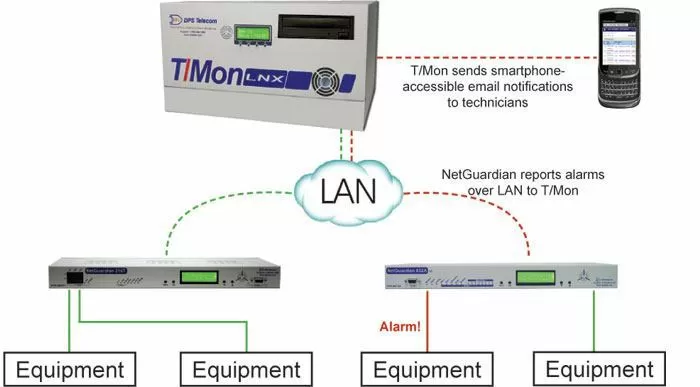
DPS Telecom provides NJ Transit with a solution for their unmonitored, unmanned sites...
While evaluating monitoring options, NJ Transit expected high costs and compatibility issues. They needed a monitoring solution that could be deployed broadly at remote, unmanned locations while still integrating alarm information into a centralized view.
"We first hooked up with DPS in 2000," said Cantwell. "We deployed a new DPS system in over 20 locations. Now we have over 50 unmanned locations supported by DPS monitoring equipment."
At a high level, the DPS Telecom architecture used by NJ Transit aligns to a standard best practice for distributed monitoring:
"We like to know when T1 are taking hits. We can take a look and repair that before we lose any service going over the T1 lines...,"
NJ Transit discovered DPS equipment that offered near-real-time notifications and detailed alarm data. For example, NJ Transit has two microwave towers with FAA-required lighting. "The KDAs monitor the lights for us," said Cantwell. "They give us real-time information if the lights go on at night and turn off in the day or if a light bulb burns out."
For organizations with similar operational profiles, DPS Telecom remote site monitoring is commonly used to:
NJ Transit deployed 20 KDAs and 20 NetGuardian 832As at various remote sites to improve visibility of transit equipment. They also deployed NetGuardian 216 remotes, which were described as a better fit for some smaller sites.
At locations with T1 service, the NetGuardian 216T proved especially effective. Cantwell explained: "A number of our rail lines have T1 equipment. We like to know when T1 are taking hits, so we can repair that before we lose any service going over T1."
In practice, this kind of deployment enables a field-oriented monitoring approach: install alarm collection at the remote site (power, environmental, transport, lighting, and other critical points), then use a central alarm master to normalize incoming alarms and drive notifications across technicians, supervisors, and management based on acknowledgment rules.
T/Mon upgrade allows for quicker response time...
NJ Transit improved not only their fleet of alarm remotes, but also their central office monitoring. "Our biggest recent improvement was upgrading our T/Mon," said Cantwell. "Our original T/Mon was installed in 1999, and in 2007 we upgraded to the new T/Mon with dual power supply and backup redundant hard drives."
"The new T/Mon.... it's like going from a Model T up to a Porsche. It's a huge improvement..."
One way Cantwell uses T/Mon at their central office is as a paging system for technicians. With improvements in the newer T/Mon, he no longer worries about missing alarms. "If people in the office don't acknowledge an alarm within a certain length of time, it will notify everybody out in the field - management, supervisors, technicians - to know what's happening in their areas," Cantwell said.
Cantwell highlighted the benefit of LAN connectivity: "The new T/Mon has LAN connection, which allows us to do a lot more." Since upgrading to the T/Mon NOC, Cantwell experienced quicker response and repair time with the help of fast, reliable alarm notification and detailed alarm data. "Response time is a lot better," said Cantwell. "It's easier to service."
He was also enthusiastic about future applications of T/Mon: "In the future, we are looking to take the T/Mon's email functionality and tie it into the company's email system. This would provide notification to all our techs as needed."
Rail and transit operations depend on distributed field infrastructure and communications. When sites are unmanned, a centralized alarm system is the practical way to detect issues early and coordinate response before service is affected.
A NetGuardian remote functions as an RTU that collects local alarm points (often discrete contact closures) and forwards alarms to central monitoring. This supports consistent visibility across many remote locations.
T/Mon NOC can drive notification and escalation when alarms are not acknowledged in a defined period, helping ensure that persistent issues are seen by technicians, supervisors, and management.
In this context, technicians want early warning that a T1 circuit is being impacted (errors or intermittent issues) so repairs can be made before service carried over the T1 is lost.
Yes. NJ Transit used KDAs to monitor FAA-required lighting. This type of compliance monitoring can be handled as part of the same alarm workflow used for other site equipment.
If you support unmanned transit, rail, or critical infrastructure sites and need centralized visibility with escalation, DPS Telecom can help you build a monitoring approach using NetGuardian remotes and T/Mon alarm management. Get a Free Consultation or call 1-800-693-0351 to speak with an expert about your project.