Check out our White Paper Series!
A complete library of helpful advice and survival guides for every aspect of system monitoring and control.
1-800-693-0351
Have a specific question? Ask our team of expert engineers and get a specific answer!
Sign up for the next DPS Factory Training!
Whether you're new to our equipment or you've used it for years, DPS factory training is the best way to get more from your monitoring.
Reserve Your Seat TodayStand-alone alarm monitoring for remote radio sites refers to using a dedicated remote telemetry unit (RTU) or controller at each unmanned site to collect alarms (generator, HVAC, temperature, door, power) and send notifications via SNMP and/or email without requiring a full on-site SCADA system.
Many organizations operating radio, microwave, and communications shelters need a small-footprint device that can accept dry-contact inputs, read analog values, support temperature sensors, and integrate with an existing SNMP-based network management system (NMS). In practice, the decision often comes down to right-sizing input capacity, choosing the best sensor bus, and ensuring the alarm path (SNMP traps, polling, and email) matches existing IT and NOC workflows.
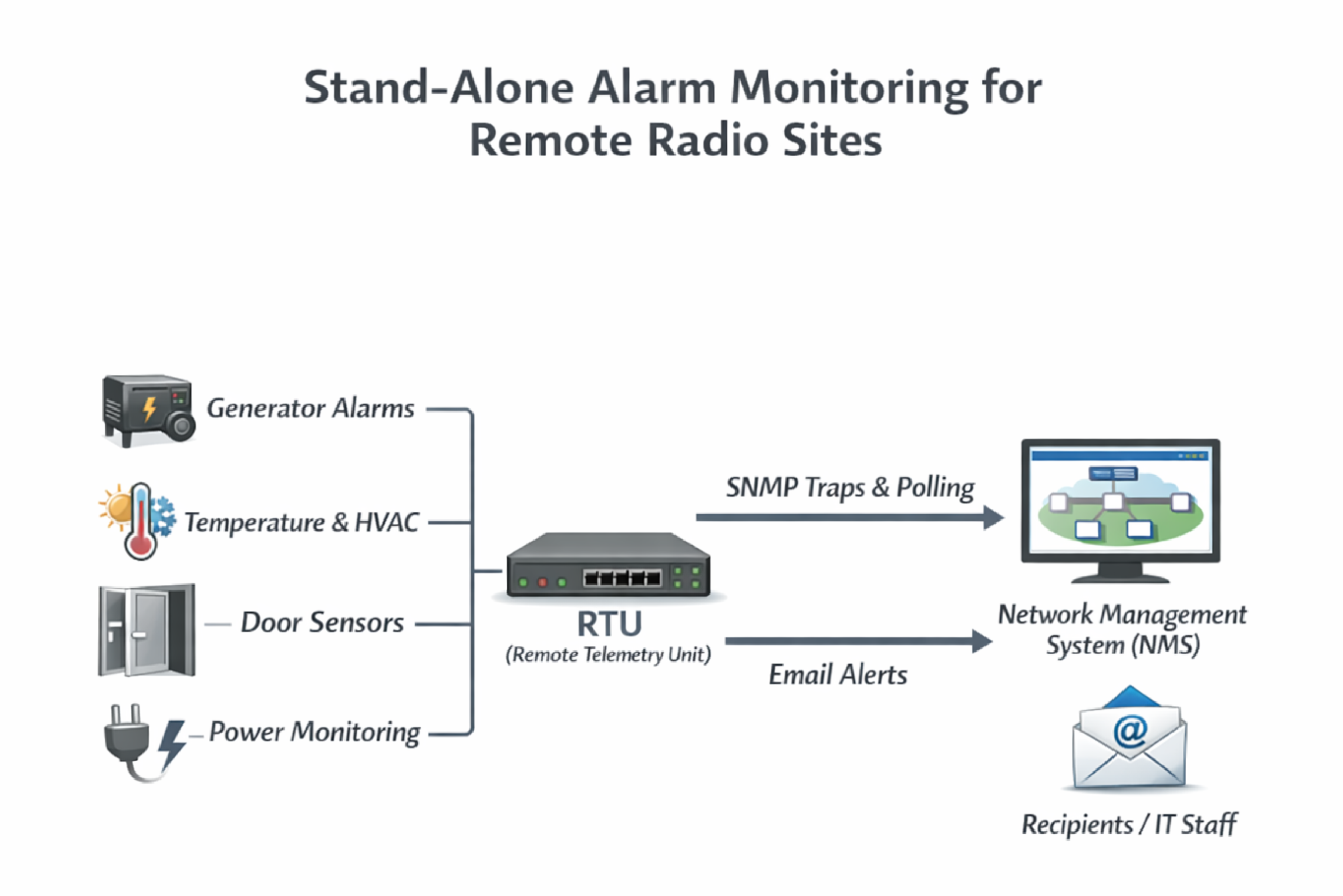
In remote site operations, an "alarm" is a discrete or analog condition that requires action, such as a door opening, generator running, room temperature out of range, or HVAC failure. Stand-alone monitoring solves the problem of detecting these conditions early, before they turn into service-impacting outages.
Remote radio sites are often lightly staffed or fully unmanned. When a generator fails to start, an HVAC unit locks out, or a shelter door is left ajar, the earliest signal is usually a local contact closure, a temperature change, or a controller status register. A site RTU translates those signals into actionable alerts that can be routed to the right team.
Remote site telemetry means converting field signals into structured points. A practical stand-alone design starts by defining the signal types and quantities the site needs today, then leaving room for expansion.
A digital input is a point that reads ON/OFF state, usually from a dry contact or relay output. Door switches, generator run contacts, breaker alarms, and HVAC alarm relays are typical discrete sources.
An analog input is a point that reads a value on a range (for example, voltage or current). For remote sites, analogs are often used for battery voltage, fuel level (0-5 V, 4-20 mA, or sensor output), and custom transducers.
Analog input scaling is important because the raw voltage or current needs to be converted into an engineering value such as volts, degrees, or percent. Thresholds are then applied to create high/low alarms and warning levels.
A sensor bus refers to a daisy-chainable sensor wiring method used to connect multiple sensors over a shared cable. For temperature and related environmental points, a daisy-chain approach reduces wiring complexity and makes it easier to add a second sensor later for dual HVAC or intake/exhaust monitoring.
In infrastructure monitoring, SNMP integration means exchanging alarm state with an SNMP manager using polling (GET) and/or asynchronous notifications (TRAP/INFORM). Email alerting means the RTU itself sends messages to configured recipients when an alarm changes state.
SNMP is commonly used when the organization already has an NMS for routers, switches, radios, and power systems. Email notifications are commonly used when the operational model is smaller, when teams need direct messages, or when an intermediary ticketing tool converts mailbox events into incidents.
A typical best practice is to use SNMP for NOC visibility and correlation, while also enabling email for direct escalation, especially for high-severity conditions such as temperature runaway, generator failure, or repeated HVAC alarms.
Qualifying time is a configurable delay that requires an alarm condition to persist for a defined time before it is declared as an alarm. In remote site monitoring, qualifying time reduces nuisance alarms caused by brief transients or expected short-duration events.
Door contacts can bounce, and short access events can produce non-actionable alerts if every open/close generates a notification. HVAC relays can also chatter during compressor start or transfer events. A qualifying time (for example, 20 seconds for a door alarm) can filter out momentary changes while still capturing meaningful events.
A virtual alarm is a logical alarm that is computed from other points using Boolean logic. In stand-alone monitoring, virtual alarms reduce alert fatigue by escalating only when conditions combine into a higher-risk state.
For example, a single temperature warning might not require an emergency dispatch, but a temperature warning combined with an HVAC alarm relay and a generator run condition might indicate a developing shelter failure during an outage. A virtual alarm can express that combined risk as a distinct, higher-severity alarm.
Modbus generator monitoring refers to reading generator controller data over Modbus (typically Modbus RTU or Modbus TCP) instead of relying only on discrete alarm relays. In remote site operations, Modbus can provide richer detail for newer generator models, including runtime counters and specific fault codes.
Discrete contacts are still valuable because they are simple and reliable, and many sites already have relay outputs wired. Modbus becomes more attractive when the generator controller exposes useful registers (status, alarms, runtime) and when maintenance teams want more than a single common alarm.
| Approach | What You Typically Get | Common Constraints | Best Fit |
|---|---|---|---|
| Discrete contacts | Run, fail, common alarm, low fuel switch | Limited detail; wiring per point | Small sites; existing relay outputs |
| Analog transducers | Fuel level, battery voltage, temperature (via transmitter) | Requires scaling and calibration | Measured values and trending |
| Modbus from generator controller | Status registers, runtime, alarms/fault codes | Register mapping, comms wiring, vendor-specific details | Newer generators where richer telemetry is needed |
Right-sizing an RTU means selecting a device with enough digital inputs, analog capacity, relay outputs, and sensor support to cover current requirements with modest headroom. In remote site deployments, under-sizing causes expensive truck rolls later, while over-sizing can add unnecessary cost and cabinet space.
During a recent evaluation discussion with a municipal communications operator in Canada, the required scope centered on generator monitoring, shelter temperature and HVAC monitoring, door alarms, and SNMP/email notifications. The organization planned to start with one unit for evaluation and integration testing, then scale once compatibility with corporate SNMP and email systems was confirmed.
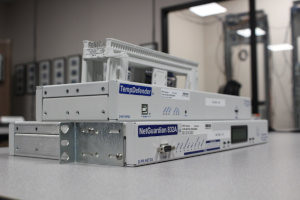
The TempDefender G6 is a stand-alone alarm and temperature monitoring RTU designed for small sites that need a straightforward termination and a focused set of inputs. In remote radio site monitoring, it is commonly evaluated when the site needs multiple discrete points and temperature sensors without requiring a larger chassis.
In the reviewed configuration, the TempDefender G6 supports 8 digital inputs, analog support, optional relay outputs, and D-Wire sensor support for temperature and other sensor types such as fuel level sensing. It also supports SNMP and email alarm notifications, which aligns with NMS-driven workflows.
A common starting configuration for a dual-HVAC shelter is two temperature sensors so each HVAC zone or return air area can be evaluated independently.
The NetGuardian 216 G6 is an RTU designed for sites that need more discrete capacity and additional local capabilities. In remote site monitoring, it is commonly considered when point counts exceed what small units support, or when a local display and additional relays are helpful for technicians.
In the reviewed option set, the NetGuardian 216 G6 was discussed as providing 16 digital inputs, analog inputs, and 2 relays. It offers similar monitoring functions to smaller units but with added headroom for future expansion and more complex sites.
For organizations standardizing remote site builds, selecting a slightly larger RTU can reduce future design variance, as long as cabinet space and budget targets remain aligned.
A combined connectivity RTU refers to a unit that consolidates monitoring and networking features, such as fiber connectivity and an integrated Ethernet switch, into one device. In remote site architecture, this approach can simplify cabinets where multiple small devices are being replaced.
An example discussed in the evaluation context was the NetGuardian 216F, which can be relevant when the site requires fiber uplink and would otherwise need a separate media converter or switch. Consolidation can reduce power supplies, cabling complexity, and failure points, but it also increases the importance of choosing the correct model for the network environment.
Legacy alarm monitoring units refer to older RTUs that still function but may have limited input capacity and may rely on components that are harder to source over time. In remote site monitoring, a legacy device can be a risk when it becomes difficult to repair or replace during an outage.
If an older unit has a tight limit on digital inputs, operators may resort to multiplexing alarms or leaving points unmonitored. A modernization plan typically focuses on ensuring adequate point count, long-term supportability, and compatibility with SNMP and modern security practices.
A pilot deployment is defined as a limited-scope installation used to validate technical compatibility, alarm quality, and workflow fit before scaling to many sites. For remote radio sites, a pilot is often the most efficient way to confirm SNMP behavior, email deliverability, and point naming standards.
Choosing between two RTUs is primarily a sizing and workflow decision. In remote site monitoring, the right choice depends on point count, future expansion, and whether features like more inputs, relays, and local interface justify a larger unit.
| Decision Factor | TempDefender G6 | NetGuardian 216 G6 |
|---|---|---|
| Primary fit | Small sites with focused alarm needs | Sites needing more input headroom |
| Digital input capacity discussed | 8 digital inputs | 16 digital inputs |
| Relays discussed | Optional relay outputs | 2 relays |
| Daisy-chained sensors | D-Wire sensor support | D-Wire sensor support |
| Integration | SNMP and email notifications | SNMP and email notifications |
| When it is usually chosen | When simplicity and cabinet footprint are priorities | When additional points and future expansion are priorities |
DPS Telecom solutions for remote site monitoring are typically built around RTUs that collect discrete, analog, and sensor-bus points and then integrate those alarms into NOC workflows using SNMP and email. In organizations that later grow into more centralized alarming, the same point models can also feed an alarm master architecture.
For stand-alone deployments, DPS Telecom commonly recommends devices in the NetGuardian RTU family or dedicated temperature and environment units such as TempDefender, depending on the required point count and site complexity. For organizations that need centralized alarm presentation, escalation, and reporting across many sites, DPS Telecom also offers T/Mon alarm master products that can aggregate and normalize alarms from large fleets.
What is the minimum monitoring recommended for an unmanned radio shelter?
Minimum monitoring typically includes at least one door alarm, at least one temperature sensor, a commercial power fail indication, and a generator run or generator common alarm point. The exact set depends on site criticality and dispatch practices.
Should remote sites use SNMP traps or SNMP polling?
SNMP polling is simple and consistent, while traps provide faster notification on state change. Many teams use both: polling for state assurance and traps for fast escalation, as long as network paths and NMS configuration are validated.
How do you monitor dual HVAC units effectively?
Effective monitoring usually combines each HVAC unit's alarm relay (discrete points) with at least two temperature measurement points so that loss of cooling is detected even if a relay fails to report. Point naming should indicate which unit and which sensor location is affected.
What is qualifying time and what value should be used for door alarms?
Qualifying time delays alarm declaration until the condition persists. Door qualifying time is commonly set to tens of seconds in environments where brief access events are expected. The correct setting should be tested to avoid both nuisance alarms and missed security events.
When should generator telemetry use Modbus instead of discrete contacts?
Modbus is useful when the generator controller exposes meaningful registers such as runtime, detailed fault codes, and status that cannot be captured with a single common alarm contact. Discrete contacts remain appropriate when simplicity is the top requirement.
How do you validate email alarms from an RTU in an enterprise environment?
Validation typically includes confirming SMTP requirements, permitted sender rules, recipient group routing, and any security filtering that could block automated messages. A pilot installation is the safest way to confirm deliverability.
If remote radio sites need stand-alone monitoring for generator, HVAC, temperature, and door alarms, DPS Telecom can help define point standards, select the right RTU footprint, and align SNMP/email alarming with NOC workflows.

Andrew Erickson
Andrew Erickson is an Application Engineer at DPS Telecom, a manufacturer of semi-custom remote alarm monitoring systems based in Fresno, California. Andrew brings more than 19 years of experience building site monitoring solutions, developing intuitive user interfaces and documentation, and opt...