Check out our White Paper Series!
A complete library of helpful advice and survival guides for every aspect of system monitoring and control.
1-800-693-0351
Have a specific question? Ask our team of expert engineers and get a specific answer!
Sign up for the next DPS Factory Training!
Whether you're new to our equipment or you've used it for years, DPS factory training is the best way to get more from your monitoring.
Reserve Your Seat Today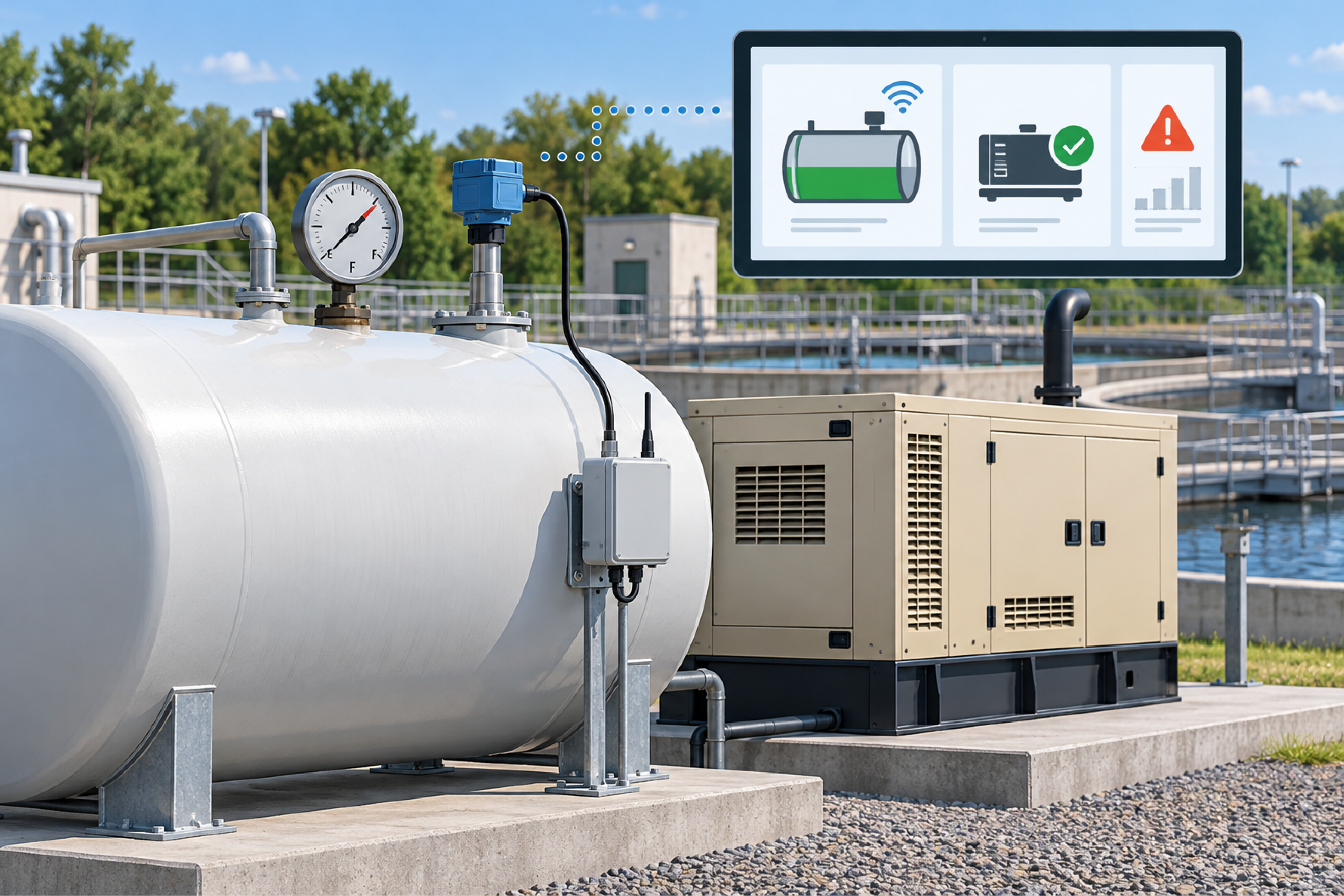
Diesel tank level monitoring is the practice of measuring the fuel in a generator's tank electronically and reporting it to operators, so refills can be scheduled before a generator runs dry. At many water, wastewater, and utility facilities, the only tank gauge is still a mechanical float dial on top of the tank - accurate enough when someone walks over to read it, invisible to everyone else.
This article explains how to retrofit electronic level monitoring onto existing diesel tanks, how to scale and alarm on the reading, and how to add generator status and leak detection to the same monitoring system. It is written for operations and maintenance teams at plants and remote facilities who have been asked to track generator fuel usage and want a practical starting point.
A mechanical float gauge only answers the question "How full is the tank?" for the person standing next to it. Fuel usage, refill timing, and unexpected drops all go unseen until someone happens to check.
Retrofitting electronic level monitoring helps with several goals at once:
Older tanks often have original gauges that are decades old. Those gauges were built to be read by eye, not wired to anything, so most projects begin by deciding how to get an electrical signal out of the tank.
A tank level sender is a device that converts the fuel level into an electrical signal - usually a voltage or a 4-20 mA current - that a remote telemetry unit (RTU) can read. Retrofit paths depend on what is already mounted on the tank.
| Existing Gauge | Retrofit Path | What You Need To Know First |
|---|---|---|
| Magnetically coupled dial | Replace the dial head with a sender that reads the same magnetic float | Gauge make and model, mounting thread |
| Older mechanical float gauge | Remove the gauge and install a new level sender with an analog output | Tank dimensions, tank depth, fitting size |
| No usable fitting or hard-to-wire location | Wireless level sensor reporting to a receiver at the RTU | Distance to the RTU, power at the tank |
Tank dimensions and depth are the most common missing inputs. The sender must match the depth of the tank, and the shape of the tank determines how level converts to volume. A horizontal cylindrical tank, for example, does not hold the same number of gallons per inch at the bottom as it does in the middle. Gather these details before quoting any hardware.
Analog scaling is the step that converts a raw electrical value into the real-world unit operators care about. Without it, the RTU would report "2.5 volts," and someone would have to work out what that means. With it, the RTU reports "50% full."
Factory training makes the point simply: nobody wants to think about whether two and a half volts is enough fuel. Typical scaling uses two reference points:
For a sender with a 0-5 volt output, 0 V reads as empty, 5 V as full, and 2.5 V as half. Two-point scaling also works as a field calibration. Some level senders return a percentage of their supply voltage, so a long cable run or a slightly low supply means a full tank never quite reaches the theoretical top value. If a known-full tank reads a little under 5 V, set that measured value as the 100% reference. The same idea applies to propane tank senders, which are a common source of this confusion.
Where a sender offers 4-20 mA output, it is often worth choosing. A 4-20 mA signal has a "live zero": 4 mA means empty, so a reading of 0 mA can only mean a broken wire or a failed sender. A 0-5 V sender cannot tell the difference between an empty tank and a cut cable. DPS RTUs accept both, and RTU analog inputs can be configured for the signal type the sender provides.
Thresholds are the scaled values at which the RTU raises an alarm. A tank typically gets at least two low-level thresholds, each tied to a different response.
Base the thresholds on hours of runtime rather than round numbers. If a full-load generator burns a known number of gallons per hour, the remaining fuel at each threshold translates directly into hours of outage coverage. That is the number operations leadership actually wants to know.
Two settings keep tank alarms from chattering:
Unused thresholds can do useful work too. Parking an unused high threshold just above the sender's normal maximum turns it into a failed-sensor alarm.
A low-level alarm is slow by design. It waits until a lot of fuel is already gone. A rate-of-change alarm compares readings over a time window and alarms when the level moves faster than it should, catching a fast drop long before the low threshold.
Factory training works through the math with a propane theft example that applies equally to diesel. Take a 1,000-gallon tank feeding a generator that burns no more than 60 gallons per hour at full load. That is 6% of the tank per hour, or about 1% every 10 minutes. Anything faster cannot be the generator. A rate-of-change alarm set at 5% in 10 minutes will flag a leak or a siphon that a 40% threshold would not notice for hours. As one trainer described a real case: the level dropped ten points in ten minutes, and "that's pretty weird."
Dedicated leak detection is a separate layer. Many double-wall tanks and containment basins accept a leak sensor in the interstitial space or sump. Sensors that provide a contact closure on detection can be wired to an RTU discrete input like any other alarm. Confirm the sensor type your tank supports and any local regulatory requirements before selecting hardware.
Fuel level answers half the question. Generator status answers the other half: is the generator running, did it start when it should have, and is it reporting a fault?
The integration path depends on the generator's age and controller:
Model numbers for each generator determine which path applies, so collect them before designing. Facilities with a mix of old and new generators often use Modbus for the newer units and discrete inputs for the older one, all landing on the same RTU.
Once the generator is monitored, fuel and runtime can be combined. An accumulation timer on the generator running input totals runtime, which can be compared against fuel used to spot inconsistencies. A derived alarm that combines low fuel, commercial power failure, and generator running highlights the condition that needs immediate attention. DPS covers power-side monitoring more broadly on its remote power monitoring page.
Many plants already run an HMI or SCADA platform for process control, and sometimes they are partway through migrating to a new one. Fuel and generator data are most useful when they appear on the same screens operators already watch.
The key question is what format the SCADA side expects. Common paths include:
Remote sites without Ethernet can still report. Cellular RTU options and cellular routers carry alarms from enclosures that have no wired network connection, and choosing the right RTU covers how to match the unit to the site.
Yes. Depending on the existing gauge, you can replace the dial head with a sender that reads the magnetic float, or remove the old gauge and install a new level sender with an analog output. Tank dimensions and depth are needed to select the right sender.
It converts the sender's voltage or current into a percentage or gallons, so operators see "50% full" instead of "2.5 volts." Two-point scaling can also correct for a sender that does not quite reach its theoretical full-scale output.
A common approach is a minor alarm around 40% for routine refill scheduling and a major alarm around 20% for urgent refills. Adjust both based on fuel burn rate and delivery lead time.
Use a rate-of-change alarm that triggers when the level drops faster than the generator could burn fuel. For a dedicated leak sensor, wire its contact closure to an RTU discrete input.
Yes. Indicator lamp circuits can often be converted to discrete inputs, and an AC sensor can confirm running status. Newer generators with Modbus provide more detail.
Usually. SNMP is the most common path, and an alarm master with protocol mediation can translate between formats. Confirm the protocol your SCADA platform expects before finalizing the design.
If your diesel tanks still rely on a dial that someone has to walk out and read, an RTU-based retrofit can put fuel level, generator status, and leak alarms on the screens your operators already use. DPS Telecom has helped utilities and public agencies monitor remote infrastructure since 1986, with RTUs designed and built in the United States. Get a Free Consultation, or call 1-800-693-0351 or email sales@dpstele.com.

Andrew Erickson
Andrew Erickson is an Application Engineer at DPS Telecom, a manufacturer of semi-custom remote alarm monitoring systems based in Fresno, California. Andrew brings more than 19 years of experience building site monitoring solutions, developing intuitive user interfaces and documentation, and opt...