Check out our White Paper Series!
A complete library of helpful advice and survival guides for every aspect of system monitoring and control.
1-800-693-0351
Have a specific question? Ask our team of expert engineers and get a specific answer!
Sign up for the next DPS Factory Training!
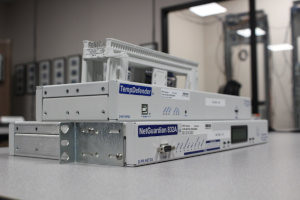
Whether you're new to our equipment or you've used it for years, DPS factory training is the best way to get more from your monitoring.
Reserve Your Seat Today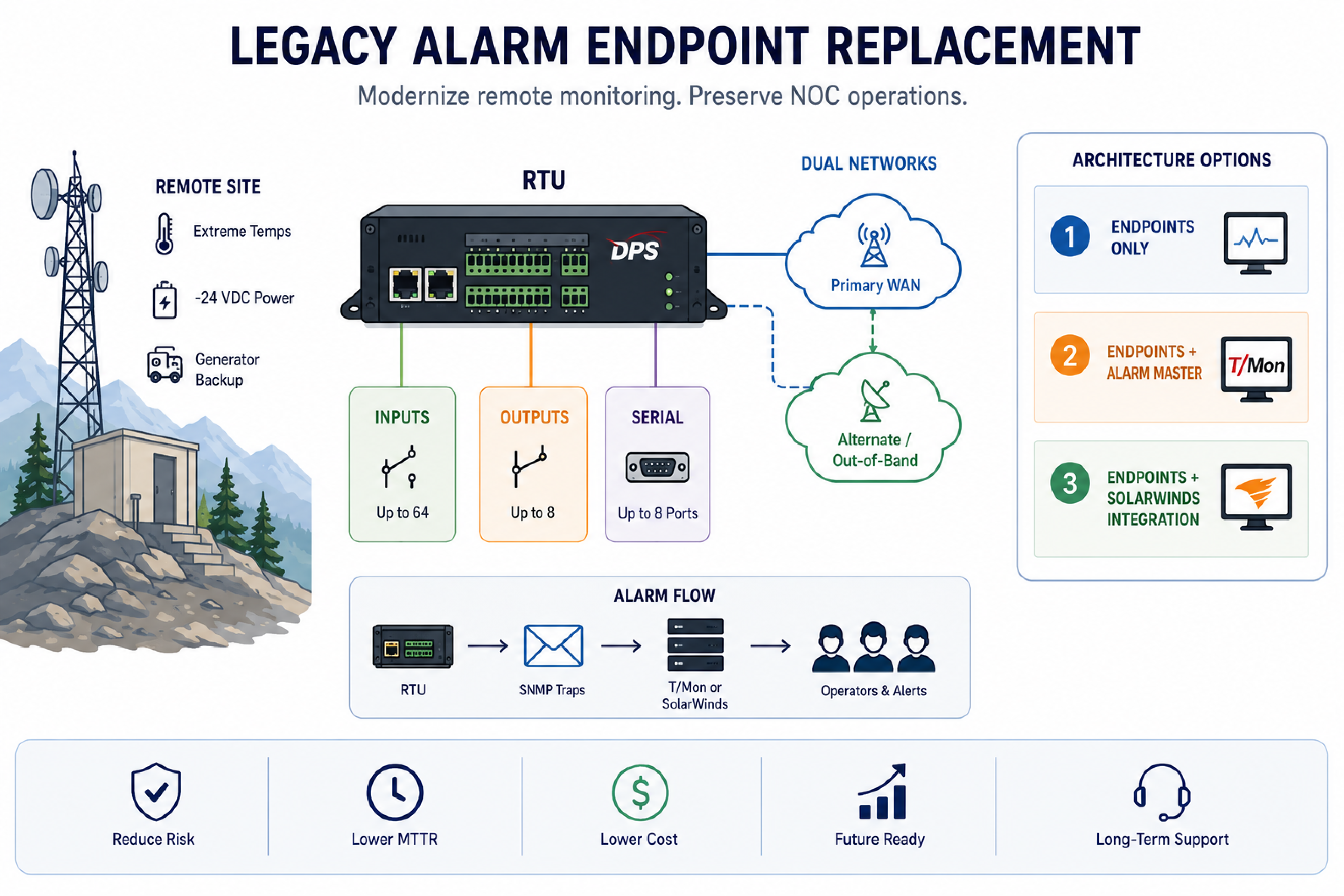
Legacy alarm endpoint replacement refers to upgrading the remote devices that collect discrete alarms (contacts), provide control outputs, and expose craft access, while preserving the operational behavior that a NOC depends on. This modernization work is common when a 1970s-era telecom alarm system has been refreshed over time but is now supported by discontinued endpoints with rising failure rates.
A legacy telecom alarm endpoint is a field device that terminates discrete wiring from sensors and equipment (such as door switches, generator status, rectifier alarms, and high-temp alarms) and forwards those conditions to a central monitoring platform. Many legacy systems also provide relay outputs for remote control and serial ports for technician craft access.
Legacy endpoints become a business risk when the manufacturer has discontinued the hardware or stopped issuing firmware updates and replacements. In remote, technician-only environments, the failure mode that hurts most is the slow increase in intermittent issues: alarm inputs that drift, serial ports that become unreliable, or networking components that cannot be secured to current standards.
A modernization plan typically starts with a choice: replace endpoints only (keep the head-end), replace endpoints plus the head-end alarm master, or integrate alarms into an existing network management platform so operators have fewer tools to watch.
Remote mountain-top sites are defined by access constraints, extreme temperatures, and limited on-site time to complete work. In these locations, the most important technical requirement is not a single feature; it is minimizing truck rolls and minimizing time on the ground during narrow weather windows.
Common requirements for remote, difficult-access facilities include:
When DPS Telecom evaluates this type of environment, the design goal is to select an RTU class device that meets the electrical and environmental requirements without oversizing the platform, because oversizing can increase cost and complicate spares strategy.
Discrete alarm monitoring capacity planning means translating the site alarm list into physical I/O counts and interface types. This translation should happen before hardware is selected, because it determines whether the device will be a good fit for the next refresh cycle.
A typical remote site profile in legacy takeover projects looks like:
For sites in this profile, we often recommend a NetGuardian 864A from DPS Telecom, because its I/O density aligns well with dozens of discrete points and multiple serial connections. As an example sizing approach, 64 discrete inputs and 8 relay outputs provide headroom without forcing a larger chassis than required, and 8 serial ports can accommodate mixed craft access needs.
Discrete input electrical behavior should be validated early. A key concept is that not all legacy alarm wiring behaves like a true dry contact. Some legacy systems use biasing or TTL-style signaling. During discovery, DPS Telecom typically confirms assumptions about grounding, contact type, and any required biasing so the new endpoint reads conditions correctly on day one.
Legacy cabling preservation refers to designing a cutover that keeps the existing field wiring terminated where it is today, while adapting the new RTU to the existing pinout. This is often the highest-leverage way to reduce on-site labor at helicopter-access locations.
In many inherited systems, legacy wiring is dressed from 66 blocks to the rack using Amphenol cables, and the discontinued endpoint uses adapter pigtails to DB25/DB37 style connectors. A practical modernization approach is to remove the legacy adapter pigtails and install new adapter cabling from the replacement RTU to the existing Amphenol wiring.
To support minimal on-site time, a project may use one of these tactics:
DPS Telecom frequently supports project-specific adapter cabling as part of the integration scope, because cabling strategy is directly tied to successful rollout schedules in remote environments.
Low-bandwidth alarm transport design means selecting polling intervals, event-driven reporting methods, and management-plane behaviors that keep monitoring traffic small and predictable. This matters when a maintenance WAN is built on DS1 transport and one direction has constrained bandwidth, such as a few hundred kilobits per second.
Techniques commonly used to limit monitoring traffic include:
NetGuardian RTUs can be configured to send SNMP notifications to more than one manager. That capability is useful during transitions because it enables parallel monitoring (for example, old and new head-ends running at the same time) while keeping traffic policy consistent.
Endpoint-only replacement is defined as installing new RTUs at remote sites while continuing to use the existing central monitoring server. This approach can reduce change risk when the head-end is stable and the immediate problem is discontinued or unreliable site hardware.
Head-end replacement is defined as updating both the RTUs and the alarm master software that receives alarms, manages escalation, and supports operator workflows. This approach is common when the organization wants to standardize alarm handling, improve reporting, or reduce the number of monitoring tools.
The right decision often depends on governance. Many infrastructure owners use gated project processes with multiple review cycles. A phased plan can support decision-making by keeping options open during discovery while still addressing the reliability risks of discontinued endpoints.
| Scenario | What Changes | When It Fits | Key Design Notes |
|---|---|---|---|
| Replace endpoints only | New RTUs at remote sites; existing head-end remains | You need faster risk reduction with minimal NOC workflow changes | Confirm protocol compatibility (TL1, SNMP, or other) and traffic limits |
| Endpoints + dedicated alarm master | New RTUs plus a centralized alarm master (for example, DPS T/Mon) | You want purpose-built alarm workflows, correlation, and escalation | Plan northbound forwarding to other tools if needed |
| Endpoints + SolarWinds integration | New RTUs; alarms integrated into SolarWinds via SNMP | You want fewer panes of glass for operators | Define trap vs poll strategy and mapping of alarms to alert policies |
SNMP integration is defined as exposing alarms and status as SNMP objects and sending SNMP traps (or informs) to an SNMP manager so that alarms can be displayed, alerted, and ticketed. For many organizations, SolarWinds is already the network device monitoring layer, so integrating discrete alarms into SolarWinds can reduce operator context switching.
A practical SNMP integration plan includes:
DPS Telecom commonly supports SNMP-based integration by helping define point maps and by ensuring the RTU configuration aligns with the NOC's alert routing model. In many projects, the goal is not to move every alarm into SolarWinds immediately, but to move the alarms that improve operator response times without overwhelming the platform.
An alarm master is defined as a centralized system that receives, normalizes, correlates, and escalates alarms from many sources. DPS T/Mon is an alarm master platform that is frequently used when operations require telecom-style alarm handling, multi-technology correlation, and policy-driven notification.
A dedicated alarm master can be the better architecture when:
A common transitional design is to use NetGuardian RTUs at remote sites, use T/Mon for alarm mastery, and forward a subset of critical alarms to SolarWinds for unified NOC visibility. This design supports consolidation without forcing SolarWinds to become the only repository for every discrete point.
Dual-network monitoring is defined as connecting a remote RTU to two different networks for resiliency or out-of-band access, such as a maintenance WAN plus an alternate route like a satellite link. This design can improve troubleshooting and reduce mean time to restore when the primary path is impaired.
Dual-network designs should include clear policy decisions:
During discovery, DPS Telecom typically documents the network-security constraints early so the RTU configuration (including dual NIC usage where applicable) aligns with the organization's security model.
Compliance requirements are defined as third-party listings and test standards that may be required by organizational policy, insurer requirements, or specific facility rules. In closed, technician-only environments, the compliance posture can differ from public-access spaces, but the requirement needs to be clarified rather than assumed.
Questions that help prevent late-stage surprises include:
DPS Telecom can support discovery by clearly stating current product compliance posture, documenting any in-house test capabilities, and outlining options if third-party certification is required for a particular deployment.
A phased cutover is defined as a rollout approach that reduces risk by validating the design on a subset of accessible locations before deploying to the hardest sites. For remote mountain-top environments, phasing is also a logistics strategy that aligns spares, cabling kits, and configuration templates.
A practical phased plan often follows these steps:
NetGuardian RTUs are commonly used in these projects because they can support phased transitions with flexible northbound alarming (including SNMP), while still meeting the physical needs of discrete wiring and serial craft access.
A budgetary proposal for a legacy takeover is defined as a ROM-level package that helps stakeholders plan funding and scope without committing to final design details. For gated project processes, the most useful proposal is usually one that presents clear options with consistent assumptions.
For remote endpoint modernization projects, a ROM proposal typically includes:
In many projects, stakeholders want assurance that they are not replacing one end-of-life platform with another. DPS Telecom addresses this by recommending current NetGuardian product lines and by emphasizing support continuity practices, such as maintaining migration paths and preserving database and pinout continuity when feasible.
The fastest risk reduction is often endpoint-only replacement, because it removes the failing field hardware while preserving the existing head-end workflow. A phased plan can still keep the door open for later head-end modernization.
Use event-driven SNMP traps for most alarm changes, tune trap behavior for flapping points, and keep polling to periodic health checks. Define which alarms truly need northbound visibility.
Yes. The RTU must support the DC input range used at the sites and handle generator/battery transitions. During discovery, confirm power polarity, grounding, and expected voltage variation.
Plan an adapter cabling strategy that maps the new RTU pinout to the existing cable terminations. Lab-validate one full kit, then replicate it for each site to keep field work connector-based.
T/Mon is a better fit when alarm workflows require correlation, escalation policy, multi-protocol normalization, and telecom-style visibility. T/Mon can still forward selected alarms to SolarWinds to support a unified NOC view.
Clarify whether third-party NRTL listing is mandatory, whether NEBS is required or optional, and what documentation is needed for acceptance. Document the requirement before selecting final hardware and rollout timing.
If a discontinued legacy alarm system is putting remote sites at risk, DPS Telecom can help you define a phased endpoint modernization plan, validate low-bandwidth monitoring approaches, and select an RTU and head-end architecture that fits your NOC workflow.

Andrew Erickson
Andrew Erickson is an Application Engineer at DPS Telecom, a manufacturer of semi-custom remote alarm monitoring systems based in Fresno, California. Andrew brings more than 19 years of experience building site monitoring solutions, developing intuitive user interfaces and documentation, and opt...