Check out our White Paper Series!
A complete library of helpful advice and survival guides for every aspect of system monitoring and control.
1-800-693-0351
Have a specific question? Ask our team of expert engineers and get a specific answer!
Sign up for the next DPS Factory Training!
Whether you're new to our equipment or you've used it for years, DPS factory training is the best way to get more from your monitoring.
Reserve Your Seat Today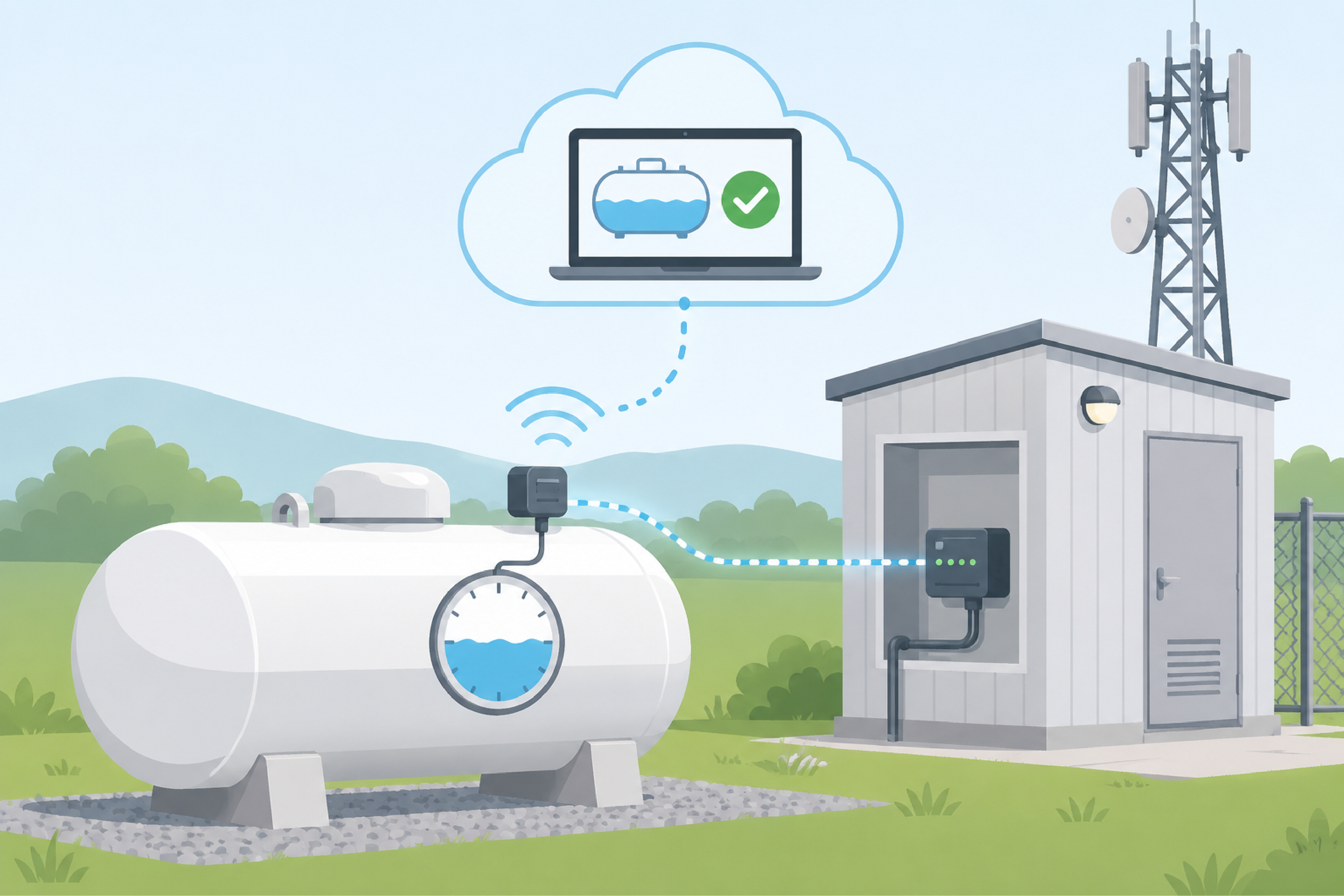
Remote propane tank monitoring is the practice of reading a tank's fuel level electronically and reporting it to the people responsible for the site, so refills are scheduled before a generator or heater runs low. Most remote reading starts at the tank's own float gauge: a remote-ready gauge accepts a small Hall-effect sensor that converts the needle position into a voltage an RTU can measure.
This article explains how Hall-effect propane senders work, how to confirm a gauge is compatible, how to choose between a direct analog input and a digital sensor bus, how to scale and alarm on the reading, and how to live alongside a propane vendor who already monitors the same tank. It is written for telecom, utility, and energy teams with propane-fueled generators or heaters at remote sites.
A Hall-effect sender is a sensor that detects the position of a magnet without touching it. On a propane tank, the float inside the tank turns a magnet behind the gauge face. The visible dial follows that magnet, and a Hall-effect sensor mounted on the gauge reads the same magnetic field to produce an electrical signal.
The common sender uses three wires:
Because the sensor reads the gauge from outside, nothing enters the tank and the tank stays sealed. That is the answer to the question factory trainers hear most often about propane: how can you read a tank without draining it? DPS has a training video on exactly that, and it still brings in calls from RV owners every week.
A remote-ready gauge is a tank float gauge built to accept a snap-in sensor. It has a removable tab or cap area where the Hall-effect sensor seats in a fixed position relative to the magnet. Gauges that are not remote-ready have no place to mount the sensor accurately.
Compatibility usually comes down to a few points:
| Question | Why It Matters |
|---|---|
| Is the gauge remote-ready? | The sensor must snap into the designated location to read the magnet accurately. |
| Which gauge family and size? | Common propane gauge families come in smaller and larger dial sizes. The sensing element is often the same, but the mounting differs. |
| Is the vendor supplying the gauge? | If the propane vendor installs the gauge, confirm with them that it is remote-ready before ordering a sensor. |
| Sensor only or full assembly? | Many projects only need the sensor and a short wiring harness, not a replacement gauge. |
A short wiring harness of a few feet typically comes with the sensor. From there, the run to the RTU is ordinary cable, often in conduit from the tank to the building.
Sensors at the tank take a beating outdoors. Field teams report wiring torn by falling branches and water working into connections over time. Plan for weatherproof connectors, strain relief, and a spare or two in stock for sites at the top of a mountain.
There are two common ways to bring the sender's signal into an RTU.
Direct analog input. The sender wires to an RTU analog input that reads its voltage. The RTU must supply the sender's power, and the input must be configured for the voltage range. This works well when the RTU has spare analog inputs and the tank is close. RTU analog inputs accept common voltage ranges and 4-20 mA current loops.
Digital sensor node. A D-Wire node made for the propane sender powers the sensor from the RTU's sensor bus, reads it, and reports the value digitally. D-Wire is generally easier to wire: three wires and three screw terminals at the node, with the main task being to match the wire order correctly. It also avoids using up an analog input.
For sites where the tank sits outside a shop or equipment building near the RTU, the digital node is often the simpler choice. Practical distance depends on how many devices share the bus, so confirm the planned layout with the vendor if the tank is far from the building. A common pattern is to keep the sensor bus short near the RTU and run conduit to the tank.
Units in the NetGuardian family support both approaches, so a site can use an analog input today and add D-Wire sensors later, or the reverse.
Scaling converts the sender's voltage into percent full, so operators see "62%" instead of a voltage. The RTU uses a low reference point for empty and a high reference point for full, and draws a straight line between them.
One practical detail trips people up. The sender returns a percentage of its supply voltage, so a full tank rarely reads exactly 5 V. Factory training teaches setting the measured value, often around 4.7 V, as the high reference instead of the theoretical 5 V. On long cable runs it may read a little differently again. Two-point scaling doubles as field calibration.
Thresholds should reflect how propane tanks are actually filled and used:
Two more settings make propane alarms reliable. Deadband keeps an alarm from toggling as fuel sloshes around a threshold - trainers compare it to a car's low-fuel light that blinks on and off around a curve. And a rate-of-change alarm catches theft or leaks. For a 1,000-gallon tank feeding a generator that burns at most 60 gallons per hour, consumption cannot exceed about 1% every 10 minutes, so an alarm at 5% in 10 minutes will catch a siphon long before the low threshold. As one trainer put it, "In 10 minutes we went from 95 to 85, that's pretty weird."
Many propane suppliers in rural areas already monitor their customers' tanks so they can plan delivery routes. A driver heading 50 miles out wants to fill every low tank in the area on the same trip. That arrangement is valuable, and customers often want to keep it.
The problem is access. Vendor monitoring portals often provide data only as a downloadable spreadsheet. Teams that want tank levels in their own dashboards end up exporting a file, converting it, and importing it into their own tools - a workflow that is doable but fragile.
There are a few ways to approach this:
Whichever path you choose, once the level is in an RTU it can go anywhere. The RTU sends SNMP traps when thresholds are crossed and answers SNMP polls for the current value, so open-source dashboards and network management tools can graph tank levels directly.
Once several sites report propane levels, the next step is a consolidated view. An alarm master can group every tank reading into one screen and send a scheduled report - for example, every Monday at 6 a.m., a list of tank levels at every site. Teams with dozens of propane sites use that report before storms to decide which sites to top off first. For small networks, the T/Mon MINI is a common starting point.
For cabinet and small-shelter sites, a compact RTU with a few discrete inputs, analog inputs, and a D-Wire port covers propane, temperature, door, and power together. Choosing the right RTU walks through sizing.
A Hall-effect sensor mounted on a remote-ready gauge reads the magnet that moves the gauge needle. Nothing enters the tank.
Only if the gauge is remote-ready, with a designated spot for the sensor to snap in. Confirm the gauge type and size with your propane vendor before ordering.
Often not. If the existing gauge is remote-ready, a sensor with a short wiring harness may be all you need.
The sender returns a percentage of its supply, so a full tank typically reads somewhat under 5 V. Set the measured full-tank voltage as the high scaling reference.
A common setup is a minor alarm around 45% for routine refill scheduling and a major alarm around 25% for urgent refills, with a high alarm above the normal 80% fill level.
Sometimes, but sharing one sender between two systems requires electrical isolation. Ask your monitoring vendor for guidance rather than splicing the signal in the field.
If your propane levels live in a vendor spreadsheet or on a dial someone has to walk out and read, an RTU can put them on your own dashboards with alarms that fire before a tank runs low. DPS Telecom has helped carriers and utilities monitor remote fuel since 1986. Get a Free Consultation, or call 1-800-693-0351 or email sales@dpstele.com.

Andrew Erickson
Andrew Erickson is an Application Engineer at DPS Telecom, a manufacturer of semi-custom remote alarm monitoring systems based in Fresno, California. Andrew brings more than 19 years of experience building site monitoring solutions, developing intuitive user interfaces and documentation, and opt...