Check out our White Paper Series!
A complete library of helpful advice and survival guides for every aspect of system monitoring and control.
1-800-693-0351
Have a specific question? Ask our team of expert engineers and get a specific answer!
Sign up for the next DPS Factory Training!
Whether you're new to our equipment or you've used it for years, DPS factory training is the best way to get more from your monitoring.
Reserve Your Seat Today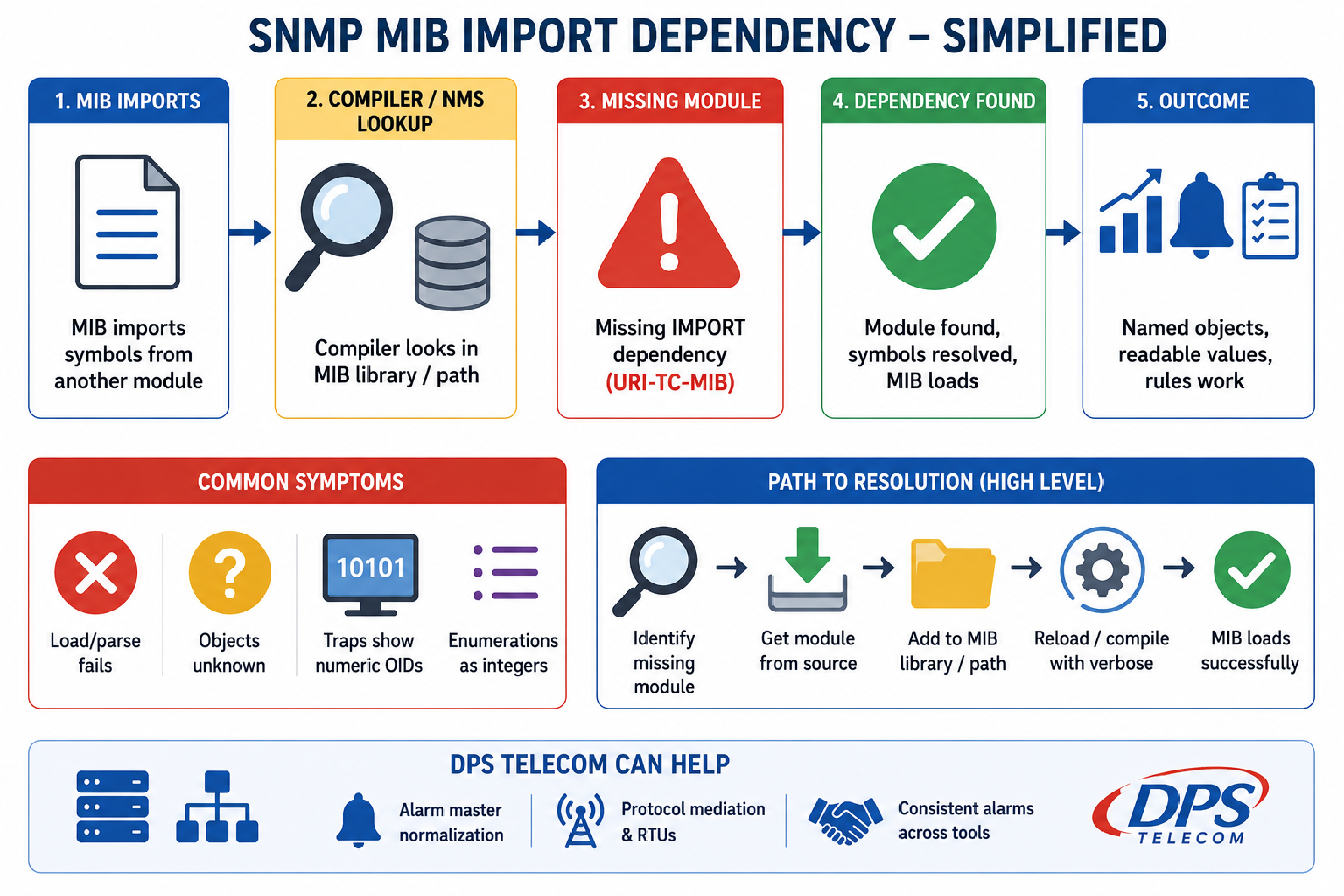
In infrastructure monitoring, an SNMP MIB import dependency refers to a separate MIB module that a vendor MIB references in its IMPORTS section. When that referenced module is missing from your local MIB library, common tools will fail to compile, load, or translate the MIB and will report errors such as "missing IMPORT dependency: URI-TC-MIB".
This article explains what these errors mean, why they occur in multi-vendor environments (including MIBs specified by industry groups such as NEMA), and how to build a repeatable process for acquiring, validating, and maintaining MIB dependencies. It also outlines how DPS Telecom typically helps teams integrate alarms even when MIB sets are incomplete or inconsistent, using alarm master and protocol mediation approaches.
A "missing IMPORT dependency" in SNMP means your MIB compiler or NMS is trying to resolve a symbol (a type, textual convention, object identifier, or macro) that is defined in another MIB module, but that module is not present or not discoverable in the compiler's search path.
The key concept is that most real-world MIBs are not standalone. They intentionally reuse definitions from other modules to stay consistent across vendors and standards. If any required module is absent, the import chain breaks.
URI-TC-MIB).MIB loading often depends on the tool's local library contents and search configuration. One environment may already have a dependency installed from a different project, while another environment starts from a clean MIB set and exposes missing modules immediately.
URI-TC-MIB is typically referenced as a module that defines textual conventions ("TC") for URI-like strings or related identifiers. Textual conventions are reusable type definitions used to standardize how values are encoded and displayed across multiple MIBs.
The important point for operations teams is not the exact content of URI-TC-MIB, but what its presence implies: the MIB you are trying to load was authored to depend on a separate, shared module. In many cases, those shared modules come from standards bodies, vendor ecosystems, or other published collections.
In environments where a MIB is "NEMA-specified" (or specified by another industry group), the dependency may be part of an external standard package rather than a device vendor's private MIB bundle. The result is a gap between what the standard references and what a typical NMS install includes by default.
An SNMP MIB IMPORTS section is a declaration that says, "this module uses these symbols, and they are defined in these other modules." A MIB compiler must locate each referenced module, parse it, and then resolve the symbols in the importing MIB.
From an engineering workflow standpoint, this behaves like a source code build with dependencies: you need the right files, in the right versions, in a path the compiler can see.
Downloading a single MIB file rarely captures the full dependency set. Many vendor portals provide a "bundle," but that bundle can still be incomplete relative to what a standard expects, or the bundle may be organized by product line rather than by dependency graph.
Sourcing a missing dependency means identifying the authoritative origin of the module and obtaining the correct version. "Authoritative" matters because multiple similarly named MIBs can exist, and older variants can compile but produce incorrect decoding.
For standards-driven MIBs, the dependency is often distributed by the standards body, by a working group repository, or by the device vendor that implements the standard. For vendor MIBs, the dependency is usually distributed by the vendor or by a support portal.
| Dependency Source | When It Is Usually Correct | Common Risk | Best Practice |
|---|---|---|---|
| Device vendor MIB bundle | Vendor-private dependencies and cross-product shared modules | Bundle may omit third-party or standards modules | Request the complete MIB set for the exact firmware release |
| Standards body package | Industry-specified shared modules used across vendors | Multiple revisions exist; tool expects a specific revision | Version-control the standard package and document revisions |
| NMS built-in library | IETF baseline MIBs and common enterprise modules | Library may be outdated or customized | Export and inventory the actual library contents in production |
| Third-party MIB repositories | Convenient for reference and quick tests | Unclear provenance; naming collisions | Use only for triage, then replace with authoritative modules |
Troubleshooting a specific missing dependency is a process of validating the dependency name, locating the required file, and ensuring the tool can see it. The method is consistent across compilers (for example, net-snmp tools), commercial NMS platforms, and custom pipelines.
IMPORTS section for the missing module and the exact symbols being imported.A maintainable MIB library is defined as a curated, version-controlled collection of MIB modules with documented provenance, explicit dependency resolution, and controlled deployment into monitoring tools. The objective is repeatability: the same MIBs produce the same decoding in test, staging, and production.
The key architectural choice is whether to rely on each NMS to compile and interpret MIBs, or to normalize traps and alarms before they reach downstream tools. Normalization is often helpful when multiple teams, tools, or vendors are involved.
| Approach | Best Fit | Tradeoff | What To Document |
|---|---|---|---|
| Compile MIBs in each NMS | Single primary NMS, limited vendor diversity | MIB sprawl and inconsistent decoding across tools | NMS-specific MIB paths, install steps, and library inventory |
| Normalize traps via an alarm integration layer | Many tools/teams, merger environments, or strict workflows | Requires integration design and mapping effort | Trap-to-alarm mapping rules, severity model, dedup logic |
In alarm operations, solving a MIB dependency problem is often only one part of a larger requirement: turning device events into actionable alarms, at the right priority, with clear ownership. DPS Telecom approaches this by focusing on alarm ingestion, normalization, and workflow integration.
When MIB sets are incomplete, a DPS-style workflow can still proceed by using numeric OIDs for initial capture, then progressively enriching alarms as MIB modules and mappings become available.
An alarm master is defined as a central system that collects alarms from many sources, applies correlation and routing, and presents a consistent alarm view to operators. In many NOC environments, DPS Telecom T/Mon alarm master products serve this role by aggregating SNMP traps, syslog, and other alarm sources into a unified workflow.
This approach can reduce operational dependence on every downstream tool having the same MIB library, because the alarm master can apply consistent naming, severity, and deduplication policies.
Protocol mediation is defined as translating or normalizing alarms and telemetry between protocols and data models so that disparate devices can be monitored consistently. In remote sites, this can be paired with RTUs that collect discrete alarms, analog values, and IP events.
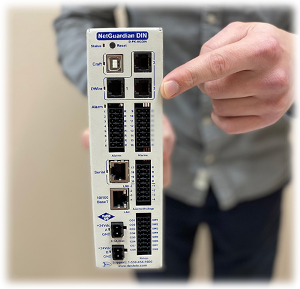
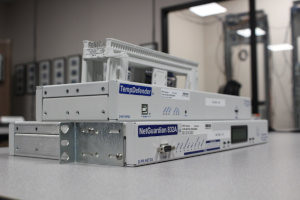
Depending on the use case, DPS Telecom may recommend NetGuardian RTUs to improve visibility at unmanned sites and to receive and act on SNMP traps. A practical outcome is that field devices with limited management interfaces can still be brought into standard NOC workflows.
This level of detail shortens the path to either locating the correct dependency set or identifying that the missing module is outside a given vendor's distribution scope and must come from a standards package.
A MIB download portal is most effective when it provides not only individual MIB files, but also enough context to ensure dependency resolution. This is especially important for teams integrating alarms under time pressure.
If you are using DPS Telecom downloads, check out the member downloads page. A repeatable internal process is still recommended so that production monitoring does not depend on one-off file retrieval.
This usually means the bundle does not include a standards or shared module that the target MIB imports. The missing module may be distributed separately by a standards body or different vendor package.
Not necessarily. Many NMS platforms ship with common IETF baseline modules, but specialized textual convention modules can be excluded, outdated, or stored under different names. The correct answer depends on your tool and the MIB revision expected.
Yes. Traps can be received and logged as numeric OIDs without MIB compilation. MIBs mainly improve human readability and enable certain rule-building features based on named objects and enumerations.
The safest approach is to maintain a centralized, version-controlled MIB repository, document which device firmware uses which MIB set, and automate compile/load validation as part of change control.
An alarm master can normalize event names, severities, and routing in one place. This reduces the requirement that every downstream tool have identical MIB libraries to achieve consistent operator workflows.
Protocol mediation is often appropriate when you have many vendors, many tools, or a mix of SNMP, discrete I/O, and legacy protocols. It can provide consistent alarm semantics even when some MIB ecosystems are incomplete.
If your team is spending cycles troubleshooting SNMP MIB imports, trap decoding, or multi-vendor alarm consistency, DPS Telecom can help you design a maintainable alarm ingestion and normalization workflow that scales across sites and tools.

Andrew Erickson
Andrew Erickson is an Application Engineer at DPS Telecom, a manufacturer of semi-custom remote alarm monitoring systems based in Fresno, California. Andrew brings more than 19 years of experience building site monitoring solutions, developing intuitive user interfaces and documentation, and opt...