Check out our White Paper Series!
A complete library of helpful advice and survival guides for every aspect of system monitoring and control.
1-800-693-0351
Have a specific question? Ask our team of expert engineers and get a specific answer!
Sign up for the next DPS Factory Training!
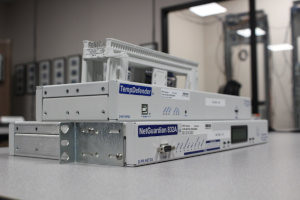
Whether you're new to our equipment or you've used it for years, DPS factory training is the best way to get more from your monitoring.
Reserve Your Seat Today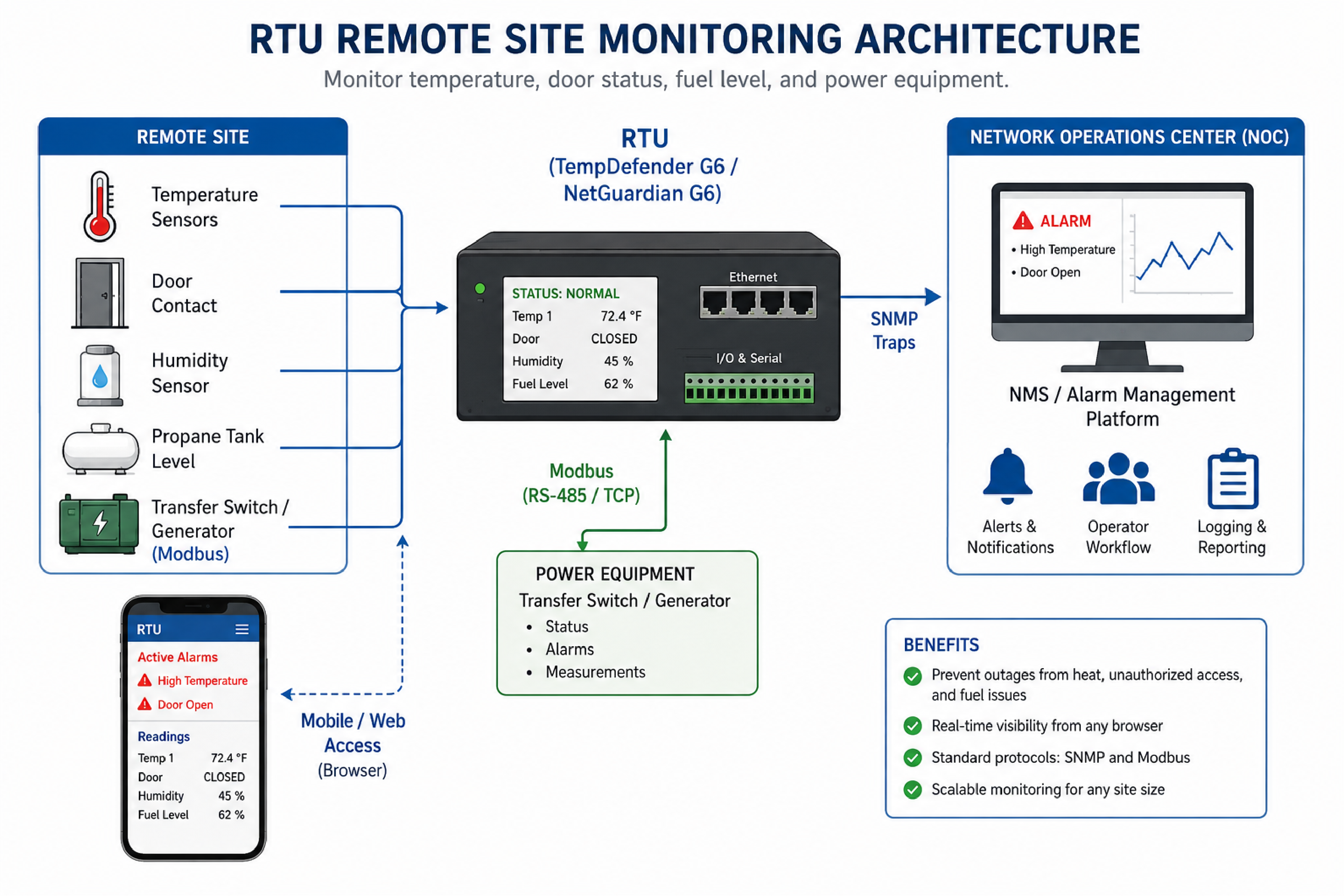
Remote site environmental and access monitoring refers to using an RTU (remote telemetry unit) to collect alarms and measurements such as temperature, door status, and fuel level, then presenting that information to operators through a browser-based interface and standard protocols such as SNMP and Modbus. Remote site monitoring is used to reduce the risk of outages caused by heat, unauthorized access, or generator and fuel issues at unmanned facilities.
This article explains how a typical telecom or utility organization evaluates RTU platforms for distributed sites, with specific attention to mobile-friendly web interfaces, temperature and door alarms, Modbus-capable transfer switches, and optional propane tank monitoring. The discussion also covers how to keep legacy integrations stable while introducing newer monitoring hardware at other locations.
An RTU is defined as a field-deployed monitoring device that terminates sensor inputs and alarm contacts, applies thresholds and logic, and reports events to a central system. In telecom and utility environments, an RTU typically sits in a shelter, cabinet, or equipment room and monitors conditions that directly affect uptime.
An RTU can be used as a standalone local alarm panel, as a reporting endpoint to an NMS via SNMP, and as an integration point for industrial data via Modbus. Many RTUs also include a built-in web interface for local and remote viewing, reducing the need for specialized client software.
A mobile-friendly RTU web interface means the RTU can be viewed and managed from a smartphone or tablet browser without losing core usability. In distributed networks, this matters because the first responder to a site alarm is often in the field, not at a desk. A browser-based interface can provide immediate visibility into current alarms, sensor readings, and basic configuration.
A practical evaluation method is to test mobile access against routine workflows: acknowledging alarms, checking current temperature trends, verifying door input state, and validating network settings. When a platform family shares a similar interface across models, it reduces training time and lowers the chance of operator error when hardware is mixed across sites.
TempDefender and NetGuardian are RTU families that can be used for remote site monitoring, but they are often selected based on physical form factor, I/O capacity, and the types of integrations planned. In many deployments, the decision comes down to how many points need to be monitored now, how much expansion is expected, and whether the organization wants a rack-mount unit or a DIN-rail footprint.
DPS Telecom commonly demonstrates the G6 web interface across devices such as TempDefender G6, NetGuardian 216 G6, and NetGuardian 832 G6, because these platforms share similar web workflows while offering different I/O capacities. That similarity helps organizations standardize processes while deploying different models based on site size.
| Platform / Model Family | Typical Fit | Key Evaluation Criteria | Notes For Planners |
|---|---|---|---|
| TempDefender G6 | Environmental monitoring focused sites | Temperature and door alarms, sensor support, future protocol needs | Often selected when environmental monitoring is the primary need and expansion to Modbus monitoring is planned. |
| NetGuardian 216 G6 | Small to medium sites | Balanced I/O capacity, common web interface, alarm reporting | Useful when you need more general alarm coverage with a similar G6 user experience. |
| NetGuardian 832 G6 | High-point-count sites | Large I/O capacity, scalable alarm monitoring | Fits central offices, headends, or aggregation sites that have many alarm points. |
| NetGuardian DIN (platform varies) | DIN-rail cabinets and compact control panels | Footprint, integration roadmap, protocol support verification | When platform generations differ, confirm current Modbus capabilities and roadmap before standardizing. |
| NetGuardian G4 / G5 (legacy) | Sites with older NMS or switch expectations | Protocol behavior consistency, integration stability | Legacy integrations can justify keeping older units in place while new G6 devices are used elsewhere. |
A digital alarm input is defined as a discrete on/off signal that indicates whether a condition is normal or in alarm. For door monitoring, a digital input is typically wired to a door contact switch so that an open door condition can generate an alarm.
Door alarms are often a first priority because they are simple to deploy and immediately useful. Door events can correlate with other problems such as temperature spikes, fan failures, or unexpected power work. A well-designed configuration includes clear alarm labeling, correct normal state selection (normally open vs. normally closed), and escalation rules that match site access policies.
An analog input is defined as a measurement channel that reads a variable signal and converts it into a numeric value such as degrees, percent humidity, or tank level. In remote site monitoring, analogs are used for sensors and transducers that provide continuous readings rather than simple on/off states.
Temperature monitoring commonly uses configurable thresholds with multiple severities. A practical approach is to define minor and major limits for both over and under conditions. Minor thresholds support early warning, while major thresholds indicate urgent conditions that can impact equipment health. Proper analog scaling is essential so that the RTU displays meaningful engineering units and alarms trigger at correct values.
When you evaluate an RTU, review how threshold configuration is presented in the web interface, how alarms are latched or cleared, and how alarm severities map to SNMP traps or other northbound reporting methods.
D-Wire sensors are defined as addressable sensors that can be daisy-chained on a single cable, allowing multiple measurement points to connect to one sensor bus. In many remote site deployments, D-Wire reduces installation complexity compared to traditional 4-20 mA or 0-10 V transducers that require separate wiring and scaling per channel.
D-Wire is often used for temperature and similar environmental measurements because it supports multiple sensors per run and simplifies expansion. A typical planning step is to count how many sensor locations are needed per site, estimate cable routing, and decide whether the simplicity of daisy-chaining outweighs the need for specialized transducer types.
| Requirement | D-Wire Sensor Approach | Analog Transducer Approach |
|---|---|---|
| Multiple measurement points on one cable | Strong fit | Usually requires multiple home runs |
| Simple expansion over time | Add sensors to the chain | Add channels and wiring, then rescale |
| Very specialized measurement type | Depends on available sensor types | Often easier to source custom transducers |
| Calibration and engineering units handling | Typically straightforward | Requires correct scaling and signal type |
Modbus monitoring refers to polling or receiving register-based data from industrial devices such as transfer switches and generator controllers. In remote power systems, Modbus can expose runtime status, alarms, and measurements that are not available through simple dry contacts.
If transfer switches support Modbus communications, an RTU that supports Modbus can be used to collect operational data and convert key states into actionable alarms. The evaluation step is to confirm Modbus support on the RTU platform you plan to standardize on, and to identify which registers matter operationally.
When multiple RTU platform generations exist in an environment, it is also important to verify whether a specific form factor line has been upgraded to the same feature set as other models. A platform roadmap discussion can prevent surprises during rollout.
Propane tank monitoring is defined as measuring fuel level so that refueling can be scheduled before a generator-backed site is at risk. For organizations that use propane rather than diesel, tank level awareness can be critical during long commercial power events when fuel deliveries are constrained.
A common approach is to interface with the site gauge hardware and convert tank level into a readable value and alarm thresholds. In practice, verifying gauge compatibility is a key step. Many installations use common gauge families, and DPS Telecom typically validates compatibility by reviewing photos and measurements of the existing gauge and tank configuration.
Legacy SNMP integration management refers to keeping an established monitoring connection stable while introducing newer hardware and software architectures at other sites. In telecom environments, older switch platforms can have strict SNMP expectations for traps, OIDs, or behavior. Changes in device architecture can affect compatibility even when the overall function is similar.
A practical pattern is to retain an existing, proven RTU for the legacy integration point, while deploying newer G6 hardware at other sites that do not have that constraint. This approach reduces risk by avoiding unnecessary changes to a stable integration, while still allowing modernization where it is safe.
DPS Telecom engineering teams often help customers review SNMP integration expectations and identify the safest migration path. When the requirement is to preserve an older integration, that requirement should be documented as a first-class design constraint, not treated as an afterthought.
A live demo for an RTU evaluation is defined as temporary access to a functioning unit so that stakeholders can validate usability, workflows, and fit to requirements. A demo is especially valuable when multiple teams need to sign off, such as operations, IT security, and management.
A meaningful demo plan focuses on tasks rather than features. It should include mobile browser checks, alarm and threshold configuration reviews, and verification that the interface is intuitive for routine actions. If external access is required for reviewers, access controls and temporary credentials should be used, and evaluation scope should be clearly defined.
A NOC workflow for remote site monitoring is defined as the set of processes and systems that receive alarms, correlate them, notify the right teams, and record resolution. RTUs are the field layer. Alarm management platforms are the central layer that helps operators prioritize and act.
DPS Telecom RTUs such as TempDefender and NetGuardian commonly report alarms northbound via SNMP traps to an NMS, or to an alarm master that specializes in alarm handling and operator workflows. For organizations with many sites and mixed equipment vendors, protocol mediation and alarm integration can reduce tool sprawl by converting diverse device signals into a consistent alarm model.
The design goal is operational clarity: when a door opens unexpectedly, when temperature crosses a threshold, or when generator state changes, operators should see the event quickly, understand severity, and know the next action.
The simplest starting point is usually door alarm monitoring and a small number of temperature sensors. These provide immediate value and are easy to validate during a demo because the alarm state changes are straightforward to test.
The correct number depends on airflow and risk points, such as battery strings, HVAC discharge areas, and dense equipment racks. Many teams start with fewer sensors and expand after reviewing trends and hot spots. A daisy-chained sensor approach can make expansion easier.
D-Wire is often preferred when multiple sensor locations are needed and installation simplicity is important. Analog transducers are a good fit when a specialized measurement type is required or when a site already uses standard signal types that must be preserved.
Start by confirming the transfer switch Modbus variant (RTU vs TCP), register map availability, and required baud or network settings. Then confirm the RTU platform supports the needed Modbus method. Finally, define which registers should generate alarms and which should be trended.
Yes. A common approach is to keep the legacy RTU where integration behavior is already validated, and deploy newer RTUs at other sites. This avoids destabilizing a proven integration while still modernizing the broader network.
It should demonstrate that operators can quickly review alarms and readings, acknowledge events, and safely make limited configuration changes from a phone or tablet. The goal is usability under real field conditions, not just desktop accessibility.
If your team is standardizing remote site monitoring for temperature, door alarms, Modbus-capable transfer switches, and optional fuel level visibility, DPS Telecom can help you select an RTU platform, validate protocol compatibility, and plan a phased rollout that protects legacy integrations. Get a Free Consultation.

Andrew Erickson
Andrew Erickson is an Application Engineer at DPS Telecom, a manufacturer of semi-custom remote alarm monitoring systems based in Fresno, California. Andrew brings more than 19 years of experience building site monitoring solutions, developing intuitive user interfaces and documentation, and opt...