Check out our White Paper Series!
A complete library of helpful advice and survival guides for every aspect of system monitoring and control.
1-800-693-0351
Have a specific question? Ask our team of expert engineers and get a specific answer!
Sign up for the next DPS Factory Training!
Whether you're new to our equipment or you've used it for years, DPS factory training is the best way to get more from your monitoring.
Reserve Your Seat TodayRemote monitoring systems for cell towers, substations, and other unmanned sites can follow two distinct architectural approaches. On-premises systems use field RTUs that report to local master stations you own and operate. Cloud-based platforms collect data from field devices and process it on remote servers accessed via a web browser.
DPS Telecom and Multitel ATLAS represent these two different philosophies. DPS (USA, 30+ years in business) manufactures on-premises hardware including NetGuardian RTUs and T/Mon alarm masters. Multitel (Canada, 40+ years in business) offers ATLAS, which they describe as a "web-based network monitoring and asset analytics" platform.
This comparison examines both approaches by looking at deployment models, technical capabilities, cost structures, and use case fit. The goal is to help you evaluate which architecture aligns with your network requirements, security policies, and operational preferences.
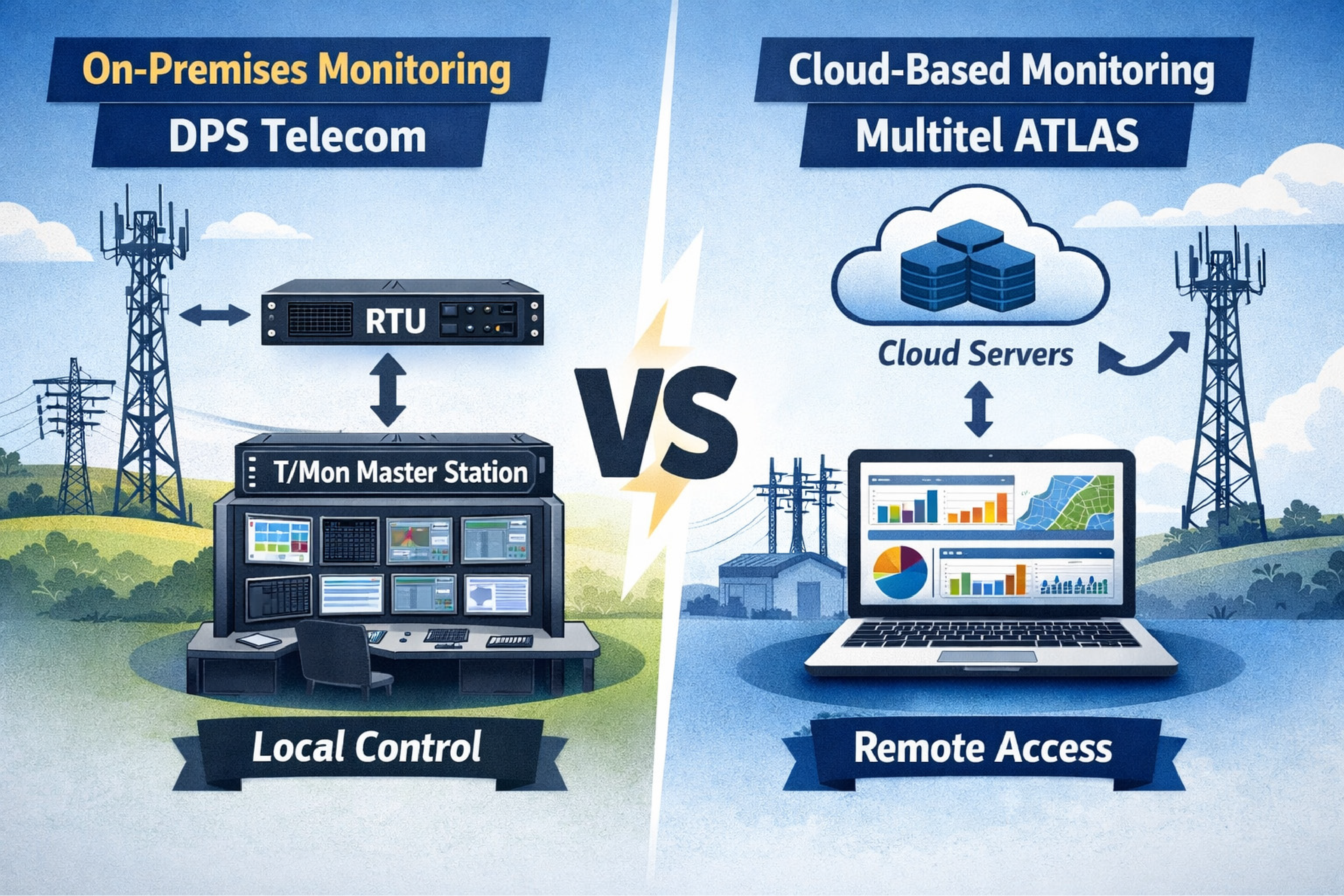
The architecture you choose determines data flow, ownership, and dependency.
On-premises architecture: Field RTUs collect alarms from equipment and sensors. These RTUs report to a master station located on your premises. The master station processes alarms, sends notifications, and provides a management interface. The system operates on your local network. Internet connectivity is optional for remote access but not required for core functionality.
Cloud-based architecture: Field RTUs or gateways collect site data and transmit it to cloud servers via Internet connection. The cloud platform processes data and serves it back to users through web interfaces. Accessing your monitoring data requires Internet connectivity.
At DPS, our NetGuardian RTUs report to T/Mon masters via SNMP, DNP3, Modbus, and 30+ other protocols. The entire system can operate air-gapped if security requirements demand it.
Multitel's ATLAS works differently. According to their platform documentation, field devices upload telemetry to ATLAS servers, which then "provide an interactive network view, real-time alerts, dashboards and reporting."
Both approaches serve the same goal (preventing outages) through different technical means. The choice between them depends on your priorities around data control, cost structure, Internet dependency, and analytics requirements.
On-premises monitoring systems use a two-tier architecture. Field devices collect data. A central master station aggregates and manages that data.
Remote telemetry units are installed at each monitored location. These units connect to equipment via contact closures, analog sensors, serial ports, or network interfaces.
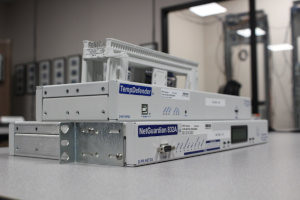
The NetGuardian 832A serves as one example. This 1U device provides 32 discrete inputs, 8 analog inputs, 8 relay outputs, and 32 network ping monitors. It can also function as an 8-port serial terminal server. A single unit monitors multiple input types simultaneously.
RTUs are built for long operational life. Equipment designed for telecom environments typically operates 20+ years before replacement becomes necessary. Extended temperature ranges allow deployment in outdoor cabinets and equipment shelters.
The master station receives alarm data from distributed RTUs. It processes this data, applies filtering rules, and delivers notifications via email, SMS, or on-screen alerts.
The T/Mon LNX model can handle up to 9,999 RTUs and 999,999 alarm points. This capacity accommodates networks ranging from a few dozen sites to several thousand.
Protocol support matters for integration. T/Mon can collect data via SNMP (v1, v2c, v3), DNP3, Modbus, TL1, and various ASCII formats. When field equipment uses different protocols, the master mediates between them. This allows monitoring of multi-vendor environments through a single interface.
The T/Mon GFX interface displays alarms on geographic maps. Operators can filter views by site, alarm type, or severity. Different users can have different permissions and alarm visibility.
On-premises systems can operate without continuous Internet connectivity. The master station runs on your local network. RTUs communicate with the master via LAN, serial, or other transport methods you control.
Internet access becomes optional rather than required. You can enable remote access for off-site monitoring. You can also operate the system completely isolated if security policies require it.
For organizations with air-gapped networks or restricted Internet access, this architecture may be necessary. Defense installations, certain utility SCADA networks, and high-security facilities often cannot depend on external network connectivity for alarm monitoring.
Cloud-based platforms centralize data processing on remote servers. Users access the system through web browsers or mobile apps.
Multitel manufactures iO series RTUs (iO Supervisor, iO Gateway, iO mini) that collect site data. Third-party devices can also integrate with ATLAS if they support compatible protocols.
The iO Supervisor provides up to 64 binary inputs, 11 analog inputs, and 8 relay outputs. These units connect to site equipment and sensors, then transmit collected data to ATLAS servers via Internet connection.
ATLAS receives telemetry from field devices and applies user-defined rules. When measurements exceed thresholds or alarm conditions occur, the platform generates notifications.
According to Multitel's documentation, users access an "interactive network view" showing all monitored sites with status indicators. The web interface includes:
Cloud platforms can include built-in analytics that may require custom development in on-premises systems. ATLAS offers pre-configured dashboards for viewing KPIs, tracking performance goals, and identifying trends across multiple sites.
Organizations using ATLAS can generate reports for management, schedule automated summaries, and extract data for offline analysis. These features come integrated with the platform rather than requiring separate tools or development work.
Cloud-based monitoring requires reliable Internet connectivity. Field RTUs must maintain connections to transmit data. Users need Internet access to view dashboards and receive notifications.
If Internet service fails at your network operations center, you cannot access the monitoring platform until connectivity restores. If field RTUs lose Internet connectivity, they cannot report alarms to the cloud servers.
For networks with consistent Internet availability and organizations comfortable with cloud-hosted data, this architecture provides centralized visibility without maintaining on-site server infrastructure. According to Multitel's materials, the platform emphasizes "greater efficiency" through quick data access and a "single-page global network view" for instant operational visibility.
| Feature | DPS Telecom (On-Premises) | Multitel ATLAS (Cloud) |
|---|---|---|
| Company Background | U.S. manufacturer, 30+ years in remote monitoring | Canadian company, 40+ years in network monitoring |
| Deployment Model | Hardware installed on customer premises. Optional Internet connectivity | Cloud-hosted platform requiring Internet connection. Subscription-based access |
| Core Products | NetGuardian RTUs, T/Mon alarm masters | ATLAS software platform, iO series RTUs/gateways |
| Protocol Support | 30+ protocols including SNMP (v1-v3), DNP3, Modbus, TL1, ASCII formats | SNMP (v1-v3), Modbus, TL1, HTTP(S), SMTP |
| Example RTU Capacity | NetGuardian 832A: 32 discrete inputs, 8 analog inputs, 8 relay outputs | iO Supervisor: 64 binary inputs, 11 analog inputs, 8 relays |
| Network Scale | T/Mon LNX handles up to 9,999 RTUs and 999,999 alarm points | ATLAS supports thousands of RTUs with cloud scalability |
| Data Access | Local web interface, SNMP traps, email/SMS alerts. Operates without Internet | Web-based portal and mobile access requiring Internet connection |
| Analytics | Standard trending and logging, customizable map displays | Built-in business intelligence dashboards and reporting |
| Notifications | Email, SMS/pager, on-screen alerts with configurable severity | Automated alerts based on user-defined business rules |
| Equipment Lifespan | Designed for 20+ year operational life | Equipment lifespan varies by model and deployment |
| Cost Model | One-time equipment purchase (RTUs start around $700) | Recurring subscription fees for cloud platform access |
| Support | Lifetime technical support included with equipment purchase | Support terms defined by service contract |
(Information gathered from published DPS Telecom and Multitel documentation, including product datasheets for NetGuardian RTUs, T/Mon masters, iO Supervisor, and ATLAS platform as of 2025. Specifications vary by model and configuration. Contact vendors for current details.)
Certain network characteristics and organizational requirements favor on-premises architectures.
On-premises systems require upfront capital expenditure. RTUs typically range from $700 to $5,000 depending on I/O capacity and features. Master stations range from $10,000 for basic configurations to $50,000+ for enterprise deployments.
After the initial purchase, there are no mandatory recurring fees for platform access. Maintenance agreements are optional. Organizations can choose to purchase extended warranties or support contracts, but basic functionality continues without ongoing payments.
Cloud platforms operate on subscription models. Monthly or annual fees provide platform access. Over a 10-year period, subscription costs can exceed the one-time purchase price of equivalent on-premises equipment.
The cost comparison depends on your network size, how long you plan to use the equipment, and whether you factor in internal IT labor for maintaining on-premises servers.
On-premises systems keep operational data within your physical control. Alarm information, site configurations, and historical logs remain on servers you own and operate.
Some organizations must comply with data residency regulations. Government agencies may be prohibited from storing operational data on commercial cloud platforms. Defense contractors often cannot use cloud services for classified or sensitive facility monitoring.
Air-gapped networks (systems with no external Internet connection) require on-premises architecture. If your security policies prohibit Internet connectivity for SCADA or alarm monitoring systems, cloud platforms cannot meet those requirements.
On-premises systems can operate when Internet service fails. RTUs communicate with the master station via your local network. Notifications and alarm processing continue as long as the LAN remains functional.
For critical infrastructure in remote locations with unreliable Internet connectivity, this independence can matter. Cell towers in mountainous areas, rural substations, and remote repeater sites may have intermittent Internet access. An on-premises master can continue collecting alarms from RTUs via serial, microwave, or satellite links when commercial Internet service is unavailable.
Organizations with established enterprise management platforms may prefer RTUs that report to existing systems rather than introducing a separate cloud portal.
On-premises RTUs can integrate with platforms like SolarWinds, IBM OpenView, and other SNMP managers. This allows you to add remote site monitoring to your existing management infrastructure rather than training staff on a new interface.
Industrial telemetry equipment designed for telecom environments typically operates for extended periods. Deployments lasting 20+ years are common in the telecom industry. Equipment built to NEBS (Network Equipment-Building System) standards withstands temperature extremes and harsh conditions.
Long operational life can reduce total cost of ownership. If equipment operates for 20 years instead of 5, the annual cost decreases accordingly. At DPS, we've heard from clients whose equipment has operated for decades. One transportation department engineer mentioned, "We've always been very pleased with DPS Telecom's RTUs. They've lasted for 20 years."
Some networks have unique requirements that don't match off-the-shelf products. Non-standard rack dimensions, unusual protocol requirements, or specialized sensor interfaces may require equipment modification.
On-premises equipment manufacturers can sometimes accommodate custom engineering requests. Organizations needing modified hardware may find this option valuable when standard products don't fit their specific deployment constraints.
Cloud platforms offer different advantages that may align with certain operational priorities.
Web-based platforms allow monitoring from any device with Internet access. Technical staff can view network status from laptops, tablets, or phones without VPN configuration or direct network access.
For organizations with distributed IT teams or contractors working from multiple locations, this accessibility can simplify operations. Cloud dashboards provide immediate visibility without requiring connection to your corporate network.
Cloud platforms often include pre-built analytics capabilities. Dashboards, KPIs, trend analysis, and automated reporting come integrated rather than requiring custom development or third-party tools.
Organizations that need executive dashboards or performance tracking across thousands of sites may value these ready-to-use features. The alternative with on-premises systems typically involves custom programming or purchasing separate analytics software.
Cloud platforms eliminate the need to purchase and maintain master station servers. The service provider handles software updates, security patches, and infrastructure maintenance.
For organizations preferring to minimize on-site IT infrastructure, this approach reduces hardware footprint and shifts maintenance responsibility to the platform vendor.
Subscription pricing converts capital expenditure into predictable operational expense. Some organizations find monthly or annual fees easier to budget than large upfront equipment purchases.
This financial structure may align better with certain organizational budgeting practices, particularly when capital expenditure approval processes are more restrictive than operational spending.
The right monitoring architecture depends on your specific operational context.
Cost structure: Do you prefer one-time capital expenditure or ongoing operational expense? How long do you plan to use the equipment? What's your total cost over the expected system lifetime?
Data control: Do you have regulatory requirements about where operational data can be stored? Are there security policies prohibiting cloud-hosted monitoring data?
Internet dependency: How reliable is Internet connectivity at your sites and network operations center? Can your monitoring system tolerate Internet outages?
Analytics needs: Do you need advanced dashboards and business intelligence? Would you use automated reporting and trend analysis across multiple sites?
Integration requirements: Do you need monitoring to integrate with existing enterprise management systems? What protocols do your current systems use?
IT resources: Do you have staff to maintain on-premises servers? Or would you prefer a cloud platform that shifts maintenance to the vendor?
Network scale: How many sites do you need to monitor? How many alarm points? Will this grow significantly over time?
Both on-premises and cloud-based monitoring achieve the same goal through different technical approaches. Neither architecture is inherently superior. The choice depends on which tradeoffs align with your priorities.
On-premises systems offer data control, network independence, and predictable costs. They require upfront capital expenditure and on-site server maintenance.
Cloud platforms offer centralized access, built-in analytics, and minimal on-site infrastructure. They require Internet connectivity and ongoing subscription fees.
When evaluating vendors, request detailed information about protocol support, scalability limits, integration capabilities, and total cost projections. Most vendors offer trials or demonstrations that let you test functionality with your actual equipment before committing.
At DPS Telecom, we've spent over 30 years helping telecom carriers, utilities, and transportation agencies protect critical infrastructure. Our NetGuardian RTUs and T/Mon masters provide on-premises monitoring that operates independently of cloud dependencies.
We offer a 30-day loaner program where you can test our equipment in your actual environment. You only pay shipping costs. We also provide factory training at our California facilities and 24/7 technical support directly from our engineering team.
Our equipment is designed, manufactured, and tested in the USA at our Fresno facilities. This gives us complete control over quality and allows us to accommodate custom engineering requirements when your infrastructure needs modifications to standard products.
If you're evaluating monitoring solutions for your network, we'd welcome the opportunity to discuss your specific requirements. Our application engineers can help you determine whether on-premises monitoring, cloud platforms, or hybrid approaches best fit your infrastructure.
Contact us at 1-800-693-0351 or visit dpstele.com to discuss your remote monitoring needs.

Andrew Erickson
Andrew Erickson is an Application Engineer at DPS Telecom, a manufacturer of semi-custom remote alarm monitoring systems based in Fresno, California. Andrew brings more than 19 years of experience building site monitoring solutions, developing intuitive user interfaces and documentation, and opt...