Check out our White Paper Series!
A complete library of helpful advice and survival guides for every aspect of system monitoring and control.
1-800-693-0351
Have a specific question? Ask our team of expert engineers and get a specific answer!
Sign up for the next DPS Factory Training!
Whether you're new to our equipment or you've used it for years, DPS factory training is the best way to get more from your monitoring.
Reserve Your Seat Today
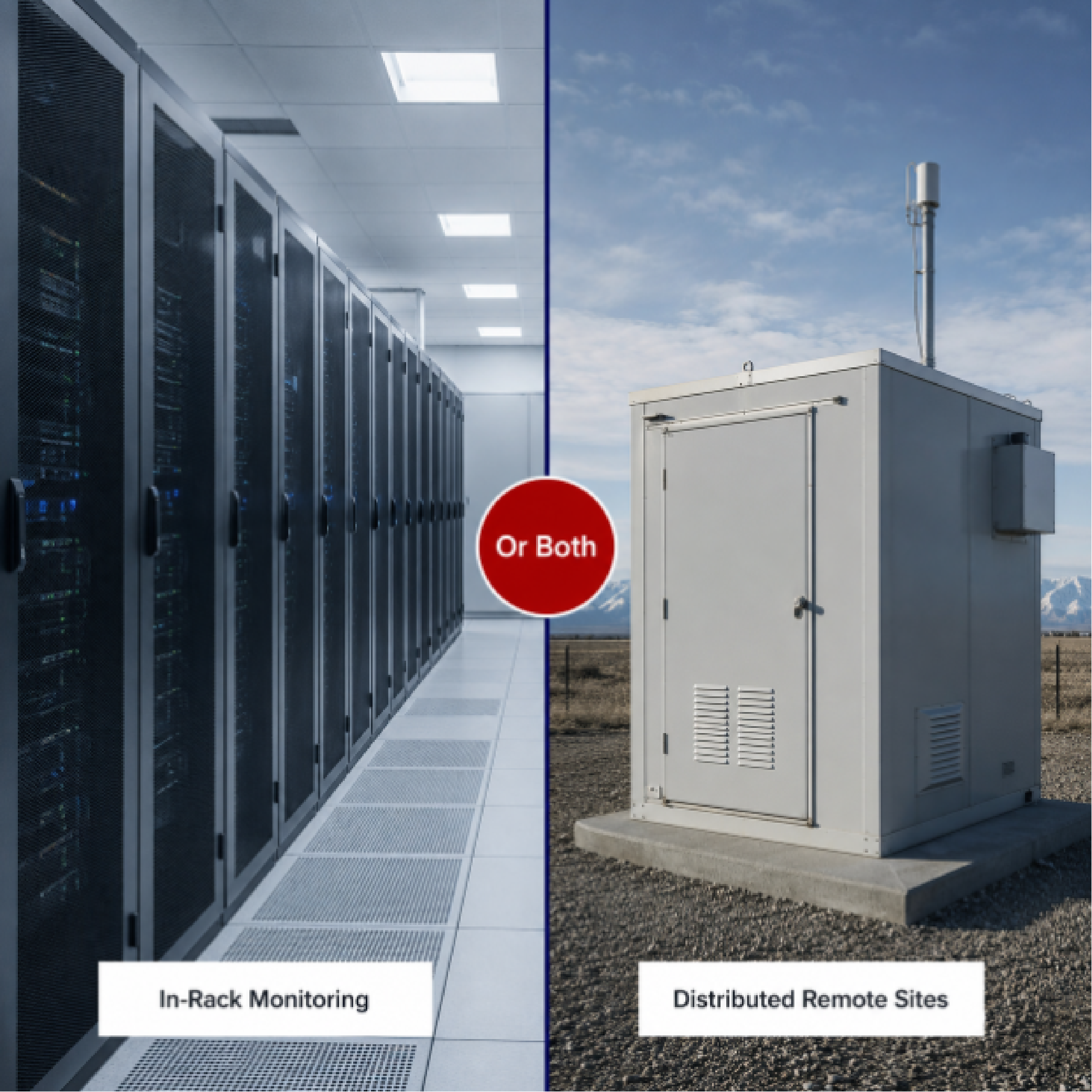
If you're comparing DPS Telecom's NetGuardian platform against the APC NetBotz 750, you're likely watching over one of two different environments: a distributed network of unmanned remote sites, or a single data-center rack.
At DPS Telecom, we've spent 37 years building alarm and telemetry systems for the first case. Our NetGuardian Remote Terminal Units (RTUs), paired with the T/Mon master station, collect equipment alarms from many unmanned telecom, utility, transit, and government sites, even where there's no climate control or reliable AC power, and centralize them in one place. The NetBotz Rack Monitor 750 solves a related but different problem: it's a data-center and server-room appliance for information technology (IT) environments, built for in-rack environmental sensing, leak and smoke detection, rack-access control, and high-definition (HD) camera surveillance inside a single controlled facility.
The most common mistake we see in this category is buying a tool for the wrong layer of the network. Rather than declaring an outright winner, we evaluated both products by their published specifications and the use cases each vendor targets, so you can see exactly where each one fits and reach the right decision for your own sites.
The fastest way to see the difference is side by side. The table below summarizes the published specifications for a representative full-featured NetGuardian (the 832A) reporting to T/Mon, against the APC NetBotz Rack Monitor 750 (model NBRK0750).
A few protocol acronyms appear in the table for the first time, so it helps to define them up front: Simple Network Management Protocol (SNMP), Distributed Network Protocol 3 (DNP3), Transaction Language 1 (TL1), and American Standard Code for Information Interchange (ASCII). The hardening standard referenced is the Network Equipment-Building System (NEBS), and the power figures use volts of direct current (VDC) and volts of alternating current (VAC).
| Dimension | DPS NetGuardian 832A + T/Mon | APC NetBotz 750 (NBRK0750) |
|---|---|---|
| Primary use case | Distributed remote-site equipment alarm and telemetry monitoring | Data-center, server-room, and edge IT rack environmental and physical-security monitoring |
| Monitoring scope | Many remote sites aggregated to one master station | Single rack to data center, one IP per appliance |
| Discrete (contact-closure) capacity | 32 native, expandable to 176 | Small native dry-contact and door footprint; scales via sensor pods |
| Analog inputs | 8 analog inputs, 4 thresholds each | 4-20mA and universal sensor ports |
| Control relays | 8 Form C control relays | 2 relay outputs |
| Serial reach-through | 8 serial terminal-server ports | None native |
| Protocols | SNMP v1/v2c/v3, DCPx at the RTU; T/Mon adds 25+ protocols including DNP3, Modbus, TL1, ASCII | SNMP v1/v3, HTTPS, SSHv2, A-Link; Modbus over IP added in later firmware |
| Power input | -48VDC telecom (also +24VDC and AC options) | 100-240 VAC |
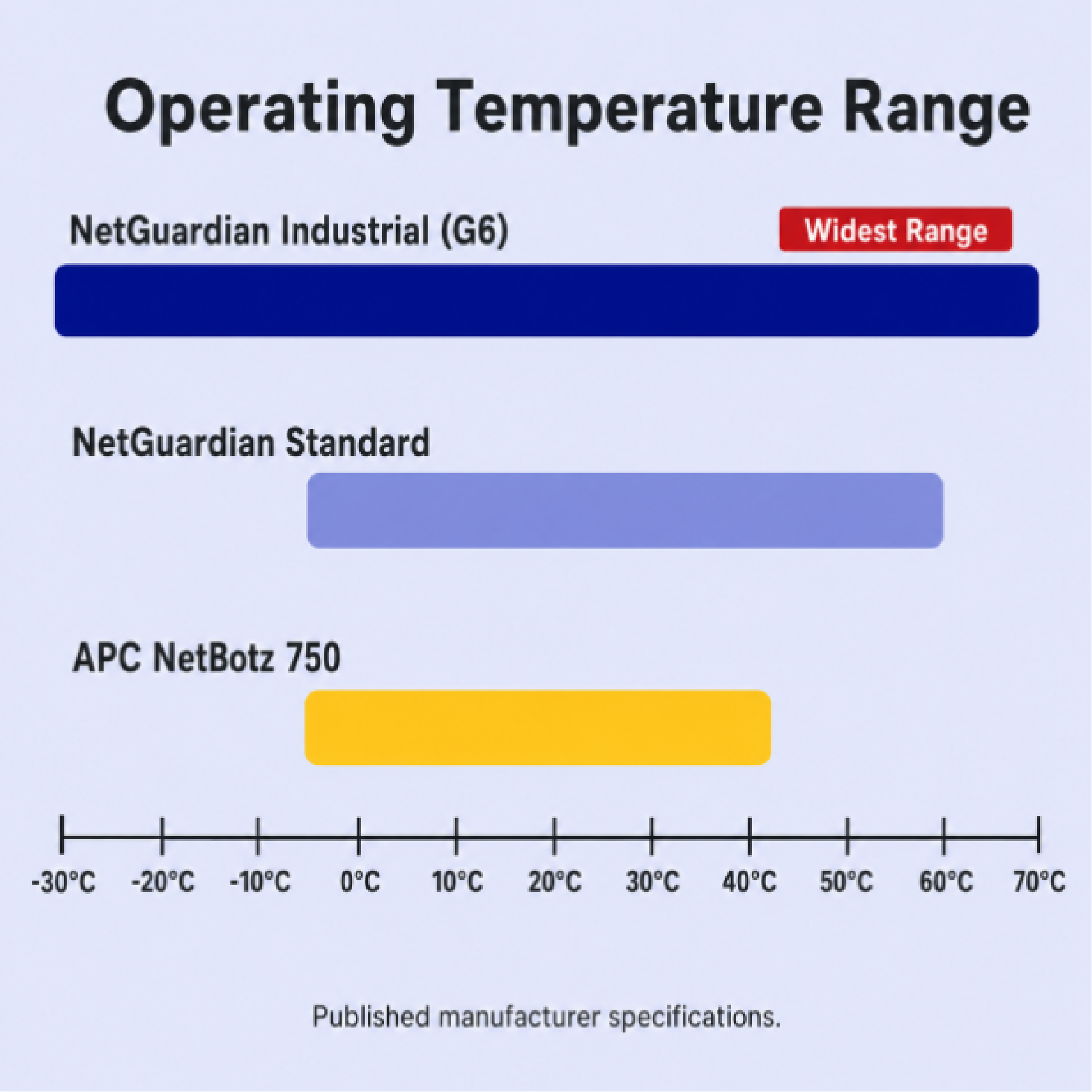
| Environmental hardening | NEBS Level 3; standard 0 to 60C, industrial version -30 to +70C | 0 to 40C, indoor and controlled spaces |
| Local data retention | RTU event log plus T/Mon history | Up to 96 hours before purging (manufacturer-stated) |
| Target industries | Telecom, electric utilities, transportation, government, public safety | Data centers, server rooms, edge IT, colocation |
The APC specifications above were gathered from published distributor datasheets and manufacturer documentation. They may not capture the full breadth of available models, and some data may have changed since it was reviewed. Confirm current capabilities, firmware features, and lifecycle status directly with the vendor before purchasing.
The NetBotz Rack Monitor 750 is a 1U rack-mount appliance built for monitoring the environment inside information technology (IT) racks. APC describes it, through its distributor datasheets, as offering "integrated surveillance, sensing, access control, and advanced alerting" for IT environments ranging from a single edge rack to a large data center.
In practical terms, the appliance focuses on facility conditions and physical security in controlled indoor spaces. Published distributor datasheets list support for up to 78 wired sensors, 47 wireless sensors, access control for 26 rack doors, and 4 camera streams behind a single IP address. Supported sensor types include temperature, humidity, dew point, airflow, door contact, dry contact, smoke, fluid leak, rope leak, and vibration. It's powered by alternating current, mounts in 1U, and is rated for an operating range of roughly 0 to 40C, which suits a climate-controlled server room.
This is a capable device for what it was designed to do. If your priority is protecting racks in a data center with environmental sensors, badged access audit trails, and video, the NetBotz 750 is a strong fit for that layer of the network.
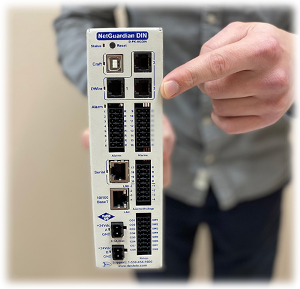
A NetGuardian is a telecom-grade RTU, which is the field device that sits at a remote site and collects alarms from the equipment around it. If you want a deeper primer on the category, our overview of what an RTU does walks through the fundamentals.
The full-featured NetGuardian 832A natively handles 32 discrete contact-closure alarms, expandable to 176 with expansion shelves, plus 8 analog inputs, 8 Form C control relays, and 8 serial terminal-server ports. It runs on -48VDC telecom power, mounts in 19 or 23 inch racks, and is built to NEBS Level 3. The standard model operates from 0 to 60C, and the industrial G6 version functions reliably from -30C to +70C for outdoor cabinets and unheated huts.
A single RTU can be a complete monitoring system on its own. As our co-founder Bob Berry put it in the book 100% Uptime, "modern RTUs can be your entire monitoring system" when you have fewer than about 10 sites. Past that point, managing each RTU's web interface separately becomes cumbersome, which is where the T/Mon master station comes in. T/Mon aggregates alarms from all your RTUs and remote equipment, mediates 25+ protocols, and presents everything in one place. T/Mon LNX can monitor thousands of devices and up to 1 million alarm points, which is what makes it practical to run a regional or national network from a single network operations center (NOC).
The clearest technical dividing line between these two products is how many discrete (contact-closure) equipment alarms each one can terminate.
A discrete alarm is the on/off signal that most field equipment produces: a generator running, a rectifier reporting a fault, a door opening, an intrusion contact tripping. Telecom and utility sites generate a lot of these. The NetBotz 750 has a small native discrete footprint, made up of dry-contact-capable universal ports and door-contact ports, and it scales primarily by adding environmental sensor pods, up to 78 wired sensors per appliance.
The NetGuardian is built around this job. It natively terminates 32 discrete contact closures and expands to 176 through expansion shelves, which is the core of equipment-alarm monitoring at telecom, utility, and transportation sites. If your sites are full of rectifiers, generators, switches, and door contacts that report through dry contacts, this gap may matter more than any other spec on the sheet.
Most real-world networks are a mix of equipment bought over many years, and that equipment rarely speaks one common language.
The NetBotz 750 communicates over SNMP, Hypertext Transfer Protocol Secure (HTTPS), Secure Shell version 2 (SSHv2), and A-Link, which APC describes as its own bus, with Modbus over IP added in a later firmware release. That covers modern IP-based management well within an IT environment.
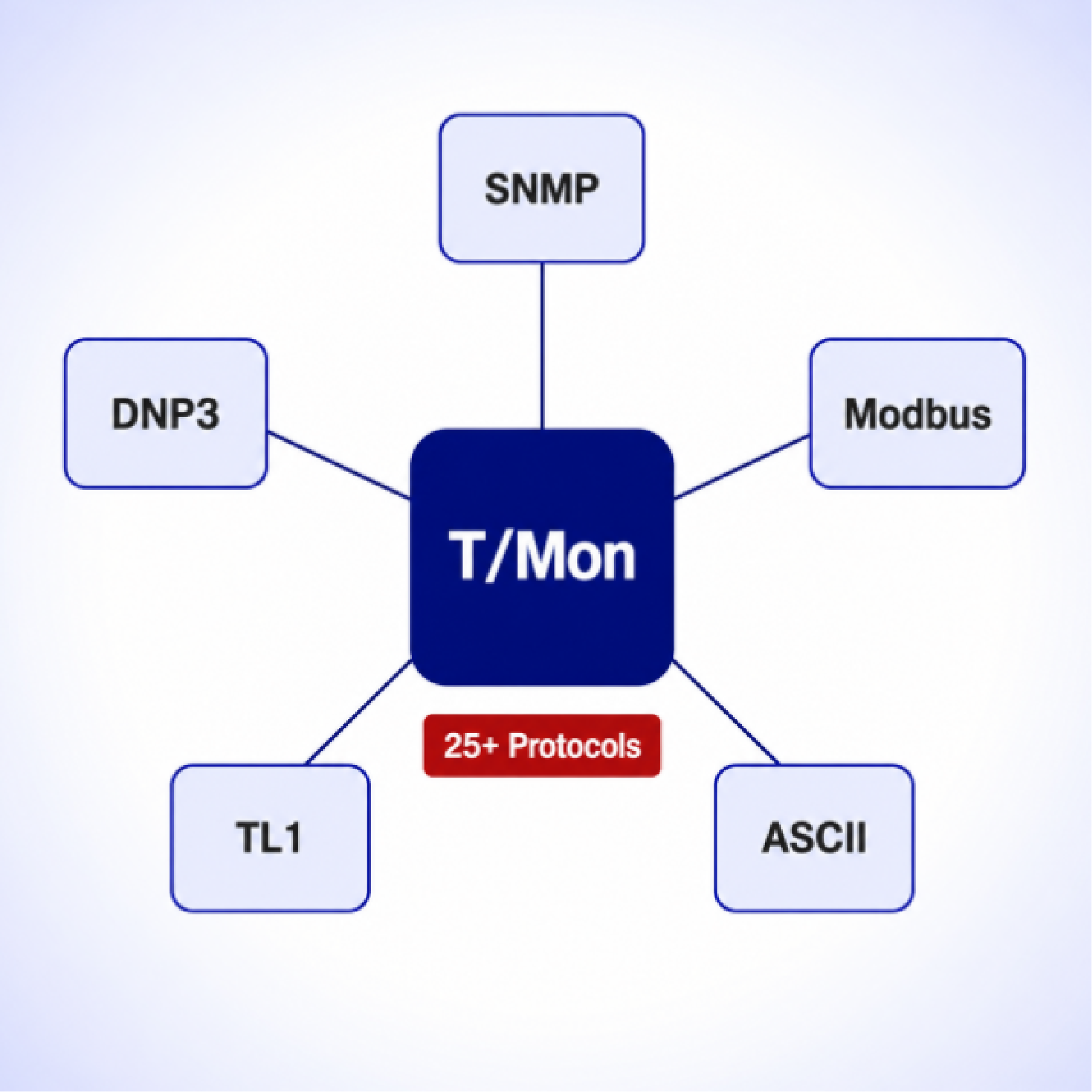
Our approach with T/Mon is built around the assumption that you have older gear you can't easily replace. T/Mon mediates 25+ protocols, including SNMP, DNP3, Modbus, TL1, ASCII, or any number of other legacy and proprietary formats. From a telecom operations perspective, DPS prioritizes bringing otherwise incompatible equipment under one monitoring umbrella, because for many of our clients the alternative is replacing field equipment that still works. If your environment includes a mix of protocols, multiprotocol alarm aggregation is often the deciding factor between platforms.
Where a device installs determines how it needs to be powered and hardened.
The NetBotz 750 is powered by alternating current and rated for indoor, climate-controlled spaces in the 0 to 40C range. That matches its purpose: a data center or server room where temperature is already managed and utility power is reliable.
Many of the sites our clients monitor have neither of those conditions. A remote cell site, a substation cabinet, or a roadside transit enclosure typically runs on -48VDC plant power and can swing well outside a controlled temperature band. The NetGuardian accepts -48VDC (with +24VDC and AC options across the family) and, in its industrial version, operates from -30C to +70C.
For unheated and unmanned locations, that hardening can be the deciding factor. NEBS Level 3, the standard the NetGuardian is built to, requires equipment to meet strict physical and environmental criteria for fire resistance, thermal margin, and vibration. This is also why the NetGuardian doubles as a capable remote environmental monitoring platform using standard analog and D-Wire sensors, even though equipment alarms are its primary job.
Both platforms offer video, but they integrate it differently.
The NetBotz 750 supports up to 4 HD cameras through a built-in Power over Ethernet (PoE) switch, with clip capture and long-term archival through APC's data-center management software. DPS offers SiteMON IP and SiteCAM cameras that integrate with NetGuardian RTUs, up to 4 per unit, and can be triggered by alarms so that a contact closure or analog threshold automatically pulls up a relevant image in T/Mon. The difference reflects each platform's center of gravity: in-rack surveillance for the NetBotz, alarm-linked site visibility for the NetGuardian.
Hardware specs are only part of the picture. What happens after the purchase matters just as much, especially for infrastructure you expect to run for a decade or more.
Both products carry a 2-year hardware warranty. Beyond that, the support models differ. With DPS, you reach the engineers who designed your equipment rather than a call center reading from scripts, and we provide free lifetime technical support, free firmware updates, and a 30-day loaner program so you can evaluate equipment in your own environment before committing. Our clients routinely run our RTUs for 20-plus years in the field, and we continue supporting products manufactured decades ago.
We focus on value and total cost of ownership rather than the lowest upfront number. For context on pricing, basic RTUs start around $700, with many deployments falling in the $2,000 to $5,000 range per site depending on configuration. Published distributor listings place the NetBotz 750 street price in roughly the $2,500 to $3,300 range, though distributors and pricing change over time.
The right choice comes down to what you're protecting and where it lives. Here's how we'd frame the decision.
Choose the APC NetBotz 750 when your priority is protecting IT racks in a controlled facility. If you need temperature, humidity, leak, and smoke sensing inside data-center racks, badged rack-access audit trails, and integrated HD video, it's purpose-built for that. A benchmark to revisit: if your sensor needs grow beyond 78 wired sensors per appliance, or you start needing contact-closure aggregation from non-IT equipment, the appliance model may stop scaling cleanly.
Choose DPS NetGuardian and T/Mon when you're monitoring distributed remote sites such as cell sites, huts, substations, cabinets, or roadway sites. When you need to collect equipment contact-closure alarms, read analog values, operate control relays, reach serial console ports, and centralize everything in a NOC, the platform is built for that work. Below roughly 10 sites with only environmental needs, a standalone RTU may be enough. Above 10 to 15 sites, or with a mix of protocols, the T/Mon master station can become the deciding advantage.
Consider running both in mixed environments. The platforms can coexist well. A NetGuardian and T/Mon layer collects equipment and contact-closure alarms while environmental appliances handle in-rack sensing, with T/Mon able to mediate SNMP from third-party devices. If you operate both server room monitoring and a fleet of remote sites, this split is common and effective.
The NetBotz 750 is powered by alternating current and rated for indoor, controlled spaces, so it's generally not aimed at -48VDC telecom plants or outdoor temperature extremes. For those sites, a -48VDC, NEBS-rated RTU like the NetGuardian is the more typical fit.
A NetGuardian 832A natively terminates 32 discrete contact-closure alarms and expands to 176 with expansion shelves. The NetBotz 750 has a small native dry-contact and door footprint and scales primarily by adding environmental sensor pods, up to 78 wired sensors total.
T/Mon mediates 25+ protocols including SNMP, DNP3, Modbus, TL1, ASCII, and a range of older formats, which lets you bring legacy and modern equipment into one monitoring system without replacing field gear.
No. In mixed environments, a NetGuardian and T/Mon layer can handle equipment and contact-closure alarms across remote sites while an environmental appliance handles in-rack sensing in the data center, with T/Mon mediating SNMP from third-party devices.
Every network is different, which is why we start by understanding what you're trying to monitor before recommending anything. If you want a straight answer on whether a NetGuardian, T/Mon, or a combined approach fits your sites, our application engineers will assess your requirements at no cost and ship a 30-day loaner so you can test it in your own environment.
Talk to an Engineer | 800-693-0351

Andrew Erickson
Andrew Erickson is an Application Engineer at DPS Telecom, a manufacturer of semi-custom remote alarm monitoring systems based in Fresno, California. Andrew brings more than 19 years of experience building site monitoring solutions, developing intuitive user interfaces and documentation, and opt...