Check out our White Paper Series!
A complete library of helpful advice and survival guides for every aspect of system monitoring and control.
1-800-693-0351
Have a specific question? Ask our team of expert engineers and get a specific answer!
Sign up for the next DPS Factory Training!
Whether you're new to our equipment or you've used it for years, DPS factory training is the best way to get more from your monitoring.
Reserve Your Seat TodayA telecom network operator planning a new project in Alaska needed a clear, bid-ready proposal to monitor multiple remote locations while staying compatible with existing NetGuardian equipment. DPS Telecom developed a modern-equivalent NetGuardian 832A and expansion plan, clarified protocol limitations (HTTP/S vs SNMP/Modbus), and right-sized environmental sensor options so the bidder could present a complete solution.
| Industry | Telecommunications (network operations and site monitoring) |
|---|---|
| Company Type | Telecom network operator (multi-location) |
| Geography / Coverage | Alaska (project sites) with multiple monitored locations |
| Sites Discussed | 14 locations to monitor (overall); later scoped to 12 sites for HVAC airflow sensing |
| Primary Challenge | Build a winning, technically accurate proposal without full specs, while matching legacy NetGuardian equipment and planning sensor monitoring |
| Solution Proposed | Modern-equivalent NetGuardian 832A build with DX expansion planning, -48 VDC matching, connector updates, and D-Wire-based environmental monitoring guidance |
| Key Result | Bidder received a detailed proposal and confirmed quote that clarified upgrade compatibility, network protocol options, and sensor selection |
| Products Referenced | NetGuardian 832A (G6 equivalent), DX expansion unit (G5), D-Wire sensors |
A telecom customer reconnected with DPS Telecom to re-open discussions about deploying a NetGuardian 832 for a current Alaska project. The client knew the network included 14 locations that needed monitoring, but had limited written specifications beyond attachments showing the existing system.
In situations like this, a bidder often needs the manufacturer to help translate diagrams and legacy part numbers into a clear bill of materials, a compatibility story, and a configuration approach that can be presented internally.
The bidder needed to build a proposal around existing NetGuardian equipment already in use, while avoiding the risk of quoting obsolete hardware. Several technical questions had to be answered quickly and accurately:
DPS Telecom reviewed the legacy equipment information and produced a proposal that mapped the older hardware to a current, supportable build while keeping field work practical.
The proposed approach included:
By reviewing our records, I'm confident that I've found a suitable modern build (G6 832A and G5 "DX" expansion unit) that matches the existing NetGuardians in question (G2 832A and G2 DX). I've matched the -48 VDC power inputs. The G6 & G5 are largely pin-compatible with the G2 model, so any replacements here would mostly be a straightforward swap of a few cables. There are limited exceptions to this (we changed the DB9 RS232/485 ports to RJ-45 connectors to eliminate your need to solder cables in the field).
The DX has a much smaller function (connects directly to the base NetGuardian 832A to expand its capacity), so there has been no need yet for a G6 model. The G5 DX is compatible with the G6 832A and remains the current model.
For telecom teams, this kind of manufacturer-backed mapping (legacy model -> current model) can be the difference between a proposal that is technically defensible and one that gets rejected due to end-of-life risk.
In addition to the hardware mapping, DPS Telecom provided language the bidder could reuse to explain why a modern equivalent was being quoted.
As the bidder here, remember to explain the fact that you're quoting a modern equivalent. The G2 was superseded by the G4 by approximately 2006 and was seldom sold after 2012. The G2 is no longer recommended for modern installs for a variety of reasons, and it is largely unavailable for manufacturing.
Although I believe this is an expansion to new sites, you can also remind your company that trading in older NetGuardians yields a 20% credit (of the lesser price, usually the original older purchase) when purchasing an upgraded model. That might be a project for the future at sites that have been deployed for perhaps 20 years or more.
This level of detail matters to decision-makers because it ties technical selection to procurement realities: supportability, availability, and total project cost. When older equipment is involved, DPS Telecom recommends including an upgrade path and trade-in options early, so the proposal stays viable as budgets and timelines change.
The client needed to understand whether alarms could be wired directly into the RTU and what could be accepted over the network.
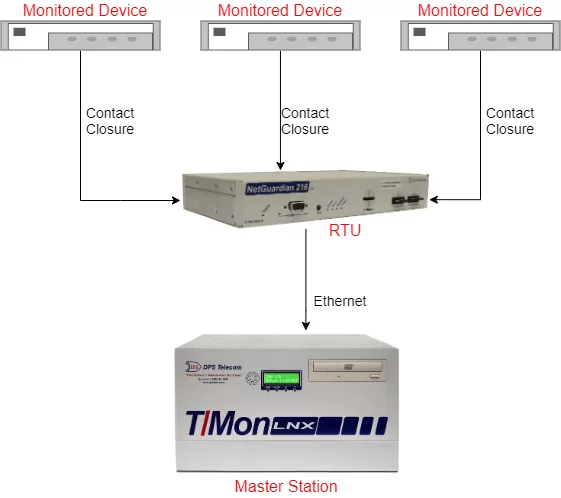
DPS Telecom clarified the basics:
When the client identified HTTP/S as the protocol in use, DPS Telecom provided a direct, practical answer:
Our NetGuardian RTUs have a web page to monitor alarms, but they do not parse alarm inputs from HTTP/S. They can accept alarms over the network with Modbus TCP or SNMP. We also have the T/Mon monitoring platform which can parse or poll alarms over HTTP/S.
For similar projects, DPS Telecom typically recommends keeping site-level alarming simple and deterministic: land dry contacts on discrete inputs when possible, and use supported industrial protocols (SNMP or Modbus TCP) for network integration. When an overall solution requires HTTP/S polling or parsing, centralized software such as T/Mon alarm monitoring may be the better fit, depending on the upstream systems and reporting requirements.
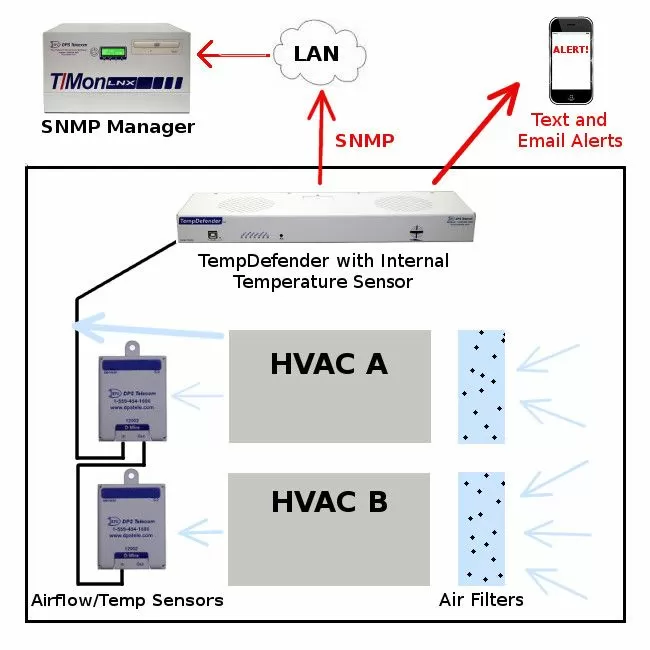
The client also needed environmental monitoring capabilities, specifically temperature, humidity, dew point, and airflow. DPS Telecom outlined available sensing options and explained how each value is typically sourced in a monitoring system.
For telecom facilities, HVAC-related alarming is often prioritized because it can provide early warning before equipment overheats. DPS Telecom commonly recommends alarming on changes from a known baseline (for example, airflow percentage or high temperature thresholds), then escalating those alarms through the same site RTU that already reports power and access conditions.
After reviewing what the HVAC provider would already supply, the client decided they only needed airflow sensing rather than dedicated dew point sensing.
The client required 24 sensors total, covering 12 sites with 2 HVAC units per site. The client also wanted to ensure they could logically pair the two HVAC units in each building.
DPS Telecom proposed daisy-chaining the HVAC sensor connections so the pair could be wired and handled together as a single unit with two halves. This approach is supported through D-Wire ports, which are commonly available on most NetGuardian models (with older exceptions noted by the customer timeframe).
With the scope clarified, DPS Telecom confirmed a quote for 24 temperature + airflow sensors. The client indicated that cabling at the sites was already under control based on their line of business.
The bidder walked away with a complete proposal package that addressed the practical points that typically stall multi-site monitoring projects:
If your monitoring design requires centralized alarm collection, escalation, and reporting across many sites, DPS Telecom also offers T/Mon alarm monitoring for building a unified view of alarms. (In this case, T/Mon was discussed as an option for HTTP/S-related workflows.)
Yes. Dry contact (contact closure) alarms are typically landed on the RTU's discrete inputs and can be mapped to alarm points for reporting and escalation.
No. NetGuardian RTUs provide a web interface for viewing status, but they do not parse alarm inputs from HTTP/S. For network alarm integration, the supported options referenced here were SNMP and Modbus TCP.
Legacy models may be end-of-life, unavailable for manufacturing, or not recommended for new deployments. A proposal that documents the modern equivalent and compatibility considerations helps reduce project risk.
The DX connects directly to the base NetGuardian 832A to expand alarm and monitoring capacity when additional points are required at a site.
Dew point is calculated from temperature and humidity. If the RTU does not perform that calculation, one approach is using a third-party dew point sensor that outputs a 0-5 V or 4-20 mA signal into an RTU analog input.
DPS Telecom supports telecom teams that need to modernize alarm monitoring, integrate legacy equipment, and produce proposal-ready designs that engineering and procurement can approve.
Get a Free Consultation or call 1-800-693-0351 to speak with a DPS Telecom expert about your project. You can also email sales@dpstele.com.

Andrew Erickson
Andrew Erickson is an Application Engineer at DPS Telecom, a manufacturer of semi-custom remote alarm monitoring systems based in Fresno, California. Andrew brings more than 19 years of experience building site monitoring solutions, developing intuitive user interfaces and documentation, and opt...