Check out our White Paper Series!
A complete library of helpful advice and survival guides for every aspect of system monitoring and control.
1-800-693-0351
Have a specific question? Ask our team of expert engineers and get a specific answer!
Sign up for the next DPS Factory Training!
Whether you're new to our equipment or you've used it for years, DPS factory training is the best way to get more from your monitoring.
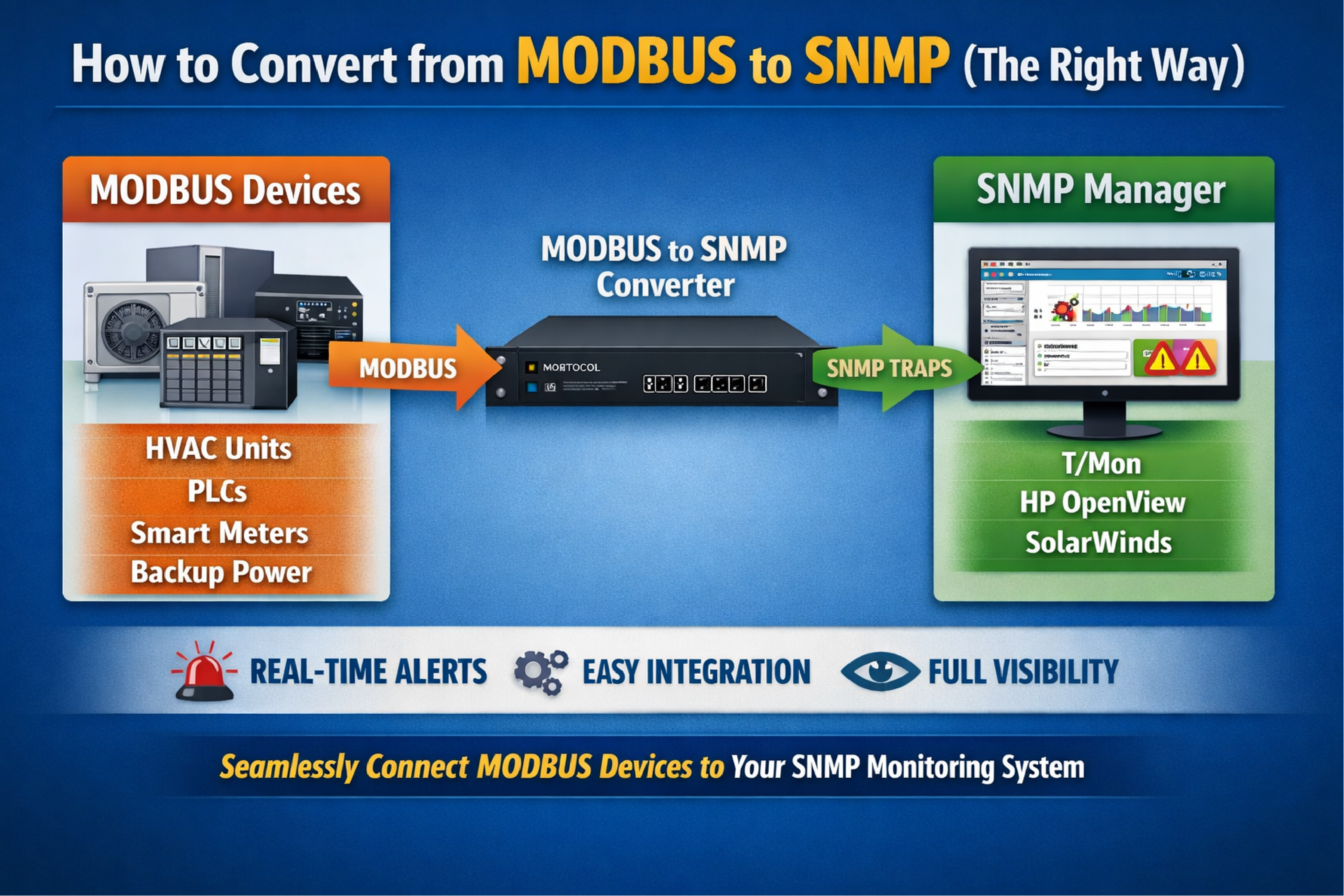
Reserve Your Seat TodayYou've got MODBUS devices (devices that use the MODBUS protocol to communicate) in the field. Those may be HVAC units, smart meters, PLCs, or backup power systems.
You've also got a central SNMP manager - and it doesn't talk to your MODBUS gear. That's a serious problem when your job is to see everything at your remote sites.
If this sounds familiar, you're not alone. In fact, MODBUS-to-SNMP protocol mismatch is one of the top integration issues in industrial and telecom environments today. And for good reason:
Let's fix this. I'll show you how to integrate MODBUS gear into your SNMP-based monitoring system without writing custom software, ripping out existing devices, or wasting your budget.
MODBUS, developed in 1979, is the workhorse of industrial automation. It's used in:
It's simple, effective, and widely adopted.
SNMP (Simple Network Management Protocol), on the other hand, is the king of network monitoring. It's used by:
If you're using something like HP OpenView, SolarWinds, or DPS T/Mon with the SNMP Trap Processor Module, you're using SNMP.
The core problem is that MODBUS and SNMP are fundamentally different in how they communicate.
| Protocol | Architecture | Direction | Communication Style |
|---|---|---|---|
| MODBUS | Master-Slave | Polling | The master must ask for everything |
| SNMP | Manager-Agent | Event-based | Devices can send alarms proactively |
This means your MODBUS gear won't send alarms unless something queries it. Your SNMP manager, meanwhile, expects traps and data updates from agents on its own schedule. NOTE: Some SNMP managers can poll via SNMP GET messages now, but this isn't the typical architecture.
That's why you can't just expect them to work nicely together without conversion.
Once people realize MODBUS and SNMP don't play nice, they typically try one of three things:
This is the old-school approach. A tech drives to the site, plugs into a serial port, and uses custom software to read MODBUS registers. There are a few issues with this approach:
Some IT teams try to write middleware that polls MODBUS and generates SNMP traps. Sometimes this works... for a little while.
But, in the end:
Keeping these homemade solutions running long-term is more trouble than it's worth.
This one sounds promising: Buy an off-the-shelf "protocol converter" box.
However, most of these are built for large SCADA systems and don't support your monitoring style:
Even after setup, you end up with something that sort of works, but doesn't give you full visibility or actionable alerts.
Let's hit pause on the frustration and think about your dream scenario:
That's the power of protocol mediation done right. And that's exactly what the DPS MODBUS to SNMP Converter gives you.
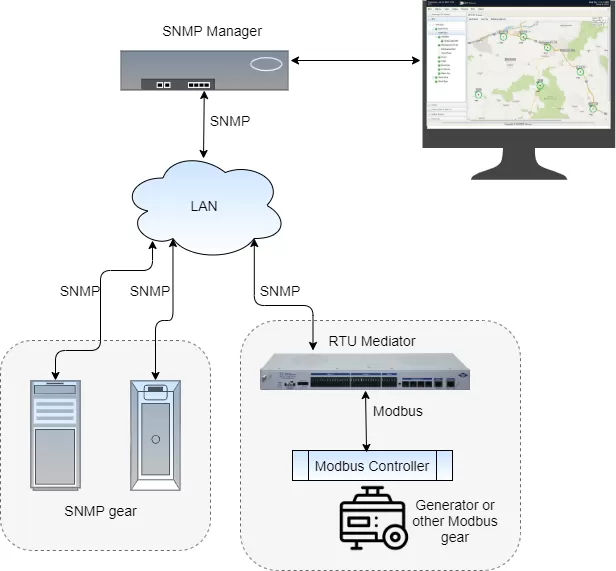
At DPS Telecom, we've been building SNMP gear and protocol converters for 30+ years. The MODBUS to SNMP Converter is our answer to the MODBUS-SNMP gap that so many of our clients face.
This device is different from everything else out there:
This isn't a general-purpose box that happens to support SNMP. It was built from the ground up for MODBUS-to-SNMP protocol mediation.
Suppose you have a MODBUS-capable HVAC unit in a remote hut. It outputs key data like:
You install a MODBUS to SNMP Converter nearby. It polls the MODBUS registers and maps them to SNMP alarms. Then, when the internal temperature crosses 85 F or the compressor fails, the converter sends an SNMP trap to your manager.
You get the alert in real time, so there's no need for a technician visit, manual checks, or surprises.
The same applies to:
If you've spent any time managing remote infrastructure, you know this truth:
"The equipment that fails silently is the equipment that causes the most damage."
With the MODBUS to SNMP Converter, your MODBUS devices no longer operate in the dark. You bring them into your SNMP world. That means:
It's not about just converting a protocol - it's about gaining control of your network.
There are dozens of vendors selling protocol converters. Choosing DPS means you work with an expert manufacturer who understands your needs.
We don't make power gear or HVAC units. We make monitoring gear. That's it.
Every DPS device - including the MODBUS to SNMP Converter - is built to help you monitor, control, and understand your remote sites.
You also get:
When you call us, you won't get a call center. You'll talk to a live engineer who knows MODBUS, SNMP, and real-world deployments.
You can't afford blind spots in your network. MODBUS devices are reliable, but they need a translator to speak SNMP.
The MODBUS to SNMP Converter gives you that translation - without headaches, complex coding, or waiting for something to break before you find out.
If you're interested, here's what I can do for you:
Call me: 559-454-1600
Email: sales@dpstele.com
Whether you're monitoring 5 MODBUS devices or 500, I'll help you get complete visibility - on your terms, using the SNMP tools you already have.

Andrew Erickson
Andrew Erickson is an Application Engineer at DPS Telecom, a manufacturer of semi-custom remote alarm monitoring systems based in Fresno, California. Andrew brings more than 19 years of experience building site monitoring solutions, developing intuitive user interfaces and documentation, and opt...