Check out our White Paper Series!
A complete library of helpful advice and survival guides for every aspect of system monitoring and control.
1-800-693-0351
Have a specific question? Ask our team of expert engineers and get a specific answer!
Sign up for the next DPS Factory Training!
Whether you're new to our equipment or you've used it for years, DPS factory training is the best way to get more from your monitoring.
Reserve Your Seat Today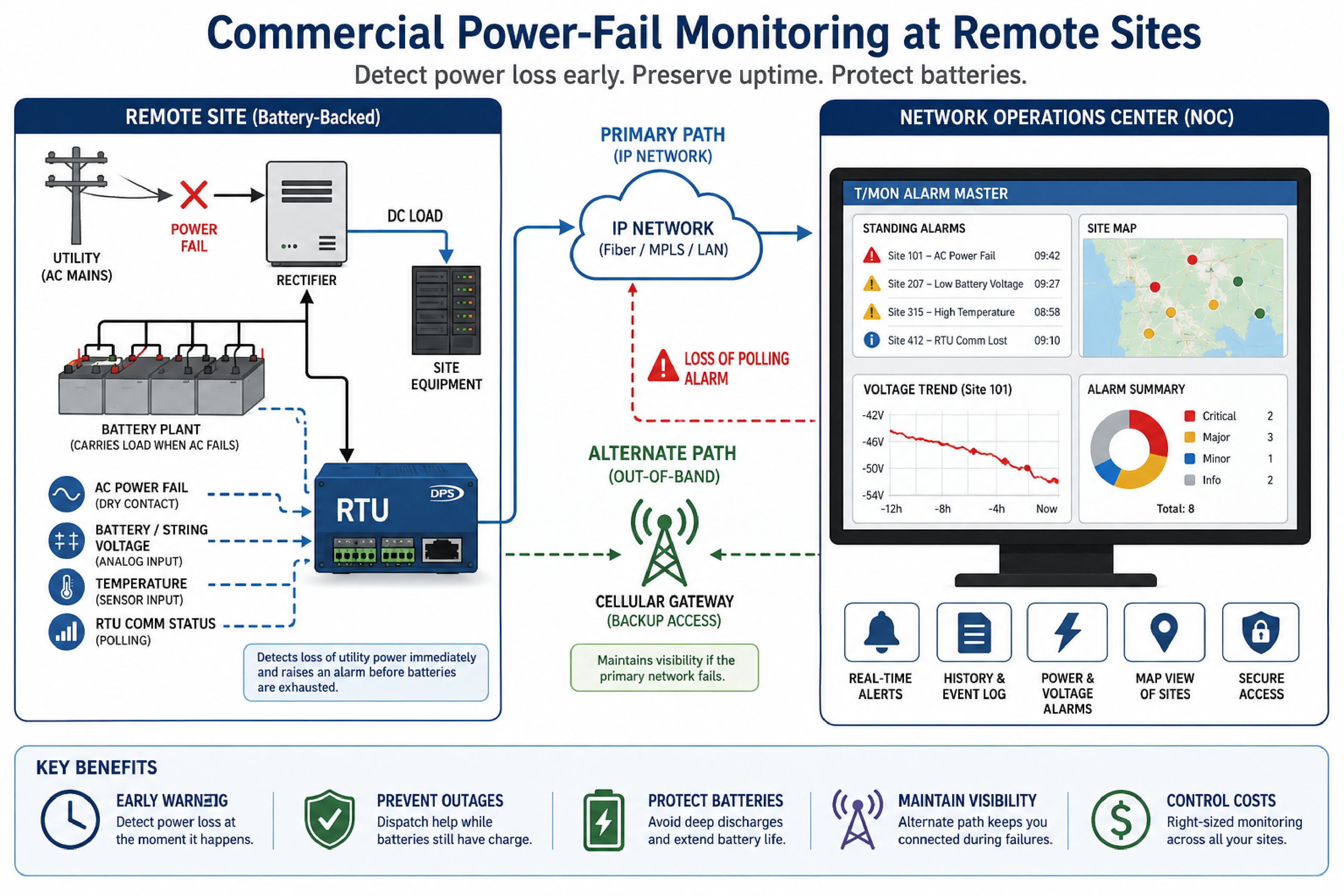
Commercial power-fail monitoring is the practice of detecting when a remote site loses utility power, so that staff can respond before the site's backup batteries are exhausted. At sites that run on grid power with battery backup and no generator, the time between a power failure and a service outage is exactly as long as the batteries last - and without monitoring, no one knows the clock is running.
This article explains why battery-backed remote sites fail silently, what to monitor to prevent power-related outages, how to watch battery health affordably across many sites, and how to keep visibility when the transport network itself is affected. It is written for network operations teams that maintain large numbers of unmanned sites and are measured against availability commitments.
Commercial power-fail monitoring is the detection and reporting of a loss of utility (mains) power at a site, delivered as an alarm to a central monitoring system. It answers one question that battery-backed sites cannot answer on their own: is this site still on utility power, or is it running down its reserve?
At a typical unmanned site, equipment is fed from a rectifier and battery plant. When utility power is present, everything runs normally and the batteries float at full charge. When utility power fails, the site keeps running on batteries - silently - until they are depleted. A remote telemetry unit (RTU) with an AC power-fail input detects the loss of mains power immediately and raises an alarm, converting an invisible countdown into an actionable event.
The value is in the lead time. Detecting the power loss at the moment it happens, rather than discovering it when services drop, is what allows a team to dispatch a technician or a portable generator while the batteries are still carrying the load.
A silent failure is an outage that develops without any warning reaching the people who could prevent it. Sites that rely on grid power and battery backup are especially prone to this, because the battery plant is designed to hide a power loss - that is its job.
The failure sequence is predictable:
There is a second, slower cost. Fully discharging a battery string shortens its service life, so every undetected power event also degrades the asset that is supposed to protect the site. Over a large network, repeated deep discharges turn into premature battery replacement spending. Visibility prevents both the immediate outage and the long-term asset damage.
Site monitoring scope is the set of conditions an RTU watches at each location. For a battery-backed site without a generator, a focused set of points covers the conditions most likely to cause or signal an outage.
A practical core scope:
| Condition | Why It Matters |
|---|---|
| Commercial (AC) power fail | The earliest warning that a site has gone onto reserve power. The single most important point at a battery-backed site. |
| Battery / string voltage | Shows how much reserve remains and whether the plant is discharging, so response can be prioritized. |
| Site or battery temperature | High temperature shortens battery life and can indicate cooling failure; it also affects equipment reliability. |
| RTU communication status | If the monitoring unit goes offline, the loss of polling is itself an alarm, so a blind spot is never silent. |
This scope deliberately stays small. The goal is not to instrument every possible point, but to capture the conditions that predict an outage. Keeping the point count modest also keeps the per-site hardware cost down, which matters when the same design is repeated across dozens or hundreds of sites. Established battery monitoring best practices reinforce starting with power-fail and string voltage before adding finer detail.
Battery monitoring ranges from a single measurement of overall string voltage to a dedicated sensor on every individual cell. Per-cell monitoring gives the most detail and is also the most expensive, especially on large strings, so the right choice depends on the value of each site.
For most remote sites, measuring overall string voltage is the cost-effective first step. A common plant - for example, a string of 12V batteries totaling a -48V system - can be read directly by an RTU analog input that accepts a wide DC range. This will not identify a single weak cell, but it reliably shows whether the string as a whole is floating normally, discharging during a power event, or failing to hold voltage.
A staged approach keeps cost proportional to risk:
This is the principle behind a dedicated battery voltage monitor: catch the string-level problems that cause most outages first, and apply expensive per-cell instrumentation only where it pays for itself.
Monitoring security is the set of measures that protect the RTU and its communications from unauthorized access and interception. Because RTUs sit on the operational network and are reachable for management, they fall within the scope of internal security scanning and policy.
Current-generation hardware is the recommended starting point because it supports modern transport encryption such as TLS 1.2, which matters to security teams that scan for encryption and unwanted network activity. Where budget forces the use of older hardware, the management interface should be locked down, but current hardware with up-to-date encryption is the better baseline. DPS Telecom documents its approach to monitoring cybersecurity, including encrypted management and access controls, so the monitoring layer does not become the weak point in an otherwise hardened network.
Network reachability is the ability of the central system to reach a remote RTU. A subtle risk in any monitoring design is that the same transport carrying the alarms can itself fail, which would hide the very problems the system exists to catch.
Two layers address this:
It is worth being clear about what an out-of-band gateway is and is not: it is a backup communication path to the RTU, not a separate cloud platform. Designing for visibility when the primary network path is down is what prevents a transport failure from becoming a monitoring blackout at the moment it matters most.
The head end is the central master station that collects alarms from every site and presents them to the NOC. For a large deployment, the RTU at each site and the head end that aggregates them should be sized together: small enough per site to control cost, large enough centrally to cover current and near-term growth.
For per-site hardware, a compact environmental RTU is often the best fit when the alarm count is small. A unit that covers AC power fail, string voltage on an analog input, and temperature - with a few spare points for expansion - meets the core scope without paying for capacity that will never be wired. A larger discrete-heavy RTU is the alternative when more hardwired points or specific termination styles are required.
For the head end, a T/Mon alarm master sized above the current site count provides room for growth and can be expanded later by software as the network adds sites. A 24/7 NOC then works from one screen showing standing alarms, change-of-state history, alarm categorization for power and voltage events, and map views of the sites. Hosting the master on the operator's own network, rather than in a cloud service, keeps the monitoring data inside the organization's security boundary.
Most rollouts of this size are installed by the customer's own technicians with vendor remote support: the vendor trains the team on a few representative installs, then the team replicates the standardized build across the remaining sites. Quoting the full near-term site count at once, rather than piecemeal, also tends to reach better pricing.
Commercial AC power fail. It is the earliest indication that a site has gone onto reserve power, which starts the countdown to a battery-depletion outage. Everything else - string voltage, temperature - adds context, but power-fail is the trigger that should drive the fastest response.
It depends on battery capacity and load, but the warning begins at the instant utility power is lost rather than when services drop. That difference - hours of lead time in many cases - is what allows a crew or portable generator to be dispatched before the site goes down.
Yes. Measuring overall string voltage with an RTU analog input is a low-cost baseline that detects most string-level problems. Per-cell sensors give more detail but are best reserved for the largest or most critical sites where a single cell failure is most costly.
Yes. Repeatedly draining a battery string to depletion shortens its service life, so undetected power events both risk an immediate outage and accelerate battery replacement costs. Early detection protects the asset as well as the service.
A polled master raises a device-failure alarm when it can no longer reach the RTU, so the loss of visibility is itself reported. For continued access, a dual-network RTU or a cellular out-of-band gateway provides an alternate path that can survive a local transport failure.
It can be hosted on the operator's own network instead, keeping monitoring data inside the organization's security boundary. A central master on-premises, reachable over the internal network, is a common choice for organizations with their own NOC and security policies.
If your remote sites run on battery backup and your team only learns about a power failure when services drop, the gap to close is visibility - knowing the moment a site goes onto reserve power, while there is still time to act. DPS Telecom can help you scope power-fail, battery-voltage, and temperature monitoring across a large site network, choose right-sized RTUs and a T/Mon head end, and plan for secure, reachable monitoring even during a transport failure. Get a Free Consultation, or call 1-800-693-0351 or email sales@dpstele.com to discuss a design and pricing for your network.

Andrew Erickson
Andrew Erickson is an Application Engineer at DPS Telecom, a manufacturer of semi-custom remote alarm monitoring systems based in Fresno, California. Andrew brings more than 19 years of experience building site monitoring solutions, developing intuitive user interfaces and documentation, and opt...