Check out our White Paper Series!
A complete library of helpful advice and survival guides for every aspect of system monitoring and control.
1-800-693-0351
Have a specific question? Ask our team of expert engineers and get a specific answer!
Sign up for the next DPS Factory Training!
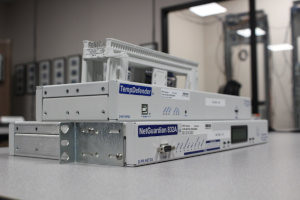
Whether you're new to our equipment or you've used it for years, DPS factory training is the best way to get more from your monitoring.
Reserve Your Seat Today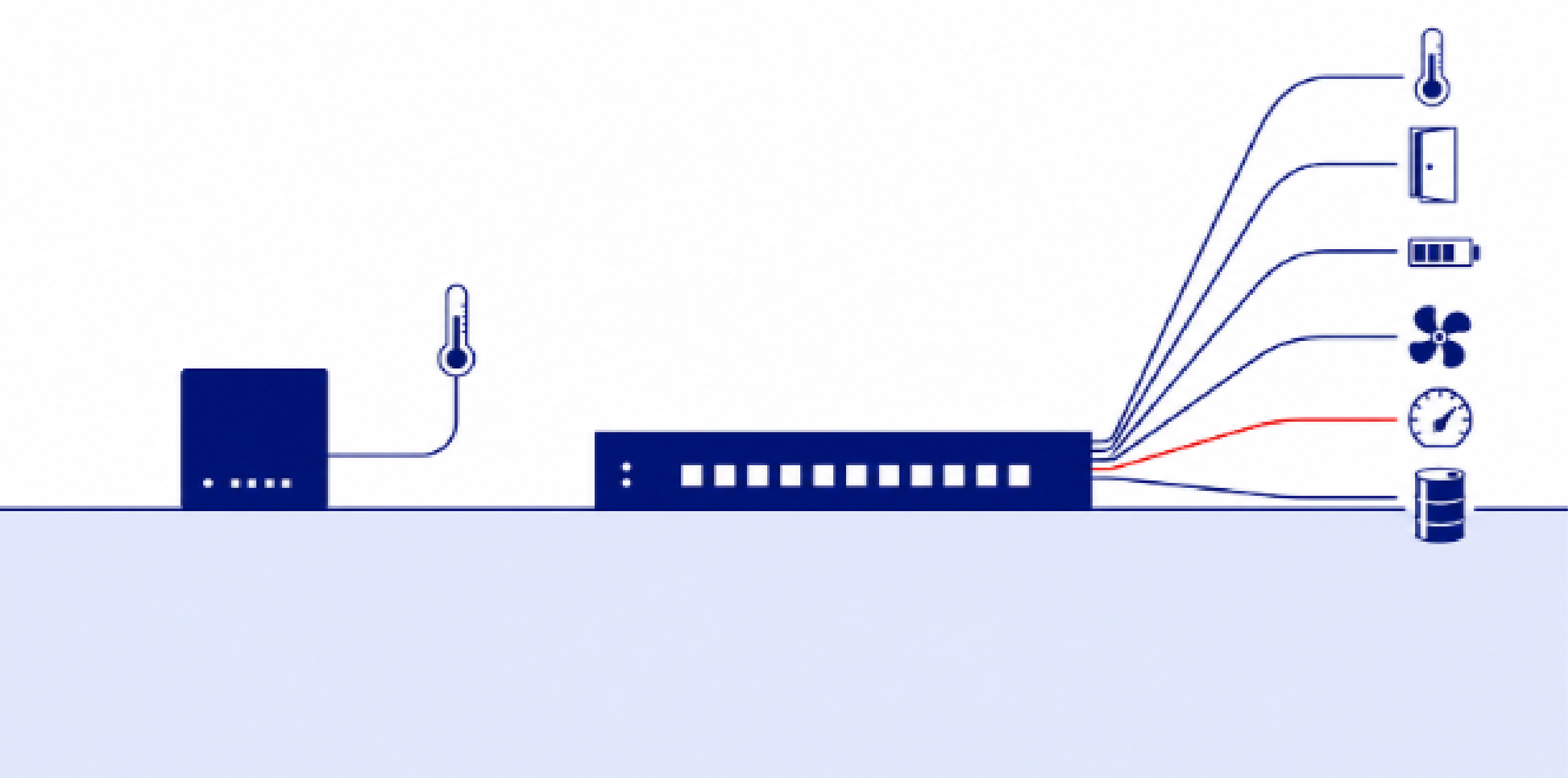
You set up the AKCP sensorProbeX+ to watch temperature and humidity, and it did the job. Then the list of things you're responsible for got longer. The rectifier needs an alarm on it. So does the door at that unmanned site down the road. And your operations manager wants all of it reporting into one master station instead of three separate web interfaces.
So you start looking at replacements, and the products all sound alike on paper, even when they're built for completely different jobs.
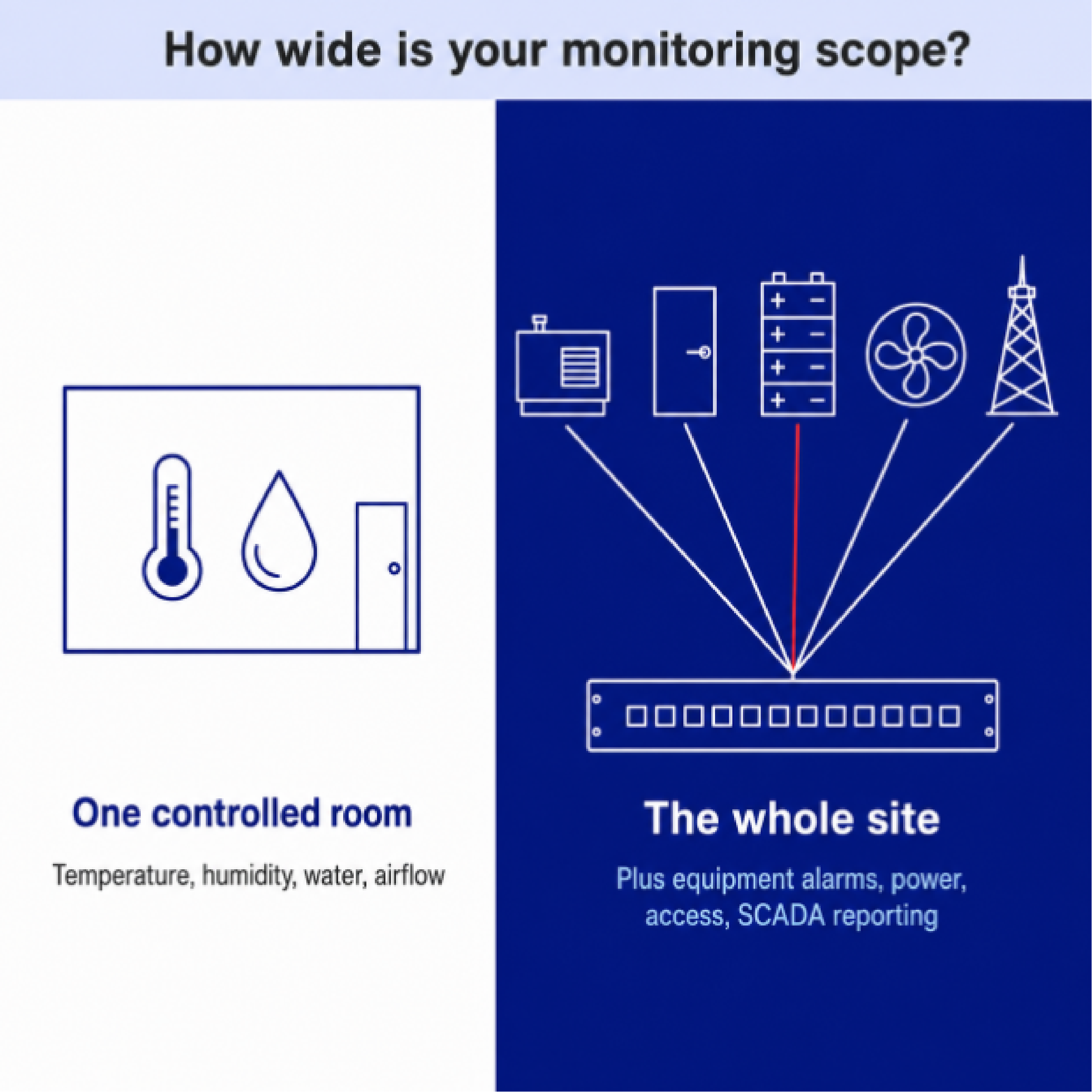
Work out how much you need to watch before you start comparing models. If you're still solving a climate problem in one controlled room (temperature, humidity, water, airflow), a dedicated environmental probe can be exactly right. Once you're also watching equipment alarms, power, and door access, or reporting into a Supervisory Control and Data Acquisition (SCADA) system, you want a Remote Telemetry Unit (RTU) platform instead.
At DPS Telecom, we have built remote monitoring equipment in Fresno, California since 1986, with more than 172,000 devices deployed across 1,500+ organizations. For most engineers who have outgrown a sensorProbeX+, our NetGuardian RTUs and T/Mon master station are the alternatives we would point you to first, and this guide explains why. It also lays out an honest framework for judging every category of alternative, including the two situational options that can be the smarter pick for a narrower job.
| Alternative | Built for | Best fit |
|---|---|---|
| RTU platform (DPS NetGuardian + T/Mon), our recommendation for most sites | Consolidating climate, equipment alarms, power, control, and access across distributed sites, reporting into one master station | Sites where monitoring has grown past one room |
| Dedicated environmental probe (Sensaphone-class, AKCP-class) | High-density climate sensing in a controlled facility | A pure single-room climate job |
| Enterprise network management platform (SolarWinds-class) | Central observability of IT and network devices | Organizations already running one who want sensor data in it |
Sensaphone has manufactured remote environmental monitoring products in the United States since 1985 and serves the same controlled-room use case as the sensorProbeX+. SolarWinds describes itself as a provider of "observability and IT management software," and if your organization already has real investment in a console like that, feeding sensor data into it can make more sense than adopting a dedicated probe. It still needs sensing hardware in the field to collect what it displays.
DPS is a strong fit when your sites are distributed, your equipment is mixed-vendor, your locations are rough on hardware, or your master station has to speak more than one protocol. If that describes your network, put an RTU platform on the shortlist.
When an engineer calls us about replacing a sensorProbeX+, the story is almost always the same. The probe still reads temperature fine. The job got bigger.
The triggers repeat:
The monitoring reasons rule out probes entirely. Once you're watching equipment alarms, power, and door access, or reporting into a master station, no probe covers that job regardless of who builds it.
The procurement reasons don't rule out probes. A second-source rule, a domestic-content requirement, or an RFP that needs two bidders is satisfied by any qualified alternative, and that alternative might still be a probe.
Monitoring scope usually grows over years rather than all at once. Our founder Bob Berry describes one case in 100% Uptime, his book on remote monitoring, when A DPS client spent six years adding sensors to his sites, and his after-hours call-outs dropped by more than 75%.
The sensorProbeX+ is solid hardware. AKCP describes it in their published product materials as "a versatile IP based sensor monitoring device." It reports over Internet Protocol (IP), builds on AKCP's intelligent sensor ecosystem, and centralizes through their own management software. AKCP describes itself as a data-center environmental monitoring specialist, and their stated target markets are data centers, server rooms, and cold storage. For high-density climate monitoring in a controlled facility, that's a capable, purpose-built base unit.
A dedicated environmental sensor probe, whether it comes from AKCP or from a probe vendor like Sensaphone, is optimized for dense, plug-and-play climate sensing. An enterprise network management platform is optimized for watching IT and network devices from a central console. An RTU is a microprocessor-based device that consolidates discrete and analog equipment alarms, applies thresholds, drives control relays, and reports telemetry to a master station or SCADA system.
Our temperature monitoring system guide covers how the pieces fit together if you want the underlying discipline.
Each criterion is a design tradeoff. A probe that specializes in dense climate sensing gives up broad equipment monitoring to do that one job well. A platform built to consolidate an entire site makes the opposite trade.
Each one also maps to a question about your own site: how many things you need to watch, how the data gets back to you, how rough the location is.
A dedicated probe covers environmental sensing in a controlled room. An enterprise platform covers IT and network device health from a central console. An RTU platform takes the environment plus discrete equipment alarms through dry-contact inputs, analog readings like voltage, current, and fuel level, power status, and building access, all in one unit.
In 100% Uptime, Bob Berry describes the payoff. "You'll know when equipment is failing. You'll know what your temperatures and humidities are doing. You'll know your security status."
If your scope really is climate in one room, a focused probe may be plenty. Once you're watching rectifiers, generators, doors, and a power plant alongside temperature, you need an RTU.
Sensors come from one of two places. Either you buy them from the device vendor, or you source them from any manufacturer you choose.
A vendor-specific intelligent-sensor ecosystem simplifies auto-detection and setup, and ties your sensor inventory to one supplier. That matters at replacement time more than at install time. When a sensor fails in year seven, you order from that vendor at that vendor's price, or you don't replace it.
Industry-standard interfaces (0-5VDC, 4-20mA, dry contact) let you source from many manufacturers and fold in gear you already own without converter hardware. We build for the open interfaces, so a single RTU can read whatever a site already has.
Our temperature monitoring device buyer's guide covers sensor types and placement.
If your data has to reach a network operations center or SCADA platform, protocols decide how smoothly it gets there.
Match a device's protocols to what your master station already speaks and integration is straightforward. Miss the match and you're adding a converter or a piece of custom middleware between the two, which means another box drawing power at the site, another thing that can fail, and another vendor to call when it does.
Simple Network Management Protocol (SNMP) is the baseline, defined by the Internet Engineering Task Force in RFC 1157, with later versions adding authentication and privacy. Distributed and industrial sites usually need Distributed Network Protocol 3 (DNP3) and Modbus too, plus a way to bring older or proprietary gear into a standard format, whether that's DNP3, Modbus, Transaction Language 1 (TL1), or any number of other older protocols.
We built T/Mon to mediate 25+ standard and proprietary protocols so one screen can present alarms from multi-vendor, multi-generation equipment. A single-protocol probe or an IT-focused platform isn't designed for that job.
Remote sites are hard on hardware. Temperature swings, unstable power, nobody there to reset a frozen unit.
NEBS is the dominant set of physical and electrical hardening guidelines applied to telecom equipment in the United States, and Level 3 corresponds to Central Office grade. Our NetGuardian 832A is offered with NEBS Level 3 capability.
We self-certify NEBS compliance in our own lab at no additional cost, using anechoic-chamber electromagnetic interference testing, drop and torture tests, and vibration simulation. Formal third-party certification is available on request, at added cost and lead time.
Dedicated probes and enterprise platforms are generally built for controlled indoor spaces. We design for wide temperature ranges and telecom power because that's where our clients put these units.
A device in a controlled data center can count on stable Ethernet, and probe and enterprise-platform deployments assume it's there. A mountaintop hut, a substation, or a cell site often can't.
A site your monitoring can't reach is a site you hear about from a customer instead of from an alarm, and the drive out costs the same whether the fault was serious or a false alarm.
NetGuardian RTUs back-haul over Ethernet, fiber, serial (RS-232 and RS-485), T1, and dialup, with cellular or satellite available through an external gateway.
Most monitoring needs fit a standard configuration. The rest need building to the site.
A fixed appliance, which is the form most probes and platform agents take, is simple to order and stock. A configurable platform gets matched to a site's exact input and output count, sensor mix, and transport.
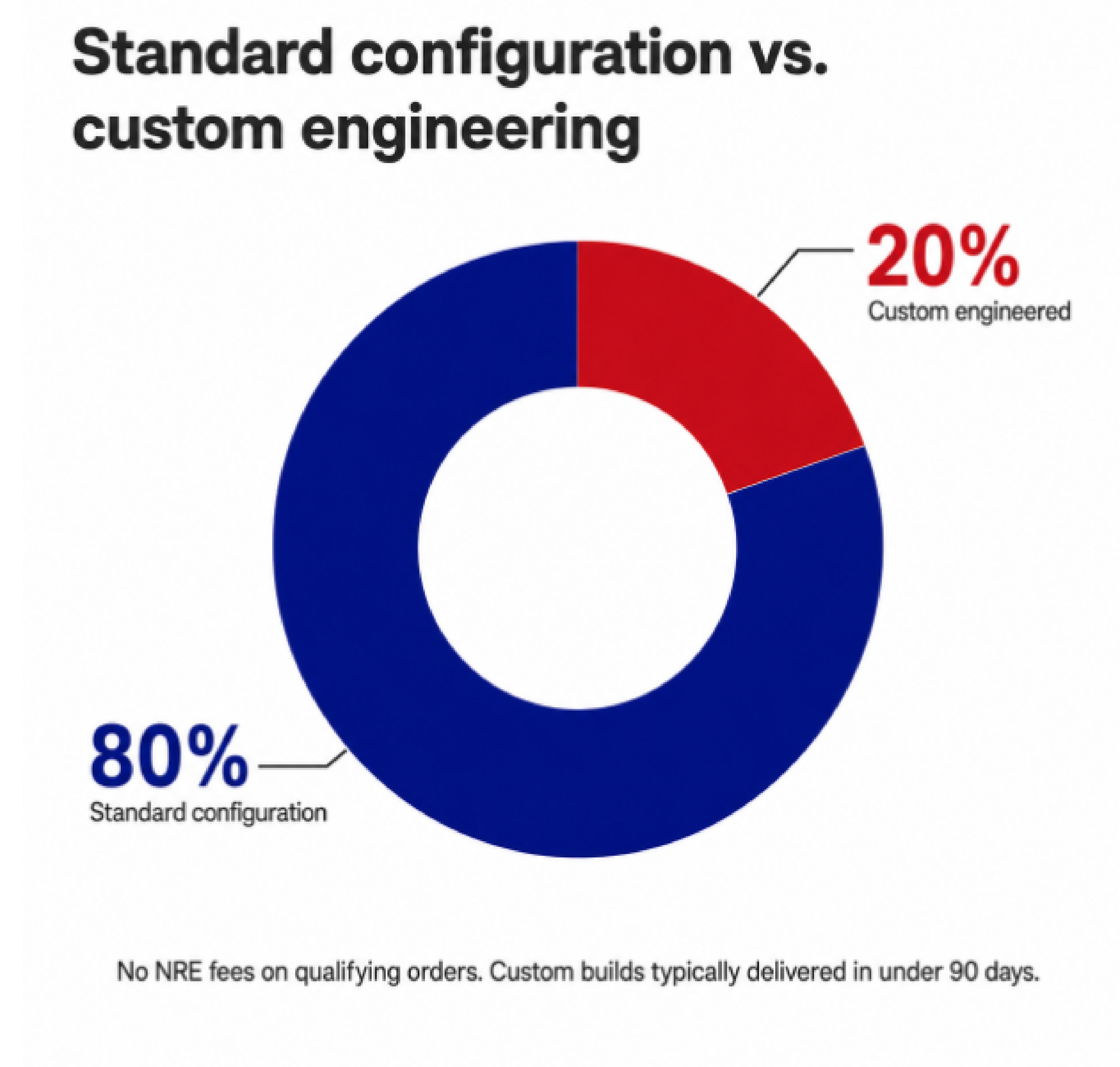
About 80% of what we see fits a standard NetGuardian config. The other 20% is where a site needs a different alarm point count, a form factor that fits an existing rack or enclosure, or a transport the standard build doesn't carry. That 20% gets custom engineering with no non-recurring engineering (NRE) fees on qualifying orders, typically delivered in under 90 days. Build-to-site work at that level is uncommon among dedicated-probe and enterprise-platform vendors.
Our piece on the benefits of a custom infrastructure product lays out where a custom build earns its keep and where a standard unit is the smarter buy.
We design, manufacture, and test all of our equipment at our Fresno, California facility, and we're International Organization for Standardization (ISO) 9001 certified.
We chose domestic manufacturing partly for direct control over quality and lead time, and partly because it can simplify procurement for federally funded projects carrying domestic-content rules.
Origin varies by vendor across all three categories. If a domestic-content rule applies to your project, confirm it for every option on your shortlist.
Everything that happens after the purchase order clears: field life, warranty terms, firmware policy, and who picks up the phone.
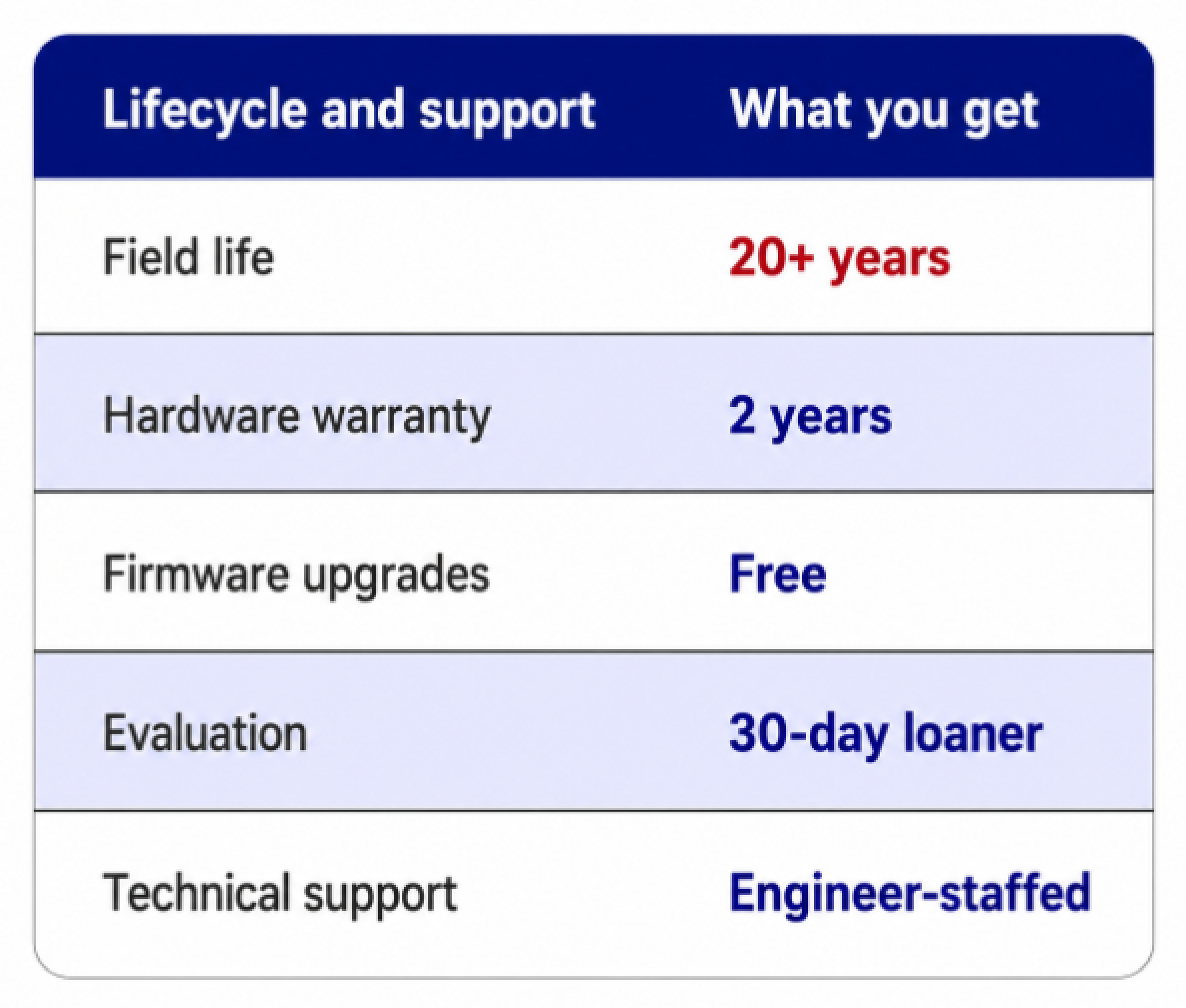
We build NetGuardian RTUs for a 20+ year field life, back them with a 2-year hardware warranty and free firmware upgrades, and run a 30-day loaner program so you can try one before you commit. Our support is engineer-staffed. Call in and you reach the people who designed the unit.
Weigh these same points on a probe or an enterprise platform. Support model and field life vary between vendors as much as the hardware does.
Run those eight criteria and, for most sites moving on from a sensorProbeX+, they point the same direction. The broader an RTU platform's reach, the fewer gaps you are left to patch later. Here is how our platform lines up against them. The NetGuardian family is our RTU line, and T/Mon is the master station that ties multiple sites together.
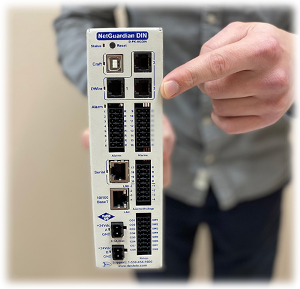
For sites that are mostly environmental but still need a path into a larger system, the NetGuardian ENV is a dedicated environmental RTU. It supports up to 15 daisy-chained D-Wire sensors for temperature, humidity, water, smoke, and airflow, plus analog channels, control relays, SNMP reporting, and optional building-access reader support. This is the model to weigh directly against a dedicated probe, since it covers the same climate job while leaving you room to grow. For full-scope sites, the flagship NetGuardian 832A handles 32 discrete alarm inputs (expandable to 176), 8 analog inputs, 8 control relays, 32 ping alarms, and 8 serial reach-through ports, reporting over SNMP v1/v2c/v3 with telecom-grade power options.
Across many sites, T/Mon pulls everything into one view. It mediates 25+ protocols, presents a single map and screen, drives notifications, and keeps an audit history, scaling up to very large alarm-point counts on the full-capacity LNX build. This is also where we stack up well against the enterprise-platform route. Rather than asking you to feed sensor data into an IT observability tool, T/Mon is purpose-built to consolidate site alarms from multi-vendor, multi-generation equipment. That combination, broad input types at the edge and multiprotocol consolidation at the master, is why we are the alternative we recommend first once environmental sensing alone stops covering the job.
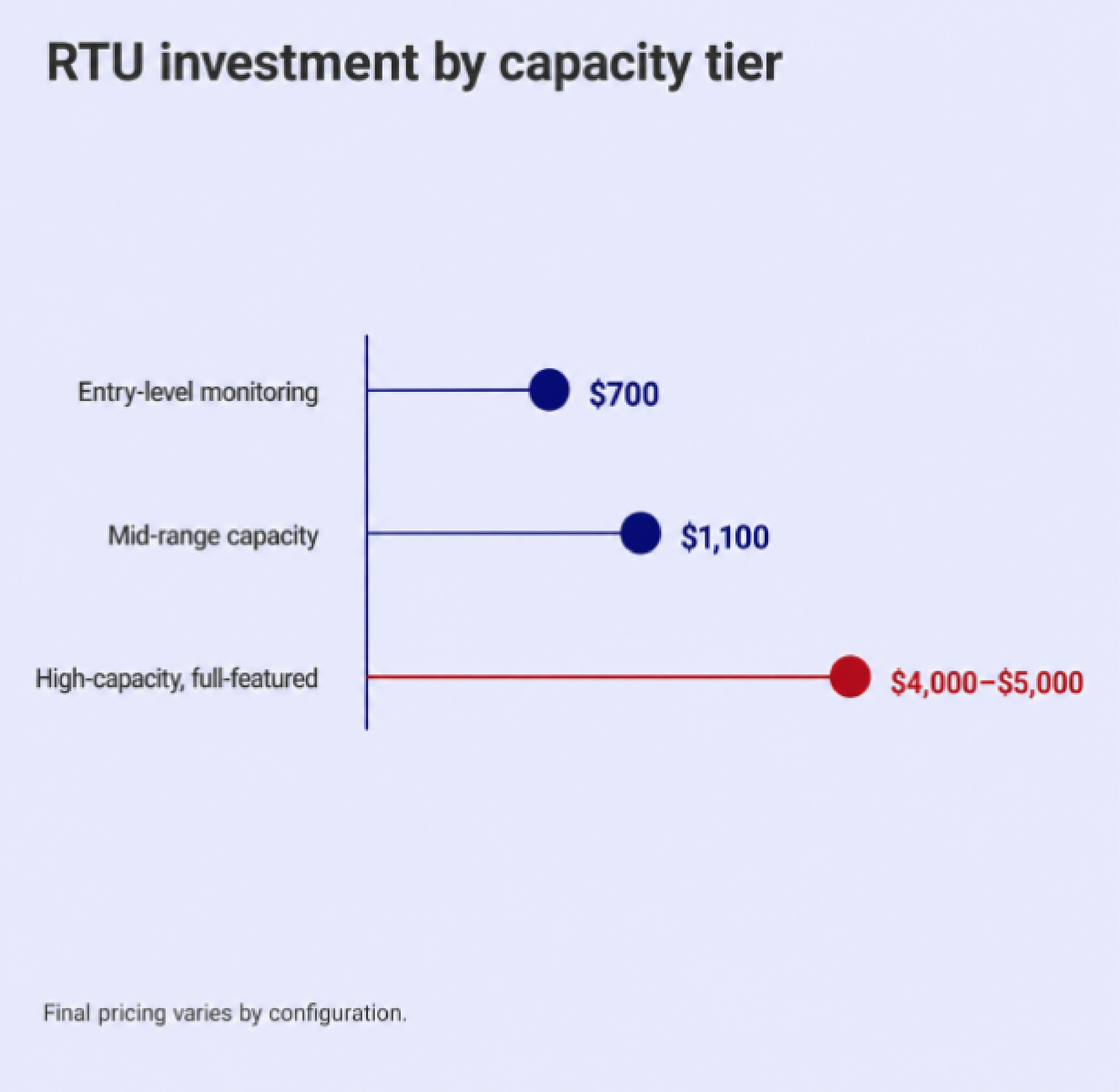
A note on budget, since it usually comes up early. NetGuardian RTUs run roughly $700 to $5,000, T/Mon master systems start around $8,000, and system design consultation is free. Final pricing varies by configuration.
The table below sets the three alternative categories side by side, using each vendor's published materials. It compares the broader RTU platform approach we recommend against a dedicated environmental probe approach and an enterprise network management platform approach.
| Capability | RTU platform (DPS NetGuardian + T/Mon), recommended | Dedicated environmental probe (Sensaphone-class or AKCP-class) | Enterprise network management platform (SolarWinds-class) |
|---|---|---|---|
| Primary design intent | Consolidating equipment alarms, analog, power, control, and protocols across distributed sites | High-density environmental sensing in controlled facilities | Central observability of IT and network devices |
| Environmental sensing | Supported via standard 0-5VDC and 4-20mA inputs plus optional D-Wire (up to 16 daisy-chained) | Core strength; large supported sensor count via a vendor-specific bus | Not native; relies on third-party sensing hardware |
| Discrete equipment alarms | Core strength; 32 discrete on the 832A, expandable to 176 | Available via dry-contact modules | Via third-party hardware reporting into the platform |
| Control relay outputs | 8 control relays on the 832A for remote equipment operation | Available via relay modules | Not typical |
| Serial reach-through | 8 terminal-server ports on the 832A | Not emphasized | Not typical |
| Protocol breadth | SNMP and DCPx at the RTU; T/Mon mediates 25+ protocols including DNP3 and TL1 | SNMP and, on some units, Modbus or Building Automation and Control network (BACnet) | Broad SNMP-based device support; not built for site-alarm protocol mediation |
| Sensor sourcing | Any-vendor industry-standard interfaces; D-Wire optional | Vendor intelligent sensors; converters for third-party | Whatever the underlying field hardware supports |
| Transport for remote sites | Ethernet, fiber, serial, T1, dialup; cellular or satellite via gateway | Typically Ethernet, with some cellular options | Assumes IP network reachability |
| Environmental hardening | NEBS Level 3 capability on the 832A; wide-temperature and telecom power options | Built primarily for controlled indoor spaces | Software; hardening depends on field hardware |
| Centralized management | T/Mon (LNX, SLIM, MINI) | Vendor management software | The platform itself |
| Manufacturing origin | Fresno, California, USA | Varies by vendor | Software platform |
Specifications above were gathered from each manufacturer's published materials. They may not capture the full product line and may have changed since this review. Verify current specifications with the manufacturer before deployment planning.
Our DPS Telecom vs. AKCP sensorProbeX+ comparison covers the line-by-line matchup against that one product.
There are two jobs where we'd point you somewhere else.
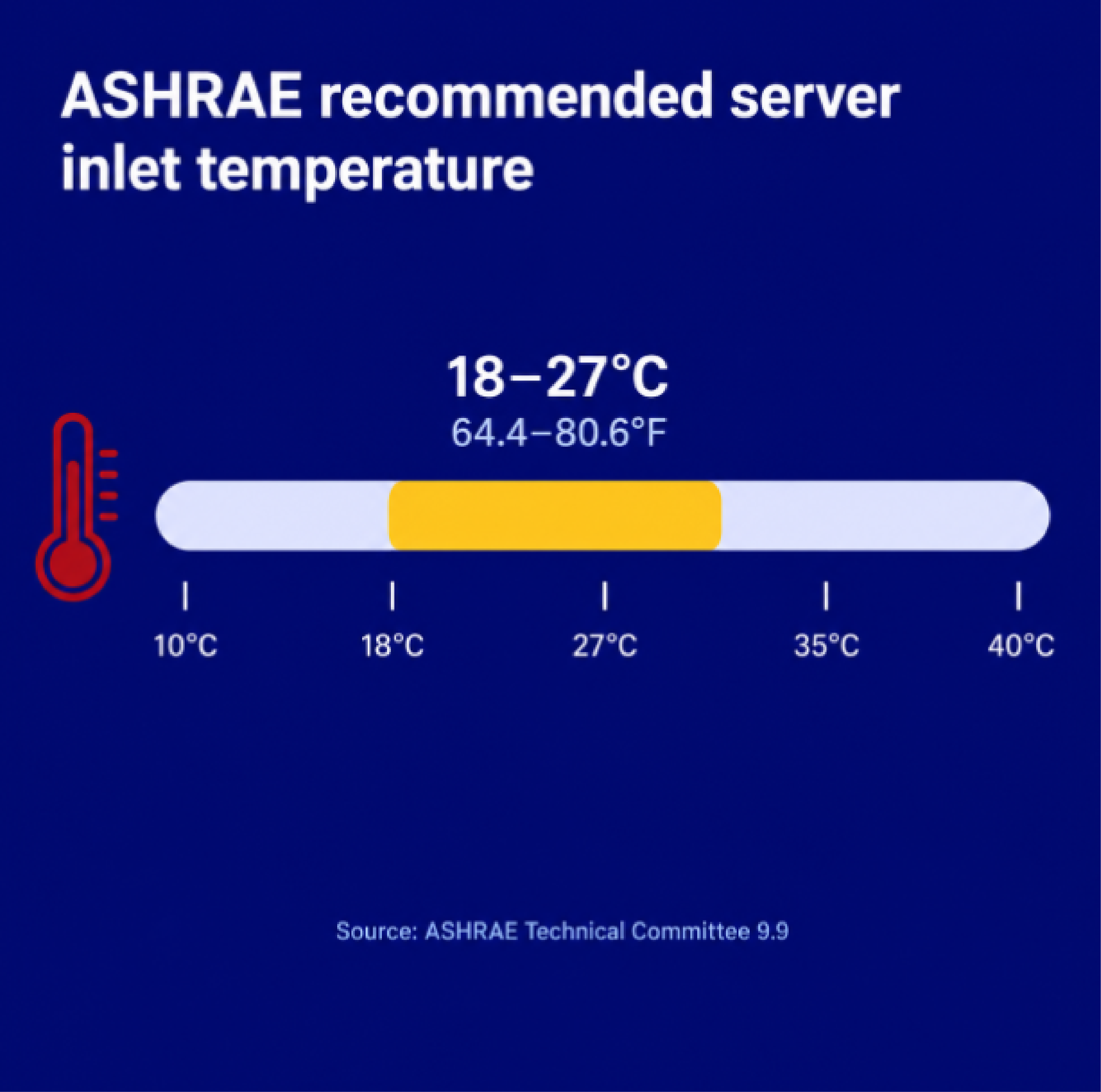
A dedicated environmental probe is the right call for pure IT server-room or data-center sensing, with high per-rack sensor density in a controlled, air-conditioned space, and the work staying in one room. Data-center thermal practice is built around exactly those conditions. American Society of Heating, Refrigerating and Air-Conditioning Engineers (ASHRAE) Technical Committee 9.9 recommends a server inlet temperature of 18 to 27°C (64.4 to 80.6°F), and hitting that target across a dense rack layout is a legitimate reason to buy a high-density probe.
An enterprise network management platform makes sense when your organization already runs one, your priority is unifying sensor data into that console, and building-management integration through protocols like BACnet is central to the requirement. Adding sensing hardware that reports into a platform you already own may beat standing up a separate system.
Everything else, meaning distributed sites, mixed equipment, harsh conditions, or a master station that has to speak many protocols, is where we'd put the RTU platform at the top of your list.
For most sites, an RTU platform. It consolidates environmental, equipment, power, and access monitoring and reports it into one master station. A dedicated environmental probe fits a pure single-room climate job, and an enterprise network management platform fits organizations that already run one and want to feed sensor data into it. Settle how wide your monitoring scope has grown and the answer follows.
Yes. An RTU such as the NetGuardian combines environmental sensors, discrete and analog equipment alarms, and power monitoring in a single unit, so you don't need a separate system for each. That's the main advantage an RTU platform has over a dedicated probe or an IT-focused platform.
Yes. We design and manufacture the NetGuardian RTU line in Fresno, California, which can simplify procurement for federally funded projects with domestic-content requirements. Manufacturing origin varies across other alternatives, so confirm it per vendor if a domestic-content rule applies.
Yes. NetGuardian RTUs report over SNMP v1/v2c/v3, and T/Mon mediates 25+ protocols so alarms can roll up into a SCADA platform or network operations center. If you already run an enterprise management platform, the RTUs can report into it as well.
An environmental probe specializes in dense climate sensing (temperature, humidity, water, airflow) in controlled facilities. An RTU consolidates equipment alarms, analog telemetry, control outputs, and protocol mediation across distributed sites. The probe is the narrower tool.
Yes. NetGuardian RTUs use industry-standard 0-5VDC, 4-20mA, and dry-contact interfaces, so you can source sensors from many manufacturers and integrate gear you already own without converters.
If you're scoping a sensorProbeX+ alternative and want a second opinion on whether an RTU platform, a dedicated probe, or an enterprise platform fits your site, we're glad to walk through it. Our engineers can map your input counts, transport, and reporting needs to the right configuration.
Talk to an Engineer | 800-693-0351

Andrew Erickson
Andrew Erickson is an Application Engineer at DPS Telecom, a manufacturer of semi-custom remote alarm monitoring systems based in Fresno, California. Andrew brings more than 19 years of experience building site monitoring solutions, developing intuitive user interfaces and documentation, and opt...