Check out our White Paper Series!
A complete library of helpful advice and survival guides for every aspect of system monitoring and control.
1-800-693-0351
Have a specific question? Ask our team of expert engineers and get a specific answer!
Sign up for the next DPS Factory Training!
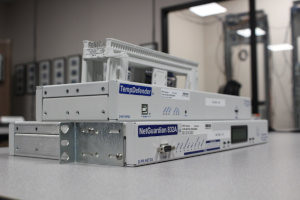
Whether you're new to our equipment or you've used it for years, DPS factory training is the best way to get more from your monitoring.
Reserve Your Seat TodayNorlight cuts service restoration time with dual redundant T/Mon NOC
| Field | Details |
|---|---|
| Industry | Telecommunications |
| Company Type | Full-service telecom provider |
| Geography/Coverage | 8 states, nearly 4,000 miles of fiber |
| Primary Challenge | Outdated monitoring slowing network response |
| Solution Deployed | Dual redundant T/Mon NOC systems |
| Key Result | Faster alarm processing and problem resolution |
| Products Used | T/Mon NOC, NetGuardian RTUs, SNMP trap processing |
Norlight Telecommunications is a full-service provider headquartered in Brookfield, Wisconsin. The company delivers voice and data solutions plus wholesale transport services. Norlight operates nearly 4,000 miles of fiber network. Their coverage spans eight states: Wisconsin, Illinois, Indiana, Iowa, Michigan, Minnesota, Missouri, and Ohio.
Norlight's network expanded significantly over six years. Their alarm monitoring did not keep pace. The company was running T/MonXM on a late 90s PC. They also used multiple element management systems. This created duplication and confusion. The outdated infrastructure impacted their ability to meet customer service goals.
"As your network grows, the importance of alarm monitoring takes on greater significance," said Paul Mankins, Norlight's operations support engineer who led the upgrade effort.
Norlight created a Strategic Alarm Committee. The committee brought senior executives and technical staff together. They evaluated remote monitoring systems as a team. Network Management staff joined the committee. These staff members had direct customer contact. The team visited DPS headquarters in Fresno for Factory Training. They tested equipment hands-on before making their decision.
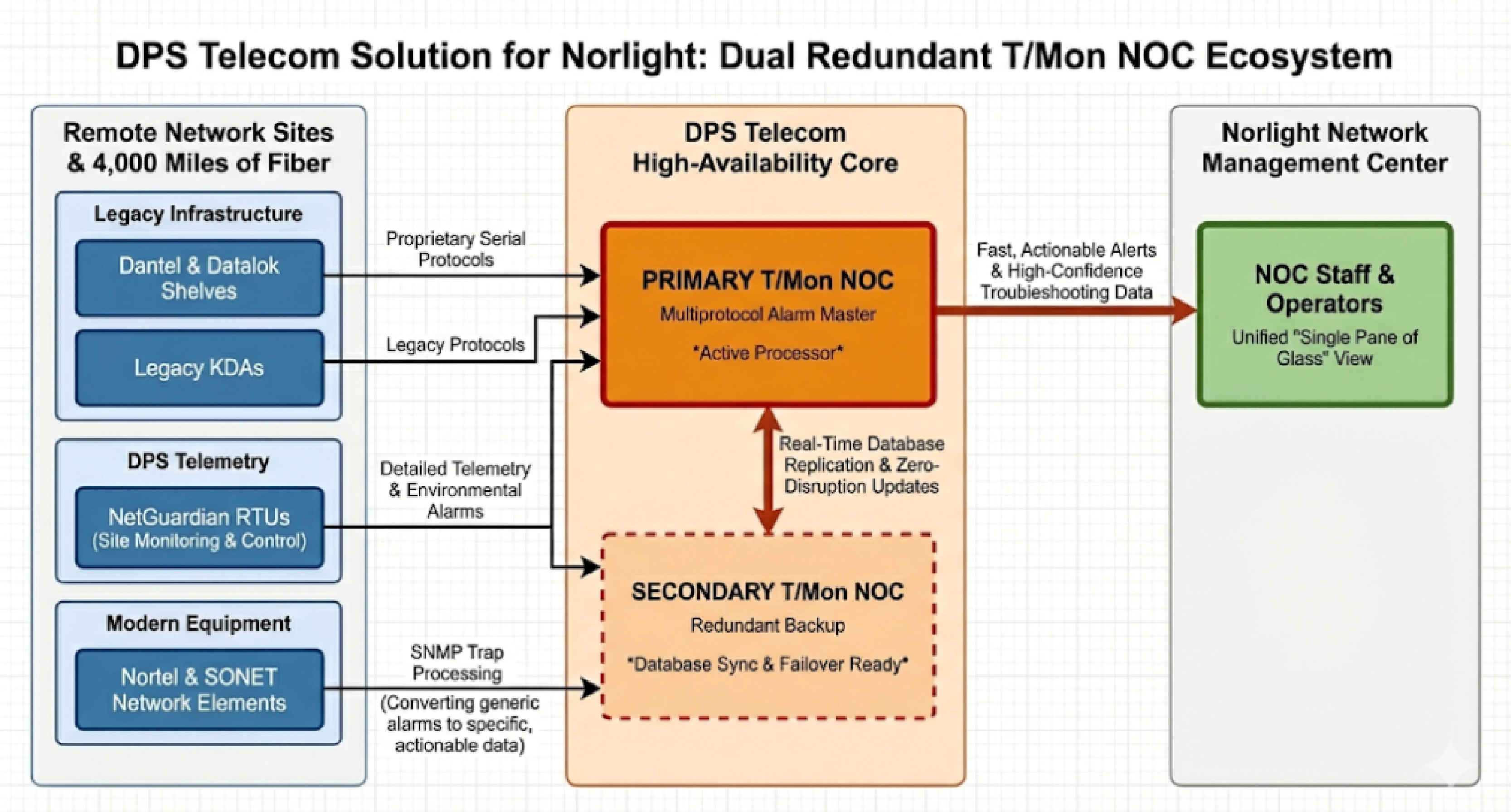
The new system supports all existing equipment. This includes KDAs, NetGuardians, Dantel serial shelves, and Datalok shelves. It also supports Nortel and SONET equipment. T/Mon NOC's SNMP trap processing replaced generic alarms with specific, actionable information.
| Phase | Details |
|---|---|
| Strategic Planning | Created cross-functional Alarm Committee. Included senior executives and Network Management staff. Defined requirements and evaluated solutions together. |
| Vendor Evaluation | Prioritized service level and customization capabilities. Conducted hands-on testing at DPS Factory Training Event in Fresno. |
| System Deployment | Implemented dual redundant T/Mon NOC systems. Configured to support all existing equipment. Deployment caused no disruption to operations. |
The improvement was immediate. T/Mon NOC's faster processing speed became apparent right away. The team could now update databases on the secondary system. They could transfer updates to primary without impacting operations. SNMP trap processing replaced generic alerts. The system now provided specific equipment status information. This cut resolution times across the board.
| Metric | Result |
|---|---|
| Alarm Processing Speed | Immediately faster upon deployment |
| Service Restoration Time | Reduced through better problem isolation |
| Equipment Event Resolution | Specific SNMP data cut resolution time |
| Database Management | Updates without NOC disruption |
"T/Mon NOC enables us to respond faster and resolve customer problems faster. It assists in troubleshooting to a level where we can isolate problems with high confidence."
Paul Mankins, Operations Support Engineer, Norlight Telecommunications
| Benefit | Impact |
|---|---|
| Strategic Executive Involvement | Getting senior leadership involved secured budget support. Aligned the upgrade with customer satisfaction metrics. |
| Faster Problem Resolution | Detailed SNMP information replaced generic alarms. Cut time from event detection to technician dispatch. |
| Zero-Disruption Updates | Dual redundant architecture allowed system maintenance. Network monitoring continued 24/7 without interruption. |
| High-Confidence Troubleshooting | Specific alarm data enabled accurate problem isolation. Technicians arrived at sites prepared with right information. |
T/Mon NOC Multiprotocol alarm manager with SNMP trap processing and dual redundancy
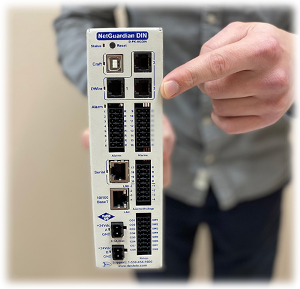
NetGuardian RTUs Remote telemetry units with customizable I/O and multiple transport options
Connect monitoring directly to customer satisfaction metrics. Norlight used Mean Time to Respond and Mean Time to Repair as their measures. Their Strategic Alarm Committee included senior executives who understood that faster alarm response translates to better customer service and retention. When you frame monitoring as a customer service issue rather than an IT expense, budget approval becomes easier.
Choose a multiprotocol master station that supports both legacy and modern protocols. Norlight's network included equipment from the 90s alongside current systems. T/Mon NOC integrated everything under one platform through native support for SNMP, TL1, ASCII, and proprietary protocols. This eliminated the need for multiple monitoring systems and reduced confusion.
Dual redundancy prevents monitoring downtime during system maintenance or failures. Norlight can now update their database on the secondary T/Mon and transfer it to the primary without disrupting their Network Management Center. For carriers serving thousands of customers across multiple states, even brief monitoring gaps can mean missed alarms and service disruptions.
Expect direct access to engineers who designed the equipment, not call centers reading scripts. Norlight prioritized vendor service level during their evaluation. DPS's willingness to customize solutions and provide hands-on factory training demonstrated the support level Norlight needed. Working directly with company leadership for problem-solving was a key factor in their decision.
Generic SNMP alarms report only critical, major, or minor severity levels without context. Specific SNMP trap processing provides detailed equipment status information. This difference dramatically affected Norlight's resolution times. Instead of receiving "Major Alarm" messages, technicians now get specific information about what failed. They arrive on-site with the right parts and knowledge to fix problems quickly.
The right monitoring solution helps you respond faster and resolve problems with confidence. We can help you evaluate your needs.
Or call us: 1-800-693-0351