Check out our White Paper Series!
A complete library of helpful advice and survival guides for every aspect of system monitoring and control.
1-800-693-0351
Have a specific question? Ask our team of expert engineers and get a specific answer!
Sign up for the next DPS Factory Training!
Whether you're new to our equipment or you've used it for years, DPS factory training is the best way to get more from your monitoring.
Reserve Your Seat TodayInterBel Telephone provides phone and internet services in northwestern Montana. After retiring a legacy 5ESS switch and moving to a MetaSwitch, InterBel replaced lost alarm collection by deploying DPS Telecom NetGuardian RTUs and a T/Mon master station, restoring day-to-day visibility and enabling more proactive response to outages.
| Industry | Telecommunications (local phone and internet service provider) |
|---|---|
| Company | InterBel Telephone |
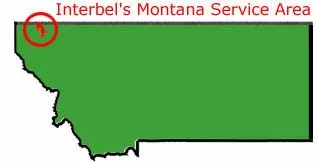
| Geography / Coverage | Northwestern Montana; approximately 1100 sq miles of territory |
| Network Footprint | Approximately 3500 access lines, 3 fiber rings, 1 central office, and 26 remote sites |
| Primary Challenge | After 5ESS retirement and MetaSwitch migration, existing alarm monitoring functions were lost and had to be rebuilt using external alarm collection and a master station |
| Solution Deployed | NetGuardian RTUs to collect and report alarms from field and central office equipment; T/Mon master station for centralized alarm management and visibility |
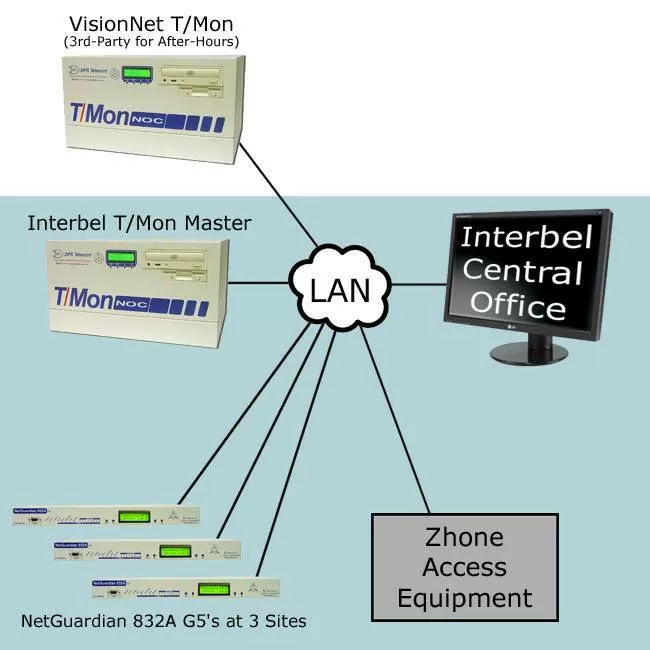
| Operational Model | InterBel monitors alarms during business hours; VisionNet monitors after hours and on weekends |
| Key Result | Restored alarming after the switch migration and improved the ability to be proactive about outages |
| Products Used | DPS Telecom NetGuardian RTUs; T/Mon platform |
InterBel Telephone supports a mix of phone and internet services across northwestern Montana. Their network spans approximately 3500 access lines, 3 fiber rings, 1 central office, and 26 remote sites, which makes efficient monitoring essential to limiting downtime and avoiding unnecessary travel to distant locations.
InterBel had been using a 5ESS switch that collected alarms for equipment around their SONET ring. As Plant Manager Rob Little explained, "The 5E switch itself had alarm points. We monitored the alarms right on the switch."
When InterBel retired the 5ESS and moved to the MetaSwitch, that built-in alarm collection went away. "When we lost the 5ESS, we lost the alarms. We went to the MetaSwitch and had to pick up that functionality in our network with RTUs," said Little. "DPS NetGuardians were the solution for that."
"It has given us the chance to be proactive when it comes to outages in our system."
Central Office Supervisor Marty Sosa recommended DPS Telecom based on previous experience. "Where I worked previously, we deployed virtually all DPS equipment," said Sosa. "One of my co-workers couldn't speak enough good about DPS, so I ended up ordering a boatload of equipment."
Sosa continued, "From that experience, I knew that DPS is a good company. It's the company I'd want to work with if I was setting up alarms. So I made the recommendation at InterBel to look at DPS."
InterBel also works with a third-party monitoring service called VisionNet. "Also, because VisionNet has a T/Mon, it made sense for us to look at DPS."
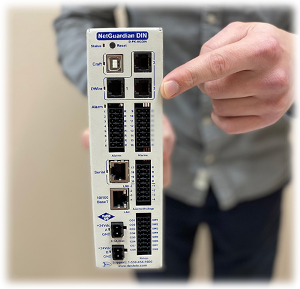
InterBel started by deploying NetGuardian RTUs to re-establish alarm collection from network and facility equipment after the switch migration. NetGuardian remote telemetry units (RTUs) are commonly used to gather discrete alarms and analog readings at central offices and remote sites, then forward those events to a master station or monitoring center for escalation.
"We started with the NetGuardians and VisionNet was monitoring our alarms for a period of time," said Little. "Then we went to a T/Mon. We started monitoring our own alarms, and having VisionNet monitor alarms after hours and on weekends for us."
With alarms being collected by NetGuardian RTUs, InterBel added a T/Mon master station to centralize visibility and operational workflows. In a typical deployment, T/Mon consolidates alarms from RTUs and network devices into a single console for acknowledgement, escalation, and reporting, helping teams standardize response across multiple sites and technologies.
After deploying T/Mon, it became a key component of InterBel's monitoring approach. "We use the T/Mon itself to monitor all of our access equipment," said Little. "It has given us the chance to be proactive when it comes to outages in our system."
Little also noted that the team began with basic IP reachability monitoring on some ISP equipment: "[T/Mon] also monitors some of our ISP equipment, but it's pretty minimal. Its just ping type stuff right now to make sure the interfaces are online."
As InterBel's comfort with the system grew, they looked to extend monitoring depth beyond reachability. "Tom and I came to Factory Training to get more alarms from the ISP end of it, coming on up into the T/Mon," said Little. "Right now all we are doing is pinging. We'd actually like to monitor processor usage and stuff like that."
"It was really insightful for me to see how things are configured, how they work, and how you put it all together."
Tom Rasmussen (SP Supervisor) and Rob Little attended DPS Telecom's four-day training course covering major protocols, DPS products, and monitoring best practices. "There are a lot of things we learned," said Rasmussen. "But, neither of us have really been in the back end of the T/Mon or the NetGuardian."
The course includes hands-on exercises so teams can better understand how to build alarm points, map inputs, and structure notifications. "It was really insightful for me to see how things are configured, how they work, and how you put it all together," said Rasmussen.
"Training went well and I've got all my questions answered."
"Understanding how it's all put together allows me to manage my central office ISP better because I know the equipment and how it works," said Little. "That's the advantage."
Factory Training also gave the team confidence to use features they had not previously utilized. "Now we aren't afraid to change stuff," said Rasmussen. "We have the knowledge of how it's configured."
In addition, the training environment enabled direct access to DPS personnel who build and design the equipment. "The hospitality was great. Everyone is really friendly and seems willing to go out of their way to help you if you have any questions," said Little. "Training went well and I've got all my questions answered."
Now, InterBel Plans to Extend Monitoring to Remote Sites
With training completed and improved understanding of system configuration, InterBel planned to expand their deployment. "I plan on adding more equipment, especially out at Wolf Prairie, which is a remote site that is very remote," said Little. "Our territory is around 1100 sq miles. It's out in the middle of nowhere."
To reduce truck rolls and help ensure backup power readiness at remote locations, InterBel wanted to monitor fuel levels. "We're putting T/Mon out at the farthest location. We want to look at the propane tank there," said Sosa.
In practical terms, propane monitoring is typically accomplished by wiring tank level sensors into an RTU as analog inputs and alarming on thresholds, then reporting those conditions up to the master station for escalation. With NetGuardian RTUs feeding a T/Mon, operators can consolidate fuel, environment, and equipment alarms into one view and decide whether a dispatch is necessary.
InterBel also expressed interest in improving access control management. "We also have a lot of interest in the Entry Control Unit," said Rasmussen. "Our current door system is cumbersome and the software isn't very good for it."
"When you are programming the doors, you physically have to go to each door and program it," said Rasmussen. "It would be nice to have something centralized."
"Its been a pain because the software always breaks," said Little. "When I need to get people access to doors, I can't do it."
InterBel highlighted the value of responsive support as they expanded their monitoring program. "Tech support a big thing in today's markets. In my experience, service at most companies is going south," said Little. "And DPS seems to be keeping theirs where it needs to be, which is very good."
"It helps relieve a lot of frustration," said Rasmussen. "As a technician, if you've got tech support that you are working with and they do a good job, you have more confidence for future projects."
In many networks, the legacy switch is more than call processing - it can also serve as an alarm aggregation point for surrounding equipment. When it is removed, those alarm points must be replaced with external alarm collection (often via RTUs) and centralized monitoring software.
An RTU such as a DPS Telecom NetGuardian can collect alarms directly from the environment and equipment (for example, contact closures and sensor readings) and report them to a monitoring system. This recreates the alarm visibility that may have been provided by the retired switch.
RTUs collect and transmit alarm conditions, while T/Mon provides the operator interface and alarm management functions such as prioritization, acknowledgement, notification routing, and centralized views across multiple sites.
Yes. InterBel used a model where they monitored their own alarms during business hours and relied on VisionNet for after-hours and weekend coverage. T/Mon supports centralized visibility that can be aligned to your staffing plan.
Monitoring propane levels at remote sites helps avoid unnecessary trips and supports better planning for backup power. When fuel alarms are integrated through RTUs into a master station like T/Mon, teams can prioritize dispatch based on real-time conditions.
If you are retiring legacy switch equipment, expanding remote site coverage, or rebuilding alarming around newer softswitch and IP infrastructure, DPS Telecom can help you design a practical monitoring architecture with NetGuardian RTUs and T/Mon. Get a Free Consultation or call 1-800-693-0351 to speak with a DPS Telecom expert about your project.