A high-quality building access system will enhance the security of your sites.
This guide to will show you how to ensure the safety of your revenue-generating equipment.
1-800-693-0351
Have a specific question? Ask our team of expert engineers and get a specific answer!
Sign up for the next DPS Factory Training!
Whether you're new to our equipment or you've used it for years, DPS factory training is the best way to get more from your monitoring.
Reserve Your Seat TodayDickey Rural Networks (DRN) needed tighter control and visibility across unmanned remote sites, including both network alarms and physical access events. Using a T/Mon NOC alarm master with NetGuardian RTUs and DPS Telecom's Building Access System (BAS), Baldwin gained centralized monitoring, configurable access control, and faster response to real issues.
Read the first part of this story.
| Industry | Telecommunications / wireless services |
|---|---|
| Company | Dickey Rural Networks (DRN) |
| Primary Challenge | Monitor "everything" at unmanned sites while controlling building/cabinet access and reducing nuisance alarms |
| Solution Deployed | T/Mon NOC alarm master integrated with NetGuardian RTUs and a Building Access System (BAS) |
| Key Result | Improved visibility, better remote site security, and quicker notification for actionable events |
| Products Used | T/Mon NOC; NetGuardian RTUs; DPS Telecom Building Access System (BAS) |
DRN operates an alarm monitoring environment centered on a T/Mon NOC alarm master and a collection of NetGuardians to monitor exterior operations. Baldwin also needed interior controls, including building entry, remote site access, and cabinet entry, while keeping a detailed access history.
Unmanned remote facilities require two kinds of operational awareness:
At the same time, Baldwin wanted to avoid being flooded with alarms that did not require action. For a telecom operator with IP links and wireless services, every unnecessary page creates noise, and every missed real alarm can increase downtime risk.
With T/Mon NOC and NetGuardian already in place, Baldwin integrated DPS Telecom's Building Access System (BAS) as an incremental expansion, associated with the necessary keypads and ECUs. BAS extends the same core DPS Telecom monitoring philosophy used for RTUs: capture the event, time-stamp it, route it to the right destination, and keep a record for later review.
Baldwin also benefited from the NetGuardian's expandable capabilities. A single NetGuardian can support up to 6 building access systems, allowing Baldwin to control multiple outbuildings, including buildings located about 300 - 450 ft away from a host NetGuardian.
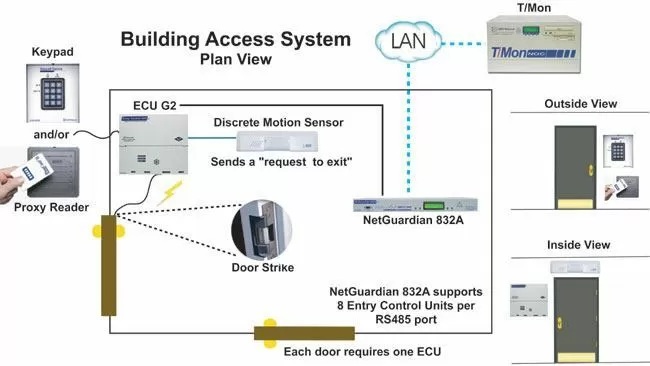
The DPS Building Access System will monitor and control access to your remote sites. This example is similar to the system deployed by Dickey Rural.
Baldwin makes full use of BAS user management, creating over 1,000 user-profiles and codes. This allows DRN to keep track of external and internal users and tailor access based on operational need.
Codes can be customized to restrict users to specific locations and times. For enhanced security, BAS can drill down to sections within sites, individual doors, days of weeks, and time of day.
"Internal employees have their own codes and access to almost everywhere," said Baldwin. "But it's the delivery people, carpenters, and outside vendors that only need access to a specific location for a specific period of time."
The system makes it easy to dispose of codes and profiles, so changes do not leave Baldwin with his guard down. For any organization managing contractors and vendors, this type of fast access revocation is a practical way to reduce risk at remote sites.
Baldwin's most utilized feature of BAS is the "stay open" mode, which temporarily overrides the door strike for a specific time frame. This helps avoid nuisance alarms from multiple re-entries while still keeping login history.
Baldwin uses the "stay open" mode as a discrete alarm input for his BAS. He uses it at up to 4 major locations, primarily those that should not be frequented often and require a keypad for entry.
If "stay open" is activated or left on during hours of non-operation, notification is sent immediately via email, pager, etc. This enables building security to be left unmanned until necessary.
"If [a building] is left in 'stay open' mode after hours, it will let us know and we can close it from home or wherever," said Baldwin.
In addition to access control, Baldwin relies on alarm monitoring to maintain service continuity. "The whole concept is to see little things before they can become big things," said Baldwin.
Baldwin's fleet of NetGuardians monitor doors, temperature, and generators. Derived alarms help keep him informed during routine testing and everyday monitoring of backup generators.
"The newer ones have an alarm point that tells us that the generator is running, the load is transferred, and it's happening because a test is in progress," said Baldwin.
When artificial or non-critical alarms occur, the NetGuardian ignores these alarms so he is not bothered with meaningless alarm data.
"If the power goes out and everything functions as it should, it just shows us as a status," said Baldwin. "If the power goes out and something doesn't function, then it becomes a critical page".
"I would be really uncomfortable not having the visibility that we have today..."With extensive wireless services, network downtime is a critical hazard to operations. Ping alarms constantly monitor for broken connections, giving Baldwin notification as soon as a link goes down.
Baldwin used this feature on the NetGuardian to consistently monitor remote equipment that delivers Internet service to customers via IP links.
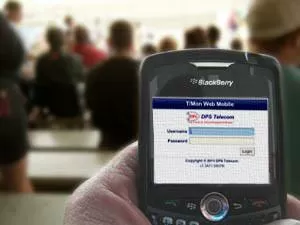
An earlier version of this story showed Mr. Baldwin checking T/Mon NOC alarms using his BlackBerry smartphone.
With rapid notification from the NetGuardian, Baldwin is able to respond quickly while minimizing downtime.
"If the link goes down, we'd know it usually before we get a customer report," said Baldwin. "It gives us a heads-up to get it fixed."
With better control over his network and access points, Baldwin is able to protect unmanned remote sites and focus attention on alarms that require action. He also emphasized the stability of the solution.
"Since switching to the T/Mon NOC, it's been error free,""Since switching to the T/Mon NOC, it's been error free," said Baldwin.
Early, detailed notifications support operational goals like reducing downtime and limiting customer churn when trouble occurs.
When a problem does arise, Baldwin relies on DPS Telecom technical support for assistance.
"Everything's positive," said Baldwin. "They're very helpful when we have trouble, which has been rare".
If your environment is similar to DRN's - unmanned sites, mixed alarm types, and a need for fast, targeted notifications - DPS Telecom typically recommends designing around an RTU (such as NetGuardian) at each site and a central alarm master (such as T/Mon) to standardize escalation paths and reporting.
BAS events (door forced open, door held open, access granted/denied, "stay open" active) can be treated like other site alarms and routed through an alarm master workflow for notification, logging, and reporting. In DRN's case, BAS was integrated alongside T/Mon NOC and NetGuardian monitoring.
A discrete input is a binary contact closure used to indicate a state, such as a door open/closed condition or a mode active/inactive condition. Baldwin used the BAS "stay open" mode as a discrete alarm input so after-hours activation could trigger immediate notification.
Ping monitoring checks connectivity to remote network equipment over IP. If a link fails, the alarm can be generated quickly, allowing a response before customers report service issues.
Reducing nuisance alarms typically involves defining normal statuses (such as expected generator tests) and escalating only when a condition indicates a true problem. Baldwin described using alarm logic so that normal operation is shown as status, while failures generate critical notifications.
If you need to secure and monitor unmanned remote sites with actionable alarms (not noise), DPS Telecom can help you design a solution using NetGuardian RTUs, T/Mon alarm management, and access control integration.
Get a Free Consultation or call 1-800-693-0351 to speak with a DPS Telecom expert about your own project.
(The trademark iPhone® is owned by Apple Inc.)
(The trademark BlackBerry® is owned by Research in Motion Limited.)