Download our free SCADA tutorial.
An introduction to SCADA from your own perspective.
1-800-693-0351
Have a specific question? Ask our team of expert engineers and get a specific answer!
Sign up for the next DPS Factory Training!
Whether you're new to our equipment or you've used it for years, DPS factory training is the best way to get more from your monitoring.
Reserve Your Seat Today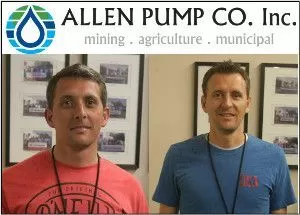
Allen Pump Co (APC) helped the Gila Valley Irrigation District monitor river salinity and manage clean-water pumping using a SCADA approach built around DPS Telecom TempDefender RTUs. With remote visibility into key measurements and alarm notifications, the team reduced the need for constant travel to dispersed pump sites while improving day-to-day operational control.
| Industry | Water and irrigation |
|---|---|
| Company Type | Family-owned pump service and integration contractor |
| Geography/Coverage | Gila River Valley |
| Primary Challenge | Monitor salinity at critical points and control pumping without daily site visits, using non-proprietary equipment that can integrate with other field devices |
| Solution Deployed | SCADA monitoring with a DPS Telecom TempDefender RTU collecting flow, pressure, and salinity inputs and sending alarms for out-of-range conditions |
| Key Result | Remote insight into water quality (EC) and quantity, fewer truck rolls, and faster response when salinity or other readings reach critical levels |
| Products Used | TempDefender G2 |
Allen Pump Company (APC) has been a family-owned business for more than 55 years. It was started by father and son, Lan and Lee Allen. APC is now run and operated by two of Lee's sons, Steve and Chris, and they carry with them a vast knowledge of over 75 years of experience. The Allen family has a deep understanding of the Gila River Valley where they are located. Curtis and Ty Allen (Steve's sons) and Ryan Allen (Chris' son) are fourth-generation at Allen Pump Co.
Over the years, APC has been part of many projects, big and small. They have been on the leading edge with new products and even innovated some of their own to suit the needs of their clients. While their specialty is servicing vertical turbine and submersible pumps, they also have experience in mining open pit dewatering, municipal drinking water, agriculture pumps, and more.
In 2013, Gila Valley Irrigation District (GVID) hired APC to work on a SCADA project. As Curtis Allen described it: "We were asked by the Gila Valley Irrigation District to install a SCADA system for a pipeline that was going to be constructed and put into place."
The project was driven by high salinity levels in the river that runs from one town to the next. The first town would divert water out of the river for agricultural needs, which significantly increases the salinity (salt level) in the river as it reaches the next town. With a new pipeline and monitoring system, GVID could monitor the salinity of the river at critical junctures and pump in clean water when the salt level is too high.
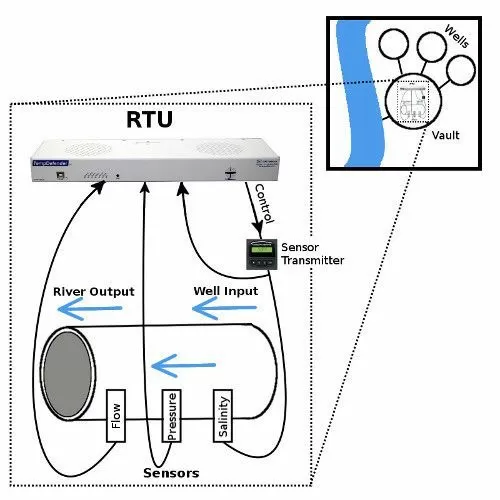
For APC, the monitoring and controls portion of the project was a new technical area. "They kinda said 'hey can you guys do this for us?' We didn't really know quite what to do, but we said 'we'd like to learn it'. So we said yes," said Curtis Allen. "It's something totally new to us. We've never been involved in SCADA, telemetry, anything of that sort."
GVID brought APC into the project based on an established working relationship. "We have a long-standing relationship with the irrigation district. They've hired us to do many many things for them in the past," said Curtis Allen. "When this project came up about putting in a pipeline and SCADA system, I think the trust that we have been able to build with them was key."
APC needed a monitoring solution quickly and reached out for technical guidance. Curtis Allen explained that they contacted Jay Okimoto of Crosswalk Technologies: "We reached out to a good friend of ours that we know is highly technical in computer networking, and he agreed to help us try to find someone to do that for us."
Okimoto helped APC define what mattered most in a field monitoring solution - flexibility, versatility, and the ability to integrate without being locked into proprietary controllers and sensors. As Curtis Allen put it: "We were looking for someone that had non-proprietary equipment that we could use. It was very important that the things that we implemented and integrated could work with various other types of equipment."
The goal was to avoid a system that forced a single-vendor ecosystem. "We didn't want to set ourselves up for being locked in a box of 'we have to buy this type of controller, we have to use this specific sensor or flow meter'," said Curtis Allen. "He made a lot of phone calls and discovered DPS Telecom."
DPS Telecom RTUs are commonly used in remote monitoring where you need to bring physical-world measurements into a SCADA or telemetry workflow. In this project, APC used a DPS Telecom TempDefender G2 to read key pipeline and water-quality inputs (flow, pressure, and salinity/EC) and to generate alarm notifications when conditions reached critical levels.
To ensure APC got a system that fit the application, DPS Telecom sent President Marshall DenHartog to field-test the setup. "Marshall helped us to spec out the job. He told us what equipment we needed. He went out and did all the research about which sensors would work with which DPS RTUs," said Curtis Allen.
Ty Allen emphasized how important on-site validation was for a team new to SCADA. "Marshall coming out was really instrumental in the whole thing. We had an idea of how we thought it would work, but it was all theory up to that point."
APC described a temporary, on-site build used to prove out power, communications, and I/O behavior before finalizing the configuration. "So Marshall came out and we did kind of a temporary setup. Temporary power, temporary communications," said Ty Allen. "He had it built to what he thought would work for our job. And then he came out and tested it on site for us. And he was a technical guy on the ground that could actually tell us if things were working."
DenHartog's practical troubleshooting stood out to APC. "He was amazing. We set up a picnic table down in this 12x12 concrete vault 10 feet below the ground. And there were a whole bunch of us guys down there with a picnic table and a laptop on there and DPS's RTU," said Curtis Allen. "Marshall said 'oh yeah, we just put these wires over here' and all of us said 'We don't know what you're doing, but it's working!'"
As requirements evolved, APC valued that DPS could adapt the configuration to match what they wanted to see and alarm on. "Marshall was great too because we were asking 'Can we look at this? And from that can we see this?'" said Curtis Allen. "And I don't think we ever heard a 'No'. We were really impressed with DPS Telecom from that point on."
Without remote monitoring, APC explained that pump operation would require constant driving and manual switching across multiple sites. "Well, we are putting in five pumps. We would have to turn on 5 pumps and put them into this pipeline. And we would send discharges into the river. If we ever wanted to turn it on, I would have to drive out there and physically drive to each pump site and turn on each one, and the same thing for turning them off," said Curtis Allen.
Remote monitoring and alarming reduced travel and day-to-day labor. "It's 23 miles to get out to the site. And to drive around to each pump, I can get to each pump with in a matter of 10 minutes," said Ty Allen. "Turning on the pumps would take 10 or 15 minutes. Then after that, I would have to have some set schedule of salinity at this pump, this pump. Which would take probably an hour for a cycle to go through and do that."
"So if you wanted to monitor and make sure that things are running regularly, you would have to go out there at least once a day."
The monitoring system also improved how quickly APC could answer operational questions about water quality and quantity. "The whole purpose behind this is to decrease the salinity of the natural river flow," said Curtis Allen. "So if this kind of system wasn't in place, I would have to be gathering manual salinity readings coming out of the pipeline. It's not just going out there and turning on the pumps. It's measuring water quality, turning on the pumps."
"And, at a moment's notice, if someone were to ask what quality of water are we putting into the river, I can look at it and say this is the EC that's going in. And if they ask for the quantity, then we can also give that to them."
APC credited DPS Telecom's involvement and confidence in the design as a key factor in delivering the solution. "I never had a doubt that the project was going to be a success," said Curtis Allen. "Marshall just had this confidence that we felt very comfortable with. We knew DPS Telecom was going to be able to come through for us."
APC used the following DPS Telecom product to monitor inputs and generate alarms for the pipeline SCADA application:
If you are designing a similar project (water conveyance, pumping, or environmental compliance monitoring), DPS Telecom can help you select the right RTU I/O and alarming approach. See the DPS Telecom RTU product overview for additional context on remote monitoring architectures.
Common engineering questions that come up in irrigation and water-quality monitoring projects like this one:
EC stands for electrical conductivity. It is commonly used as an indicator of salinity (dissolved salts) in water. Higher EC generally means higher salinity.
An RTU (remote terminal unit) gathers field inputs from sensors and equipment, evaluates conditions against thresholds, and reports status and alarms back to operators. In this project, APC used a DPS Telecom TempDefender RTU for that role.
Alarms let operators act on exceptions instead of checking every site on a schedule. For distributed pumps and long pipelines, this helps reduce daily travel and supports faster response when readings reach critical levels.
When monitoring systems can work with different brands of sensors and meters, it is easier to expand coverage, swap components, and avoid being locked into a single supplier for every device in the system.
Typical checks include verifying sensor wiring and scaling, confirming readings match expected values, proving alarm thresholds and notification paths, and validating power and communications reliability at the actual installation site.
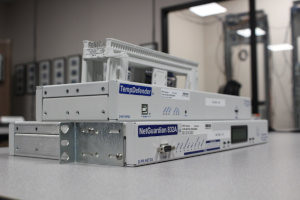
This hardware overview shows the DPS Telecom TempDefender G2 platform referenced in this project.
To receive a price quote or ROI analysis...
Call 1-800-693-0351
If you are planning a SCADA, telemetry, or alarm monitoring project for pumps, pipelines, or water quality, DPS Telecom can help you select the right RTU and alarm strategy and ensure your sensors and communications work as intended.
Get a Free Consultation or call DPS at 1-800-693-0351 to speak with an expert about your project.