Download our free Monitoring Fundamentals Tutorial.
An introduction to Monitoring Fundamentals strictly from the perspective of telecom network alarm management.
1-800-693-0351
Have a specific question? Ask our team of expert engineers and get a specific answer!
Sign up for the next DPS Factory Training!
Whether you're new to our equipment or you've used it for years, DPS factory training is the best way to get more from your monitoring.
Reserve Your Seat TodayWhen NEC discontinued the 21SV remote and the 21GTX Fault Management System, Cingular engineer Chuck Wood needed a path to expand monitoring without replacing hundreds of legacy remotes.
| Industry | Wireless telecom (cell site operations) |
|---|---|
| Company Type | Wireless carrier |
| Geography / Coverage | Massachusetts and southern New Hampshire |
| Operational Scope | 350 cell sites at the time of the project (later over 400) |
| Primary Challenge | Discontinued NEC 21SV remotes and 21GTX master system created expansion, reliability, and database-management risk |
| Solution Deployed | T/MonXM WorkStation with a custom 21SV Interrogator Software Module, plus NetGuardian RTUs at new sites |
| Key Result | Legacy NEC 21SV sites and new SNMP sites monitored from one T/Mon alarm display; NEC master and hard masters were removed from service |
| Products Used | T/MonXM WorkStation (T/Mon platform), NetGuardian RTUs, 21SV Interrogator Software Module |
Chuck Wood supported remote alarming for a large group of Cingular cell sites in Massachusetts and southern New Hampshire. At each site, NEC 21SV remotes were used to monitor microwave radios, MUXs, and environmental conditions.
When NEC discontinued the 21SV remote and the 21GTX Fault Management System, the existing monitoring architecture became difficult to maintain and even harder to expand as new sites came online.
Wood faced a practical problem that many telecom operators recognize immediately: new sites were being built, but the discontinued RTU could not be purchased anymore. At the same time, the legacy master and its supporting components were becoming a single point of failure.
With the 21SV and 21GTX discontinued, Wood had to keep his existing system running without normal vendor support.
Wood needed a remote monitoring solution for new cell sites. From an operational standpoint, the obvious paths both carried major drawbacks:
Even if the legacy NEC platform could be kept alive, the new sites still needed a modern alarming approach. Wood evaluated options that would either reduce visibility or increase complexity:
Wood consulted with DPS Telecom to evaluate the NetGuardian RTU product family as an SNMP remote for new sites. As he became more familiar with DPS capabilities, he identified a bigger opportunity: unify both old and new sites under one monitoring system, without replacing working NEC 21SV remotes.
Wood determined that a DPS Telecom T/Mon Remote Alarm Monitoring System would be a better fit than a general-purpose SNMP manager for day-to-day telecom operations and alarm response.
"At first we were looking at NetGuardians reporting to OpenView, but when we saw the capability and simplicity of T/Mon, we realized T/Mon would be easier to implement and we'd get better performance," said Wood.
In practical terms, a T/Mon system is purpose-built for alarm collection, event processing, and operator workflows. When you are consolidating alarms from many sites and device types, T/Mon is designed to keep alarm presentation clear and actionable, while supporting multiple protocols and integration methods.
During the evaluation, DPS Telecom offered a legacy support path that addressed Wood's core concern: keep the 21SV remotes in place and still monitor everything from a single screen.
"They told me they could develop a solution for polling NEC remotes for T/Mon. I wasn't really confident that it could be done, so I said, 'Prove to me that it works, and I'll buy it,'" said Wood.
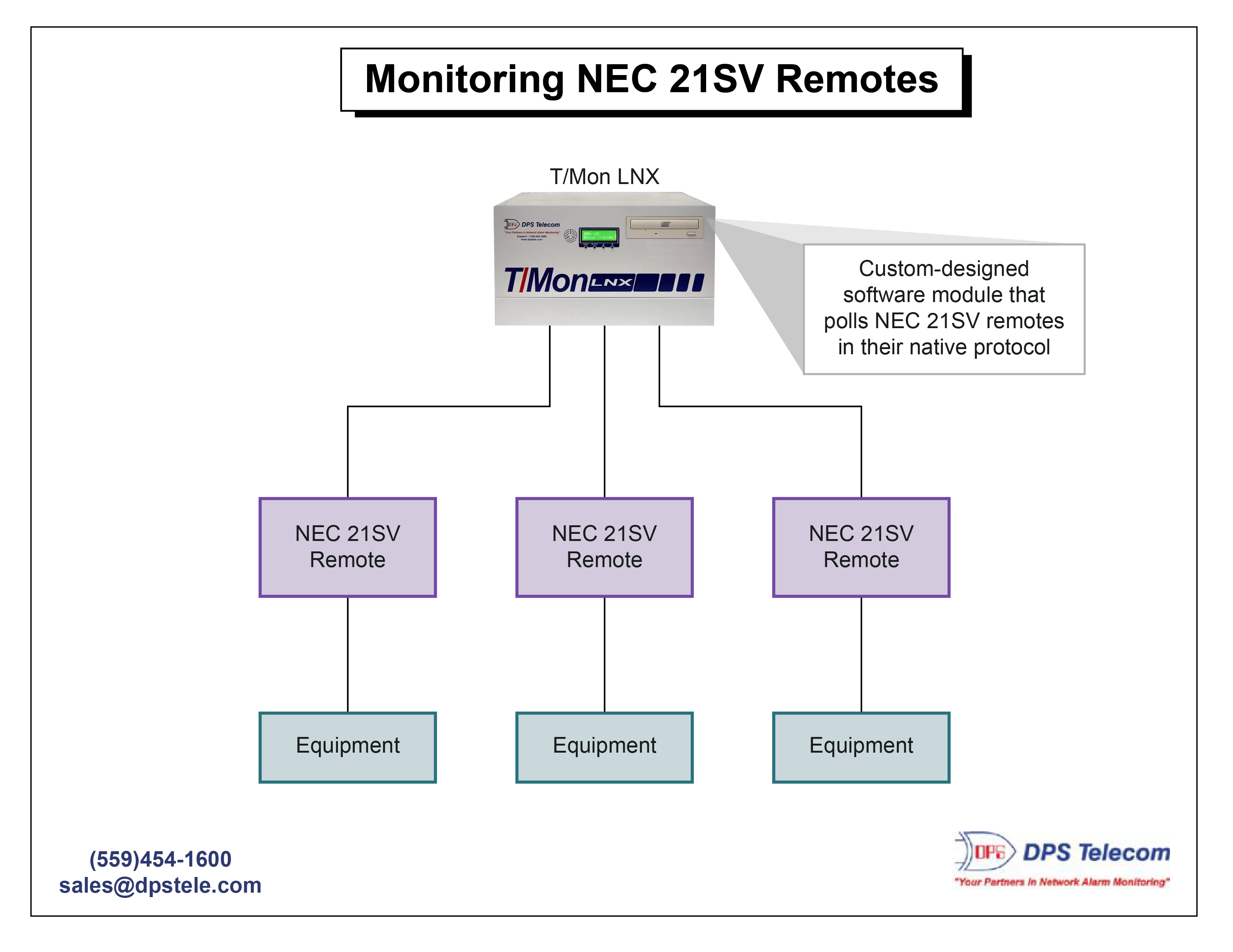
Wood deployed a T/Mon alarm monitoring workstation with a custom-designed software module that polls NEC 21SV remotes in their native protocol. This became Wood's central platform for alarms across both legacy and new sites.
To reduce administrative overhead, DPS also developed software to convert Wood's 21SV alarm database to T/Mon format, eliminating the need for new database work during the transition.
As new sites were added, Wood installed DPS Telecom RTUs (NetGuardians) to provide SNMP-based alarming and site I/O expansion where needed, while keeping the monitoring and operator interface consistent at the center.
Wood received his custom-developed solution, the 21SV Interrogator Software Module for T/Mon. With legacy polling integrated and new sites using NetGuardian RTUs, Wood could manage alarm monitoring from a single T/Mon system.
Wood summarized the operational outcomes of the integrated approach:
Chuck Wood's custom solution, the 21SV Interrogator Software Module, is available to DPS clients. NEC 21SV support is one of many integration options available for T/Mon, which supports over 30 standard, legacy, and proprietary protocols.
T/Mon can consolidate alarms from remote sites to one screen, reducing the need for multiple specialized consoles and helping operators focus on actionable alarm detail.
Yes. This project combined legacy NEC 21SV polling (via a T/Mon software module) with new SNMP-based alarming from NetGuardian RTUs, all presented through one T/Mon operator view.
When key master components become unavailable, failures can create gaps in alarm visibility. In this case, Wood described limited spares for hard masters and the risk of losing monitoring capability if another unit failed.
Many SNMP managers are general-purpose tools that can be complex to configure for telecom alarm workflows. Wood preferred T/Mon because it was easier to implement for alarm presentation and day-to-day operations.
NetGuardian RTUs are commonly deployed at new sites to collect discrete alarms, environmental inputs, and equipment status, then forward alarms upstream via SNMP. Wood used NetGuardians for new sites while keeping NEC 21SV remotes in service at existing sites.
In this case, DPS developed software to convert the NEC 21SV alarm database into T/Mon format, reducing manual re-entry and accelerating cutover.
If you want to protect your network against the dangers of service outages and equipment loss, check out the new IAM-6. It's 2-6 times faster than the IAM-5 and fully compatible with your existing IAM/T/MonXM software and database.
If you are expanding into new sites while supporting discontinued RTUs or legacy protocols, DPS Telecom can help you consolidate alarming into one operational view with T/Mon and NetGuardian RTUs.