Check out our White Paper Series!
A complete library of helpful advice and survival guides for every aspect of system monitoring and control.
1-800-693-0351
Have a specific question? Ask our team of expert engineers and get a specific answer!
Sign up for the next DPS Factory Training!
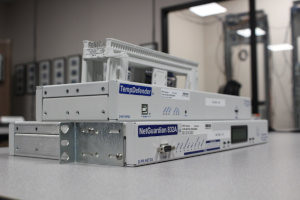
Whether you're new to our equipment or you've used it for years, DPS factory training is the best way to get more from your monitoring.
Reserve Your Seat Today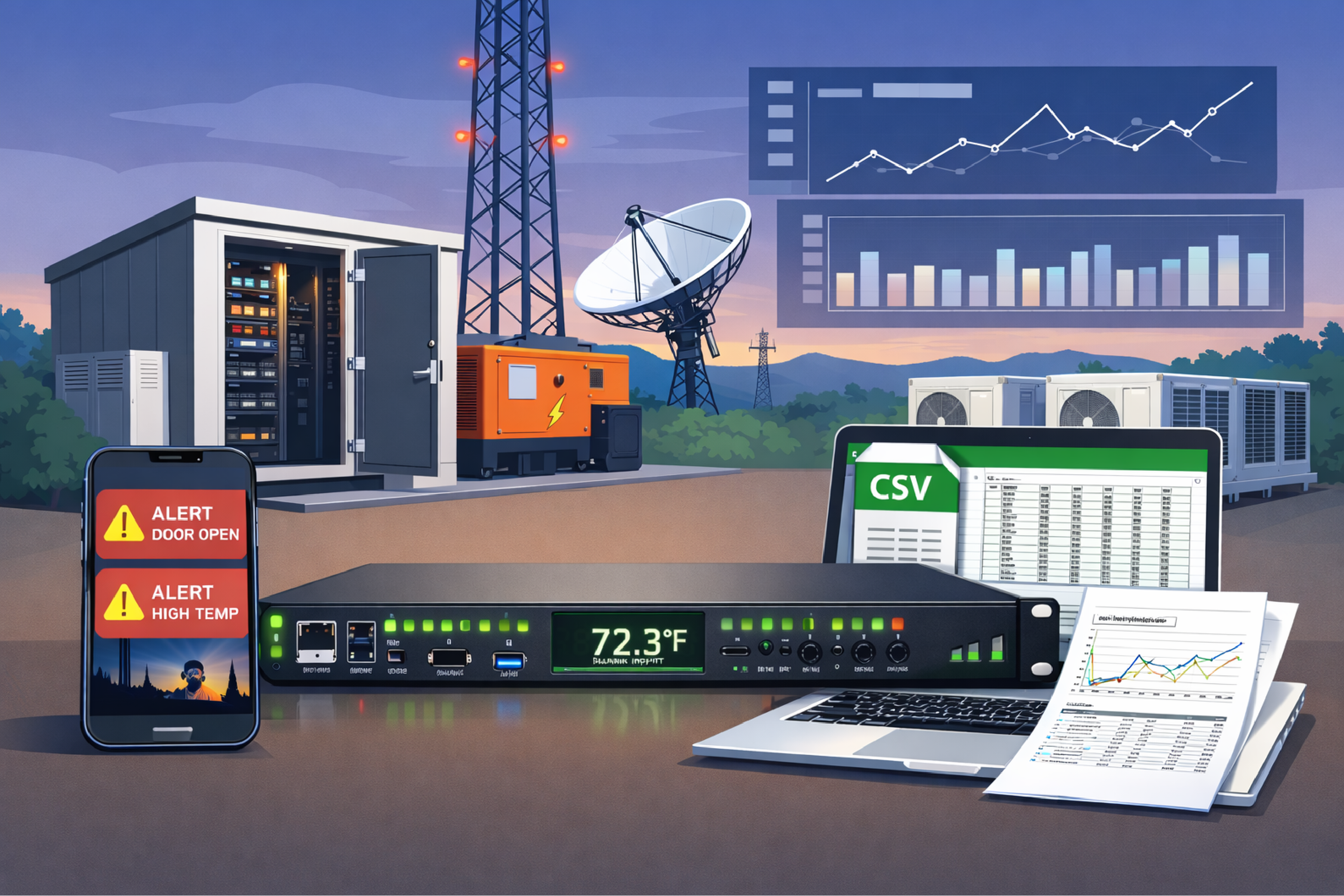
Remote sites fail quietly. Doors open, generators stall, and HVAC systems drift out of range long before anyone notices - especially at transmitter buildings, telecom huts, and other unmanned facilities. When that happens, delayed awareness often turns a small issue into extended downtime.
Remote site monitoring is defined as the ability to detect, alert on, and review critical site conditions without being physically present. Effective monitoring requires two things at the same time: immediate alerts and reliable historical records.
This article explains why a customer evaluating legacy monitoring hardware ultimately deployed the NetGuardian 216 G6 from DPS Telecom, and how its modern logging, higher input count, and lower price addressed their operational requirements more effectively than an older RTU.
Real-time alerts notify operators when something is wrong right now. Historical logs explain what happened before and after an event. A monitoring system that provides only one of these creates blind spots.
For this deployment, the customer had taken responsibility for an unattended TV transmitter building supporting broadcast and tower operations. The site required:
These requirements ruled out alert-only monitoring. The customer needed auditable, exportable data to review trends, confirm compliance, and diagnose intermittent issues. This could be a CSV or any similar parseable format that could be imported into any industry-standard tool in the future for storage and analysis.
The NetDog G2 is a long-supported DPS Telecom RTU used successfully at many small sites. However, it is based on an older hardware and software architecture that limits data logging and (especially) data storage.
The NetDog G2 focuses on alarm notification rather than long-term data retention. While it can report when thresholds are crossed, it does not support robust internal logging suitable for trend analysis. It has a limited capacity to store no more than 100 alarm events. This capability reflects the typical limits of older embedded devices and was designed only to prevent lost data during brief communication disruptions.
The customer specifically required daily CSV files with hourly temperature readings. The NetDog G2 does not natively generate or export CSV logs, making automated reporting difficult without workarounds.
Although still supported, the NetDog G2 lacks the modern web interface and performance expected for new deployments that prioritize data visibility and ease of use.
For this application, the limitations were functional, not theoretical. The customer needed a system designed for continuous data review, not just alarms.
Based on the operational goals, the correct solution required:
These requirements point directly to a modern RTU designed for hybrid alerting and logging.
The NetGuardian 216 G6 is built on DPS Telecom's G6 platform, introduced in 2022 and expanded in later releases. It is designed specifically for small-to-medium remote sites that require both alerts and historical visibility.
The NetGuardian 216 G6 stores temperature readings, alarm events, and timestamps internally. This allows operators to:
The G6 platform supports direct export of historical logs in standard CSV format. These files can be:
CSV export is a core capability, not an add-on.
The NetGuardian 216 G6 sends immediate alarm notifications for conditions such as:
Email alerts are sent directly from the unit. Text alerts are supported through commonly used email-to-SMS gateways.
The device provides 16 alarm inputs, doubling the customer's original requirement and eliminating the need for expansion hardware. Typical uses include:
While the standard configuration uses a 50-pin Amphenol connector, DPS Telecom offers a wire-wrap back panel that converts inputs to pluggable screw terminals, simplifying field wiring.
Remote monitoring is not only about reacting to alarms. It is also about building an accurate operational record that supports better decisions over time. The NetGuardian 216 G6 is designed to function as both an alarm device and a long-term data source for site oversight.
Because the unit stores timestamped temperature readings and alarm events internally, operators can review historical conditions without relying on third-party systems. This makes it easier to confirm whether HVAC issues are intermittent, seasonal, or progressively worsening.
Daily CSV exports provide a structured dataset that can be reviewed by engineering, operations, or compliance teams. Hourly temperature trends can be graphed, archived, or compared across sites to identify patterns that would not be visible through alarms alone.
For unattended facilities, this level of historical visibility reduces guesswork. Instead of asking whether a problem "just happened," teams can verify exactly when conditions changed and how long they persisted. Over time, this supports more accurate maintenance planning, fewer emergency site visits, and clearer accountability for site performance.
Despite being newer and more capable, the NetGuardian 216 G6 is priced lower than the NetDog G2. The G6 platform benefits from modern manufacturing and standardized components, reducing total cost of ownership while increasing functionality.
DPS Telecom continues to support legacy devices when parts are available. However, when a newer solution provides more capability at a lower cost, it is recommended for new deployments.
This approach helps customers avoid locking new sites into outdated limitations while still protecting existing infrastructure investments.
The NetGuardian 216 G6 is well-suited for:
It is designed to provide immediate awareness and long-term visibility without unnecessary complexity.
If you manage remote facilities and need both alerts and historical data, the NetGuardian 216 G6 provides a practical, cost-effective monitoring foundation.
Call: 559-454-1600
Email: sales@dpstele.com
Describe your site, alarm points, and reporting needs. DPS Telecom will recommend a monitoring solution that fits your operational reality - not just minimum requirements.

Andrew Erickson
Andrew Erickson is an Application Engineer at DPS Telecom, a manufacturer of semi-custom remote alarm monitoring systems based in Fresno, California. Andrew brings more than 19 years of experience building site monitoring solutions, developing intuitive user interfaces and documentation, and opt...